Indonesia Leads EM Rally as Carry Appeal, Growth Lure Investors

Foreign Investors Put $53 Billion into Indonesia in 2025, Singapore on Lead​


Jayanty Nada Shofa
January 15, 2026 | 5:52 pm
1768577943398.png
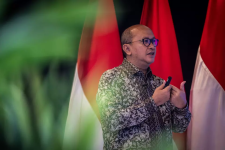
Investment Minister Rosan Roeslani holds a press conference on the 2025 investments in Jakarta on Jan. 15, 2025. (Antara Photo/Bayu Pratama S)


Jakarta. Indonesia announced Thursday that it had attracted Rp 900.9 trillion ($53 billion) in foreign direct investment or FDI throughout 2025, as Singapore clings onto the top position.


Indonesia amassed $17.4 billion worth of Singaporean FDI in 2025, followed by Hong Kong at $10.6 billion. China was Indonesia’s third-biggest source of FDI over the said period, investing $7.5 billion in Southeast Asia’s biggest economy. Close neighbor Malaysia put $4.5 billion into Indonesia, while Japan contributed $3.1 billion to the FDI realization.


“More or less $5.1 billion of that [$17.4 billion] Singaporean FDI went to the basic metal, metal goods, and non-machinery sector. Some $2.5 billion was in other services,” Investment Minister Rosan Roeslani told a press conference in Jakarta.

Indonesia wants to move up the value chain by turning its abundant natural resources into more sophisticated goods. And Singapore is the top foreign investor that is aiding this ambitious downstream policy. The island country invested $7.9 billion in Indonesia’s downstream industry last year, seconded by Hong Kong at $6.2 billion. China accounted for the $4.8 billion that flowed into this industrial value creation, while Malaysia entered the top 4 at $3 billion.

“American investors put $1.6 billion into our downstream industry last year,” Rosan said.


West Java is the most popular among foreign investors, amassing $9.2 billion in FDI throughout last year. Followed by Central Sulawesi ($7.4 billion) and the capital Jakarta ($6 billion).


In 2025, Indonesia recorded approximately Rp 1.9 quadrillion in combined investments, including those coming from the investors at home. Domestic investments stood at around Rp 1 quadrillion over the said period.


Indonesia already has a bilateral investment treaty with Singapore, with the most updated document entering into force in March 2021. The accord grants investors of both economies access to better legal protection, including access to international arbitration.


Read More:​

Mandalika Attracts €2.76 Million Spanish Investment for High-End Villas
 

Jakarta Composite Breaks 9,100 to Set New All-Time High​


Ria Fortuna Wijaya, Associated Press
January 15, 2026 | 4:18 pm

To view this content we will need your consent to set third party cookies.
For more detailed information, see our cookies page.


Jakarta. Jakarta Composite Index (JCI) pushed deeper into record territory on Thursday, briefly breaking above the 9,100 mark to set a new all-time high before closing at 9,075, up 42 points or 0.47%. The benchmark moved within a 9,040–9,100 range during the session.


RTI data showed total trading volume reached 50.32 billion shares, with turnover at Rp 27.86 trillion ($1.65 billion) across more than 3.36 million transactions. Market breadth was nearly balanced, with 339 gainers, 331 decliners, and 133 stocks unchanged.


Pilarmas Investindo Sekuritas said the rally was driven by optimism over domestic stimulus, as investors welcomed the government’s plan to allocate Rp 101 trillion ($5.98 billion) to support the textile industry. The policy is aimed at safeguarding labor-intensive sectors that employ millions of workers while enhancing national industrial competitiveness amid intensifying global competition. “This sentiment became a positive catalyst for the market, especially ahead of the national holiday, despite weaker Asian bourses,” Pilarmas wrote in its research note.


Gains were concentrated in textile-related names. Bersama Zatta Jaya (ZATA) led the top gainers with a 35% jump, followed by Ever Shine Textile Industry (ESTI), which rose 34.75%, Inocycle Technology (INOV) up 34.56%, and Trisula Textile Industries (BELL) gaining 34.15%. On the losing side, Sentral Mitra Informatika (LUCK) fell 13.25%, Danasupra Erapacific (DEFI) dropped 12.03%, PAM Mineral (NICL) slid 11.32%, and Acset Indonusa (ACST) declined 10.70%.

Regionally, Pilarmas noted Asian markets were weighed down by rising geopolitical risks and renewed trade tensions after US President Donald Trump imposed a 25% tariff on chip products. China responded by requiring domestic companies to stop using cybersecurity software produced by US and Israeli firms, highlighting the intensifying technology rivalry between the two economies. The brokerage warned the dispute could heighten global uncertainty, add to US inflationary pressures, and limit the Federal Reserve’s room to cut interest rates in the near term. Separately, Chinese regulators raised the minimum margin for stock financing to 100% from 80% to rein in excessive risk-taking.


Most Asian equities ended lower on Thursday after Wall Street retreated, dragged down by losses in Big Tech stocks.


Japan’s Nikkei 225 slipped 0.9% to 53,863, pressured by technology-related shares, with SoftBank Group down 5.6%, Advantest falling 4.1%, and Tokyo Electron sliding 3.3%. Toyota Industries, however, jumped 6% after reports that Toyota Motor raised its buyout offer to 18,800 yen ($118.61) per share.


Hong Kong’s Hang Seng dropped 0.6% to 26,850, while Hong Kong-listed Trip.com shares plunged more than 20% after Beijing opened an antitrust investigation into the group. The Shanghai Composite Index fell 0.6% to 4,101. South Korea’s Kospi gained 0.5% to 4,747.


On Wall Street overnight, the S&P 500 fell 0.5% to 6,926 for a second straight loss, the Dow Jones Industrial Average slipped 0.1% to 49,149, and the Nasdaq Composite dropped 1% to 23,471. Big Tech stocks weighed on performance as investors trimmed exposure to the artificial intelligence trade, with Nvidia down 1.4% and Broadcom sliding 4.2%.


JCI Passes 9,150 Mark, Defying Global Trade Pressures​


Ria Fortuna Wijaya, Associated Press
January 20, 2026 | 9:51 am


To view this content we will need your consent to set third party cookies.
For more detailed information, see our cookies page.


Jakarta. Indonesia’s benchmark stock index opened higher on Tuesday, extending its record run despite rising global geopolitical and trade tensions.

Jakarta Composite Index (JCI) climbed 23 points, or 0.25%, to 9,156 in early trading, marking another all-time high. The index moved within a 9,126–9,169 range shortly after the opening bell.


RTI data showed that in the first five minutes of trading, volume reached 5.46 billion shares with a turnover of Rp 2.40 trillion ($141.40 million), recorded across more than 324,000 transactions. Gainers slightly outnumbered decliners, with 256 stocks up, 250 down, and 177 unchanged.

According to Pilarmas Investindo Sekuritas, markets are navigating escalating global trade frictions as the United States moves toward imposing new tariffs on the European Union. Washington plans to levy a 10% import tax starting Feb. 1, with the possibility of raising it to 25% by June should negotiations fail. Germany, Sweden, and Denmark are seen as the most exposed.

The European Union has signaled potential retaliation, preparing tariffs worth €93 billion ($108 billion). European inflation, however, remains contained, with monthly CPI unchanged at 0.2%, annual CPI easing to 1.9% from 2%, and core CPI steady at 2.3%.


In China, economic momentum softened. Annual GDP growth slowed to 4.5% from 4.8%, while year-to-date growth eased to 5% from 5.2%. Pilarmas noted that despite headline growth holding at 5%, underlying momentum in 2025 appears weaker, pressured by subdued consumption, sluggish investment, a cooling labor market, and falling home prices.


“China has diversified its export partners toward Europe and Africa,” Pilarmas said, noting that net exports contributed about one-third of national growth in 2025, the strongest contribution since 1997. The brokerage added that China’s 2035 advanced-economy ambition implies average growth of around 4.17%.


Meanwhile, Goldman Sachs Group Inc. and Standard Chartered Plc have revised down their US growth projections to 4.5% and 5%, respectively.


Despite global uncertainties, Pilarmas said Indonesia’s equity market has remained resilient, with the JCI continuing to climb even as the rupiah weakens, supported by attractive domestic prospects and policy momentum.


On the fiscal front, the government’s Free Nutritious Meal (MBG) program is targeted to reach 82.9 million beneficiaries in 2026, with implementation expected within five months through May. Backed by an accelerated rollout of nutrition service units (SPPG kitchens), the program carries a Rp 335 trillion budget, sharply higher than last year, and is expected to generate strong multiplier effects through domestic demand. Beneficiary sectors include food, agriculture, livestock, fisheries, logistics, and MSMEs, while also supporting job creation and long-term human capital improvement. Pilarmas cautioned, however, that the scale of spending requires strong governance to prevent inefficiencies and fiscal strain.


Regionally, Asian markets opened mostly lower. Japan’s Nikkei slipped 0.44% to 53,348, South Korea’s Kospi eased 0.08% to 4,900, and Hong Kong’s Hang Seng fell 0.07% to 26,544. China’s Shanghai Composite initially rose 0.04% to 4,116 before turning lower.


US markets provided no lead, as Wall Street were closed on Monday for the Martin Luther King Jr. Day holiday.


Read More:​

Indonesia Stocks Finish Higher as Investors Await BI Rate Announcement


IMF Raises Indonesia’s 2026 Growth Forecast to 5.1%​


Grace el Dora
January 20, 2026 | 2:05 pm

Jakarta. The International Monetary Fund has raised its economic growth forecast for Indonesia in 2026, signaling growing confidence in the country’s resilience even as global trade and policy uncertainty continues to cloud the outlook.


In its January 2026 World Economic Outlook, the IMF projects Indonesia’s economy will expand by 5.1% year on year in 2026, up 0.2 percentage points from its October estimate. The fund also lifted its 2027 forecast to 5.1%, while maintaining its 2025 projection at 5.0%.


Indonesia’s economy grew 5.04% year on year in the third quarter of 2025, indicating steady momentum toward the government’s full-year target. While the 2025 state budget assumes growth of about 5.2%, both official projections and analysts expect a more realistic outcome in the range of 5.0% to 5.1%. The government has set a more ambitious growth target of 5.4% for 2026.

The IMF said Indonesia’s outlook is underpinned by strong domestic consumption, macroeconomic stability, and an improving investment climate, with private-sector adaptability and technology-driven development supporting medium-term growth.


To view this content we will need your consent to set third party cookies.
For more detailed information, see our cookies page.


Indonesia–EU Trade Agreement Becomes a Historic Milestone for RI–EU Economic Cooperation

The signing of a substantive agreement between the Indonesian government and the European Union under the Indonesia–European Union Comprehensive Economic Partnership Agreement (IEU-CEPA) marks a historic milestone in strengthening trade and investment cooperation between Indonesia and the EU.

The Ralf Beste, German Ambassador to Indonesia, stated that the IEU-CEPA trade agreement serves as a gateway for increased German investment into Indonesia. As Germany is the third-largest economy in the world, with most of its trade and investment deeply integrated within the EU, closer Indonesia–EU cooperation is expected to encourage German investors to enter the Indonesian market.

For Germany, Indonesia’s large market potential and strategic geographic position make it an attractive hub for expanding investment and trade across the Asia-Pacific region. German companies and investors have already been operating in Indonesia for decades, including Mercedes-Benz, BMW, Bosch, Siemens, and Bayer.

The discussion also explored the prospects and challenges of German investment in Indonesia amid global economic volatility and the deepening of EU–Indonesia economic cooperation.

For further insights, watch the full dialogue between Safrina Nasution and German Ambassador Ralf Beste on Profit, CNBC Indonesia (Friday, January 23, 2026).

Media Ownership and Affiliation


CNBC Indonesia is part of the CT Corp media ecosystem. The network operates in affiliation with CNBC International and is under the Trans Media group, alongside: CNN Indonesia, Trans TV, Trans7, Detikcom, Transvision, CNN Indonesia.com


Rupiah Strengthens Ahead of Fed Decision, US Political Risks Weigh on Dollar​


Natasha Khairunisa
January 27, 2026 | 5:20 pm


To view this content we will need your consent to set third party cookies.
For more detailed information, see our cookies page.


Jakarta. Rupiah strengthened against the US dollar on Tuesday as markets turned cautious ahead of the Federal Reserve’s policy meeting and amid renewed political and trade-related uncertainties in the United States.

The rupiah closed 14 points firmer at Rp 16,768 per USD, recovering after briefly weakening by as much as 20 points earlier in the session. The local currency had ended Monday at Rp 16,782 per $1.


Ibrahim Assuaibi, director of Traze Andalan Futures, said the rupiah’s rebound reflected investor focus on the outcome of the Federal Reserve’s policy meeting, which concludes on Wednesday.


“The market broadly expects the central bank to keep interest rates unchanged after three consecutive rate cuts in previous meetings,” Ibrahim said in a written statement on Tuesday.

He added that the rupiah also gained support from market concerns over the independence of the US central bank, following tensions between President Donald Trump and Fed Chair Jerome Powell.

“Investors are paying close attention to growing concerns about the Federal Reserve’s independence after the dispute between President Trump and Fed Chair Jerome Powell,” Ibrahim said.


Meanwhile, fears of another US government shutdown resurfaced after Democratic senators pledged to block a major funding bill, further weighing on global sentiment.


The rupiah remained in positive territory amid escalating US trade tensions, including tariff pressure on several European countries linked to a dispute over Greenland, higher tariffs on Canada, and Trump’s announcement that the US would raise tariffs on South Korean goods to 25%.


“The renewed escalation in US trade tariffs has added pressure on the dollar, which in turn provides room for emerging market currencies, including the rupiah, to strengthen,” Ibrahim said.


Jakarta’s Answer to MSCI’s Market Doubts​


Muhammad Ghafur Fadillah, Akmalal Hamdhi
February 2, 2026 | 7:19 pm

1770076378062.png
Financial Services Authority (OJK) Acting Chairwoman Friderica Widyasari Dewi speaks to reporters at the Indonesia Stock Exchange in Jakarta on Monday. (Beritasatu.com/Akmalal Hamdhi)

Jakarta. Indonesia’s financial regulator on Monday outlined a series of market reforms aimed at addressing concerns raised by MSCI, as authorities sought to reassure investors following a sharp sell-off in local equities.


Financial Services Authority (OJK) Acting Chairwoman Friderica Widyasari Dewi said all of MSCI’s concerns had been formally submitted in proposal form, but the index provider had made clear that execution, not intent, would be decisive.


“Everything requested by MSCI has been laid out in our proposals. But they are not looking for plans alone; they want to see concrete implementation of the action plan,” Friderica told reporters at the Indonesia Stock Exchange on Monday.

OJK told MSCI it had committed to three key measures to improve transparency and market quality:

First, Indonesia plans to expand disclosure of share ownership below the current 5% threshold. Under the proposal, listed companies would disclose ownership stakes starting from above 1%, providing more transparent information to the public and regulators. Friderica said the rule could be implemented as early as this month.


“Ownership data that was previously disclosed only above the 5% level will now be visible from 1%,” she said.

The policy is expected to improve data quality, narrow the scope for irregular trading practices, and strengthen confidence among global investors.


Second, OJK is also finalizing regulations to raise the minimum free float requirement for listed companies to 15% from 7.5%, a reform designed to deepen liquidity and align Indonesia more closely with MSCI’s market standards.


“We are targeting the free float regulation to be issued in March,” Friderica said, adding that the timeline was firm. The change could prompt corporate actions among companies with low public ownership, including divestments or secondary share offerings.


Third, OJK is working to improve the granularity of market data, another area flagged by MSCI, covering transaction statistics, order fragmentation and ownership categorization. Friderica said these upgrades were also expected to be completed by March.


The Indonesian Central Securities Depository (KSEI) will broaden its investor classification framework from nine categories to 27 subcategories, a move intended to improve clarity around beneficial ownership and align local practices more closely with international standards.

“The discussion went very well,” according to Hasan Fawzi, an OJK commissioner overseeing capital market, after the meeting. “MSCI even opened the door to providing technical guidance on its assessment methodology, which shows alignment with the direction of our reforms.”

The talks came as Indonesia’s benchmark Jakarta Composite Index (JCI) remained under pressure, falling 4.88% on Monday to close at 7,922.73 after a wave of sell-offs last week erased about 7% of market capitalization. OJK said the recent weakness reflected portfolio rebalancing by investors rather than a deterioration in market fundamentals.

Friderica said investors were trimming exposure to stocks that had previously posted sharp gains and were seen as fully valued, a common risk-management strategy after a strong rally.


“Most of the stocks that declined today are those whose prices had risen too far,” she said, adding that the correction should be viewed as temporary.


She said some fundamentally strong stocks continued to rise, indicating that investors were becoming more selective. Foreign investors, after four consecutive sessions of net selling, returned as net buyers on Monday with inflows of Rp 654.9 billion ($42 million), a development OJK described as encouraging amid volatility.


Regional factors also weighed on sentiment, with major Asian indices, including South Korea’s Kospi, posting steep losses. Gold prices weakened as well.

OJK urged investors to remain calm and focus on medium- to long-term prospects, stressing that it would continue to ensure trading remains orderly, fair and efficient. Friderica said the regulator would maintain close communication with MSCI, alongside the IDX, KPEI, KSEI and sovereign wealth fund Danantara, to strengthen the credibility and competitiveness of Indonesia’s capital market.


MSCI has previously flagged issues related to market accessibility, transparency and free float levels in Indonesia. Authorities hope the latest commitments will address those concerns ahead of MSCI’s next market classification review.


JCI Reclaims Positive Territory After MSCI Talks Soothe Market Nerves​


Ria Fortuna Wijaya, Associated Press
February 3, 2026 | 4:11 pm

1770119812351.png

Investment Minister Rosan Roeslani, second left, speaks during a meeting with market participants and regulators, accompanied by Financial Services Authority (OJK)'s acting head Friderica Widyasari Dewi, left, in Jakarta on Sunday, Feb. 1, 2026. (B-Universe Photo/David Gita Roza)


Jakarta. After days of pressure linked to MSCI-related concerns, the Jakarta Composite Index finally returned to positive territory on Tuesday, surging 199.87 points, or 2.52%, to close at 8,122 as investors cheered constructive signals from regulators and a calmer policy outlook.


Total transaction value reached Rp 28.71 trillion ($1.71 billion), with market breadth firmly positive. 677 stocks advanced, 121 declined, and 160 were unchanged. Trading volume stood at 57.09 billion shares across 3.19 million transactions.


On the gainers’ board, Langgeng Makmur Industri (LMPI) soared 35%, Humpuss Maritim Internasional (HUMI) jumped 34.08%, Eka Sari Lorena Transport (LRNA) climbed 34.04%, and Logindo Samudramakmur (LEAD) advanced 26.98%.


Meanwhile, Nusantara Sawit Sejahtera (NSSS) slid 14.9%, Mora Telematika Indonesia (MORA) fell 14.86%, MD Entertainment (FILM) dropped 14.81%, and Inter-Delta (INTD) sank 14.74%.

Pilarmas Investindo Sekuritas said the rebound was driven by positive sentiment from regulators, supported by domestic and global macroeconomic data. The index, which opened lower, moved back into the green as markets responded favorably to steps aimed at stabilizing trading.


Confidence improved after a constructive discussion involving the Financial Services Authority (OJK), the Indonesia Stock Exchange (IDX), and MSCI. “MSCI guided index methodology and calculation, and the discussion will continue at the technical stage. This is a positive signal and raises hopes for better management of the domestic capital market,” Pilarmas wrote in its research note.

The JCI’s rally tracked gains across Asian markets. Sentiment was lifted by news of an agreement between the United States and India, under which US President Donald Trump cut import tariffs on Indian goods to 18% from 25%. Pilarmas added that upbeat US economic data also helped support risk appetite.


In the region, Japan’s Nikkei 225 jumped 3.9% to 54,720.66, its highest close on record, led by technology stocks. Disco Corp. rose 7.4%, while Advantest gained 7.1%. Optimism was further supported by expectations that Prime Minister Sanae Takaichi’s Liberal Democratic Party will secure a strong majority in the Feb. 8 election, though some analysts cautioned that increased fiscal spending could weaken the yen.


South Korea’s Kospi surged 6.8% to 5,288, also a record, as confidence returned to AI-linked stocks. Samsung Electronics jumped 11.4%, while SK Hynix rocketed 9.3%.


Elsewhere, Hong Kong’s Hang Seng edged up 0.2% to 26,834, and China’s Shanghai Composite rose 1.3% to 4,067.


Overnight in the US, the S&P 500 gained 0.5%, snapping a three-day losing streak, while the Dow Jones Industrial Average climbed 1.1% and the Nasdaq Composite added 0.6%.


Government Tightens Oversight as Tax Revenue Rises 30% in January​


Arnoldus Kristianus
February 4, 2026 | 11:12 am


To view this content we will need your consent to set third party cookies.
For more detailed information, see our cookies page.


Jakarta. Indonesia booked a strong start to 2026, with tax revenue in January growing 30% year-on-year, as the government called on businesses to strengthen compliance amid the rollout of the new Coretax system.


Finance Minister Purbaya Yudhi Sadewa said preliminary data showed a sharp pickup in collections at the beginning of the year. “The latest figures we received show that January tax revenue recorded net growth of 30%,” Purbaya said at the 2026 Indonesia Economic Summit, organized by the Indonesian Business Council in Jakarta on Tuesday.


Based on Finance Ministry data, tax revenue stood at Rp 88.89 trillion ($5.33 billion) as of Jan. 31, 2025. With 30% growth, January 2026 revenue is estimated at Rp 115.56 trillion.

Purbaya linked the improvement to stronger domestic economic conditions, stressing the close relationship between growth and state revenue. “Tax revenue cannot be separated from economic growth. When the economy improves, it creates a domino effect on tax receipts,” he said.

“So the situation is good. The economy is growing better.”


To secure this year’s Rp 2.35 quadrillion tax revenue target, the Finance Ministry is also moving to tighten internal governance. Purbaya said the government will rotate 70 tax officials this week. “There will be a rotation of tax officials, most likely on Thursday,” he said.


The reshuffle follows the tax authority’s failure to meet its 2025 revenue target and recent corruption cases involving tax officers. Earlier this year, the Corruption Eradication Commission (KPK) arrested three officials from a North Jakarta tax office for allegedly accepting bribes to reduce a company’s tax liabilities.


Investigators said the officials cut a company’s tax bill from Rp 75 billion to Rp 15.7 billion, allegedly receiving Rp 4 billion in return.

Meanwhile, tax consultant Ariel Sharon, a senior associate at One Community Consultant, warned businesses that the Coretax system significantly raises compliance risks if data are not aligned. “With Coretax, discrepancies between taxpayer-reported data and what the authority holds are much easier to detect,” Ariel said in a statement on Monday. “For businesses, this is a clear signal to strengthen compliance systems.”


He added that SP2DK requests should no longer be treated as routine administration. “In the Coretax era, SP2DK is part of system-based supervision and must be managed as a strategic business risk,” Ariel said. “Misalignment between financial statements and tax filings can increase correction risks and affect cash flow and business planning.”


Separately, the Directorate General of Taxes reported 1,150,414 annual tax returns filed as of Feb. 2, 2026, 06:00 a.m., according to tax office spokesperson Rosmauli.


The tax authority also recorded 12.92 million activated Coretax accounts, mostly individual taxpayers. Rosmauli urged taxpayers who have yet to file to activate their Coretax accounts and submit returns on time. “Taxpayers who fail to submit their annual returns will be subject to administrative penalties,” she said.


Late filings carry fines of Rp 100,000 for individual taxpayers and Rp 1 million for corporate taxpayers.

 
Indonesia’s economy: Closing 2025 on a firmer footing


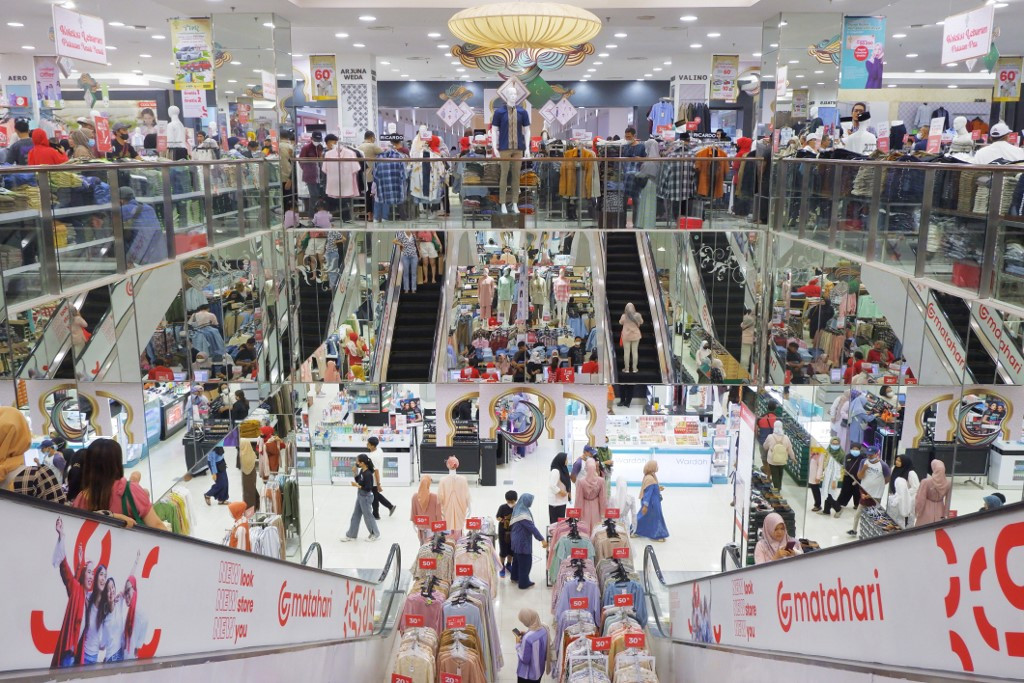
Strong household consumption, fiscal acceleration and transmission from government capital spending to investment may be sufficient to grow economic growth faster in Q4 2025.

Shahifa Assajjadiyyah (The Jakarta Post)
JakartaTue, February 3, 2026


1770273471395.png
People shop at a mall in Serang, Banten, on April 9, 2023. (AFP/Dziki Oktomauliyadi)

Indonesia Q4 GDP growth beat forecast at 5.39% y/y, full-year at 5.11%​


Reuters


JCI Rises to 8,317 Amid Stimulus Hopes and Market Reforms​


Ria Fortuna Wijaya, Associated Press
February 12, 2026 | 9:30 am


To view this content we will need your consent to set third party cookies.
For more detailed information, see our cookies page.


Jakarta. Indonesian stocks staged a sharp early rally on Thursday, with the Jakarta Composite Index (JCI) jumping 0.36% at the open as improving domestic sentiment and policy optimism outweighed mixed global cues.


The benchmark index rose 26.27 points to 8,317 in early trade, moving within a range of 8,295 to 8,334. Trading activity was brisk in the opening minutes, with volume reaching 5.11 billion shares and turnover totaling Rp 2.72 trillion ($161.72 million) across more than 351,000 transactions. Gainers slightly outnumbered decliners, with 258 stocks rising, 239 falling and 199 unchanged.


BRI Danareksa Sekuritas attributed the surge to improving investor sentiment following President Prabowo Subianto’s meeting with major conglomerates, alongside reform measures and active communication between the Indonesia Stock Exchange and the Financial Services Authority. Additional support came from corporate earnings releases, technical factors and a stronger rupiah against the US dollar.

Phintraco Sekuritas likewise cited growing confidence in Indonesia’s capital market, solid earnings performance and technical momentum, as well as continued rupiah appreciation. The brokerage added that a combination of fiscal stimulus and seasonal consumption linked to Lunar New Year, Ramadan and Idul Fitri is expected to support economic growth in the first quarter of 2026.

The government has prepared Rp 12.83 trillion in first-quarter stimulus measures, including transport fare discounts, toll road tariff cuts and social assistance distributed between February and March.

Phintraco also highlighted continued discussions between the stock exchange and MSCI on improving market transparency, including disclosure of shareholders owning more than 1%, more granular investor data and progress toward raising the minimum free-float requirement from 7.5% to 15%. The exchange is also set to introduce a shareholder concentration list identifying stocks with highly concentrated ownership.


Global markets offered a mixed backdrop. US equities fluctuated after a stronger-than-expected labor report showed employers added 130,000 jobs last month and the unemployment rate edged lower. The S&P 500 ended little changed, slipping less than 0.1%, while the Dow Jones Industrial Average fell 66 points, or 0.1%, and the Nasdaq Composite declined 0.2%, reversing earlier gains.


Solid employment data reassured investors about the strength of the US economy but also reduced expectations for near-term Federal Reserve rate cuts, pushing market bets toward the summer. Higher interest rates typically weigh on equity valuations, while lower rates could support markets at the risk of rekindling inflation. Investors are now awaiting the next US consumer inflation report for further policy signals.


Across Asia, markets were mostly higher. Japan’s Nikkei gained 0.36% to 57,864 and South Korea’s Kospi climbed 1.3% to 5,425, while Hong Kong’s Hang Seng slipped 0.21% to 27,210. China’s Shanghai Composite edged up 0.19% to 4,136.


Read More:​

JCI Rises to 8,152 on Tax Revenue Push and Easing Risk-Off Mood


Indonesian, US Firms Ink $38.4 Billion MoUs as Tariff Deal Nears​


Jayanty Nada Shofa
February 19, 2026 | 2:29 pm


To view this content we will need your consent to set third party cookies.
For more detailed information, see our cookies page.


Jakarta. Indonesian and American firms inked pledges totaling up to $38.4 billion on Wednesday local time, a curtain-raiser to the bilateral trade deal signing.


Companies and associations secured the 11 memoranda of understanding (MoUs) during President Prabowo Subianto’s Washington trip. These documents covered a plethora of fields, including semiconductors and furniture.


The signatories and the respective fields of the business MoUs were as follows:

1. Critical Minerals - The Indonesian government and Freeport Indonesia
2. Oil Field Recovery - Pertamina and Halliburton
3. Agriculture (Corn) - Arena Agro Andalan, Cargill Inc, and its Indonesian unit
4. Cotton - Busana Apparel Group and US National Cotton Council
5. Cotton - Daehan Global and US National Cotton Council
6. Shredded Worn Clothing - Indonesian Garment and Textile Association (AGTI), Pan Brothers, Ravel
7. Furniture - Indonesian Furniture Industry & Handicraft Association (Asmindo) and Bingaman & Son Lumber
8. Semiconductor - Galang Bumi Industri and Essence
9. Semiconductor - Galang Bumi Industri and Tynergy Technology Group
10. Transnational Free Trade Zone Friendship - Galang Bumi Industri and Solanna Group
11. Furniture/Wood Product - The Indonesian Furniture and Handicraft Industry Association (HIMKI) and American Hardwood Export Council

The Indonesian government had said that the agricultural portion of these pledges was worth $2.5 billion. The industrial sector MoUs reached $35.9 billion in value, including the cooperation on semiconductors and strategic industrial materials.


Freeport-McMoran has agreed to transfer 12% of its share interest in its local arm to the Indonesian government in 2041. It will hold a 48.76% stake in the unit that operates one of the world’s largest copper and gold mines through 2041. Its shares will then drop to 37% the following year. The MoU extends Freeport’s mining permit beyond 2041.


To the Jakarta Globe, HIMKI’s chair Abdul Sobur said that the association’s freshly signed MoU was not a purchase contract, but a strategic cooperation.


“It deals with ramping up the supply of American hardwood raw materials for the Indonesian furniture industry. It covers knowledge exchange and sustainable forestry standards. … But do note that this is a framework cooperation agreement, so there is no transaction value,” Sobur stated.


“In the long term, it can help boost exports of Indonesian furniture to global markets, particularly the US.”


Prabowo is currently in the world’s richest country to attend the inaugural Board of Peace’s meeting and seal the highly anticipated trade agreement. Both governments have been negotiating a trade pact after US President Donald Trump launched tariff threats over multibillion-dollar deficit last year. Senior government official Haryo Limanseto told the Globe that the signing remained “on schedule”.


Indonesia Raises $4.5 Billion to Defy Fiscal Health Concerns​


By Harry Suhartono and Prima Wirayani
February 26, 2026 at 10:02 AM GMT+7
Updated on
February 26, 2026 at 10:46 AM GMT+7

1772090740178.png

Takeaways by Bloomberg AI​

  • Indonesia pulled off its biggest global bond sale since at least 2017, raising €2.7 billion via euro-denominated debt and 9.25 billion in offshore yuan.
  • The country priced the euro offering at lower risk premiums over benchmark rates than initially sought, reflecting a strong 3.4-time demand ratio.
  • The dual-currency debt sale shows Indonesia’s ability to tap global markets with relatively competitive borrowing costs and healthy demand, despite worries about its fiscal health.
Indonesia pulled off its biggest global bond sale since at least 2017, overcoming the threat of a credit rating downgrade and signaling easing investor concerns about fiscal woes in Southeast Asia’s largest economy.

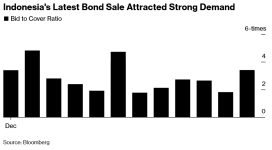
The country raised €2.7 billion ($3.2 billion) via euro-denominated debt, as well as 9.25 billion in offshore yuan ($1.3 billion), according to people familiar with the matter who requested anonymity discussing private matters. The euro portion drew €9.2 billion of orders excluding underwriters’ bids, one of the people said.

Reflecting the strong 3.4-time demand ratio, Indonesia priced the three-part euro offering at lower risk premiums over benchmark rates than initially sought. Its offshore yuan notes also saw similar tightening in credit spreads.

The dual-currency debt sale shows Indonesia’s ability to tap global markets with relatively competitive borrowing costs and healthy demand, even as worries about its fiscal health have roiled the country’s assets in recent months. It came after the nation posted a rare budget deficit in January and followed Moody’s Ratings’ decision to lower Indonesia’s credit outlook to negative earlier this month.

Indonesia's Latest Bond Sale Attracted Strong Demand​


1772086728913.png

“The nation’s stable and strong credit metrics have contributed to the strong demand for these offshore notes despite recent warnings from rating agencies on the country’s finances, “ according to Timothy Tan, Bloomberg Intelligence’s chief Asia fixed income and credit strategist. “Spreads of Indonesia dollar bonds didn’t materially widen against peers like the Philippines.”

The latest bond sale shows global investor confidence has started recovering since the decision by Moody’s. It also followed the worst selloff in Indonesian stocks in nearly three decades last month after MSCI Inc. warned of lowering the nation’s equity market to frontier status.

When Moody’s cut Indonesia’s Baa2 rating outlook, it warned of cutting the actual rating if there is a sustained increase in the budget deficit, prolonged currency depreciation or capital flows, or a material weakening of state-owned firms. Such a downgrade would be the first by Moody’s since 1998 in the depths of the Asian financial crisis, when the country needed a bailout from the International Monetary Fund.

Indonesia recorded a fiscal deficit of 54.6 trillion rupiah ($3.25 billion) last month, equivalent to 0.21% of gross domestic product. Post-pandemic, the government has typically posted a surplus in the first month of the year, when tax revenues are strong and projects are just getting started.

The country’s fiscal deficit is likely to widen well beyond its legal limit this year as the government ramps up spending on its nationwide free meals program and the rebuilding of flood-hit provinces in Sumatra island, according to Citigroup Inc.

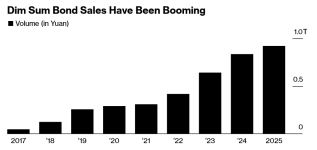
Dim Sum Bond Sales Have Been Booming​


1772090356609.png
The offshore yuan notes were another highlight as the offering marked Indonesia’s return to the so-called dim sum bond market after its debut sale in October. Borrowing appetite for such debt has been strong globally as the funding costs are hovering near record lows.

Issuance of dim sum bonds has boomed in recent years, signaling the yuan’s growing popularity in global finance as President Donald Trump’s tariff war and unpredictable policies weaken the appeal of dollar assets. Beijing has been encouraging such offshore bond sales as a crucial driver of its long-term ambition to turn the yuan into a major world currency.


— With assistance from Grace Sihombing and Abraham Gonzalez Dominguez

(Updates with comments and chart)


Indonesia Benefits from Global Energy Shock in Asia Market​


30 March 2026 11:19​


To view this content we will need your consent to set third party cookies.
For more detailed information, see our cookies page.

Pertamina Jambaran Tiung Biru Gas Field, East Java


Bloomberg Technoz, Jakarta — The global energy shock triggered by geopolitical tensions in strategic areas such as the Strait of Hormuz has now evolved into broad macroeconomic pressure. This development is no longer merely an oil supply issue but has spread across key economic indicators.

According to Shan Saeed of IQI Global, this phenomenon acts as a “macro filter”, separating economies with strong resilience from those that are more vulnerable.

“This is not just an energy shock. It is a financial conditions shock that spreads through inflation, exchange rates, and sovereign risk premiums,” Shan said.
Approximately 20% of global oil flows pass through the Strait of Hormuz. Disruptions in this route not only drive energy prices higher but also create significant ripple effects on:

  • Inflation
  • Exchange rates
  • Country risk
“Disruptions in the Strait of Hormuz do not distribute pressure evenly but instead reprice each economy’s resilience based on balance sheet strength and policy credibility,” said Shan Saeed, Chief Economist of IQI Global.

Indonesia Amid Global Energy Pressure​

Within ASEAN, countries with high dependence on energy imports—such as:

  • Singapore
  • Thailand
  • The Philippines
  • Cambodia
face greater pressure. Rising oil prices directly impact production costs, logistics, and consumption.

“Countries with high energy import dependence will face layered pressures: rising inflation, tightening fiscal space, and simultaneous currency depreciation,” Shan said.
However, Indonesia stands in a different position. Its commodity-based economic structure and strong external buffers are key factors supporting its resilience.

With a trade surplus of around US$41 billion in 2025 and a non-oil and gas surplus exceeding US$60 billion, Indonesia has sufficient buffers to absorb global volatility.

“Indonesia is in a different position. Its commodity scale acts as macro insurance against global volatility,” Shan explained.

1774874075115.png

Chief Economist IQI Global, Shan Saeed​


Strategic Commodity Advantage​

Indonesia’s strength also lies in its dominance in strategic commodities:

  • Major coal exporter (~50% global market share)
  • Key player in nickel
  • Leading producer of palm oil
In a high energy price environment, Indonesia benefits significantly.

“In a high energy price environment, Indonesia not only absorbs the shock but converts it into strengthening its external balance,” he added.

Turning Disruption into Opportunity​

In this situation, Indonesia is not only resilient but also capable of turning global disruption into economic strength. Strong external fundamentals also help mitigate potential capital outflows caused by global instability.

Shan noted that markets will begin to reprice risk across ASEAN economies as these dynamics unfold.

“Markets will start repricing ASEAN risk, clearly distinguishing between fragile and resilient economies,” he said.

Risks Remain​

Despite these advantages, risks still persist. Oil prices rising above US$110 per barrel could pressure fiscal conditions, particularly through increased energy subsidies.

“This is not a traditional energy crisis, but rather a test of each country’s economic architecture,” Shan said.

Strategic Position in the New Energy Order​

Ultimately, in an evolving global energy landscape, Indonesia is seen as being in a strategic position to leverage volatility as an advantage.

“In the new global energy order, some countries will be hit hard, while others, like Indonesia, can monetize volatility into a strategic advantage,” Shan concluded.


Indonesia retains fiscal space as fuel prices held - World Bank​


By Bernama
April 8, 2026 @ 10:40pm


To view this content we will need your consent to set third party cookies.
For more detailed information, see our cookies page.


JAKARTA: Indonesia retains adequate fiscal space after deciding to keep subsidised fuel prices unchanged until the end of the year, even as global oil prices rise amid conflict in Middle East.

World Bank chief economist for East Asia and the Pacific Aaditya Mattoo said the country's fiscal position remains relatively strong, with the 2025 deficit below three per cent of gross domestic product (GDP) and government debt at around 40 per cent of GDP.

"Indonesia shows a tendency towards fiscal prudence and thus has the capacity to continue providing support through energy subsidies, both implicitly and explicitly," he said, according to ANTARA News Agency on Wednesday.

However, Aaditya stressed that subsidies should be better targeted to reach lower-income groups as well as vulnerable segments of the middle class.

He said support should also extend to small businesses and parts of the medium enterprise segment to cushion economic pressures, while urging improvements in subsidy delivery mechanisms to avoid excessive long-term fiscal burdens.

"A more targeted subsidy design will reduce fiscal risks and prevent long-term pressures that could hamper economic recovery," he said.

On April 6, Finance Minister Purbaya Yudhi Sadewa said subsidised fuel prices would remain unchanged until year-end, noting that the government had assessed the resilience of the state budget under various oil price scenarios.

He added that Indonesia has additional buffers beyond the state budget, including a budget surplus fund (SAL) of about 420 trillion rupiah, with 200 trillion rupiah placed in banks, as well as non-tax state revenues from the energy and mineral resources sector.


– Bernama


Users who are viewing this thread

Pakistan Defence Latest

Back
Top