Indonesia Leads EM Rally as Carry Appeal, Growth Lure Investors

Jakarta Stocks Hits 8,025 After BI Rate Cut, Cabinet Reshuffle​


Ria Fortuna Wijaya, Associated Press

September 17, 2025 | 4:05 pm


Jakarta. The Jakarta Composite Index (JCI) ended in positive territory on Wednesday, as investors weighed President Prabowo Subianto’s latest cabinet reshuffle alongside Bank Indonesia’s move to cut its benchmark interest rate for the fifth time this year.


The benchmark index gained 67.4 points, or 0.85 percent, to close at 8,025 after opening at 7,964. It touched an intraday high of 8,025 and a low of 7,940. Market capitalization stood at Rp 14.5 trillion, with 1.78 million transactions recorded. A total of 360 stocks advanced, 318 declined, and 124 were unchanged.

Banking shares led the gains, reflecting investor optimism over cheaper borrowing costs.

Bank Indonesia lowered the BI Rate by 25 basis points to 4.75 percent, while cutting the deposit facility rate by 50 basis points to 3.75 percent and setting the lending facility rate at 5.5 percent. Governor Perry Warjiyo said the move was aimed at stimulating growth while keeping inflation within the 2.5 percent target range, plus or minus 1 percent, for both 2025 and 2026.

President Prabowo, meanwhile, carried out his third cabinet reshuffle in a ceremony at the State Palace. He appointed new ministers and senior officials as he consolidated his administration nearly one year into office.


The changes included Erick Thohir, who was dismissed earlier in the day as state-owned enterprises minister before being reappointed as youth and sports minister, replacing Dito Ariotedjo. His removal left the state-owned enterprises ministry without a minister as it balances its role alongside sovereign wealth fund Danantara, which currently oversees SOE assets.


Prabowo also named retired army general Djamari Chaniago as chief political and security affairs minister, filling the post left vacant after Budi Gunawan was dismissed in a previous reshuffle earlier this month.


Across Asia, markets traded mixed as Wall Street eased from record highs and attention shifted to the U.S. Federal Reserve’s policy outlook. Japan’s Nikkei 225 slipped 0.3 percent to 44,790.38, while the Hang Seng in Hong Kong jumped 1.7 percent to 26,885.91. The Shanghai Composite added 0.4 percent, Australia’s S&P/ASX 200 lost 0.7 percent, and South Korea’s Kospi fell 1.1 percent.


On Wall Street, the S&P 500 and Nasdaq edged 0.1 percent lower from record highs, while the Dow Jones Industrial Average fell 125 points, or 0.3 percent, as investors bet on the Fed to begin cutting rates.


Indonesia’s New Finance Chief Lauded for Out-of-the-Box Economic Strategy​


Heru Andriyanto
September 17, 2025 | 5:51 pm


1758112378078.webp
Finance Minister Purbaya Yudhi Sadewa gives his thumbs-up after a meeting with lawmakers at the parliamentary complex in Jakarta on September 11, 2025. (Antara Photo/Dhemas Reviyanto)


Tangerang. Indonesia’s new Finance Minister, Purbaya Yudhi Sadewa, has earned praise from economists for adopting bold and unconventional fiscal policies less than two weeks into his tenure.

Purbaya, who took office on September 8, quickly made headlines by transferring Rp 200 trillion ($12.2 billion) in government funds from Bank Indonesia to state-owned commercial banks. He followed this by ordering ministries and state institutions to use their budgets consistently and warning that he would withdraw funds left unused by the end of 2025.

According to senior economist Ryan Kiryanto, these moves show that Purbaya is not a passive policymaker but one willing to take initiative and push for breakthroughs to stimulate a sluggish economy.

Compared with his predecessor, Sri Mulyani Indrawati, who emphasized prudence and administrative discipline, Purbaya is "more aggressive" and proactive, Ryan said during a discussion hosted by B-Universe Media Holdings in Pantai Indah Kapuk 2, Tangerang, Banten.

“Between Sri Mulyani and Purbaya, their playing styles are different. The former was more defensive, like Manchester United today. Purbaya plays more aggressively,” Ryan joked.


Stimulating Credit and Growth
Ryan said he understood Purbaya’s rationale for shifting idle government funds into commercial banks: to make credit more accessible to businesses while also generating interest income for the state.


“His spirit is to break the deadlock in the economy. By boosting supply from lenders and leveraging idle funds, businesses can benefit. This way, state-owned banks can become true agents of development,” Ryan explained.


He added that while boosting credit supply is crucial, demand from businesses must also be encouraged. “The business community must feel comfortable to expand in a safe and stable environment. But this is not the finance minister’s job. Security rests with the police and other authorities,” Ryan said.


Ryan also welcomed Purbaya’s demand that ministries fully utilize their budgets, noting that weak government spending could drag down growth. “Encouraging ministries to meet their spending targets could be a lever to lift the economy,” he said.


Indonesia Stock Benchmark Holds Above 8,000 Amid Asia Market Losses​


Associated Press, Ria Fortuna Wijaya

September 19, 2025 | 4:10 pm

Jakarta. Indonesia’s benchmark stock index swung sharply in the first trading session on Friday but managed to stay above the 8,000 level.


The Jakarta Composite Index (JCI) closed the session up 0.54 percent at 8,051.1, after moving within a range of 7,983–8,051, according to RTI data. A total of 301 stocks gained, 350 declined, and 148 remained unchanged. Trading volume reached 46.5 billion shares worth Rp 66.7 trillion across 1.9 million transactions.


Asian markets mostly retreated on Friday following Wall Street’s latest record highs, driven by a rally in technology giants Nvidia and Intel.

Japan’s Nikkei 225 slipped nearly 0.6 percent to 45,045.81 after the Bank of Japan kept its short-term interest rate steady at 0.5 percent. Fresh data also showed Japan’s inflation cooled to 2.7 percent in August, the lowest in 10 months.

Elsewhere in Asia, Hong Kong’s Hang Seng Index edged down less than 0.1 percent to 26,537.97, while the Shanghai Composite fell slightly to 3,829.34. Investors are eyeing a scheduled call between US President Donald Trump and Chinese President Xi Jinping on tariffs and a deal to keep TikTok operating in America.


Australia’s S&P/ASX 200 rose 0.3 percent to 8,773.50, recovering from losses the day before. South Korea’s Kospi slipped nearly 0.5 percent to 3,445.24, India’s Sensex dropped 0.6 percent, and Taiwan’s Taiex slid 0.7 percent.


On Wall Street, all three major U.S. indexes notched fresh records Thursday. The S&P 500 gained 0.5 percent, the Dow Jones Industrial Average added 124 points, or 0.3 percent, and the Nasdaq Composite jumped 0.9 percent.


U.S. and global growth forecast lifted by OECD as economies surprise to the upside​

Published Tue, Sep 23 20255:00 AM EDT
Updated Tue, Sep 23 20259:14 AM EDT

  • The OECD now expects global growth of 3.2% this year, compared to the 2.9% expansion it had forecast in June.
  • “Global growth was more resilient than anticipated in the first half of 2025, especially in many emerging-market economies,” the OECD said.
  • The full effect of tariffs is yet to be felt, however, the organisation said, warning of “significant risks to the economic outlook.”
1758685563310.webp
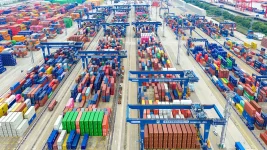
Container backlog occurs at Longtan Port Container Terminal in Nanjing, Jiangsu Province, China, on September 21, 2025. (Photo by Costfoto/NurPhoto via Getty Images)


The Organisation for Economic Co-operation and Development upgraded its global economic growth forecast on Tuesday, with many economies appearing more resilient than expected so far this year.

The OECD now expects global growth of 3.2% this year, compared to the 2.9% expansion it had forecast in June. Expectations for 2026 were unchanged at 2.9%. This would mark a slowdown from the 3.3% growth seen in 2024.


Growth expectations for the U.S. were also lifted, to 1.8% for 2025, compared to June’s 1.6% estimate. This still marks a significant fall from 2024′s 2.8% growth, however. The organization forecasts 1.5% growth for the U.S. in 2026.

“Global growth was more resilient than anticipated in the first half of 2025, especially in many emerging-market economies,” the organisation said in a new report.

“Industrial production and trade were supported by front-loading ahead of higher tariffs. Strong AI-related investment boosted outcomes in the United States and fiscal support in China outweighed the drag from trade headwinds and property market weakness,” it noted.

Alvaro Pereira, chief economist of the OECD, on Tuesday told CNBC’s Charlotte Reed that individual economic events in emerging markets including Brazil, Indonesia and India also boosted the world economy.

“But to be honest with you, for most of our forecasts we have not changed significantly the forecast for virtually all the G20 countries and we still expect a slowing in the second part of the year after this front loading took place in the first quarter,” he said.


The OECD warned, however, that “significant risks to the economic outlook remain,” as investment and trade continue to be hit by high levels of policy uncertainty and elevated tariffs.

Sweeping duties on goods entering the U.S. came into effect in August after months of policy changes, temporary pauses, and threats from U.S. President Donald Trump.

Countries and regions around the world now face tariff rates as high as 50% on their exports to the U.S., with some still trying to negotiate trade frameworks.

“US bilateral tariff rates have increased on almost all countries since May. The overall effective US tariff rate rose to an estimated 19.5% at the end of August, the highest rate since 1933,” the OECD said.

“The full effects of tariff increases have yet to be felt – with many changes being phased in over time and companies initially absorbing some tariff increases through margins – but are becoming increasingly visible in spending choices, labour markets and consumer prices,” it added.

Labour markets are showing signs of softening as some countries see higher unemployment and fewer job openings, according to the report, while the disinflation process appears to have flattened.

The OECD’s Pereira said that “the tariff shock is bringing more inflationary pressures in many countries.”

“We expect it will be additional price impacts for firms not only in the United States but other parts of the world too,” he said.

The OECD now expects headline inflation to amount to 3.4% across G20 countries in 2025, slightly lower than June’s 3.6% projection. Inflation expectations for the U.S. were revised down more sharply, with the OECD now forecasting price rises of 2.7% in 2025, down from the previous 3.2% forecast.

Looking ahead, further tariff increases and a return of inflationary pressures were flagged in the organization’s report as two key risks, alongside growing concerns about the fiscal situation and the possibility of repricing in financial markets.

“High and volatile crypto-asset valuations also raise financial stability risks given growing interconnectedness with the traditional financial system. On the upside, reductions in trade restrictions or faster development and adoption of artificial intelligence technologies could strengthen growth prospects,” the OECD noted.


Oracle plans to invest in Indonesia’s tech sector, Minister says


In May, the Communications and Digital Ministry partnered with Oracle to build Southeast Asia’s largest graphics processing unit (GPU) cluster, with the goal of positioning the country as a hub for AI development in the region.


Ni Made Tasyarani (The Jakarta Post)
Premium
Jakarta
Mon, September 22, 2025

United States technology giant Oracle Corporation is planning to invest in Indonesia’s technology sector, Investment and Downstream Minister Rosan Roeslani wrote in an Instagram post on Thursday through his personal account.

Rosan, who also serves as CEO of state asset fund Danantara, shared a short video of his meeting with Oracle representatives in Jakarta. He said the discussion covered “AI utilization to strengthen data sovereignty, improve efficiency in the public and private sectors, create new jobs in the technology sector and accelerate Indonesia’s digital transformation toward becoming a developed country.”

However, he did not provide further details about the investment plan.


Read also: As users surge, Indonesia falls short on AI talent


Established in 1977, Oracle Corporation was founded by Larry Ellison, Bob Miner and Ed Oates. The company provides database software for businesses and claims to offer the “world’s first autonomous database.”


Earlier this month, Oracle announced that it had signed four multi-billion-dollar contracts with three different customers in the first quarter of this year. The company expects to sign several additional multi-billion-dollar agreements, projecting its contract backlog to exceed half a trillion dollars in the coming months, Oracle CEO Safra Catz said in a statement on Sept. 9.


ChatGPT Go launches in Indonesia with $4.5 monthly plan | Digital Watch Observatory​


23 Sep 2025


Following a successful launch in India, where subscriptions doubled, OpenAI is introducing ChatGPT Go in Indonesia to capture more cost-conscious users.

OpenAI has launched its low-cost ChatGPT Go subscription in Indonesia at $4.5 a month, expanding access to AI tools in emerging markets.


OpenAI has launched its low-cost ChatGPT Go subscription in Indonesia, pricing it at 75,000 rupiah ($4.5) per month. The new plan offers ten times more messaging capacity, image generation tools and double memory compared with the free version.

The rollout follows last month’s successful launch in India, where ChatGPT subscriptions more than doubled. India has since become OpenAI’s largest market, accounting for around 13.5% of global monthly active users. The US remains second.

Nick Turley, OpenAI Vice President and head of ChatGPT, said Indonesia is already one of the platform’s top five markets by weekly activity. The new tier is aimed at expanding reach in populous, price-sensitive regions while ensuring broader access to AI services.

OpenAI is also strengthening its financial base as it pushes into new markets. On Monday, the company secured a $100 billion investment commitment from NVIDIA, joining Microsoft and SoftBank among its most prominent backers. The funding comes amid intensifying competition in the AI industry.

 
Finance Minister Claims Potential Rp220 Trillion in Additional Tax Revenue if Economic Growth Rises by 1%

By Muhamad Wildan
~2 minutes

1758849121158.webp


JAKARTA, DDTCNews — Finance Minister Purbaya Yudhi Sadewa plans to boost tax revenues through faster economic growth.


According to Purbaya, tax revenue will automatically increase if the national economy is able to grow more rapidly.


“For every 1% increase in economic growth, I gain an additional income of around Rp220 trillion or more. So that’s what we’re aiming for. If it increases by 0.5%, I gain Rp110 trillion more. That’s what we’ll pursue later,” Purbaya said on Tuesday (Sept 23, 2025).


With stronger economic growth, the government would not be forced to take on additional debt to meet spending needs in the state budget (APBN).


“We shouldn’t have to be compelled to add more debt because I will encourage faster economic growth, so under the same conditions, with the same state budget, I will achieve higher economic growth and greater revenues,” Purbaya said.


One of the policies the government has adopted to spur growth is placing Rp200 trillion of state funds in five state-owned banks. According to Purbaya, state funds have so far tended to remain idle at Bank Indonesia (BI) and have not circulated within the economy.


Placing state funds in the national banking system will lower the cost of funds, stimulate credit growth, boost consumption and investment, and create a multiplier effect for national economic growth.


“With this additional liquidity, banks must immediately channel credit to accelerate activity in the real sector, drive higher growth in consumption and investment, and generate a stronger multiplier effect for the economy,” Purbaya said. (dik)


Indonesia Stock Market Rally Continues on Fed Speculation, China Stimulus Hopes​


Ria Fortuna Wijaya, Associated Press
September 29, 2025 | 4:14 pm


Employees stands in IDX Main Hall. (JG Photo)

Jakarta. The Jakarta Composite Index (JCI) closed higher on Monday, climbing 23.9 points or 0.30 percent to 8,123, supported by a flood of positive external and internal sentiment. Market turnover reached Rp 23.3 trillion ($1.4 billion) from 49.9 billion shares traded in 2.6 million deals, with 392 stocks advancing, 289 declining, and 117 remaining flat.

Pilarmas Investindo Sekuritas said the gains were underpinned by optimism following the release of US inflation data. The Personal Consumption Expenditure (PCE) index rose 0.3 percent month-on-month and 2.7 percent year-on-year in August, in line with market expectations. “The report helped shape prospects for the Federal Reserve’s policy direction and strengthened speculation over a potential rate cut later this year,” Pilarmas noted in its research.

Markets are also watching the looming US government shutdown, with President Donald Trump set to meet congressional leaders in a last-ditch effort to prevent it. From China, sentiment was buoyed by the People’s Bank of China’s new measures to attract foreign investors into the bond market and boost the use of the yuan.


On the domestic front, the government’s decision to delay a 0.5 percent e-commerce income tax also provided relief. “The postponement helps safeguard household purchasing power and gives businesses time to adapt,” Finance Minister Purbaya Yudhi Sadewa said.

Meanwhile, top gainers included IT company Multipolar (MLPL) up 34.6 percent, battery producer Merdeka Battery Materials (MBMA) up 12.1 percent, retailer Matahari Putra Prima (MPPA) up 27.5 percent, and miner Bumi Resources Minerals (BRMS) up 17.4 percent.

Across Asia, most markets advanced after Wall Street snapped a three-day losing streak. Hong Kong’s Hang Seng rose 2 percent to 26,652.90, Shanghai Composite gained 0.9 percent to 3,862.53, Australia’s S&P/ASX 200 added 0.9 percent to 8,862.80, and South Korea’s Kospi climbed 1.3 percent to 3,431.21. Japan’s Nikkei was the outlier, falling 0.7 percent to 45,043.75.

In the US, the S&P 500 rose 0.6 percent to 6,643.70, the Dow Jones Industrial Average gained 0.7 percent to 46,247.29, and the Nasdaq Composite added 0.4 percent to 22,484.07, all moving closer to their all-time highs.


Jakarta Shares Rise Following Finance Minister Purbaya Moves​


Ria Fortuna Wijaya, Associated Press

October 2, 2025 | 4:06 pm


Jakarta. Indonesia’s benchmark Jakarta Composite Index (JCI) closed in the green on Thursday, gaining 27.2 points or 0.34 percent to 8,071. The index moved between 8,059 and 8,109 throughout the session.


RTI data showed 42.8 billion shares traded with a turnover of Rp 26.4 trillion ($1.6 billion) across 2.6 million deals. Market breadth was mixed, with 321 stocks advancing, 337 declining, and 138 unchanged, leaving overall market capitalization at Rp 14,966.7 trillion (approx. $884 billion).


Analysts credited fresh policy moves by Finance Minister Purbaya Yudhi Sadewa, who replaced Sri Mulyani less than a month ago, for supporting market confidence. “So far, Pak Purbaya’s steps remain positive for the JCI,” said Kiwoom Sekuritas equity researcher Abdul Azis Setyo Wibowo, noting that stimulus measures must be closely monitored to avoid misuse.


Abdul added that Purbaya’s stance aligns with Bank Indonesia’s recent policy rate cuts, which are expected to lower borrowing costs and encourage corporate expansion. The JCI gained 2.94 percent in September, hitting an all-time high of 8,126 on Sept. 24, supported by these fiscal and monetary measures.

Since taking office on Sept. 8, Purbaya has announced a Rp 200 trillion capital injection into state-owned lenders, pledged to hold tobacco excise steady in 2026, and vowed to pursue 200 major tax delinquents with Rp 60 trillion in arrears.


Separately, lawmakers passed a long-awaited amendment to the State-Owned Enterprises Law, elevating the SOEs Ministry into a standalone agency. The IDX BUMN20 index fell 0.21 percent to 358.48, dragged by declines in Aneka Tambang (-2.49 percent), Bank Rakyat Indonesia (-1.84 percent), and Semen Indonesia (-1.77 percent). Gainers were led by Bank Raya (+3.2 percent) and Telkom Indonesia (+2.94 percent).


Across Asia, regional markets tracked Wall Street’s record run. Seoul’s Kospi jumped 2.7 percent after Samsung Electronics and SK Hynix sealed a chip-supply deal with OpenAI, while Tokyo’s Nikkei rose 0.9 percent and Hong Kong’s Hang Seng added 1.7 percent.


On Wall Street, the S&P 500 hit another record high, rising 0.3 percent to 6,711.20, while the Dow Jones and Nasdaq also closed at fresh peaks.

 
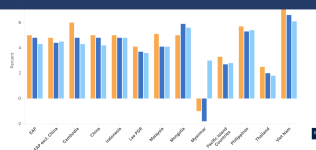
World Bank Latest Projection add Indonesia growth in 2025 and 2026 to 4.8% from their previous Projection couple months ago at 4.7 %. Indonesia economy is projected among top growth within Asia Pacifict

1759841000658.png

Jobs: East Asia and Pacific Economic Update — October 2025​


Explore the report​


GDP growth in the East Asia and Pacific (EAP) region remains above the global average but is projected to slow down in 2025 and even further in 2026.

Growth in China, the region’s largest economy, is projected to decline from 4.8 percent this year to 4.2 percent in 2026. The rest of the region is projected to grow by 4.4 percent in 2025 and 4.5 percent in 2026. The Pacific Island Countries are projected to grow by 2.7 percent in 2025 and 2.8 percent in 2026.


World Bank sees momentum slowing in Asia

 
To view this content we will need your consent to set third party cookies.
For more detailed information, see our cookies page.


The Jakarta Composite Index (IHSG) closed higher by 0.36%, reaching 8,169.38 at the end of trading on Tuesday (October 7).


Meanwhile, Indonesia’s realized investment reached Rp 1,400 trillion (84 billion USD) in the third quarter of 2025.


For more details, watch the discussion between Shinta Zahara and Dina Gurning in the Market Focus segment of CNBC Indonesia’s Closing Bell program, Tuesday (October 7, 2025).
 
To view this content we will need your consent to set third party cookies.
For more detailed information, see our cookies page.


Oct 10, 2025

The Jakarta Composite Index (IHSG) has finally surpassed the 8,250 level for the first time in history. This is not merely a numerical record — it also reflects a new dynamic in Indonesia’s capital market.


From verbal interventions by the Finance Minister to the growing dominance of domestic investors, the Indonesian stock market is entering a new phase.


What’s driving this rally? Who currently dominates the market? And what’s happening while foreign capital remains on the sidelines?


Find out more in Sarah Ariantie’s analysis on CNBC Indonesia’s Power Lunch program, Friday (October 10, 2025).


-------------

Rp 200t Bank Fund Absorption Reaches 56%, Purbaya Says​


Ria Fortuna Wijaya
October 10, 2025 | 12:07 am

1760088322999.webp
Finance Minister Purbaya Yudhi Sadewa speaks at the Investor Daily Summit (IDS) 2025 in Jakarta on Thursday (Oct 9, 2025), where he outlined the government's fiscal strategy to boost credit growth through state banks. (Photo Courtesy of Jakarta Globe/Ria)


Jakarta. Finance Minister Purbaya Yudhi Sadewa is moving ahead with a major fiscal initiative to channel Rp 200 trillion ($12 billion) into state-owned banks, underscoring the government’s push to accelerate credit growth and strengthen domestic liquidity.


Speaking at the Investor Daily Summit (IDS) 2025 in Jakarta on Thursday, Purbaya said the policy, which places idle government funds into the State-Owned Bank Association, Himbara, is designed to keep money circulating in the real sector through productive lending.


“When I move government money into banks, it doesn’t mean there’s a shift in fiscal policy,” he said. “It simply means the money is working through loans, investments, and real economic activity.”


As of early October, around Rp 112.4 trillion ($6.8 billion), or 56 percent of the total allocation, has been absorbed by state lenders.


Bank Mandiri led with Rp 40.6 trillion in disbursement (74 percent of its share), followed by BRI at Rp 33.9 trillion (62 percent), BNI at Rp 27.6 trillion (50 percent), BSI at Rp 5.5 trillion (55 percent), and BTN at Rp 4.8 trillion (19 percent).


Indonesia’s 10-Year Bond Yield Falls to Lowest in Almost 4 Years​


Prima Wirayani

October 9, 2025 at 9:43 AM GMT+7

Updated on

October 9, 2025 at 4:33 PM GMT+7


Indonesia’s 10-year yield dropped to its lowest level in nearly four years as expectations for more interest-rate cuts helped government bonds extend a rally driven by strong demand from domestic investors.

The benchmark yield slid five basis points in a fifth day of declines on Thursday to 6.128%, its lowest level since November 2021. It has fallen more than 110 basis points from this year’s high in January.


Jakarta Stocks Hit Historic High on Strong Domestic Liquidity, Rate Optimism​


Muhammad Ghafur Fadillah

October 11, 2025 | 11:30 am

To view this content we will need your consent to set third party cookies.
For more detailed information, see our cookies page.

New Finance Minister interview in CNBC Indonesia


Jakarta. Indonesia’s benchmark stock index surged to an all-time high this week, lifted by strong domestic liquidity and optimism over monetary easing both at home and abroad.


The Jakarta Composite Index (JCI) climbed 1.72 percent to 8,257.86 on Friday, marking its highest level in history and extending gains for a second straight week. The rally pushed the market capitalization of the Indonesia Stock Exchange (IDX) to a record Rp 15,560 trillion ($974 billion), up 3.19 percent from the previous week.


Trading activity also showed impressive momentum, with the average daily transaction value jumping 12.48 percent to Rp 28.15 trillion, and trading frequency rising 11.83 percent to 2.93 million times. Only trading volume fell slightly, down 14.9 percent to 42.3 billion shares.

“The momentum is still strong, supported by solid domestic liquidity, sector rotation into energy and commodities, and optimism after recent rate cuts by Bank Indonesia and the US Federal Reserve,” said Muhammad Wafi, head of research at KISI Sekuritas.

According to Wafi, the index’s next resistance is at 8,300, and as long as local funds dominate and energy shares lead, “breaking through to the 8,250–8,300 range is quite realistic in the near term.”


Wafi cautioned, however, that short-term risks remain, including potential profit-taking after a two-week rally, rising US Treasury yields, and uncertainty surrounding the possible US government shutdown.


Investors are also turning their attention to the upcoming third-quarter earnings season, which could influence market sentiment. “If earnings come in below expectations, we may see a brief consolidation,” he said.


Energy and green commodity stocks are expected to remain in focus, with Barito Renewables Energy (BREN), Barito Pacific (BRPT), Dian Swastatika Sentosa (DSSA), Amman Mineral (AMMN), and Merdeka Copper Gold (MDKA) among top picks. Major banks such as Bank Rakyat Indonesia (BBRI), Bank Mandiri (BMRI), and Bank Central Asia (BBCA) continue to serve as defensive anchors.


According to Ekky Topan, an analyst at Infovesta Kapital Utama, the rally has been driven primarily by local investors taking advantage of lower interest rates and steady macroeconomic conditions. “If third-quarter results are strong and fiscal policy under the new government becomes clearer, foreign investors could return,” he said.


Foreign investors recorded net purchases of Rp 728.9 billion on Friday, though they remain net sellers of Rp 53.49 trillion year-to-date.


Market observer and Republic Investor founder Hendra Wardana said the JCI’s gains also reflect positive global sentiment, following Fed minutes hinting at more rate cuts this year and easing geopolitical tensions in the Middle East. “News that Israel and Hamas are exploring peace talks has reduced global risk appetite, prompting investors to return to equities,” he said.


Read More:​

Indonesia to Issue Yuan-Denominated 'Dim Sum' Bonds in Late 2025

Domestically, data showed retail sales grew 3.5 percent year-on-year in August, signaling that household consumption remains robust. The government is also preparing a Rp 70 trillion ($4.4 billion) fourth-quarter stimulus package aimed at boosting purchasing power and accelerating infrastructure projects.


Finance Minister Purbaya Yudhi Sadewa said the new stimulus package will reinforce existing programs by creating jobs, boosting household spending, and accelerating infrastructure development. “This policy will sustain economic momentum through the end of 2025 and support growth into 2026,” he said.


The newly appointed minister also cautioned the Indonesia Stock Exchange (IDX) against speculative trading, saying the bourse would not receive any fiscal incentives unless it strengthened enforcement against stock manipulation, locally known as goreng saham. He warned that such practices continue to erode investor confidence and undermine market integrity.


A report from Pilarmas Sekuritas noted that Indonesia’s macro stability, global monetary easing, and fiscal stimulus provide strong support for further gains. “We see the JCI trading within a positive range of 8,140 to 8,300, with limited downside risk,” the firm wrote.


Bank Indonesia has cut its benchmark rate by 125 basis points since late 2024, a move analysts believe will strengthen liquidity and help maintain stable capital inflows.


While the JCI may see intermittent pullbacks, analysts remain optimistic that the index could break above 8,300 by year-end. “As long as domestic investors stay dominant and the economy keeps expanding, Indonesia’s stock market still has room to climb higher,” Wafi said.


Indonesia Attracts $86.5 Billion Investments as of September 2025​

Jayanty Nada Shofa

October 17, 2025 | 10:47 am

1760696562741.webp
Danantara's Chief Executive Officer and Investment Minister Rosan Roeslani visits the presidential palace for a meeting with President Prabowo Subianto in Jakarta on May 20, 2025. (Antara Photo/Hafidz Mubarak A)

Jakarta. Indonesia has amassed Rp 1,434.3 trillion (around $86.5 billion) in investments from home and abroad so far this year as of September, the government announced Friday, with Singapore still keeping its crown as the biggest foreign investor.


The latest announcement showed that Indonesia had met 75.3 percent of its full-year investment target. Southeast Asia’s biggest economy aims to record approximately Rp 1,905.6 trillion in investments throughout 2025, which marks President Prabowo Subianto’s first year in office.


“We do admit that tensions were on the rise at the start of the year, but things have calmed down. … This has given a positive atmosphere,” Investment Minister Rosan Roeslani told reporters in Jakarta, alluding to the US tariff war and the Hamas-Israel ceasefire.


To view this content we will need your consent to set third party cookies.
For more detailed information, see our cookies page.


The January-September 2025 figures showed a 13.7 percent year-on-year (yoy) growth. The money that investors had put into the country had generated jobs for around 1.9 million people.

Domestic investors remained on the lead, contributing about Rp 789.7 trillion or about 55.1 percent of the same nine-month period. Rosan revealed the mining giant AMMAN’s smelter project in West Nusa Tenggara has also contributed to the investment realizations.


Indonesia saw Rp 644.6 trillion (almost $38.9 billion) in foreign direct investment (FDI) inflows. The top 5 FDI source rankings remained unchanged compared to the first half statistics. Singapore remained the biggest source at $12.6 billion in January-September. Followed by Hong Kong ($7.3 billion), China ($5.4 billion), Malaysia ($2.7 billion), and Japan ($2.3 billion).


The latest statistics brought good news for Indonesia, which is seeking a more balanced growth across its archipelago. Approximately Rp 741.8 trillion had been allocated to regions outside Java, accounting for 51.7 percent of the total investments. Businesses had invested Rp 692.5 trillion in Java, the country's most populous island, as of the end of September.


“Looking at the current trend and inflows, we are confident that we can reach the full-year target [of Rp 1,905.6 trillion], if God is willing,” Rosan said.


Users who are viewing this thread

Pakistan Defence Latest

Back
Top