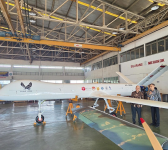
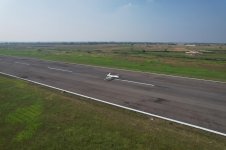
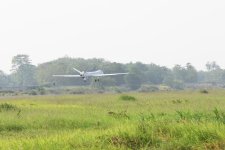
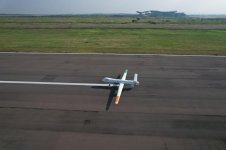
Indonesian Aerospace Elang Hitam (Black Eagle) MALE UCAV

Indonesia's Elang Hitam surveillance UAV makes maiden flight​


By Oishee Majumdar |
30 July 2025

1753892232060.jpeg
A screen-grab from a PTDI video showing the maiden flight of its Elang Hitam UAV at West Java International Airport (BIJB) in Majalengka on 28 July. (PTDI)


Indonesian state-owned aerospace company PT Dirgantara Indonesia (PTDI) announced on 29 July that its Elang Hitam (Black Eagle) unmanned aerial vehicle (UAV) has made its maiden flight.

PTDI said the Elang Hitam medium-altitude long-endurance (MALE) UAV was tested at West Java International Airport (BIJB) in Majalengka on 28 July.

Elang Hitam is designed to conduct intelligence, surveillance, and reconnaissance (ISR) operations. It features an open and modular architecture to enable further developments based on mission requirements. Elang Hitam can currently fly for up to 24 hours at altitudes of up to 20,000 ft, PTDI added.

This UAV has been developed by a PTDI-led consortium that includes Indonesia's Agency for the Assessment and Application of Technology (BPPT), National Institute of Aeronautics and Space (LAPAN), and Bandung Institute of Technology. The development was supported by the Ministry of Defense (MoD) and the Indonesian Air Force, PTDI added.

“The flight test serves as a proof of concept for mastering key technologies [incorporated in Elang Hitam], which include the system configuration design, automatic flight control system, and long-range communication system. This proof of concept serves as a basic reference for further development of MALE UAVs in line with national requirements,” Moh Arif Faisal, director of Commerce, Technology, and Development at PTDI, said.

During the test, a PTDI-owned Kodiak aircraft acted as the chase aircraft for Elang Hitam to monitor its performance and ensure flight safety, PTDI said. The tests will continue until the UAV obtains “official certification from the relevant authorities”, PTDI added.


Elang Hitam is designed to conduct intelligence, surveillance, and reconnaissance (ISR) operations. It features an open and modular architecture to enable further developments based on mission requirements. Elang Hitam can currently fly for up to 24 hours at altitudes of up to 20,000 ft, PTDI added.

The tests will continue until the UAV obtains “official certification from the relevant authorities”, PTDI added.


Open and Modular architecture ? More likely learning from KF21/IFX program.


Indonesian Aerospace conducts maiden flight of indigenous Black Eagle MALE UAV despite no firm orders​


By Greg Waldron
31 July 2025


Indigenous 1t surveillance platform completes first sortie as manufacturer begins certification campaign, with government orders contingent on regulatory approval.

Indonesian Aerospace has conducted a maiden sortie with its Black Eagle unmanned air vehicle (UAV), although a firm order for the type has yet to emerge.

The first flight of the indigenously developed medium-altitude, long-endurance (MALE) UAV took place on 28 July, according to Indonesian Aerospace, also known as PTDI.

1754279454903.jpeg
Source: Indonesian Aerospace

The sprawling archepelago of Indonesia presents significant surveillance challenges

The work marks the first of a series of tests that will continue until the Black Eagle attains “full certification” from Indonesia’s aviation authorities. The company indicates that certification is a prerequisite for any government orders.


“The test flight serves as a proof of concept for mastering key MALE UAV technologies, including system configuration design, autonomous flight control, and long-range communication systems,” says company technology chief Mohammed Faisal.

“It lays a critical foundation for future developments aligned with national defence priorities. We extend our appreciation to all team members for their precision and dedication throughout the project.”


The flight was conducted from Bandung’s Kertajati airport. Indonesian Aerospace did not provide details of the length of the flight.


Black Eagle – ‘Elang Hitam’ in Bahasa Indonesia – was originally rolled out in December 2019, but the programme was suspended in 2022. Applications envisaged at the roll-out included strike, as well as intelligence, surveillance and reconnaissance (ISR). It was developed in conjunction with the country’s National Research and Innovation Agency.

1754279533929.jpeg
Source: Indonesian Aerospace

The Black Eagle has yet to secure customers


Indonesian Aerospace makes no mention of a weapons capability in relation to the test campaign but instead focuses on the type’s ISR potential.

According to the company, the 1t Black Eagle will have endurance of 24h and an operational altitude of up to 20,000ft. Military uses include maritime patrol, disaster response, and border monitoring. The aircraft will also have civilian applications.


“This is more than just a flight test – it is a declaration of Indonesia’s readiness to stand on equal footing with global defence innovators,” adds Faisal.


“Black Eagle is a strategic foundation for building a self-reliant and competitive national UAV ecosystem.”


A Historic Maiden Flight for the Elang Hitam UAV –


Written by Indonesian engineer who involve in the program


On Monday, July 28, the MALE (Medium Altitude Long Endurance) UAV Elang Hitam successfully completed its maiden flight at Kertajati Airport, taking off with a weight of over one ton. This UAV is equipped with a fly-by-wire flight control system operated remotely, supported by a mission system at the Ground Control Station (GCS). Ensuring the performance and reliability of the flight control system—especially its control laws—is crucial to guarantee flight safety and satisfactory handling quality.


While working on my Master’s thesis in Aerospace Engineering at ITB, I was also entrusted with this project, serving as Flight Control Law Engineer and Project Leader of Flight Physics from October 2024 until the end of June 2025. In this role, I led the team in designing and tuning control law gains, configuring the structural coupling filter, setting envelope protection parameters, and evaluating overall control law performance.


These efforts included flight quality evaluations for this augmented aircraft, handling quality assessments with test pilots, gain robustness (sensitivity) analysis, as well as mode and failure effect evaluations.


The control law evaluations were carried out extensively through software-in-the-loop, hardware-in-the-loop, and ground testing environments—not only for fully autonomous modes, but also as a complete validation framework for the entire flight control system. These activities were also vital for fulfilling the requirements of the Indonesian Military Airworthiness Authorities (IMAA), and we prepared three key documents detailing the requirements, procedures, and autopilot test results to support the flight permit.


To my knowledge, this may be PTDI’s first project to conduct a comprehensive analysis of inner-loop, outer-loop, and envelope protection control laws by PTDI engineers.


I am deeply grateful to Allah for the success of this maiden flight. My sincere thanks go to everyone involved in this achievement—from the early stages of development to this historic milestone—whose dedication and hard work are far too many to mention one by one.


This milestone marks a historic step toward Indonesia’s independence in developing large-scale UAVs—and also a meaningful closing chapter to my eight-year journey with PTDI. I truly hope that my contributions can be further developed and continued for the future of PTDI and Indonesia’s aerospace innovation.
 
Yudi Supriono post (Indonesian journalist and writer specializing in aerospace and avionics)


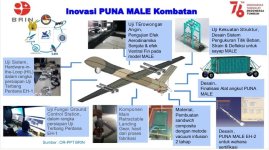
An Old Diagram, But Still Interesting to Discuss — At Least Three Points:

1755147536109.jpeg


— Landing Gear

The prototype of the MALE UAV Elang Hitam EH-1B still uses a fixed landing gear. In the future, for the Elang Hitam Block D (phase 3) and Block C (phase 4), it will use retractable landing gear.


There are two types of landing gear: Nose Landing Gear (NLG) and Main Landing Gear (MLG). In the PPT photo is the result of MLG fabrication.


— Composite
The composite manufacturing of the Elang Hitam still relies on the old autoclave at PTDI. In the future, there is a possibility that composite production will use the autoclave in the KFX hangar.


— EH-2 Design
The design process for the EH-2 has apparently been ongoing for quite some time. It’s been heard that a few months ago, the budget for this second prototype was in the process of being proposed.
 
1. The development of retractable landing gear for the Black Eagle male UCAV has been ongoing since 2021.

2. Drop test has been conducted on a full-scale prototype

3. Retractable Landing gear will be used for second prototype/ EH2


1755275624289.jpeg
1755275639436.jpeg
 
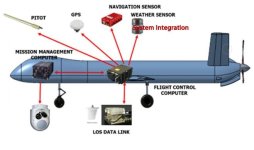
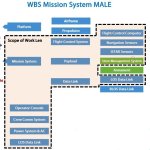
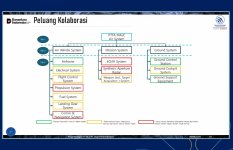
PT LEN Industry which is part of the MALE Elang Hitam Consortium. Responsible on mission system hardware.

1755440207137.jpeg
1755440701634.jpeg
1755440718358.jpeg
1755440738277.jpeg
 
1. The development of retractable landing gear for the Black Eagle male UCAV has been ongoing since 2021.

2. Drop test has been conducted on a full-scale prototype

3. Retractable Landing gear will be used for second prototype/ EH2


View attachment 141139
View attachment 141140

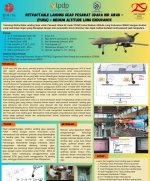
Drop testing Landing gear facility in Indonesia

Aerospace testing facility usually is in BRIN (Gov Research Agency) facility

1755754703920.jpeg
 
The lab is likely in here

 
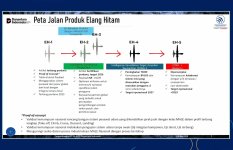
Latest Roadmap

EH-5 = UCAV capability

1755764193999.jpeg
1755764231516.jpeg
 
Kemenko Polkam Visits PT Dirgantara Indonesia, Reviews Progress on MALE Drone and National Missile Development

Jumat, 7 November 2025 | 18:35 WIB


1762605096013.webp


The Coordinating Ministry for Political, Legal, and Security Affairs (Kemenko Polkam), through the Deputy for Coordination of State Defense and National Unity, conducted a working visit to PT Dirgantara Indonesia (PT DI) in Bandung, West Java, on Thursday (6/11).

The visit was led by Brigadier General (Mar) Kresno Pratowo, Assistant Deputy for Coordination of Defense Strength, Capability, and Cooperation.


The delegation’s primary objective was to review strategic developments in Indonesia’s defense industry, in line with the 2025–2029 National Medium-Term Development Plan (RPJMN). The agenda focuses on strengthening national defense capabilities and accelerating self-reliance in defense technology.


“We want to ensure that the progress of the national defense industry remains aligned with government priorities, especially in strengthening Indonesia’s self-sufficiency in defense,”
said Brig. Gen. Kresno in an official statement.

During the visit, PT DI executives presented the company’s four core operational pillars:


  1. Aircraft Design and Production
  2. Aerostructure Manufacturing
  3. Aircraft and Engine Maintenance Services
  4. Engineering and Weapon System Development

These pillars support PT DI’s role in both production and advanced defense technology development.

1762700813914.webp


PT DI also outlined several key ongoing programs, including:


  • Production of the CN235-220, NC212i, and N219 aircraft currently used by the Indonesian Air Force.
  • Development of the N219 Amphibious variant.
  • Ongoing work on a Medium Altitude Long Endurance (MALE) unmanned combat aerial vehicle (UCAV).
  • Participation in the national missile development program.

The company emphasized its continued effort to increase local content utilization (TKDN) and advance technology readiness and manufacturing readiness levels to ensure full production capability and competitiveness in the global market.


Elang Hitam Drone Targets Certification in 2027, Proposed as National Strategic Project​


RNS
September 20, 2026

1789906642210.png

AIRSPACE REVIEW
– After a long period out of the spotlight, Elang Hitam, envisioned as Indonesia’s first domestically developed Medium-Altitude Long-Endurance (MALE) drone, was showcased by PT Dirgantara Indonesia (PTDI) at the TNI Fair around the National Monument (Monas) in Jakarta on September 19–20, 2026.

The drone was displayed in the outdoor exhibition area at the Indonesian Ministry of Defense booth, which featured several domestic defense companies. The aircraft appeared smaller than its actual size because the unit on display was a 1:2-scale mock-up.

PTDI Vice President of Business Development & Marketing Heber M.F. Panjaitan said the Elang Hitam MALE drone has been proposed for inclusion as a National Strategic Project and is currently pursuing certification from the Ministry of Defense, targeted for 2027.

“The Elang Hitam MALE drone has just been proposed for inclusion as a National Strategic Project. We conducted its maiden flight in August 2025 at Kertajati Airport in Majalengka, but it has not yet received certification from the Ministry of Defense. The target is to obtain it by next year,” Heber told Airspace Review at the exhibition.

Heber added that the development of Elang Hitam has faced several challenges, particularly related to funding. So far, PTDI has financed the drone’s development and maintenance using its own funds.

“Development is continuing, but we cannot move at full speed. We have also submitted a proposal to Danantara for additional investment to support its development,” Heber said.

Targeting Operational Deployment in 2028​

Regarding the target for the drone to become operational in 2028, in line with the Ministry of Defense’s strategic plan, PTDI is optimistic that it can complete the certification process for the MALE drone.

However, PTDI acknowledged that it needs to build additional prototypes for flight testing and other trials in accordance with the aircraft’s design, which will require additional funding.

PTDI has so far built two Elang Hitam units. The first was a mock-up unveiled during the drone’s initial rollout in 2019, while the second was the prototype used for its maiden flight in 2025.

“To this day, we continue to maintain the flight-test prototype, including its engine, flight-control system, ground-control station, and onboard systems,” Heber explained.

Regarding reports that development of Elang Hitam had been redirected toward the civilian market, Heber said this was not entirely accurate.

He emphasized that the Elang Hitam MALE drone being developed by PTDI is designed to meet military requirements.

Development for civilian applications, meanwhile, represents an additional market opportunity that could be pursued through cooperation with organizations such as the Ministry of Forestry or other government agencies.

“Civilian requirements represent an opportunity within the existing MALE market. The program has not been shifted from military to civilian applications,” Heber emphasized.

Elang Hitam Drone: Technical Specifications and Capabilities​

Elang Hitam is a MALE-class Unmanned Aerial Vehicle (UAV) developed by PTDI together with a national consortium to strengthen Indonesia’s technological self-reliance in the defense sector.

Designed specifically to conduct Intelligence, Surveillance, Target Acquisition, and Reconnaissance (ISTAR) missions and capable of being equipped with weapons, the drone is intended to play a strategic role in monitoring border areas and Indonesia’s outermost regions, as well as securing maritime routes against infiltration and other illegal activities.

In terms of its design and dimensions, Elang Hitam is relatively large for a surveillance and combat UAV.

The aircraft measures 8.73 meters long and 3.27 meters high, with a 16-meter wingspan and a wing area of 12.8 square meters.

With a maximum gross take-off and landing weight of 1,300 kg, the drone can carry up to 420 liters of fuel and a payload of up to 300 kg, allowing it to accommodate various radar sensors and weapon systems.

Elang Hitam’s range and flight efficiency are also designed to support long-endurance operations.

The drone can remain airborne for just under 30 hours and has a Line-of-Sight (LOS) operational radius of up to 250 km.

Elang Hitam is designed to operate at cruising altitudes of 3,000–5,000 meters, with a maximum ceiling of 7,200 meters.

In terms of speed, the drone has a cruising speed range of 50–180 km/h and can reach a maximum cruising speed of 235 km/h.

For runway operations, Elang Hitam requires less than 1,000 meters for take-off and landing at maximum weight under sea-level conditions.

The combination of these capabilities positions Elang Hitam as a symbol of Indonesia’s technological progress and as an aerial surveillance platform designed to help safeguard the country’s territorial sovereignty.

(RNS)
 

Users who are viewing this thread

Pakistan Defence Latest

Back
Top