
Indos
INT'L MOD

- Thread starter
- #31
INKA Sends Eight KRL Cars to Madiun for Final Testing
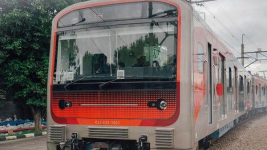
PT Industri Kereta Api (Persero), or PT INKA, has officially sent eight iE305/CLI226 electric multiple unit (KRL) cars from its Banyuwangi factory to Madiun for final testing, while seven trainsets already in operation undergo maintenance.
INKA said through its official Instagram account, @pt_inka, that the KRL cars were being transported from its Banyuwangi production facility to INKA Madiun to undergo final testing.
The testing is intended to ensure that every aspect of the rolling stock meets quality and reliability standards as well as certification requirements before the trains are declared fit for operation.
“The journey of the eight iE305/CLI226 KRL cars forming the ninth trainset, manufactured by PT INKA Banyuwangi, has officially begun,” the company said in a post quoted on Tuesday (September 15, 2026).
According to the post, the trains departed from Bulusan Pier in Banyuwangi for Tanjung Perak Port in Surabaya.
The eight cars were transported aboard LCT vessels, with each vessel carrying four cars. After arriving in Surabaya, the eight cars will be carefully unloaded onto the tracks at Kalimas Station and then hauled together by rail to PT INKA’s facility in Madiun.
“The testing process is extensive. This KRL has undergone a comprehensive series of tests as part of our commitment to product safety and reliability,” INKA said.
The train is part of an order for 16 new trainsets, comprising a total of 192 cars, placed with INKA by PT Kereta Api Indonesia (Persero), or KAI. The procurement contract is valued at Rp3.85 trillion (approximately US$217 million) and is financed through a state capital injection (PMN) provided to KAI.
At least four stages of testing must be completed before the KRL can enter daily passenger service.
The first is structural testing, which assesses the strength of the train’s frame. The testing involves the National Research and Innovation Agency (BRIN), the Directorate General of Railways (DJKA), and the customer.
During this process, the train structure is evaluated for its ability to withstand static and operational loads without excessive deformation or structural damage. Structural testing is therefore an important step in ensuring the safety, reliability, and durability of the train throughout its operational life.
The second stage is static functional testing, which evaluates the KRL while it is stationary. This involves comprehensive inspections of structural strength, dimensional conformity, and the operation of mechanical, electrical, and safety systems.
Static testing is a crucial preliminary stage for identifying potential defects or non-conformities at an early stage, ensuring the train’s readiness, reliability, and safety before proceeding to dynamic testing and operations.
Functions and components tested include lighting, air conditioning, horns, doors, interior noise levels, dimensions, train weighing, and loading-gauge clearance tests, the latter ensuring that the rolling stock’s dimensions comply with clearance limits established by the Directorate General of Railways.
The tests are conducted together with the DJKA and the customer.
The third stage is dynamic functional testing on railway tracks to assess the KRL’s performance parameters and evaluate its reliability under actual operating conditions.
The testing assesses the train’s response to acceleration, braking, speed, and stability, while ensuring that systems including propulsion, braking, suspension, and control operate properly as an integrated system.
Parameters tested include acceleration, deceleration, stop-and-go performance on gradients, load testing simulating a fully occupied train (crush load), and door-opening and closing simulations.
The fourth and final stage is the endurance test, during which the train is operated under conditions resembling normal service for 2,000 km, or 4,000 km for the first production unit.
If any functional failure is detected during endurance testing, the test must be restarted from zero kilometers.


