Indonesian Democracy and Islamic Ethics

Status
Not open for further replies.

Veteran Indonesian journalist Fikri Jufri dies at age 88​


To view this content we will need your consent to set third party cookies.
For more detailed information, see our cookies page.

Fikri Jufri Biography, he is Arab Indonesian


JAKARTA: Fikri Jufri (pic), one of Indonesia’s most celebrated journalists, died in Jakarta on Thursday (March 6) at the age of 88.

Fikri's family said in a statement that he died at around 9am. He was laid to rest at the city’s Karet Bivak public cemetery on the same day.


He is survived by his three children.

Fikri died on the same day that Tempo, which he had helped found in 1971, celebrated its 54th anniversary.


Former Tempo chief editor Wahyu Muryadi said that when he was a cub reporter in 1989, Fikri was his editor on Tempo’s business and economics desk.

“I knew and learned so much from him since 1989 when I was posted in Jakarta,” he told The Jakarta Post on Thursday.

“He had a very broad network among top diplomats and politicians. He contributed a lot to our desk during the days. He was also a very cheerful but well-informed editor. We used to call him om [uncle] FJ,” said Wahyu.


“With his networking and lobbying skills, I think he was one of the best journalists at the time.”

Wahyu said senior journalist Goenawan Mohamad, a friend and coworker of Fikri’s, had informed him of Fikri’s passing.

Fikri and Goenawan established Tempo magazine in 1971 with fellow journalists Harjoko Trisnadi and Lukman Setiawan, among others. Fikri was the recipient of Stanford University’s John S. Knight Journalism Fellowship in 1973.

Ten years later, he worked with Goenawan once again, as well as other journalists and businessmen, to establish The Jakarta Post.

His 2017 autobiography Saya Al Jufri bukan Al Capone (I’m Al Jufri not Al Capone) offers a glimpse into his journalistic and photojournalistic career, during which he covered countries including Cambodia, Germany and South Korea.

In 2018, the Press Council gave Fikri a lifetime achievement award for his contributions to journalism and press freedom in the country.

Prominent Indonesians paid their respects at Fikri’s residence in Lebak Bulus, South Jakarta, including former Jakarta governor Anies Baswedan, former education minister Nadiem Makarim and political expert Effendi Gazali.

Effendi said Fikri had always maintained his idealism, even in the face of Suharto’s authoritarian regime.

“His idealism can be seen through his writing,” Effendi said, as quoted by kompas.id.

Journalists, politicians, scholars and civil organisations sent condolences on social media, including the Alliance of Independent Journalists (AJI) and the Jakarta-based Centre for Strategic and International (CSIS).

Fikri was one of 56 journalists who signed a declaration in August 1994 that marked the establishment of the AJI to protest the closure of three media outlets during the New Order regime.

Fikri was also a member of the CSIS’ board of trustees. - The Jakarta Post/ANN


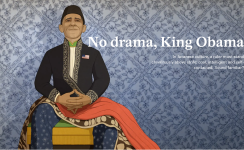
Obama is America’s first Javanese president.​


In Javanese culture, a ruler must stand chivalrously above strife: cool, intelligent and self-contained. Sound familiar?
1741409931617.png


Edward L Fox is a writer and associate lecturer in creative writing at the Open University. His latest book is River Spirits: An Amazonian Fantasy (2012).
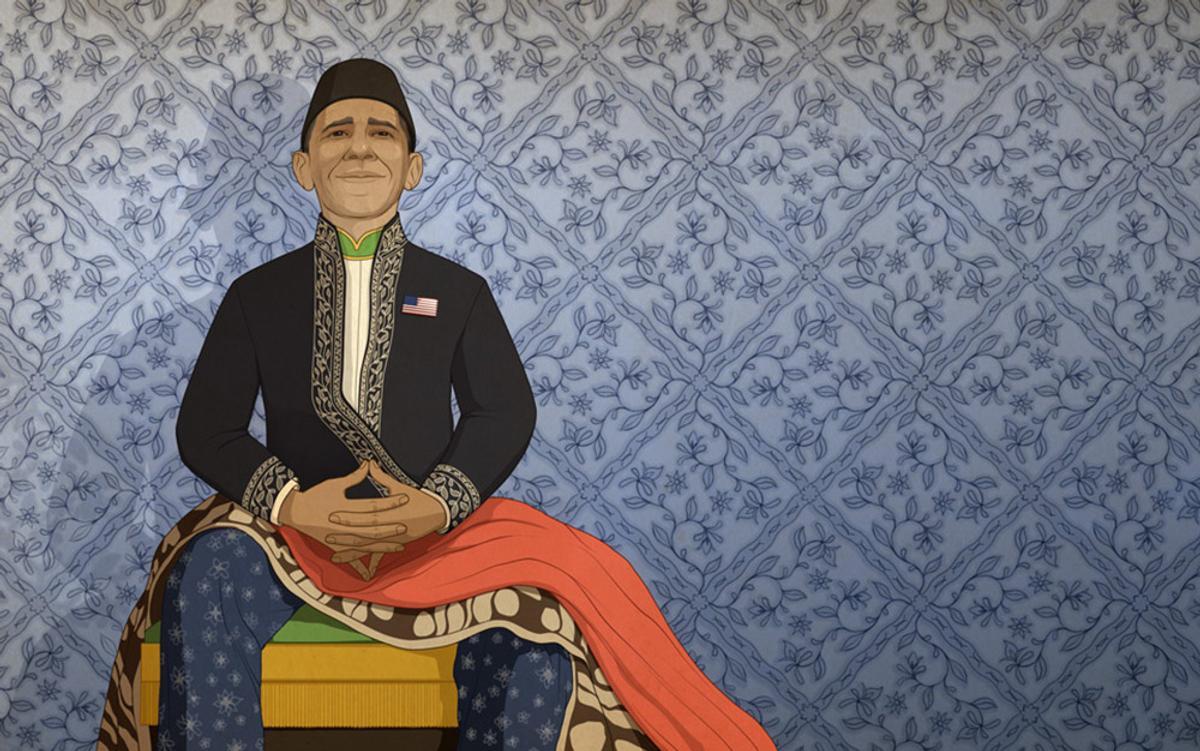
Like a lot of people in the autumn of 2012, I watched the TV debates between Barack Obama and Mitt Romney. It was the last big performance in that interminable presidential election campaign in the United States. Every now and then, as Obama did verbal battle with his adversary, I noticed something I didn’t expect to see. It was a gesture he made with his hand: for emphasis, he would point at Romney with his thumb.

I wasn’t the only one to have seen this. In a short piece on the BBC website, a reporter wrote
Featured in the three presidential debates were Romney, Obama, and Obama’s thumb. At the debates, the president frequently jabbed his hand, with his thumb resting atop a loosely curled fist, to emphasise a point. The gesture — which might appear unnatural in normal communication — was probably coached into Obama to make him appear more forceful … And pointing the index finger is simply seen as rude and too aggressive.

But I’d seen this gesture before, and Obama hadn’t learnt it from a debating coach. Whether consciously or not, he was revealing his boyhood in the Indonesian island of Java, where it is considered impolite to point with your index finger. Seeing Obama point with his thumb in the debates confirmed something I had suspected for some time. Whatever else he might be, Obama is America’s first Javanese president.

Some time ago, I devoted a significant period of time and study to the traditions of Javanese kingship. I was writing a book called Obscure Kingdoms (1993) about traditions of kingship in non-Western societies, and I spent a period of time in Indonesia. One of the book’s chapters was about kingship in Java and, in the course of my research, I had become well-acquainted with a certain Javanese mannerism. I was struck to see that mannerism once again, uncannily echoed by Obama during the televised US presidential debates.

Unlike most political analysts, I see the imprint of Java in Obama far more than the imprint of Hawaii (where he was born and later went to high school); more than the imprint of Chicago (where he began his political career), and certainly more than Kenya (a highly popular notion that is particularly far-fetched). Indeed, it was in Java that Obama spent his childhood, had his primary education, and where his mother made her career. It was the country where his stepfather and his half-sister were born, and which he visited several times in his early adulthood. Obama still speaks some Indonesian.

Considerable time and energy has been spent speculating and theorising about Obama’s Kenyan background. There is a ridiculous book called The Roots of Obama’s Rage (2011) by Dinesh D’Souza. It’s a piece of popular controversialism which suggests that the key to understanding Obama — as a man and as a president — lies in his Kenyan background. Obama’s father, whom he barely knew, was a government economist in the early days of Kenyan independence. D’Souza argues that Obama inherited his father’s Kenyan anti-colonial mindset, and that this is what motivates Obama politically and informs how he sees the world.

Traditionally, the Javanese ruler triumphs over his adversary without even appearing to exert himself

Naturally, the idea caught on in the loony blogosphere, and as a result there are now millions of people in America who hold the view that Obama’s political approach is somehow ‘Kenyan’, and that by the end of Obama’s term of office the US will be governed according to a pernicious form of Kenyan socialism. Absurd, certainly, but then again there are also Americans who believe in black helicopters and alien abduction.

It’s true that Obama has written comparatively little about his time in Java in either of his books. His first autobiographical book, Dreams from My Father (1995), is principally about his search for Barack Obama Snr’s Kenyan roots. In fact, he only went to Kenya to research this book. The search for his African roots was important to him in his journey of self-discovery and self-invention, a process that was completed in his adoption of African-American cultural and social identity, and his choice of the black neighbourhoods of Chicago as the place where he began his political career. Part of the process of forging his own identity and his own path in life involved distinguishing himself from the world view of his mother, Ann Dunham, which was based on her international development work in Java. Most telling of all perhaps, when it comes to Obama’s own downplaying of his time in Java, was a comment in his second book, The Audacity of Hope (2006), in which he wrote: ‘Most Americans can’t locate Indonesia on a map.’

To view this content we will need your consent to set third party cookies.
For more detailed information, see our cookies page.

Obama speech in University of Indonesia, Greater Jakarta

While Dreams from My Father was about the father who returned to Kenya when Barack was a baby, undoubtedly the strongest influence on Obama throughout his childhood was his mother. A truly extraordinary person, Dunham was an anthropologist who devoted her life to the study of small-scale industry in rural Java, while also working as a development economist and raising two children. When Barack was six, he and his mother moved from Hawaii, where he was born, to Jakarta, the Indonesian capital, where he spent the formative years of his childhood. It was in Java where Obama learnt and adopted the cool, calm, unflappable personal and presidential style that has earned him the nickname ‘No Drama Obama’. It’s a genuinely Javan ideal.

Anyone who has visited the island of Java will know what great value the Javanese people place on maintaining a serene demeanour, harmonious social relations, and not appearing visibly angry. Acutely aware of local norms of behaviour, Dunham made a point of ensuring that her son adopted Javanese manners. In his memoir, Obama recalls how his mother ‘always encouraged my rapid acculturation in Indonesia. It made me relatively self-sufficient, undemanding on a tight budget, and extremely well-mannered when compared with other American children. She taught me to disdain the blend of ignorance and arrogance that too often characterised Americans abroad.’

But this formative period entailed more than a process of pragmatic acculturation. In Janny Scott’s biography of Obama’s mother, A Singular Woman, one of her interviewees maintains: ‘This is where Barack learnt to be cool … if you get mad and react, you lose. If you learn to laugh and take it without any reaction, you win.’ What the young Barack had to take was being taunted by Indonesian children — his classmates and the children he played with in his Jakarta neighbourhood — for his dark skin colour. At first he was often thought of as an Indonesian from one of the outer (racially Melanesian) islands of the Indonesian archipelago. Yet of this period in Jakarta, Obama’s biographer David Maraniss wrote that the young Barack ‘had become so fluent in the manners and language of his new home that his friends mistook him for one of them’.

The Javanese have a word for this kind of bearing. They call it halus. The nearest literal equivalent in English might be ‘chivalrous’, which means not just finely mannered, but implies a complete code of noble behaviour and conduct. The American anthropologist Clifford Geertz, who wrote some of the most important studies of Javanese culture in English, defined halus in The Religion of Java (1976) as:
Formality of bearing, restraint of expression, and bodily self-discipline … spontaneity or naturalness of gesture or speech is fitting only for those ‘not yet Javanese’ — ie, the mad, the simple-minded, and children.

Even now, four decades after leaving Java, Obama exemplifies halus behaviour par excellence.

Halus is also the key characteristic of Javanese kingship, a tradition still followed by rulers of the modern state of Indonesia. During my period of study in Indonesia, I discovered that halus is the fundamental outward sign or proof of a ruler’s legitimacy. The tradition is described in ancient Javanese literature and in studies by modern anthropologists. The spirit of the halus ruler must burn with a constant flame, that is without (any outward) turbulence. In his classic essay, ‘The Idea of Power in Javanese Culture’ (1990), the Indonesian scholar Benedict Anderson describes the ruler’s halus as:
The quality of not being disturbed, spotted, uneven, or discoloured. Smoothness of spirit means self-control, smoothness of appearance means beauty and elegance, smoothness of behaviour means politeness and sensitivity. Conversely, the antithetical quality of being kasar means lack of control, irregularity, imbalance, disharmony, ugliness, coarseness, and impurity.

One can see the clear distinction between Obama’s ostensibly aloof style of political negotiation in contrast to the aggressive, backslapping, physically overbearing political style of a president such as Lyndon Johnson.

Traditionally, the Javanese ruler triumphs over his adversary without even appearing to exert himself. His adversary must have been defeated already, as a consequence of the ruler’s total command over natural and human forces. This is a common theme in traditional Javanese drama, where the halus hero effortlessly triumphs over hiskasar (literally, unrefined or uncivilised)enemy. ‘In the traditional battle scenes,’ Anderson notes:
The contrast between the two becomes strikingly apparent in the slow, smooth, impassive and elegant movements of thesatria [hero], who scarcely stirs from his place, and the acrobatic leaps, somersaults, shrieks, taunts, lunges, and rapid sallies of his demonic opponent. The clash is especially well-symbolised at the moment when the satria [hero] stands perfectly still, eyes downcast, apparently defenceless, while his demonic adversary repeatedly strikes at him with dagger, club, or sword — but to no avail. The concentrated power of thesatria [hero] makes him invulnerable.
Even to seem to exert himself is vulgar, yet he wins. This style of confrontation echoes that first famous live TV debate in the election of 2012 between Obama and Romney, in which Obama seemed passive, with eyes downcast, apparently defenceless (some alleged ‘broken’) in the face of his enemy, only to triumph in later debates and in the election itself.

Like a Javanese king, Obama has never taken on a political fight that he has not, arguably, already won

But such a disposition is not just external posturing. Halus in a Javanese ruler is the outward sign of a visible inner harmony which gathers and concentrates power in him personally. In the West, we might call this charisma. Crucially, in the Javanese idea of kingship, the ruler does not conquer opposing political forces, but absorbs them all under himself. In the words of Anderson again, the Javanese ruler has ‘the ability to contain opposites and to absorb his adversaries’. The goal is a unity of power that spreads throughout the kingdom. To allow a multiplicity of contending forces in the kingdom is a sign of weakness. Power is achieved through spiritual discipline — yoga-like and ascetic practices. The ruler seeks nothing for himself; if he acquires wealth, it is a by-product of power. To actively seek wealth is a spiritual weakness, as is selfishness or any other personal motive other than the good of the kingdom.

That’s the theory, though highly simplified. The modern Republic of Indonesia is in many ways the direct successor and continuation of the ancient Javanese kingdom. Java remains the political centre of an empire of islands. The first president of Indonesia, Sukarno, was inaugurated in 1945 in Yogyakarta, the Javanese city that remains the capital of the Javanese kingdom, in the very spot in the royal palace where the Sultans of Yogyakarta were crowned. Yogyakarta was briefly the capital of the Republic of Indonesia, and the Sultan of Yogyakarta was its second vice president. Sukarno began his term as president with a policy that combined communism, Islam and nationalism, a weird combination in Western terms, but one that makes sense in Javanese terms: in claiming ownership of these political forces, Sukarno was seeking to subjugate them and harmonise them under his own kinglike authority.

I can’t help but feel the parallels with Obama are striking. He dismayed many liberals in the first term of his presidency, by persisting in a political approach that sought to absorb the Republican Party — his political opponents — into his policy-making, just as Sukarno sought, at first, to absorb all political forces in Indonesia, and as the Javanese king absorbed all natural and human forces. Four years later, of course, with political dramas such as the fiscal cliff behind him, one can see an Obama that has adjusted to American political conditions; he is now playing American, not Javanese politics. But then again, like a Javanese king, Obama has never taken on a political fight that he has not, arguably, already won.

There is, however, another reason why I persist in looking at Obama in the context of traditional Javanese kingship. After Barack left Indonesia to attend high school in Hawaii, his mother Ann Dunham moved from Jakarta to the very cradle of Javanese civilisation, the compound of the palace (Kraton) of the Sultan of Yogyakarta, in central Java. The Kraton is the past and present home of Javanese kings; in recognition of the role of Sultan Hamengkubuwono VIII in the struggle for independence from Dutch colonial rule, the area around Yogyakarta was given special political status inside Indonesia, and the sultans retain political status within the Indonesian republic. Not only does the sultanate of Yogyakarta represent the theoretical and cultural model of government and political power in the modern state of Indonesia, the Kraton is the home of traditional Javanese culture. The Kraton’s walled compound — essentially, a densely populated urban village — is traditionally the residence of members of the royal family and of palace servants and officials. Foreigners are forbidden from living here, but Dunham secured the unusual privilege of being allowed to live there because her mother-in-law, Eyang Putri, the mother of her second husband, Lolo Soetoro, was believed to be a distant relative of the royal family and lived in the compound. Although the old lady was in very good health, Obama’s mother was allowed to move into her house in the palace compound for the nominal purpose of looking after her.

Let your opponent yell and scream, and listen politely

Now it might or might not be true that Dunham’s mother-in-law — Obama’s step-grandmother — was a blood relative of the Sultan. Maraniss, Obama’s biographer, found no evidence either way. But Obama’s stepfather believed it, as did Obama’s mother, and so did their daughter, Obama’s half-sister Maya Soetoro-Ng. This belief or family myth is by itself significant. It places the family firmly within the system of Javanese kingship. Growing up, in Java or back in Hawaii, Obama would have known about this connection and its meaning.

After leaving Java for his education, Obama visited his mother regularly over the years. The palace compound (bekel, in Javanese) is a beautiful place. While I was researching my book on non-Western traditions of kingship, I would walk around it in the evenings, glimpsing the interiors of the houses, with their green and pink glowing aquariums, and blue and grey glowing televisions. Stars could be seen through the palm-tree branches, the air was filled with birdsong. I looked back at my own book and found the following reflection of the place: ‘Tourists are forbidden from staying here, but a few academic researchers had managed it, and I envied them.’ I didn’t know then about Dunham.

As Obama entered adulthood, he sought to create a new identity for himself that was based on an American and, within that, a black American identity. He distanced himself from what he saw as his mother’s ‘internationalist idealism’. But the influence of Javanese ways remained, unconsciously perhaps, a crucial part of him. When he was a community organiser in Chicago, working with black churches and local institutions, people noticed his unusual tendency to prefer harmony to confrontation, to bringing all forces together under his quiet leadership. Maraniss quotes an informant who was present at a meeting of church leaders when one of the leaders attacked Obama as a ‘do-gooding outsider’:

To Barack’s credit, he didn’t get up from the back of the room and come to defend himself. He left it there and let the guy say what he needed to say …. Barack absorbed it. But then, as soon as it was over, he waited until the guy left, and said, ‘Now, what just happened? Let’s make sure we understand what just went on so we can go from here.’ Civility, being respectful, was always very important to him.

He would use this same technique again and again in later political conflicts: let your opponent yell and scream, listen politely, and then, when your adversary has exhausted himself, somehow end up winning. Indeed, that is halus through and through.

*This article was amended on 7th February 2013. It should have stated that the Sultan of Yogyakarta was the second vice president, rather than the first.

4 February 2013


Read more essays on anthropology, cultures & languages and politics & government


Edward L Fox is a writer and associate lecturer in creative writing at the Open University. His latest book is River Spirits: An Amazonian Fantasy (2012).


Prabowo's Aide Dismisses Rumors of Sri Mulyani's Resignation​


Muhammad Farhan


March 14, 2025 | 11:47 am

1741951833841.webp
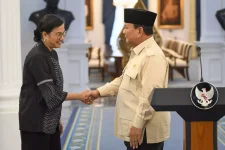
President Prabowo Subianto shakes hands with Finance Minister Sri Mulyani following a press conference on Eid bonuses at the presidential palace in Jakarta on March 11, 2025. (Antara Photo/Aditya Pradana Putra)


Jakarta. A close aide to President Prabowo Subianto has dismissed speculation about the possible resignation of Finance Minister Sri Mulyani Indrawati, saying on Friday that there is no indication of an impending cabinet reshuffle.


Sufmi Dasco Ahmad, Deputy Speaker of the House of Representatives, downplayed the swirling rumors and pointed to a recent meeting between Sri Mulyani and President Prabowo at a Ramadan fast-breaking dinner on Wednesday, where they reportedly engaged in friendly discussions about the country’s economic situation.


"I have checked with the government, and there is no immediate plan for a cabinet reshuffle," said Dasco, who also serves as an executive in Prabowo’s Great Indonesia Movement Party (Gerindra).


"From what I understand, they met for dinner and discussed economic matters. As you can see from media reports, their interaction was amicable," he added, calling speculation about Sri Mulyani’s resignation baseless.

Sri Mulyani was summoned to the State Palace on Wednesday evening, prompting journalists to question her about the circulating rumors. However, she left the palace without making any comments.


A recent survey by Indikator Politik Indonesia found that Sri Mulyani is perceived by the public as the best-performing minister in Prabowo's cabinet. She has held the finance ministerial post under three different presidents, earning a reputation as a key figure in Indonesia’s economic management.


Sri Mulyani first assumed the role of finance minister in 2005 during the administration of President Susilo Bambang Yudhoyono. Under her leadership, Indonesia saw significant improvements in fiscal management and economic resilience. However, she resigned in 2010 to take on the position of managing director at the World Bank, where she played a crucial role in global development policies.


In July 2016, she returned to the Indonesian government as finance minister under President Joko Widodo, maintaining her post throughout both of his terms. Her policies have been credited with steering Indonesia’s economy through turbulent times, including the COVID-19 pandemic, during which she implemented stimulus measures to stabilize the financial sector.


Known for her firm stance on economic reforms, Sri Mulyani has been a strong advocate for transparency in government spending, tax reforms, and prudent fiscal policies. Despite the ongoing rumors, her track record continues to position her as a key player in shaping Indonesia’s financial landscape.


Top journalists from mainstream media are called to discuss with President Prabowo. This is the second time Prabowo invited media leaders to discuss current issues with him. The discussions also touch matters like Trump recent tariff and the role of military in Indonesian democracy

This is in Prabowo private house and conducted in holidays, so he wants the meeting to be less formal and more casual

To view this content we will need your consent to set third party cookies.
For more detailed information, see our cookies page.


To view this content we will need your consent to set third party cookies.
For more detailed information, see our cookies page.


To view this content we will need your consent to set third party cookies.
For more detailed information, see our cookies page.
 
The Stakes for Indonesia’s Future


Indonesia’s new military law does not announce a return to authoritarian rule. It does not call for martial law, suspend civil liberties, or dissolve parliament. But it codifies a structural shift in how the state conceives of security and who it trusts to maintain it. This quiet legal reconfiguration may prove more consequential in the long run than any open crisis.


The deeper question now is whether Indonesia is drifting toward a model where the military views society itself as a threat. If so, the implications for democratic accountability, human rights, and regional stability will likely be far-reaching. Southeast Asia is already home to several hybrid regimes where militaries play central roles in governance – or rule outright, as in Myanmar. Indonesia, once seen as a democratic anchor in the region, must decide whether it still aspires to be different.


Upholding military professionalism means more than preventing coups. It requires protecting institutional boundaries, reaffirming civilian control, and ensuring the armed forces are trained, equipped, and focused on external defense. Despite its progress since 1998, Indonesia’s reform project remains unfinished – and this moment could well determine its future prospects.


IDN Times has posted recent interview between Prabowo Subianto and Uni Zulfiani Lubis, Chief Editor of IDN Times. One by one the interview with each chief editor will be released by each media invited by President.

It is free discussion as said by Uni Lubis, there is no screening of the questions where the discussions last for more than 3 hours.

Location : Prabowo private house in Bogor, Greater Jakarta.

To view this content we will need your consent to set third party cookies.
For more detailed information, see our cookies page.
 
CNN Indonesia has posted no cut version of the conversation between Indonesian President, Prabowo Subianto, and several big and influential media that are represented by their Chief Editors.


To view this content we will need your consent to set third party cookies.
For more detailed information, see our cookies page.
 

In defence of free speech​


Thursday, 01 May 2025

To view this content we will need your consent to set third party cookies.
For more detailed information, see our cookies page.

Indonesia Constitution Court during the decision on 2024 election dispute


The country’s Constitutional Court has approved in part a petition brought by an environment campaigner, opening the way for a legal change to bar the government or a company from filing defamation complaints in the event of criticism.

Human rights activists have said the Electronic Information and Transaction Law is a threat to freedom of speech and that the government has used it to criminalise its critics.


Environment activist Daniel Frits Maurits Tangkilisan had petitioned the Constitutional Court to revoke an article in the law regulating defamation.

The court did not revoke the article but banned a “government, company, institution or groups with specific identities” from filing defamation complaints against an individual, judge Arief Hidayat said.


He said defamation complaints could only be filed by the person who had been defamed and the court’s action aimed to ensure legal certainty and prevent “arbitrariness by the law enforcer”.

The President’s spokesperson, Prasetyo Hadi said the government respected and would follow the ruling if it affected policy.

He also reiterated the importance of “responsible freedom of speech” such as addressing critics based on data.

Any ruling by the Constitutional Court is effective immediately and legally binding.

Tangkilisan’s lawyer Todung Mulya Lubis praised the decision, saying even a good government needed critics.

Usman Hamid, executive director of Amnesty International in Indonesia, also said the ruling on Tuesday was positive.

“We can still put our hope to the court in preventing the setback of civil liberty in Indonesia,” he said.

Among the more prominent defamation cases in recent years, two rights activists were charged with defamation in 2023 after being accused of defaming a senior cabinet minister. They were later acquitted.

A singer and opposition figure Ahmad Dhani was sentenced to a year in prison in 2019 under the law after calling political rivals idiots in an online video. — Reuters


Indikator survey, lead by political researcher Professor Burhanudin Muhtadi so far is the most trusted political survey company in Indonesia. Not only in Indonesia, Burhanudin is also trusted internationally among foreign experts, media, and think tanks.​


--------------​


Indicator Survey: Public Trust Level to President 82.7%​

Yogi Ernes - detikNews​

Tuesday, May 27, 2025 15:11 WIB​

1748407666002.jpeg


Jakarta -

The Indonesian Political Indicators polls released the results of the survey related to the level of public trust in the performance of state institutions and the eradication of corruption. The TNI and the president became the institution that gained the highest public trust.

The survey was followed by 1,286 respondents with telephone interviews. The sample method uses double sampling by generating a margin of error of 2.8 percent and a 93 percent confidence level.

"So trust in the TNI and the President is still ranked highest. Those who trust the TNI are about 85 percent, while the trust to the President is 82 percent," said Executive Director of Indonesian Political Indicators, Burhanuddin Muhtadi, in a press conference broadcast virtually on Tuesday (5/27/2025).


Burhanuddin said the survey only recorded public perceptions of confidence in state institutions. The results of the survey do not reflect public satisfaction over the performance of the institution.


In the Indicator survey, the President gained public trust by 82.7 percent. That number is a combination of the category of trust and quite believe in the survey.

"This is public trust, not approvalapproval, meaning this is a trust for institutions, not the performance of people per person," Burhanuddin said.

"At this point, two institutions, namely the army and the presidency, it was the highest, while the third rank was the Supreme Prosecutor's Office in total there were 76 percent of citizens who believed in the Attorney General's Office," he said.

This Indonesian Political Indicator Survey also shows that the level of public confidence in political parties is at the very bottom. Public trust in political parties only ranges in 65.6 percent.

Here are the full results of the Indonesian Political Indicators survey on the Level of Public Trust in the Performance of State Institutions and Corruption Eradication:

TNI/Armed Force
Very Confident: 23.9%
Quite Believe: 61.8%

Not Believe: 11.2%
Not Believe It At All: 1%
TT/TJ: 3.8%

President
Very Believing: 17.3%
Quite Believe: 65.4%

Not Believe: 13.8%
Not Believe It At All: 1%
TT/TJ: 3.9%

The Attorney General's Office
Very Confident: 13.1%
Quite Trust: 62.9%

Not Believe: 14.3%
Not Believe It At All: 1.3%
TT/TJ: 8.4%

DPD/Senators
Very Believing: 8.0%
Quite Believe: 67.1%

Unbelieving: 15.0%
Not Believe It At All: 1.8%
TT/TJ: 8.0%

MPR/People Consultative Assembly
Very Believing: 9.0%
Quite Believe: 65.1%

Not believing:14,6%
Not Believe It At All: 2.0%
TT/TJ: 9.2%

MA/Supreme Court
Very Confident: 10.6%
Quite Believe: 63.1%

Unbelieving: 17.1%
Not Believe It At All: 4.3%
TT/TJ: 4.9%

Court
Very Confident: 12.1%
Quite Believe: 61.2%

Not Believe: 16.3%
Not Believe It At All: 2.0%
TT/TJ: 8.4%

KPK/Anti Corruption Body
Very Believing: 12.7%
Quite Believe: 59.9%

Disbelief: 20.0%
Not Believe It At All: 2.5%
TT/TJ: 5.0%

Polri/Police
Very Confident: 13.3%
Quite Believe: 58.9%

Not Believe: 19.7%
Not Believe Me In Total: 3.0%
TT/TJ: 5.1%

DPR/Parliament
Very Believing: 7.7%
Quite Believe: 63.3%

Unbelieving: 20.04%
Not Believe It At All: 3.35
TT/TJ: 5.2%

Political Parties
Very Believe: 7.4%
Quite Believe: 58.2%

Unbelieving: 22.5%
Not Believe It At All: 3.5%
TT/TJ: 8.4%

 
The survey is pretty extensive, I will post this one only while you can see whole survey in Indikator official twitter account

Six provinces in Java Island

Jakarta, Banten, West Java, Central Java, East Java, Jogjakarta

West Java = Jawa Barat/JABAR
Central Java = Jawa Tengah/Jateng
East Java = Jawa Timur/Jatim
Jogjakarta = Daerah Istimewa Yogjakarta/DIY


------------

SATISFACTION WITH THE GOVERNOR'S PERFORMANCE

Although varied, the majority of the public in the six provinces are quite or very satisfied with the performance of the Governors in their respective regions. The very satisfied group is very prominent in West Java.

To view this content we will need your consent to set third party cookies.
For more detailed information, see our cookies page.
 
Prabowo Holds Night Meeting After Inaugurating EV CATL Battery Factory in Karawang


Kompas.com - 30/06/2025, 13:31 WIB

1751424149039.jpeg
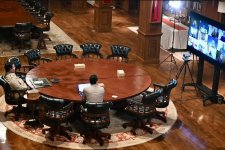
President of the Republic of Indonesia Prabowo Subianto held a limited meeting (ratas) virtually at his residence on Sunday (29/06/2025) night. Instagram @secretariat.kabinet)


JAKARTA, KOMPAS.com - President of the Republic of Indonesia Prabowo Subianto held a limited (ratas) meeting virtually at his residence on Sunday (29/06/2025) night.


Cabinet Secretary (Seskab) Teddy Indra Wijaya revealed that the meeting was held after the Head of State inaugurated the EV CATL battery plant in Karawang Regency.

"After a working visit in Karawang Regency, on Sunday night, June 29, 2025, President Prabowo Subianto held a limited meeting with a number of Red and White Cabinet Ministers conducted through video conferencing," Teddy said on Instagram account @secretariat.kabitet, Monday (30/06/2025).


Why is Prabowo Surprised There Is Tomy Winata in the Inauguration of the Electric Battery Industry?


Through the Instagram account, Teddy uploaded photos of Prabowo sitting listening to the television screens featuring other meeting participants.


Teddy revealed that in the meeting also the President Director of PT Dirgantara Indonesia Marsda TNI (Retired.) Gita Amperiawan and President Director of PT Pindad (Persero) Sigit P. Santosa.


"Ratas that started at 19:30 WIB and lasted for two hours," he said.


According to Teddy, the meeting discuss various things, including the strategic steps of the government in various fields.


"Discussing various developments and strategic steps of the government in various fields, ranging from agriculture, marine, higher education and science, investment, global conditions to shipping and aviation," he said.


Read also: Bahlil to Prabowo: Red Dates Are No Longer in Cabinet That Mr. Lead


Just before the meeting was limited, Prabowo previously inaugurated the laying of the first stone of the construction of an electric vehicle battery plant resulting in cooperation between Contemporary Amperex Technology Co. Limited (CATL) and Indonesia Battery Corporation (IBC) on Sunday (29/06/2025).

This inauguration was carried out in the Artha Industrial Hills Area, Karawang, West Java.


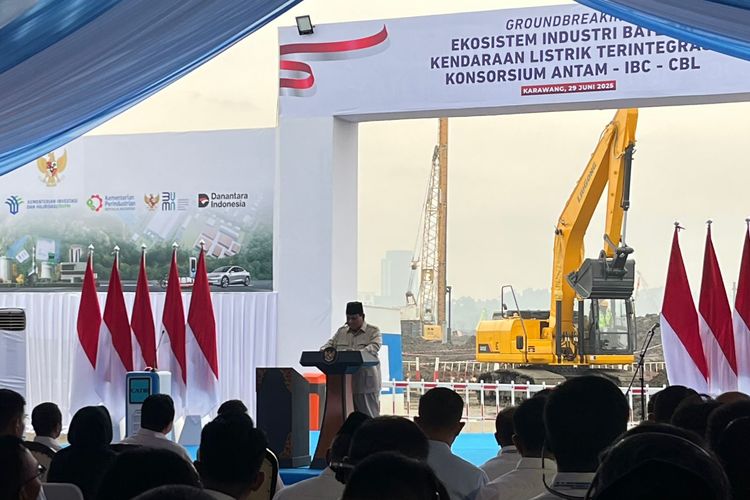
President Prabowo Subianto inaugurated the groundbreaking Ecosystem of Industrial Electric Battery Integrated Consortium of ANTAM-IBC-CBL in the Artha Industrial Hills (AIH) Area in Karawang Regency, West Java, Sunday (29/06/2025).

President Prabowo Subianto inaugurated the groundbreaking Industrial Ecosystem of the Integrated Electric Battery Consortium of ANTAM-IBC-CBL in the Artha Industrial Hills (AIH) Area in Karawang Regency, West Java, Sunday (29/06/2025). KOMPAS.com/ ELSA CATRIANA)


This national strategic project cost an investment of about 6 billion US dollars or equivalent to Rp 97.07 trillion.

"Groundbreaking is a testament to the seriousness of our leaders and our cooperation with our partners, friends, and friends with a program that I think is colossal, a tremendous breakthrough," Prabowo said in his speech which was broadcast online on Sunday.


"From this we can produce renewable and environmentally friendly energy that the whole world aspires to," he continued.


Read also: Mention the Name of Soekarno to Jokowi, Prabowo Reveals the Ideals of Downstream Already Existed since the Past


Prabowo emphasized that the construction of the electric vehicle battery industry (EV) is an important step towards national energy independence.


With this, Indonesia can achieve energy self-sufficiency in the next 5-7 years.

“One of our paths to self-sufficiency is electricity, electricity from solar power, and the key to solar power is batteries. And today we see, the report produced 15 gigawatts (GW)," he said.

Also read: Prabowo apologizes not to be able to attend direct inauguration of power plants due to bad weather


Prabowo also said the national electricity requirement is estimated to reach 100 GW to support energy independence targets.

Therefore, he hopes that similar projects can continue to grow.

“It means that maybe this project should be multiplied, maybe. I believe we can do that," Prabowo said.

 
Former President, Megawati Soekarno Putri, with her children and grand daughters visited Prophet Muhammad tomb in Madinah

To view this content we will need your consent to set third party cookies.
For more detailed information, see our cookies page.
 
Absolutely! Here is an English translation and summary of the key points from Muhammad Husayn Haykal’s (Heikal) biography Abu Bakr al-Siddiq regarding the democratic nature of the succession after Prophet Muhammad, as found in the Arabic sources and the shorouknews.com article referenced above:


1.​

Summary of the Event:

  • After the death of Prophet Muhammad, leaders of the Ansar (Helpers of Madinah) and the Muhajirun (Emigrants from Mecca/Quraish) gathered at the Saqifah (meeting place) of the Banu Sa’ida tribe to discuss who should succeed the Prophet as the leader (Caliph).
  • An open, direct debate and exchange of opinions took place between the two groups.
  • Both sides presented their arguments, with the Ansar initially nominating Sa’d ibn Ubadah, while the Muhajirun, represented by Abu Bakr, Umar, and Abu Ubaidah, argued that leadership should remain with the Quraish, as per the Prophet's guidance.
  • The decision was reached through discussion, consultation, and essentially a “vote” or pledge (bay’ah)—an early form of collective decision-making.

2.​

A. On the process:

“He [Abu Bakr] offered to the people their real right to debate, discuss, and choose.”
(Found in the section discussing the events at the Saqifah after the Prophet’s death.)
B. On Abu Bakr’s acceptance speech:

“I have been appointed over you, though I am not the best among you. If I do well, help me; if I do wrong, correct me.”
(This statement, cited by Haykal, illustrates early Islamic accountability of leadership to the community—an essential democratic value.)
C. On Haykal’s analysis:

“The pledge to Abu Bakr was created by consultation (shura); the election of the President of the Republic in France or America is not any freer than this.”
(Haykal directly compares the process to modern democratic elections.)

3.​

  • In the Hindawi edition (a well-known open-access version), the detailed events about the Saqifah and the democratic nature of the discussion can be found roughly between pages 90 and 110—specifically in the chapters:
    • “The Arabs at the Prophet’s Death”
    • “The Pledge to Abu Bakr”
  • Look for passages that reference:
    • Debate or discussion among the Ansar and Quraish,
    • The collective agreement/pledge (bay’ah),
    • Abu Bakr’s inaugural speech to the people.

4.​

Haykal’s Abu Bakr al-Siddiq presents the succession of Abu Bakr as an act of collective decision-making—a precursor to modern democratic practices—marked by:

  • Public debate and consultation,
  • The involvement of both major groups (Ansar and Muhajirun/Quraish),
  • An explicit offer to the people to hold their new leader accountable.
Haykal famously asserts that this act of consultation and open debate was no less free or democratic than elections in France or America.


If you have the English or Arabic PDF, search for keywords like “consultation”, “shura”, “debate”, “pledge of allegiance”, or look for Abu Bakr’s inaugural address. If you want direct page numbers for a particular edition, let me know your version and I can help further!
 
Prabowo Subianto is in Saudi Arabia now

We also can see foreign minister, trade minister, and Danantara CEO (SOE Superholding) who is also investment minister doing Umrah with President. Some President security guards also present

To view this content we will need your consent to set third party cookies.
For more detailed information, see our cookies page.
 
Prabowo went to Jokowi residential in Solo, Central Java, and discussed many things together.

To view this content we will need your consent to set third party cookies.
For more detailed information, see our cookies page.
 
Status
Not open for further replies.

Users who are viewing this thread

Latest Posts

Back
Top