Indonesian International Commercial Trade Thread

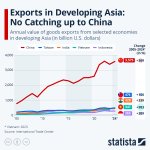
Exports in Developing Asia: No Catching up to China
by Katharina Buchholz,
Apr 16, 2025

As U.S. President Donald Trump's new trade war is narrowing in on China, other nations in Asia are seeing a window of opportunity to expand their exports to the United States, a major buyer of goods.

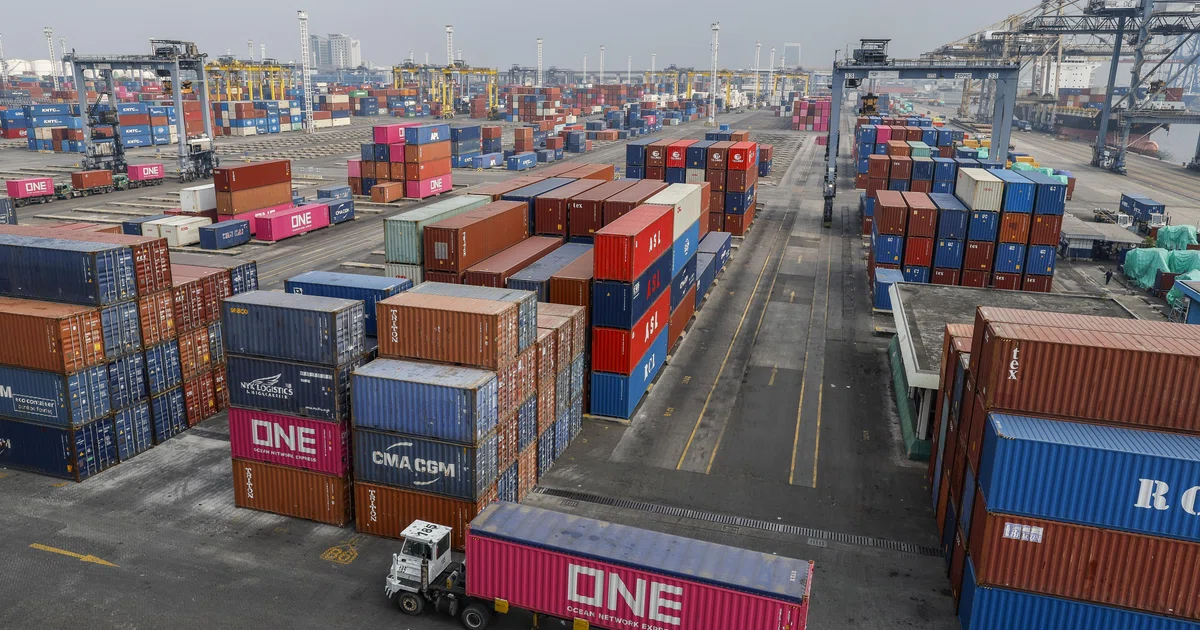
However, as data from the International Trade Center shows, no other nation in developing Asia is coming even remotely close to China's export prowess. Countries like India, Indonesia or Vietnam can theoretically provide the workforce and other framework for the production of low or medium-value goods, but progress in the export trade has been slow.

Smaller nation Vietnam has been growing exports most quickly over the past 20 years and in this respect already rivals larger countries in the region like India or Indonesia. Potentially because of this, the nation had also received a hefty reciprocal tariff from the Trump administration, but this has now been paused along with higher tariffs on other countries, while China's tariffs have stayed in place.

The Indian government has been looking to support factories and Prime Minister Narendra Modi has spearheaded an initiative called "Make in India". Manufacturing in India most recently made up only 13 percent of GDP, The New York Times reports, half of the rate in China and other East Asian nations.

As new factories are starting out, it takes time to built up supply chains and operations are heavily dependent on imports, the report finds. Finding suitable staff is also an issue widely reported as India has been among the developing nations where the education sector has been found unfit to teach skills needed by the employment market and has also not been regulated sufficiently. Finally, courts and bureaucracy that are hardly functioning as well as corruption are giving factory owners a headache, even though improvements have been made.
1744880537129.jpeg


Indonesia books larger-than-expected US$4.3 billion trade surplus in March​

The United States has announced a 32 per cent tariff on Indonesian products, which has been paused for 90 days

To view this content we will need your consent to set third party cookies.
For more detailed information, see our cookies page.

Exports from the resource-rich country have rebounded from lows reached after the end of a commodity boom in 2022. PHOTO: EPA-EFE


Published Mon, Apr 21, 2025 · 01:04 PM


[JAKARTA] Indonesia reported on Monday (Apr 21) a US$4.33 billion trade surplus in March, more than expected and the widest in four months as shipments beat estimates and imports were weaker than anticipated.

A Reuters poll of analysts had expected a surplus of US$2.64 billion in March. The March surplus was the largest since November 2024, according to LSEG data.

Exports from the resource-rich country have rebounded from lows reached after the end of a commodity boom in 2022, but shipments could soon be affected by dimming global trade outlook due to the US tariff policies.

The United States has announced a 32 per cent tariff on Indonesian products, which has been paused for 90 days. Several Indonesian ministers have been in Washington since last week to try to negotiate a deal to avoid the tariff.

Exports rose 3.16 per cent on an annual basis in March to US$23.25 billion, official data showed on Monday, compared with a 3.4 per cent fall expected by economists polled by Reuters.

Imports were worth US$18.92 billion, the statistics bureau said, up 5.34 per cent on a yearly basis, compared with the poll’s prediction of a 6.6 per cent rise. REUTERS


Indonesia’s Surplus with US Soars Amid Tariff Negotiations​


Jayanty Nada Shofa

April 21, 2025 | 2:15 pm


1745225931109.webp
Chief Economic Affairs Minister Airlangga Hartarto meets US Secretary of Commerce Howard Lutnick on April 17, 2025. (Photo Courtesy of Coordinating Ministry for Economic Affairs)


Jakarta. The Central Statistics Agency (BPS) reported Monday that Indonesia’s trade surplus with the US had grown amid the ongoing negotiations on Washington’s tariffs.

Indonesia is currently in talks with the US government in hopes that the latter will slash its 32 percent reciprocal tariff. After July 9, the US will begin charging nearly all its trading partners steep tariffs -- which differ by country -- as President Donald Trump wants to improve Washington’s trade imbalance. A 10 percent universal levy is already in place on imports coming to the American market.

Indonesia is giving itself a deadline of 60 days to reach an agreement on the tariffs. As Jakarta tries to appease Trump by promising to buy more American agricultural commodities, the gap in bilateral trade grows, according to the latest official statistics.

BPS data showed that Indonesia ran a $1.57 billion surplus in non-oil and gas trade with the US in February 2025. The numbers jumped to $1.98 billion the following month.

A surplus means that Indonesia’s exports to the US exceed what it imports. Electrical machinery and equipment made up the lion’s share of the surplus in March, adding $465 million to the positive trade balance. Followed by footwear ($239.7 million). Indonesia saw a $238.7 million surplus when trading animal/vegetable fats and oil, which would include its top commodity, palm oil.


“Indonesia's total surplus with the US hit $4.32 billion in the first quarter of 2025,” BPS’ head Amalia Adininggar Widyasanti told a press briefing.


The said figures, which also took into account oil and gas trade, marked quite a significant jump from the $3.61 billion surplus recorded in the same quarter in 2024. This also means that bilateral trade has become more imbalanced under the Trump 2.0 administration. The businessman-turned-politician returned to the White House on Jan. 20.


“The US -- alongside India and the Philippines -- has been the biggest contributor to our trade surplus over the past 10 years. Our highest-ever surplus with the US was $16.57 billion in 2022,” Amalia said.


BPS’ latest data only encompassed the trade figures up to the end of March. Trump announced his punitive tariff plans in early April. BPS will release April’s trade statistics next month. The statistics agency also revealed that Indonesia had run a 59-month surplus streak in overall trade since May 2020.


January 31, 2025

Indonesia yet to clarify on LNG exports beyond Q1 2025 as it reviews domestic demand​


HIGHLIGHTS

LNG exports uncertain after Q2 2025 after recent approval for Q1

Indonesia positions among world's top 10 LNG producers

Country introduces annual export assessments in recent years


Indonesia has yet to clarify its LNG exports beyond the first quarter of 2025 following its review of domestic natural gas demand, sources familiar with the matter told S&P Global Commodity Insights Jan. 31.


The country has been reviewing its domestic gas demand and LNG exports since late 2024 as initial assessments of needing more than 50 LNG cargoes for domestic requirements in 2025 were larger than expected, sources said.


The initial assessments of domestic gas requirements for 2025 made Indonesia's LNG exports uncertain, however, the country allowed LNG exports for the first quarter at the beginning of the year, sources said.


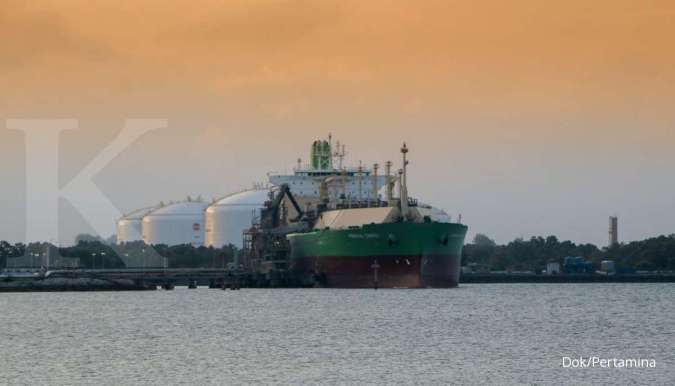
The Southeast Asian producer is still scrutinizing a number of LNG cargoes necessary from the country's projects -- Bontang, Tangguh and Donggi-Senoro -- for domestic demand and its quarterly exports beyond Q1 for 2025, with the move creating uncertainty for buyers, sources said.


A source at one Asian buyer of Indonesian LNG confirmed that LNG exports have been cleared for Q1 2025. However, it remained unclear about exports from April onward.


"Indonesia seems to want to take [LNG] cargoes to the domestic market as demand is strong," said a source with another Asian lifter of Indonesian LNG, adding that the Q2 export approval is in focus.


"The impact on the Asian LNG market will be not small [if Indonesia's exports are suspended]."


Commodity Insights reported Jan. 24 that Indonesia is projected to need an additional 54 LNG cargoes for 2025 to meet its domestic gas requirements amid declining production levels.


Asked to comment on whether Indonesia would halt LNG exports, Energy and Mineral Vice Minister Yuliot Tanjung said Jan. 31, "If there is a contract with an overseas buyer, we must fulfill the contract."


"So, we can't just cancel the contract. Therefore, if there is a need, we will look at the domestic allocation, and see which can be allocated for the domestic market and which for the contract."


Top 10 producer​


Indonesia is among the world's top 10 LNG producers and a key supplier to consumers in Japan, South Korea, China and Taiwan through its three main projects.


The resource-rich country also has a long history of nationalization, which has seen Jakarta impose export restrictions on a wide range of commodities, including coal, nickel ore, palm oil and even carbon credits, in previous years.


The government recently said it would divert all state crude oil allocations originally intended for export to be processed domestically as part of a broader move toward energy self-sufficiency, which was a thorny issue in its recent elections. It has even asked for the crude specifications to be changed to match domestic refineries.


Energy and Mineral Resources Minister Bahlil Lahadalia said the country plans to delay LNG exports to meet rising domestic demand and prioritize LNG for domestic use before allowing exports, local media reported Jan. 23.


Indonesia has been diverting about 5 million mt/year of LNG for domestic consumption out of its total LNG production of almost 18 million mt/year, a share that has been rising over the years from no diversions in 2011, according to historical data.

Annual assessments​


The country in recent years implemented a policy of annual export assessments so that sufficient piped gas and LNG can be allocated for the domestic market, but growing uncertainty has pushed customers such as Singapore to expand LNG receiving capacity and hedge long-term gas supply.


Indonesia's own LNG import plans are also in limbo as they require government approval despite state power and gas comp
anies PLN and PGN not having enough gas supply contracts.


"PLN and PGN remain under-contracted, and for both to continue relying on annual LNG cargo allocations is not sustainable," Johan Utama, principal research analyst at S&P Global Commodity Insights, said.


"Future Indonesian LNG output that will come from projects such as Eni's Geng North and IDD projects, or the Abadi project, are likely to require long-term offtake arrangements to go ahead. Beyond the volume availability, pricing policy such as capping prices for domestic industries and the power sector also need to be factored in," Utama added.


Allowing the import of international cargoes is straightforward, but if PLN's short-term purchases have to be done at relatively high market prices, and more low-priced domestic cargoes are diverted, the issue gets more complex, market analysts said.


LNG buyers with long-term contracts could be more willing to defer since they have longer contract periods. However, this just kicks the can further down the road since Indonesia has to make up for the deferred cargoes at a later date regardless of any penalties, analysts said.


Indonesia will stop exporting LNG to Singapore starting from 2028 as of 2025 June the gas export volume to Singapore (using gas pipe) is already been cut


Sembcorp falls 4.9% as Indonesia gas deal gets scrapped amid regulatory hurdle​

The last time it traded at such levels was in February last year

Therese Soh &

Bapat Sara Manish

Published Fri, Mar 14, 2025 · 11:09 AM

[SINGAPORE] Shares of energy and urban solutions provider Sembcorp : U96 -0.3% dropped on Friday (Mar 14) morning after a deal inked by one of its subsidiaries to import natural gas from Indonesia fell through.

At 10.11 am, the counter fell by 4.9 per cent or S$0.30 to an intraday low of S$5.79, with 3.1 million securities changing hands. The last time it traded at such levels was February 2024.

Shares of Sembcorp last closed 0.7 per cent or S$0.04 higher at S$6.09 on Thursday, before the news.

After the midday trading break, the share price eased back up to S$5.85 as at 1.03 pm, still down by 3.9 per cent or S$0.24 with 4.1 million securities transacted.

News broke on Thursday that the deal inked by Sembcorp’s wholly owned subsidiary, Sembcorp Gas, to import natural gas from Indonesia fell through due to the failure to obtain regulatory approval.

Sembcorp Gas signed the deal, announced in September 2023, to import up to 111 billion British thermal units per day of piped natural gas from the Mako gas fields in Indonesia, with West Natuna Exploration, Empyrean Energy and Coro Energy Duyung (Singapore).

Had the deal gone through, gas delivery was expected to start from 2026, for a tenure of about 11 years.

Sembcorp said on Thursday: “The gas sales agreement was subject to regulatory approvals as a condition precedent. As regulatory approval in Indonesia has not been obtained, the gas sales agreement will accordingly be terminated.”


Malaysia imposes anti-dumping duties on PET polymer imports from China, Indonesia​

  • Wednesday, 07 May 2025

    11:58 AM MYT
KUALA LUMPUR: Malaysia has imposed definitive anti-dumping duties on imports of Polyethylene Terephthalate (PET) from China (from 2.29 per cent to 11.74 per cent), and Indonesia (37.44 per cent), effective today.

The Investment, Trade and Industry Ministry (MITI) said this came after the conclusion of its months-long investigation into unfair trade practices.


The anti-dumping investigation, initiated on Aug 9, 2024, was conducted under the Countervailing and Anti-Dumping Duties Act 1993 and its associated regulations.

The ministry said the investigation concluded that PET from China and Indonesia had been entering the Malaysian market at prices below the domestic selling prices in the respective exporting countries, causing material injury to Malaysia’s domestic PET industry.


"These duties will be enforced by the Royal Malaysian Customs Department for a five-year period, starting May 7, 2025 and ending May 6, 2030.

"The imposition of these duties is expected to address the issue of unfair trade practices and provide relief to the domestic PET industry,” said MITI.

Interested parties, including local producers, importers, exporters, and trade associations involved in the investigation, may request access to the non-confidential version of the final determination report by submitting a formal written application.

The ministry added that the move underscores Malaysia’s commitment to protecting its domestic industries from unfair competition and ensuring a level playing field for local manufacturers. - Bernama

 
There you see trade will be more protective, but Indonesia can do the same as it has biggest market in SEA

Under more protective measure in international trade, countries with bigger market usually has more advantage than smaller nations

This then FDI sources should think where it should invest within current international trade more protective mode
 

Indonesia Among the Least Protective Economies, Industry Ministry Says​


Leonard AL Cahyoputra
May 9, 2025 | 10:22 am

4–5 minutes


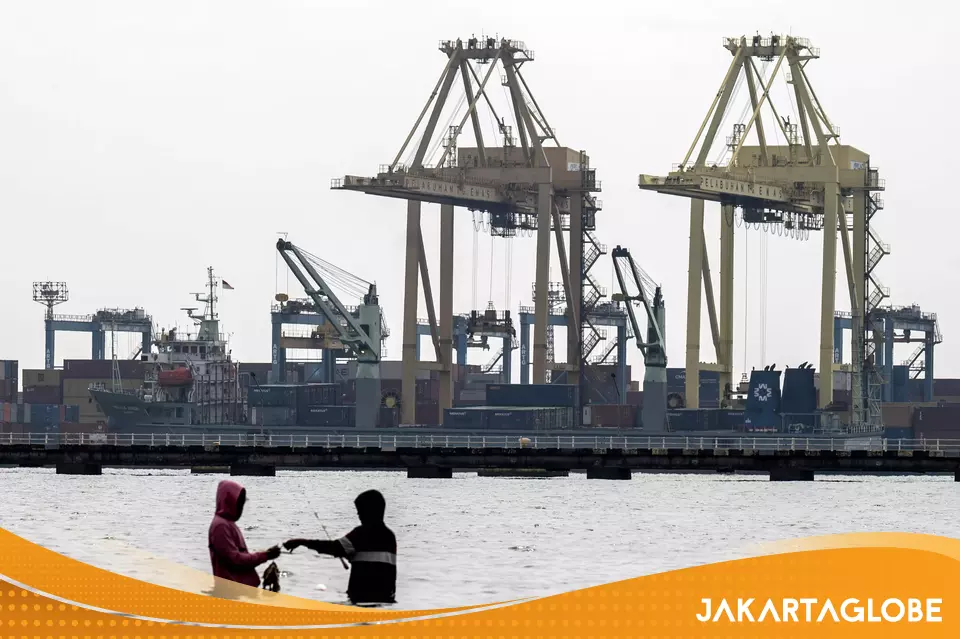
Fishermen fish near the Tanjung Emas container port in Semarang on March 7, 2025. (Antara Photo/Aprillio Akbar)

Jakarta. Indonesia has one of the lowest counts of non-tariff barriers (NTBs) and non-tariff measures (NTMs) in the world -- a reality the Industry Ministry sees as a key obstacle to boosting the competitiveness of local industries.

While NTBs and NTMs are widely used by developed economies to shield their domestic industries from foreign imports, Indonesia has yet to fully adopt such protective policies.

Industry Ministry spokesperson Febri Hendri Antoni Arief said Indonesia currently imposes only around 370 NTBs. In contrast, China has more than 2,800 such policies, India over 2,500, and the European Union around 2,300. “Even Malaysia and Thailand each have more than 1,000 NTBs and NTMs,” Febri said in a statement on Thursday.

This imbalance in protective instruments, Febri explained, leaves Indonesian manufacturers struggling to compete both at home and abroad. Indonesian exporters often face numerous non-tariff requirements from their destination countries -- such as quality standards, testing, and recommendations -- which their products must fulfill before entering those markets.


To address this, the ministry is pushing for stronger industrial safeguards through regulations that comply with World Trade Organization (WTO) rules. “We must make optimal use of non-tariff measures to help local industries grow and compete fairly,” he said.

The government is currently reviewing strategic sectors that may require stronger non-tariff protections, including textiles, chemicals, steel, electronics, and automotive industries. “Our goal is not just to serve as a market for foreign goods, but to reinforce and deepen our own industrial base,” said Febri.

He also called for stronger inter-ministerial cooperation and support from the private sector to defend national interests amid growing global challenges. “With strong collaboration and coordination among stakeholders, we’re optimistic that the industrial sector can recover and thrive,” Febri said.

As the country faces ongoing labor market pressures, the government will prioritize safeguarding the domestic industry -- especially from the surge of low-cost imports. “Protecting local industry means protecting our workforce as well,” he added.

Questioning Trade Ranking Transparency

Febri also responded to a recent survey by the Tholos Foundation, which ranked Indonesia 122nd in its 2025 International Trade Barriers Index. He criticized the ranking, alleging that the organization lacked transparency in its data and methodology.

“It’s similar to those questionable polling agencies that release survey results just before elections,” he said.

According to Febri, credible international benchmarks such as those from the WTO show that Indonesia’s NTB count remains significantly lower than those of many developed and neighboring countries.

He suggested that certain interests may prefer to see Indonesia struggle in its pursuit of becoming an advanced economy. However, he emphasized that Indonesia has significant potential -- from its natural resources and large domestic market to its demographic dividend.

“These are assets we must maximize, particularly in strengthening the industrial sector, which is key to achieving the vision of a Golden Indonesia by 2045,” Febri said.


RI to halt refined fuel imports from Singapore

The energy minister has announced a plan to stop importing refined fuels from Singapore, and instead procure the commodity from Middle Eastern countries.

Divya Karyza (The Jakarta Post)
Premium
Jakarta
Fri, May 9, 2025


Indonesia to cut fuel imports from Singapore in favour of US​


Eko Listiyorini and Eddie Spence / Bloomberg
Fri, May 09, 2025 • 04:08 PM GMT+08 • • 2 min read

1746783373185.jpeg
Indonesia imports about 290,000 barrels per day of liquid refined fuels from Singapore / Photo: Bloomberg


Indonesia will cut its fuel imports from Singapore and source supplies from the US and Middle Eastern countries instead, according to the country’s energy minister.

Southeast Asia’s largest economy will look to gradually eliminate its shipments of oil products from Singapore, which account for more than half its imports, Energy Minister Bahlil Lahadalia told reporters on Friday. Purchases will be switched to suppliers in the US and Middle East as Indonesia seeks lower prices and a “better balance” in the changing global geopolitical environment, Lahadalia said.

“It is not only a matter of price but also geopolitical issues, we need to have a balance with other countries,” Lahadalia said, adding that imports from Singapore would be reduced to zero “some day”.

Indonesia is among several countries seeking to rebalance their trade relationships with the US to avoid President Donald Trump’s punitive tariffs. Officials in Jakarta have offered to boost purchases of American commodities like oil and liquefied petroleum gas.

While Singapore has no crude oil production of its own, the city-state is a refining hub and a major supplier of products to other countries in the region.

That includes Indonesia, whose own output of the fossil fuel has shrunk over the years and which imports about 290,000 barrels per day of liquid refined fuels from its smaller neighbour, according to analysis from Sentosa Shipbrokers. Most of those flows from Singapore consist of gasoline and gasoil.

“If these plans come to fruition it would certainly be a noticeable reshuffle for the tanker market,” said Sentosa.


Lahadalia said the cuts would begin within six months and that state oil firm, PT Pertamina, is building jetties to accommodate larger tankers. He had said earlier this week that Indonesia would suspend its oil imports from Singapore for six months (starting from six months from now - Indos).


Pertamina to Phase Out Fuel Imports from Singapore Following Government Order​


The Jakarta Globe

May 11, 2025 | 11:14 pm

Jakarta. State-owned energy company Pertamina confirmed on Sunday that it will follow the government’s directive to gradually reduce and eventually stop fuel imports from Singapore, shifting its supply sources to other countries.


Fadjar Djoko Santoso, Pertamina’s spokesman, said the company is still waiting for more detailed instructions from the government before implementing the policy.


“In principle, we are following the government’s directives,” Fadjar told Kompas. “While awaiting formal instructions, we will conduct a comprehensive assessment of the policy, including its logistical cost implications,” he added.


The move comes after Energy and Mineral Resources Minister Bahlil Lahadalia on Friday announced the plan to phase out fuel imports from Singapore, which currently accounts for around 60 percent of Indonesia’s total fuel imports.

Bahlil criticized Singapore’s pricing strategy, noting that the country sells fuel to Indonesia at prices similar to those from Middle Eastern suppliers, despite its geographic proximity.


“After reviewing it myself, I found the price to be the same as oil from the Middle East. That’s why we’re considering alternative suppliers,” Bahlil said, without providing further details.

Indonesia is also exploring new fuel import deals with the United States as part of a broader effort to ease trade tensions and tariff barriers left over from the Donald Trump administration. As part of that arrangement, Indonesia has agreed to purchase refined fuel, crude oil, and liquefied petroleum gas (LPG) from the US, Bahlil noted.


The shift away from Singapore is expected to begin in November, with imports from the city-state projected to be reduced by up to 60 percent.


To accommodate longer-distance imports, the government plans to establish a large oil terminal, which will help minimize logistical costs when sourcing fuel from farther suppliers.


Earlier this week, President Prabowo Subianto revealed that Indonesia currently spends nearly $40 billion annually on oil imports. He reiterated his administration’s goal to achieve energy independence in the coming years.

 
But due to transportation costs, importing gasoline from ME or the US will cost more! Amazing, wise guy! Indonesia's economy is troubled due to excessive spending and insufficient income tax proceeds. And they will buy the "turkey" Rafale too for 7 billion. I am not sure why they He said China has more non-tariff regulations. Because Indonesia has one of the strictest investment rules, add to that red tape, and has to share with local companies, Nobody wants to invest in Indonesia except the Chinese. They have to get rid of SOE since they are corrupt and drain on State budget

Prabowo Subianto’s economic policy is weakening Indonesia​

And it comes at a time where America is slapping tariffs on the world​

Muslims gather for Eid al-Fitr prayer marking the end of the holy fasting month of Ramadan on a street in Jakarta, Indonesia
A lot of hot air?Photograph: AP
May 15th 2025|Jakarta
Share
How would Prabowo Subianto grade his first six months in office? Indonesia’s president recently said he would give himself six marks out of ten. His administration has certainly been busy. It has launched an expensive school-lunch programme and created a sovereign wealth fund. It has given teachers a pay rise, enacted economic stimulus and junked a plan to increase value-added tax.

Yet what has all this achieved? The economy is suffering: first-quarter growth figures released this month were the weakest since 2021. In Jakarta, the capital, businessmen grumble about a dearth of animal spirits. This year’s Eid al-Fitr holiday, usually a boon for spending as over 150m Indonesians return to their hometowns, was a bust; the number of travellers fell by 24% from the previous year. Consumer confidence has soured since December, while sales of cars and two-wheelers both dipped 3% between January and April, compared to the same period last year.

All of this has happened before Donald Trump’s now-delayed 32% tariff on Indonesian exports to America takes effect.
df13727556ea4eb513614a522574c956583c3c7e.avif
Chart: The Economist
Investors are not impressed. Since Mr Prabowo took office in October, Indonesian stocks have fallen by more than a tenth and the rupiah has weakened by 7% against the dollar, briefly reaching an all-time low in April, below the depths reached during the Asian financial crisis of 1997-98 (see chart). Spreads on credit-default swaps, which pay out if Indonesia defaults on its bonds, have crept up.

The government’s muddle has disoriented investors. Some worry about overspending. A 2003 law limits fiscal deficits to 3% of GDP. Years of self-restraint have granted Indonesia a decent credit rating. Keeping investors happy is crucial: the Indonesian government relies on external financing, in part because its income from tax, equal to 10% of GDP, is only half the average in the region. The budget for 2025 assumes a deficit of 2.5% of GDP.

Yet in recent months Mr Prabowo’s administration has been boasting about new outlays. The most expensive relates to free school lunches, the president’s most high-profile campaign promise. In January the president’s brother said Mr Prabowo had promised an extra $6bn for the programme this year, on top of the $4bn already budgeted for 2025. This and other new commitments will cost 0.9% of GDP, according to an estimate in February by Euben Paracuelles of Nomura, a bank. Without more revenue, that would bust the deficit cap.

The government has implied that there are two ways it could find the extra cash. One is through austerity. In January Mr Prabowo made one-off “efficiency” cuts worth $19bn, including slashing funding for the public-works ministry, which oversees infrastructure, by 70%. A second way is to collect more tax: the budget assumes that tax receipts will rise by 11%.
To help achieve this Mr Prabowo has set up a state revenue agency, reporting directly to him, and the finance ministry has launched an online portal, called Coretax, that is meant to ease tax filing and collection.

Mr Prabowo’s top economic adviser suggested this portal could raise the tax-to-GDP ratio by two percentage points. But a previous e-filing system set up in 2018 did not change much. Coretax is prone to bugs: one analysis counted 34 technical errors. In February an older system had to be revived so Coretax could be patched up. In the first two months of the year Indonesia posted a surprise fiscal deficit, driven by a 30% drop in tax revenue related to Coretax’s shaky rollout.
Despite these concerns Sri Mulyani Indrawati, the finance minister, has stuck with the 2.5% deficit target, urging investors to ignore short-term fluctuations.

Finance-ministry officials have said forthcoming April numbers will also show year-on-year revenue growth, according to Ari Jahja of Macquarie, a bank. But investors remain worried. Weak global and domestic growth and low prices for key Indonesian exports such as nickel and coal could weigh down revenue later in the year.

The launch in February of Danantara, Indonesia’s new sovereign wealth fund, has only added to the confusion. It has been put in charge of $900bn in state-owned enterprise assets, which in 2024 yielded around $5bn in dividends. This is money that would once have flowed directly to the central government.
Were Mr Prabowo’s policies creating difficulties now in exchange for near-certain gains later, that would be one thing. Yet even if the government manages to find the money it needs for all its pledges, the cuts required to pay for them could backfire. Investments in infrastructure tend to bring higher returns than many other kinds of public spending. So the government’s decision to chop the public-works ministry looks misguided. Meanwhile the abrupt reallocation of resources has weighed on growth: government spending contracted by 1% in the first quarter compared with the previous year.

The expensive school-lunch programme looks flawed—it aims to provide calories in a country where poor nutrition is the bigger problem. Dozens of children have been hospitalised after eating bad food provided by it. Corruption watchdogs have called for a halt to the programme, alleging that money may be leaking out.

From Washington with love​

Looming over all this are Mr Trump’s tariffs. Indonesia is less exposed than South-East Asian neighbours, such as Vietnam. But tariffs are disruptive nonetheless; Sri Mulyani has said they could cut Indonesia’s long-run growth rate by half a percentage point. Indonesian negotiators hope the Trump administration will smile upon a package of concessions.

But in the chaos caused by Mr Trump’s tariff threats, there is a silver lining for Indonesia’s economy. American bullying could push Mr Prabowo to scrap protectionist policies that have long deterred foreign direct investment. For example, his support for local-content requirements has recently wavered. Despite their “good nationalist intentions” they may need to become “more realistic”, Mr Prabowo said in April.

As with all Mr Trump’s tariff talks, what America wants is not clear. Indonesia may agree to lower non-tariff barriers in principle, while fudging the implementation. But there is, at least, a narrow path to a mutual reduction in trade barriers and an end to Indonesia’s most self-defeating policies. If Mr Prabowo chooses to go down that road, he would be able to give himself much higher marks. ■
 
Last edited:

Landmark Indonesia-EU Trade Deal Concluded, Opening Path for Greater Market Access​


The Jakarta Globe


June 8, 2025 | 1:25 am


1749473133839.webp
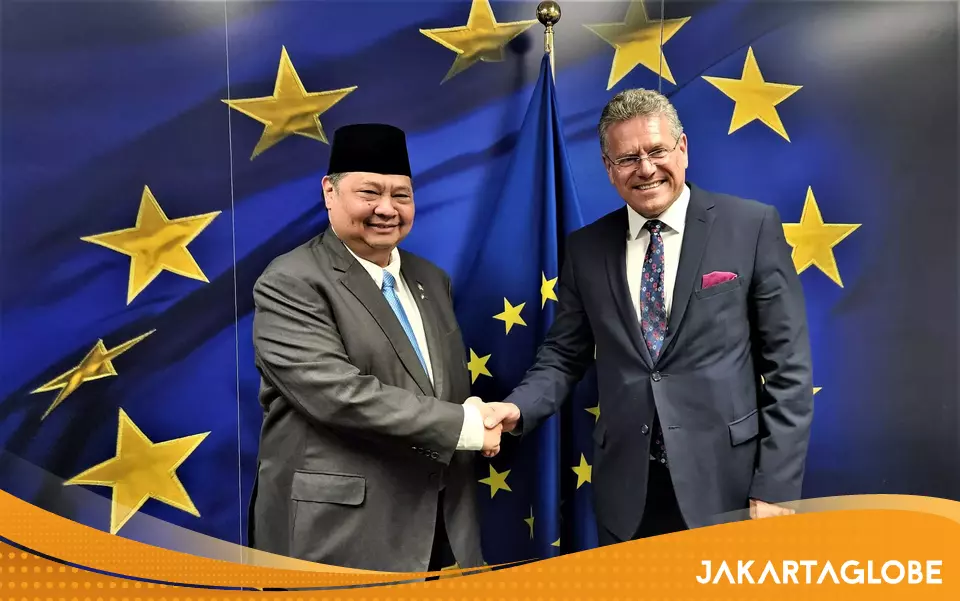
Coordinating Minister for Economic Affairs Airlangga Hartarto, left, shakes hands with European Commissioner for Trade and Economic Security Maros Sefcovic in Brussels on Friday, June 6, 2025. (Handout)


Brussels. Indonesia and the European Union have finalized negotiations on the long-anticipated Comprehensive Economic Partnership Agreement (CEPA), a landmark trade pact aimed at expanding market access and deepening bilateral economic cooperation, Coordinating Minister for Economic Affairs Airlangga Hartarto announced on Saturday.


The conclusion marks the end of a nine-year negotiation process involving 19 intense rounds of talks. Speaking in a video press conference from Brussels, Airlangga confirmed that all remaining issues have been resolved and both sides are ready to move forward.


“Negotiations have officially concluded, with several technical issues settled in the final round at the Chief Negotiators’ level,” Airlangga said. “The Indonesian government remains firmly committed to finalizing trade agreements with key strategic partners to open markets, enhance trade and investment, and reduce both tariff and non-tariff barriers.”


The announcement followed Airlangga’s meeting with European Commissioner for Trade and Economic Security Maroš Šefčovič in Brussels on Friday. The final outcome of the negotiations will soon be reported to President Prabowo Subianto and European Commission President Ursula von der Leyen.

The EU is Indonesia’s fifth-largest trading partner, with bilateral trade reaching $30.1 billion in 2024. Indonesia recorded a $4.5 billion trade surplus with the bloc last year.

Airlangga stressed the strategic importance of the deal at a time of heightened global uncertainty. “Indonesia and the EU recognize this as a critical moment. Our major commodities complement rather than compete with one another. By finalizing this agreement, we can jointly strengthen global supply chains.”


Key Provisions of the CEPA Deal
One of the agreement’s main benefits is the substantial elimination of import tariffs. Within one to two years of implementation, 80 percent of Indonesia’s exports to the EU will enjoy zero tariffs. Labor-intensive industries such as footwear, textiles, and garments -- along with palm oil, fisheries, renewable energy, and electric vehicles -- are expected to receive fairer preferential treatment.


The EU, meanwhile, raised several issues during the negotiations, including local content requirements (TKDN), the automotive sector, access to critical minerals, and incentives for foreign investors.


Indonesia also pushed for fair treatment of its fishery exports, requesting the EU to align its policies with those extended to other ASEAN nations like Thailand and the Philippines. According to Airlangga, the EU has agreed to provide a level playing field for Indonesia’s fishery products.

Regarding the EU’s deforestation policy, Commissioner Šefčovič assured that special consideration would be given to Indonesia -- an assurance Airlangga said would benefit Indonesia’s forest-based exports.


The CEPA is expected to significantly boost Indonesia’s global competitiveness by improving access to the European market and eliminating key trade barriers. The Indonesian government projects that exports to the EU could rise by more than 50 percent over the next three to four years. The deal is also seen as a catalyst for attracting greater strategic investment from Europe, reinforcing international confidence in Indonesia’s legal and business environment.


Competitive US Tariffs than Vietnam’s 20% Deal​

July 3, 2025 | 10:26 pm

1751638480010.webp
Finance Minister Sri Mulyani attends a bilateral meeting with US Secretary of Treasury Scott Bessent in Washington DC on April 24, 2025. (Photo Courtesy of @smindrawati)

Jakarta. The Indonesian government is seeking lower import tariffs from the United States than those recently granted to Vietnam, in an effort to improve the competitiveness of Indonesian products in the US market.


Vietnam secured a new tariff agreement with the US this week, with duties set at 20 percent, down from an initial 46 percent proposed by former President Donald Trump in April. Trump announced the revised deal on Truth Social on Thursday, saying it was the result of direct talks with Vietnam’s top leader, To Lam, ahead of a July 9 deadline.


Indonesia, meanwhile, is still in the process of negotiating a similar deal with the US, aiming to reduce tariffs currently set at 32 percent -- excluding the 10 percent baseline tariff.


“We hope to achieve a rate lower than Vietnam’s, which stands between 20 and 40 percent,” said Coordinating Minister for Economic Affairs Airlangga Hartarto during a press conference in Jakarta on Thursday.

The proposed tariff reduction is part of Indonesia’s broader effort to secure better access for its exports to the US and strengthen its trade position amid intensifying global competition.

The Indonesian government has proposed boosting imports from the United States by up to $34 billion as part of ongoing negotiations, Airlannga said.


This includes the purchase of US energy products with a potential value reaching $15.5 billion.


“We’re offering to purchase goods worth more than what the US trade deficit is -- $34 billion in total, compared to the $19 billion deficit,” he said.


Users who are viewing this thread

Pakistan Defence Latest

Back
Top