Indus Water Treaty: Discussion, News & Updates

I disagree. We currently lack the capacity to divert a significant portion of Indus River. But the intentions are very clear.

that's what i am also saying having no capacity to divert water but still politicians are claiming Not a single drop of water will flow to Pakistan. Its just like "nahi khaunga na khane dunga" statement - can you vouch that after 14 years of ruling did corruption reduced ?

First, build dam, barrage & canals to divert water then we can think about stopping or allowing the flow of water, until then its just fooling us.
 
I had said this in 2013, the indians will mess around with our rivers. We should be prepared to blow up anything they build illegally to divert our share. Period!!! There can be no compromise on this, absolutely nothing!

And no western country will be against our bombing so long as we dont do it after they have constructed their dams and filled it up. So, basically continue highlighting every time at every international forum so that the world is prepared once we take action. Also, we should not stop at just bombing, take kashmir over like Azerbaijan did with Armenia. May 2025 was perfect for that but alas we missed that opportunity.

When the next opportunity arises which is inevitable since the indians need to get their revenge we should be prepared to F them up completely and take kashmir and immediately ask the UN to hold a plebiscite.
 
I had said this in 2013, the indians will mess around with our rivers. We should be prepared to blow up anything they build illegally to divert our share. Period!!! There can be no compromise on this, absolutely nothing!

And no western country will be against our bombing so long as we dont do it after they have constructed their dams and filled it up. So, basically continue highlighting every time at every international forum so that the world is prepared once we take action. Also, we should not stop at just bombing, take kashmir over like Azerbaijan did with Armenia. May 2025 was perfect for that but alas we missed that opportunity.

When the next opportunity arises which is inevitable since the indians need to get their revenge we should be prepared to F them up completely and take kashmir and immediately ask the UN to hold a plebiscite.

India will come to senses long before that.

In any case 1 MAF is like 2-3% of Chenab water. The Pakistan need to build dams on Chenab on emergency basis. To take more share from Chenab India will have to build large scale infrastructure which will take decades. Jhelum is even more difficult to divert and Indus near impossible.

Sindhu nationalists retarded idea of not building dams is the cause of current crisis.

India is desperate because their dams on eastern rivers are being filled with silt and their capacity reduced as time pases on. By 2050 bhakra dam, their biggest one on Satluj will have less then 50% storage capacity left. All that extra water in will come to Pakistan naturally.
 
India will come to senses long before that.

In any case 1 MAF is like 2-3% of Chenab water. The Pakistan need to build dams on Chenab on emergency basis. To take more share from Chenab India will have to build large scale infrastructure which will take decades. Jhelum is even more difficult to divert and Indus near impossible.

Sindhu nationalists retarded idea of not building dams is the cause of current crisis.

India is desperate because their dams on eastern rivers are being filled with silt and their capacity reduced as time pases on. By 2050 bhakra dam, their biggest one on Satluj will have less then 50% storage capacity left. All that extra water in will come to Pakistan naturally.

Pakistan can't realistically build large storage dams on the Chenab because it enters the plains of Punjab where there are no suitable narrow valleys or mountain sites for major reservoirs... At best, only small to midscale projects like Chiniot can add limited storage (just a couple of MAF)..

The real issue is structural... Pakistan has only about 13 MAF of live storage (mainly Tarbela and Mangla) against over 100 MAF of annual flows... That means a buffering capacity of only a few weeks instead of months. Bridging this gap needs large projects like Bhasha and Mohmand, plus better political consensus on options like Kalabagh...

But dams alone won't fix this... The real gains lie in system efficiency..... multi tier storage, cutting canal losses, managing groundwater, and capturing floodwater instead of losing it to the sea .... Engineering and management matters as much as new dams/infrastructure

In the bigger picture, the greater threat isn't upstream control by India, it's climate variability hitting an already under-stored system... Pakistan sits on a highly volatile hydrological system but still lacks the infrastructure to absorb floods, droughts, and seasonal extremes...
 
To view this content we will need your consent to set third party cookies.
For more detailed information, see our cookies page.
 
Pakistan can't realistically build large storage dams on the Chenab because it enters the plains of Punjab where there are no suitable narrow valleys or mountain sites for major reservoirs... At best, only small to midscale projects like Chiniot can add limited storage (just a couple of MAF)..

The real issue is structural... Pakistan has only about 13 MAF of live storage (mainly Tarbela and Mangla) against over 100 MAF of annual flows... That means a buffering capacity of only a few weeks instead of months. Bridging this gap needs large projects like Bhasha and Mohmand, plus better political consensus on options like Kalabagh...

But dams alone won't fix this... The real gains lie in system efficiency..... multi tier storage, cutting canal losses, managing groundwater, and capturing floodwater instead of losing it to the sea .... Engineering and management matters as much as new dams/infrastructure

In the bigger picture, the greater threat isn't upstream control by India, it's climate variability hitting an already under-stored system... Pakistan sits on a highly volatile hydrological system but still lacks the infrastructure to absorb floods, droughts, and seasonal extremes...

Dams on Chenab in planning stages.

Dam ProjectLocationStorage Capacity (MAF)
Wazirabad DamWazirabad District1.0
Chiniot DamChiniot District0.9
Midh Ranjha DamSargodha District1.2
Shah Jewna DamJhang District1.3
4.5 MAF in medium sized dams that can be build in 3-4 years.
 
Dams on Chenab in planning stages.


Dam ProjectLocationStorage Capacity (MAF)
Wazirabad DamWazirabad District1.0
Chiniot DamChiniot District0.9
Midh Ranjha DamSargodha District1.2
Shah Jewna DamJhang District1.3
4.5 MAF in medium sized dams that can be build in 3-4 years.

The 4–5 MAF figure is theoretical gross storage.... Once you factor in floodplain geometry, sedimentation, land constraints, and operational limits, the realistic usable gain is closer to around 2 MAF as stated earlier.

Also, AFAIK, only Chiniot (0.8-0.9 MAF) is a relatively defined project... The rest are conceptual floodplain storage ideas, not approved or under construction as a coherent program....

And even then, it doesn't change the bigger picture... Pakistan still has only around 13 MAF of live storage against over 100 MAF of annual river inflows, so the structural storage gap will remain the same even if we add 2-3 MAF to it..

As for the 3-4 year timeline, not sure where that comes from... Even if started today, land acquisition, design, approvals, and construction make these multi years project well beyond 3, before they can become operational ...
 
India will come to senses long before that.

In any case 1 MAF is like 2-3% of Chenab water. The Pakistan need to build dams on Chenab on emergency basis. To take more share from Chenab India will have to build large scale infrastructure which will take decades. Jhelum is even more difficult to divert and Indus near impossible.

Sindhu nationalists retarded idea of not building dams is the cause of current crisis.

India is desperate because their dams on eastern rivers are being filled with silt and their capacity reduced as time pases on. By 2050 bhakra dam, their biggest one on Satluj will have less then 50% storage capacity left. All that extra water in will come to Pakistan naturally.
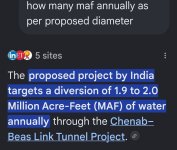
It's actually 2 MAF, which is like 7-10% of Chenab annual flow which includes monsoon flood. It would be more catastrophic if diverted during Lean Season.
Btw it's not like Pakistan is floating in surplus water. 2MAF is equivalent to 1.5 million acres of Wheat crop not getting water.
SmartSelect_20260620_133856_Brave.jpg
 
It's actually 2 MAF, which is like 7-10% of Chenab annual flow which includes monsoon flood. It would be more catastrophic if diverted during Lean Season.
Btw it's not like Pakistan is floating in surplus water. 2MAF is equivalent to 1.5 million acres of Wheat crop not getting water.
View attachment 202407
They cannot 2 maf. Entire flow of that Chandra upper stream north to Atal is max 1.3 to 1.5 maf.
 
It's actually 2 MAF, which is like 7-10% of Chenab annual flow which includes monsoon flood. It would be more catastrophic if diverted during Lean Season.
Btw it's not like Pakistan is floating in surplus water. 2MAF is equivalent to 1.5 million acres of Wheat crop not getting water.
View attachment 202407

That tunnel at must will get 0.5 MAF max. And Pakistan will use this as opportunity to present India as rough state. India will not go ahead even if there is 1% chance of war as usual after being humiliating from rest of the world for weaponizing water.
 
It's actually 2 MAF, which is like 7-10% of Chenab annual flow which includes monsoon flood. It would be more catastrophic if diverted during Lean Season.
Btw it's not like Pakistan is floating in surplus water. 2MAF is equivalent to 1.5 million acres of Wheat crop not getting water.
View attachment 202407

Even many Indian hydrology assessments suggest the diversion would likely be well under 1 MAF, with 2 MAF being a political overestimate used in external narratives....

Pakistan using higher figures like 1.9 MAF to frame "water aggression" is politically understandable... So is Indian right wing chest-thumping about "stopping Pakistan’s water"..

Also, the "2 MAF = 7–10% of Chenab flow" framing is misleading unless you flatten the river into annual averages... Chenab is highly seasonal, most of that flow is concentrated in a few peak months, when irrigation systems are already operating near capacity. That’s where timing matters more than headline...

And no, 2 MAF does not mean 1.5 million acres of wheat are deprived of water... That’s classroom maths, not how river systems or irrigation networks actually work....
 
They cannot 2 maf. Entire flow of that Chandra upper stream north to Atal is max 1.3 to 1.5 maf.
It's flow becomes 3+ MAF during 4 months of summer glacier melting + monsoon flood season. Tunnel can drain more than 1 MAF in 4 months of May-Aug alone.

And no, 2 MAF does not mean 1.5 million acres of wheat are deprived of water... That’s classroom maths, not how river systems or irrigation networks actually work....
Irrespective of textbook maths v/s real world maths. That deficit need will be filled out of borewells. In reality area affected will be even larger.
 
When the next opportunity arises which is inevitable since the indians need to get their revenge we should be prepared to F them up completely and take kashmir and immediately ask the UN to hold a plebiscite.
We cannot take revenge for something you imagine, it's been over a year now you guys have been claiming victory without showing any meaning full damage on Indian side. India has shown satellite images and videos to back most of their claims and damage on Pakistani side. 9 terrorist locations and 11 military installations or bases.

As for Indus water treaty, it's not the same anymore. With the capability to store or to divert partially increases over Time , Pakistan will receive less water accordingly, it's a long process and it will be gradual , you will not even realise it and will get used to less water.
 
Irrespective of textbook maths v/s real world maths. That deficit need will be filled out of borewells. In reality area affected will be even larger.

That is still textbook conversion, not irrigation reality.... "2 MAF = 1.5 million acres wheat deprived" assumes water is uniformly available, perfectly deliverable, and fully efficient at farm level, none of which is true in the Indus system...

Crop water demand is not met from a single source.... it’s a mix of canal supply, rainfall, losses, and groundwater... So there is no direct "missing MAF = missing acres" linear equation....

And pushing it further to "even more via borewells" just shifts the argument again, from river allocation to groundwater depletion, without changing the basic point..... : water systems don't translate into clean acreage arithmetic...
 

Users who are viewing this thread

Country Watch Latest

Latest Posts

Back
Top