Internal Security Review

Rules reset

After years of restraint, Pakistan has carried out limited kinetic actions, which, security and diplomatic analysts say, reflects a recalibration of the “rules of engagement” after political and diplomatic efforts failed to move the Taliban.

“Pakistan’s patience has worn thin due to the Taliban regime’s persistent denial of TTP sanctuaries on Afghan soil,” says Inam. “On Oct 11, Pakistan revised its ‘rules of engagement’, declaring it would strike targets inside Afghanistan without restraint if credible evidence exists. This shift was long overdue,” he adds.

“While border skirmishes with Afghanistan have occurred in the past too — from Bajaur in the 1960s to Angoor Adda in 2008 and Tari Mangal in 1987 — this latest flare-up is different. It is no longer a localised issue, but one directly linked to the policies and protection offered by the Taliban regime,” adds Inam, who has the firsthand experience of leading the fight against terrorists on the western frontier.


quote-masood-khalid1760812347-5.png


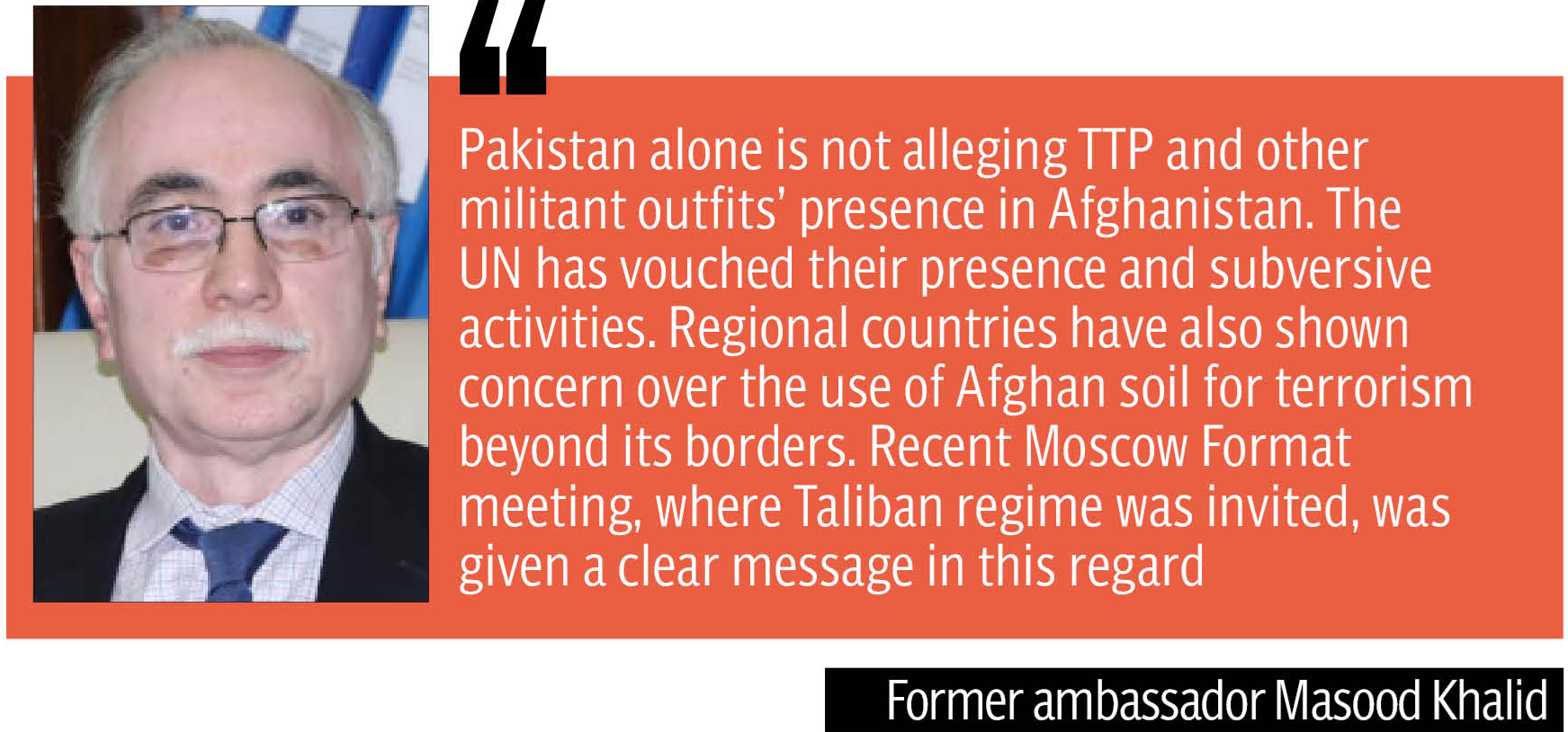
International law gives Pakistan the right to act in self-defence when its sovereignty or the security of its people is threatened by cross-border terrorist aggression. “Pakistan acted only when its urgings were not heeded and when its territory was attacked.

Pakistan also made it clear that it has not targeted Afghan people but only terrorist centres being used against her,” says former ambassador Masood Khalid. “Pakistan has a right of self-defence under the UN Charter.”

After establishing deterrence through proportionate action, focus should now shift to diplomacy, argues former ambassador Mansoor Ahmad Khan. “In view of the sensitivity and strategic importance of our relations with Afghanistan, we should have drawn a wider agenda of dialogue with TTP/BLA terrorism to be taken up aggressively with Afghanistan,” says Khan, who has also served in Afghanistan.
 
Foolish gimmick or message?

Islamabad claims that the TTP, BLA, and its Majeed Brigade serve as proxies backed by India under the “Doval Doctrine” — a hybrid warfare strategy attributed to Indian National Security Adviser Ajit Doval — designed to destabilise Pakistan. Against this backdrop, the Taliban’s outreach to India, including Foreign Minister Muttaqi’s visit to New Delhi and Deoband, has raised questions about whether this is a calculated message or a diplomatic misstep.

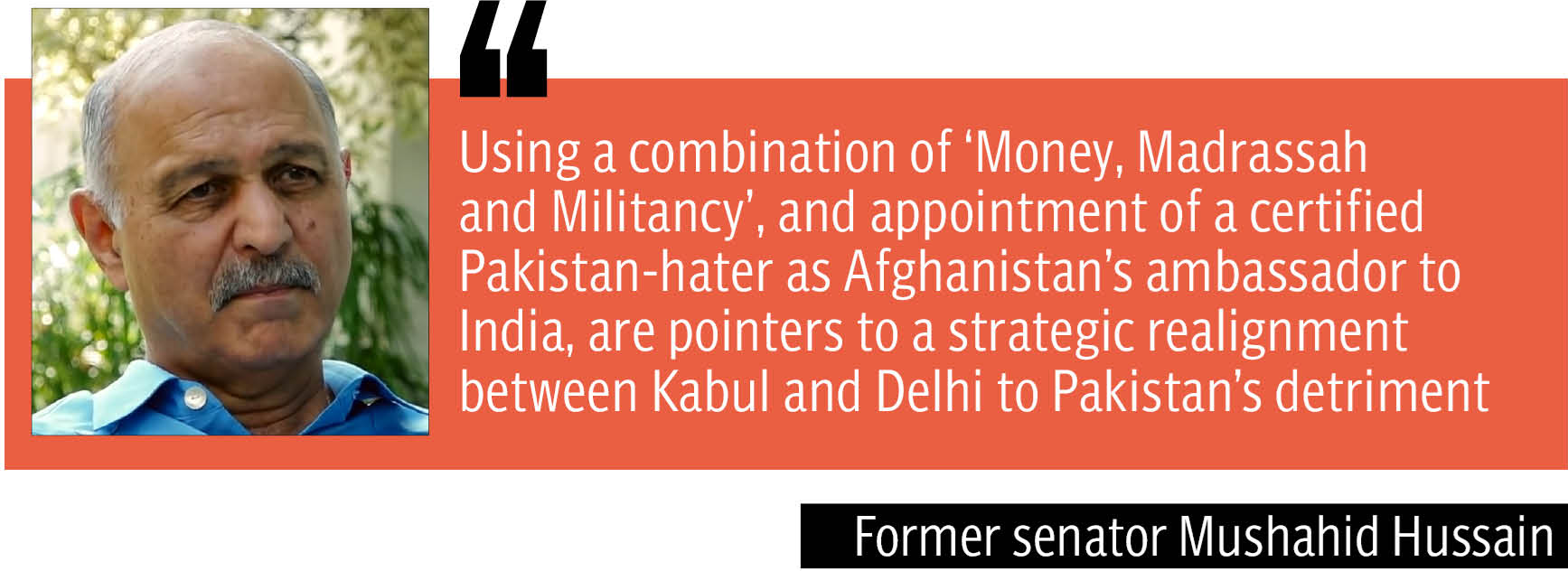
“Connecting the dots: three separate but related actions are quite clear as to Kabul regime’s intentions: the extraordinary protocol accorded by India to Mullah Muttaqi together with his eagerness to please his newfound Indian godfathers and his visit and speech at Deoband, then the openly-proclaimed Doval Doctrine of destabilising Pakistan, using a combination of ‘Money, Madrassah and Militancy’, and appointment of a certified Pakistan-hater as Afghanistan’s ambassador to India, are pointers to a strategic realignment between Kabul and Delhi to Pakistan’s detriment,” says Mushahid.

mushahid-hussain1760812346-3.png
“Certainly, this emerging Indo-Afghan axis seems to be the preferred option of the dominant Kandahari ruling faction in the Taliban regime,” he adds.

Khan says Afghanistan has always used India ties as a card in its dealing with Pakistan. “[However] the quantum of strategic space India gets in Afghanistan depends on its relations with Pakistan. If Pakistan-Afghanistan relations could be addressed effectively, Kabul has much higher natural inclination for linkages with Pakistan which, in turn, limits India’s space. Pakistan has to worry more about deteriorating relations with Afghanistan and less about its overtures towards India,” he adds.

Inam, however, views Muttaqi's visit not as a calculated move, but as a misguided one, arguing that “it was not driven by a love for India, but aimed at provoking Pakistan.”

The Taliban’s overtures to India defy logic, especially considering the history between the two, says the retired general. “It was the same Modi regime that labeled them as terrorists not long ago and colluded with NATO forces occupying Afghanistan. Modi's government was also involved in planning against the Taliban and managed US bases in Afghanistan.”

While the Taliban regime is free to establish diplomatic relations with any country, it should not engage with one that has been hostile to Pakistan, given Islamabad’s long-standing support, including hosting refugees and providing diplomatic and economic aid. “Pakistan deserves respect for its good neighbourliness,” he says, calling the Taliban’s approach to India a “foolish gimmick.”

Lodhi views the Taliban’s outreach to India through a different lens. “The forging of closer ties with New Delhi is a tactical response by the Taliban and for that reason not a source of anxiety for Islamabad,” she says. “The reality is that Pakistan has a border with Afghanistan, and not India. That makes landlocked Afghanistan needing Pakistan.”
 
To view this content we will need your consent to set third party cookies.
For more detailed information, see our cookies page.
 
To view this content we will need your consent to set third party cookies.
For more detailed information, see our cookies page.
 
To view this content we will need your consent to set third party cookies.
For more detailed information, see our cookies page.
 
Construction and Beautification of Mosques in Former FATA by Pakistan Army

In various districts of Khyber Pakhtunkhwa, the Pakistan Army and Frontier Corps have completed multiple projects for the construction, restoration, and beautification of mosques.

These projects are playing an important role in promoting religious harmony, public unity, and peace.

The construction of Speen Mosque in Wana, South Waziristan, was completed in July 2021 with the support of FC (South), serving as a valuable gift for the local people.

In Bajaur, FC (North) completed the restoration work on Masjid Sulaiman Khel and Masjid Arab, which had been destroyed by terrorism.

At the University of Malakand, Jamia Masjid Farooq-e-Azam was constructed in a short period with the support of the Pakistan Army and FC (North) in response to the request of male and female students.

Jamia Masjid Farooq-e-Azam also has a separate space and all facilities for women.

Similarly, in the areas of Mir Ali, Sararogha, Ladha, and Makeen in North and South Waziristan, multiple mosque repair and restoration projects have been completed.

Alongside the restoration of places of worship through these projects, the bond of trust and brotherhood between the people and the Pakistan Army has been further strengthened.


To view this content we will need your consent to set third party cookies.
For more detailed information, see our cookies page.
 

Pakistan will not hold talks with any terrorist group: FO


Abdullah Momand | News Desk
November 14, 2025

1763123861431.png


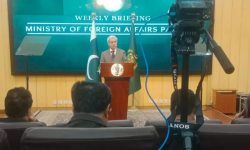
Foreign Office Spokesperson Tahir Andrabi addresses a weekly briefing on Friday. — Abdullah Mohmand

Foreign Office (FO) Spokesperson Tahir Hussain Andrabi asserted on Friday that Pakistan had never eschewed dialogue with any government in Kabul but would not hold talks with any terrorist groups.

The spokesperson’s speech came in the context of the third round of talks that concluded on November 7 in Istanbul between Pakistan and Afghanistan, aimed at ending cross-border terrorism and consolidating a fragile ceasefire that was initially agreed upon after border clashes last month.

Since the skirmishes, representatives of the two countries held two rounds of talks — first in Doha and then in Istanbul — but a final agreement could not be achieved. Defence Minister Khawaja Asif said that a ceasefire, however, was still in place “for the time being”.

“Pakistan has never eschewed dialogue with any government in Kabul. However, Pakistan will not hold dialogue with any terrorist groups, be it Tehreek-i-Taliban Pakistan (TTP) or Balochistan Liberation Army (BLA),” he said while addressing his weekly press briefing.

“The third round of talks with the Afghan Taliban regime concluded on November 7 in Istanbul,” he said, expressing appreciation for the “sincere efforts” of mediating countries Qatar and Turkiye.

“Since the Taliban regime came to power in Afghanistan, there has been a sharp surge in terrorist attacks emanating from Afghan soil on Pakistan. Throughout these years, Pakistan — despite suffering military and civilian casualties — exercised maximum restraint and did not escalate,” he said.
 

Users who are viewing this thread

Country Watch Latest

Back
Top