Internal Security Review

To view this content we will need your consent to set third party cookies.
For more detailed information, see our cookies page.
 
To view this content we will need your consent to set third party cookies.
For more detailed information, see our cookies page.
 
To view this content we will need your consent to set third party cookies.
For more detailed information, see our cookies page.
 

Can Pakistan stem the tide of terror resurgence?

Ismail Khan
January 2, 2025

 THERE has been a whopping 279.8 per cent increase in the number of terrorist incidents; from 572 in the year 2021 to 2,173 in 2024.—AFP/file


THERE has been a whopping 279.8 per cent increase in the number of terrorist incidents; from 572 in the year 2021 to 2,173 in 2024.—AFP


• ‘Own losses’ far outstrip the dent IBOs and other kinetic actions have put in militants’ operational ability
• Need to revisit the existing anti-terror strategies is apparent, but lack of political will and ‘Afghanistan factor’ complicate the quagmire


STANDING before a select audience in a small but imposing auditorium at the headquarters of Pakistan’s premier intelligence agency, the now-reviled former spymaster, Gen Faiz Hameed flashed slide after slide on two giant LCDs to establish that the Afghan Taliban insurgency — then just weeks away from capturing Kabul — was in fact a ‘Pashtun nationalist uprising’.

Shortly before wrapping up his monologue and opening the floor to questions, Faiz said something diametrically opposite to his long presentation on the rise of the Taliban in Afghanistan: “Not many people agree with me, but I do believe that the Tehreek-i-Taliban Pakistan (TTP) and the Afghan Taliban are two faces of the same coin.”

Weeks later, the beaming former ISI chief stood in the lobby of an iconic Kabul hotel, sipping coffee as he waited to meet Afghanistan’s new rulers — the Taliban. “Don’t worry, everything will be okay,” he famously told Channel 4 News’ Lindsey Hilsum.

Now holed up in his interrogation cell, facing a military trial over political meddling, the beleaguered general must be wondering how under his watch, Pakistan’s top spy agency — which has been overseeing so many other complex and complicated issues — got the Afghan Taliban-TTP nexus so horribly wrong.

With terror incidents rising and casualty figures mounting year-on-year since August 2021, his brief repartee with Lindsey will probably haunt him forever — a reversal of the hard-fought gains against militants in successive military operations in Pakistan’s troubled border regions.

A simple chart showing Khyber Pakhtunkhwa’s descent into violence since the Taliban’s rise to power in Kabul would be enough to illustrate how quickly Pakistan’s optimism over the Afghan Taliban’s ability to rein in the TTP turned into a nightmare.
 
If the sharp spike doesn’t explain the trajectory of violent incidents and fatalities that has befallen KP, consider the percentage.

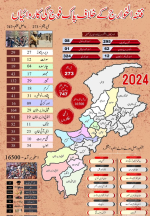
There has been a whopping 279.8 per cent increase in the number of terrorist incidents from 2021’s 572 to 2,173 in 2024. Likewise, casualty figures shot up by a staggering 231pc, from 238 in 2021 to 788 in 2024.
 
Similarly, compared to 2023, the number of terrorist incidents in KP shot up by 54.89pc while casualties increased by 11.9pc. On average, the province lost two men per day, including personnel from the security forces, civilian law enforcement and ordinary citizens.

Overall, KP’s south remains quite troubled, with spikes in attacks in the two Waziristans, Dera Ismail Khan, Tank, Lakki Marwat and Karak. The Malakand and Hazara regions, meanwhile, have remained relatively peaceful — with a major exception being the attack on Chinese workers in Bisham, Shangla in March, 2024. Kurram, together with Khyber’s scenic Tirah Valley, saw a resurgence of militants, bringing renewed threats to the provincial capital Peshawar.
 
Contrast this with the security situation in Afghanistan in the period before and after the return of the Taliban. The Brussels-based International Crisis Group (ICG), in its August 2022 report, while acknowledging the “dramatic shifts in the security situation”, noted five-fold decrease in the rate of battles, explosions and other forms of violence per week during the first ten months of the Taliban rule, compared to the same period during Ashraf Ghani’s regime.

IBOs

Amid mounting concerns over the escalating attacks across KP, the military launched small-scale operations and intelligence-based operations (IBOs).

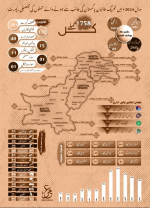
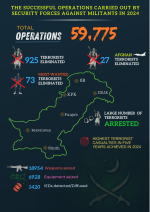
At a media briefing last week, the head of the military’s media department said that over 59,000 IBOs were conducted across Pakistan in 2024 — an average of 161 operations per day. Although KP-specific IBO figures were not available, official statistics suggest that a total of 384 militants were killed over the course of the year.

Meanwhile, the proportion of “own” casualties versus militant losses is huge.

This gap between the effort to hunt down militants and the damage they have sustained may be explained by the complex nature of guerilla warfare, but while the TTP and its affiliates have not been able to find a permanent foothold, their spread and presence has increased manifold.

“Clearly, the existing strategy is working to cause a significant dent. This is not sustainable. We need deliberations to take stock of the situation and frame a new strategy to overcome the problem,” an insider said, pointedly.

Opinions vary as to why, despite a huge effort, Pakistan’s counter-terrorism campaign has not been able to overcome its security challenges and cause a significant dent in the rise of militancy.

According to background discussions with security officials, there are many factors that have contributed to this.
 
Clearance vs containment

Adding to the complexity of the challenges, the TTP has been able to successfully adopt the Afghan Taliban playbook by declaring it would only target men in uniform and avoid targeting civilians in an attempt to drive a wedge between the security forces and the citizenry. This is largely in line with group leader Mufti Noor Wali’s own strategy, outlined in a booklet he had authored before he became its head.

Officials and analysts believe that much of the state’s efforts were focused on containment rather than clearance, and that the issue could be sufficiently addressed if forces are deployed in sufficient number.

But while there is a general agreement to undertake military operations in a couple of regions in a phased manner, the lack of public and political support, and appetite for another round of displacement, is complicating the issue.

Officials and analysts believe it is time to re-visit the counter-terrorism strategy, and focus more on the use of technology to track, monitor, surveil and strike, coupled with a whole set of political, legal and administrative reforms.
 
To view this content we will need your consent to set third party cookies.
For more detailed information, see our cookies page.
 
To view this content we will need your consent to set third party cookies.
For more detailed information, see our cookies page.
 
To view this content we will need your consent to set third party cookies.
For more detailed information, see our cookies page.
 
To view this content we will need your consent to set third party cookies.
For more detailed information, see our cookies page.
 

Users who are viewing this thread

Pakistan Defence Latest

Latest Posts

Back
Top