International loans / Grants / Investments / Reports

Lie and BS. Fdi is actually 300 million USD and the remaining is just reinvestment. We wont get investment in real term unless we lower business taxes which is one of the highest globally more than 30% and fix electricity issue.
 
Great news can we get a breakdown of this as well.
 
I mean all of the MNC companies are quitting Pakistan. I wonder who and where is this investment coming from? Is it like the $11bn manipulation in trade, I wonder.
 
What exactly was that FDI? Can we have a breakdown?

And I like the cherry picking of numbers. Are trade gap and other metrics are now ballooning again once we slightly loosened our controls on everything.
 
I asked dear ChatGPT to break it down for me.

  • FDI inflows (gross) FY25: $4,026.6m
  • FDI outflows FY25: $1,569.6m
  • FDI net FY25: $2,457.0m.

FY2024–25 (Jul–Jun) — NET FDI (adds up to SBP total)​


Net FDI by country (headline contributors)​


(All values USD million; net = inflows minus outflows. Totals reconcile to SBP’s $2,457 m net FDI for FY25.)


  • China: 1,224.3
  • Hong Kong: 470.1
  • United Arab Emirates: 283.1
  • Switzerland: 203.3
  • United Kingdom: 201.8
  • All other countries (net, incl. positives like South Korea and negatives like Canada, Norway, Germany, Panama): 74.4
    Sum check:
    1,224.3 + 470.1 + 283.1 + 203.3 + 201.8 + 74.4 = 2,457.0 ✅ División de Finanzas+3The Daily CPEC+3Business Recorder+3

Sources: SBP-based tallies in mainstream press give China’s net ≈ $1.22 bn and list HK, UAE, Switzerland, UK next; SBP’s summary gives the net total ($2.457 bn). The Economic Survey also names notable net outflows (e.g., Canada −79.7, Norway −42.0, Germany −19.6, Panama −18.5) that explain the small residual. División de Finanzas+3The Daily CPEC+3Business Recorder+3

Net FDI by sector (top buckets)​


(All values USD million; net. These are FY25 full-year numbers reported from SBP’s sector workbook; telecom is a net outflow. Totals reconcile to the same $2,457 m.)


  • Power (total): 1,165.7 (incl. Hydel ~759.4)
  • Financial services: ~702.2
  • Electrical machinery: ~176.0
  • Oil & gas exploration: ~123.5
  • Electronics: ~95.9
  • Information technology: ~57.0
  • Food: ~42.0
  • Petroleum refining: ~37.5
  • Textile: ~25.7
  • Telecommunications (communications): ~−131.0 (net outflow)
  • All other sectors (combined): ~162.5
    Sum check:
    = 2,457.0 ✅ The Nation+2The Nation+2


I mean all of the MNC companies are quitting Pakistan. I wonder who and where is this investment coming from? Is it like the $11bn manipulation in trade, I wonder.

SBP doesn't have $ printing machine to make up these numbers, be serious.
 

China Tops Pakistan’s FDI Chart in Q1 FY2026​

By Tahir Ali | Gwadar Pro
Oct 21, 2025

ISLAMABAD– China emerged as the leading source of foreign direct investment (FDI) in Pakistan during the first quarter of Fiscal Year 2026, with net inflows of $188.6 million, accounting for 33.15% of the country’s total net FDI of $568.8 million, according to the latest data released by the State Bank of Pakistan (SBP) on Monday.

Hong Kong Special Administrative Region (HKSAR) of China followed with an additional $96 million, consolidating the overall Chinese footprint as the dominant foreign investor group during the July–September period. Other major contributors included Switzerland ($55.2 million), the United Kingdom ($53.9 million), the UAE ($50.1 million), and Canada ($38.2 million).

In September 2025, China once again led the monthly inflows with $68.2 million, followed by Hong Kong ($35.9 million) and the United Kingdom ($30 million). Total net FDI for the month stood at $185.6 million.

Sector-wise data highlights that electricity, gas, steam, and air conditioning supply attracted the highest net FDI at $255.2 million during Q1 FY2026, nearly half of Pakistan’s total FDI inflows in the quarter. This is a traditional focus of Chinese investors under the China-Pakistan Economic Corridor (CPEC), with several energy projects either operational or under construction.

The manufacturing sector followed with net FDI of $84.5 million, while construction received $39 million. Wholesale and retail trade drew $11.5 million, and agriculture registered $1.15 million in net inflows. The mining sector posted net outflows of $18.1 million, while information and communication recorded a negative balance of $17.4 million.
 

Pakistan, Kuwait ink $25mn loan agreement for Mohmand Dam Hydropower Project


BR Web Desk
November 1, 2025

Pakistan and Kuwait on Friday formalised the second loan agreement worth Kuwaiti Dinar 7.5 million, i.e. approximately $25 million, for the Mohmand Dam Hydropower Project, further strengthening bilateral economic cooperation between the two countries.

The agreement was signed at the Ministry of Economic Affairs in Islamabad between the Government of Pakistan and the Kuwait Fund for Arab Economic Development (KFAED), read a statement.

The agreement was signed by Muhammad Humair Karim, Secretary, Ministry of Economic Affairs, on behalf of the Government of Pakistan. Fahad Hesham H. A. S. Aldousari, Deputy Head of Mission, Embassy of the State of Kuwait, and senior officials from the Ministry of Economic Affairs and WAPDA attended the ceremony.
 
The government is considering seeking technical assistance from the International Monetary Fund (IMF) to help revise the resource distribution formula under the National Finance Commission (NFC) Award, The News reported, citing sources.

The proposal aims to address the growing fiscal deficit and unsustainable debt levels that have resulted from the current distribution structure.

The Ministry of Finance has prepared a preliminary report highlighting the challenges of the last NFC Award, which was implemented 15 years ago. The report notes that the fiscal deficit has widened over the years, leaving the government with no choice but to increase borrowing to cover the emerging liabilities. As a result, both the absolute debt numbers and the debt-to-GDP ratio have ballooned to unsustainable levels.

Sources suggest that the IMF could offer technical assistance on resource allocation, especially considering the experience of other economies in the region and globally. However, no formal request has yet been made to the IMF, and discussions between the Ministry of Finance and the IMF are still pending on the specifics of the resource distribution and the Federal Divisible Pool (FDP) under the NFC.

One of the key issues under discussion is the proposed 27th Constitutional Amendment, which aims to adjust the resource distribution both vertically between the Centre and provinces and horizontally within the provinces. The federal government seeks to reduce the share of the provinces in the NFC Award, which currently stands at 57.5%. This would increase the Centre’s share, though the 18th Constitutional Amendment protects the provinces’ financial share, requiring an amendment to this clause for any reduction.

Additionally, the distribution criteria within provinces may be modified. Currently, the population-based weightage stands at 82%, with smaller allocations for poverty and backwardness (10.3%), revenue collection (5%), and Inverse Population Density (2.7%). The proposal suggests lowering the weightage of population as a primary criterion.

According to the existing NFC formula, the provinces’ share of the Federal Divisible Pool (FDP) is divided as follows: Punjab receives 51.74%, Sindh 24.55%, Khyber Pakhtunkhwa (KP) 14.62%, and Balochistan 9.09%.

This ongoing discussion about the NFC Award highlights the government’s intent to review the financial framework to address the country’s rising debt and improve fiscal sustainability.
 
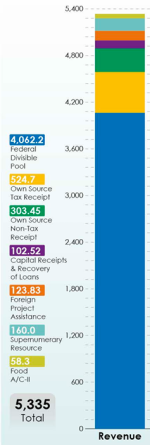
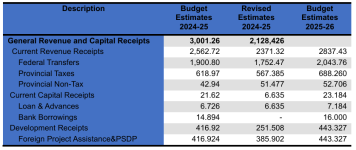
this should not have been done in the first place. all provinces, including punjab, are lazy. they have not improved the collection of sales tax, excise and other provincial taxes. their budgets still have the federal grant as a major component.
 
this is for punjab, :

1762427132740.png
this is for sindh:
1762427315851.png
 
The International Monetary Fund (IMF), in its long-awaited Governance and Corruption Diagnostic Assessment (GCDA), has highlighted persistent corruption challenges in Pakistan driven by systemic weaknesses across state institutions and demanded immediate initiation of a 15-point reform agenda to improve transparency, fairness and integrity.

The report, publication of which is a precondition for the IMF executive board’s approval of a $1.2 billion disbursement next month, estimates that Pakistan could boost economic growth by about 5 to 6.5 per cent over five years if it implements a package of governance reforms beginning within the next three to six months.

Read more: https://www.dawn.com/news/1956186
 
• Lender’s Governance and Corruption Diagnostic Assessment proposes 15-point reform plan
• Calls for tighter limits on govt’s financial powers
• Demands first public annual report of SIFC, concessions granted
• Points to opaque tax system, intrusive regulations, weak independent regulators

ISLAMABAD: The International Monetary Fund (IMF), in its long-awaited Governance and Corruption Diagnostic Assessment (GCDA), has highlighted persistent corruption challenges in Pakistan driven by systemic weaknesses across state institutions and demanded immediate initiation of a 15-point reform agenda to improve transparency, fairness and integrity.

The report, publication of which is a precondition for the IMF executive board’s approval of a $1.2 billion disbursement next month, estimates that Pakistan could boost economic growth by about 5 to 6.5 per cent over five years if it implements a package of governance reforms beginning within the next three to six months.

ADVERTISEMENT


Aritifical Inteligence uses


The GCDA seeks an end to special treatment for a few influential public sector entities in direct government contracts and transparency in the affairs and decision-making of the Special Investment Facilitation Council (SIFC). It also recommends tighter limits on the government’s financial powers without greater parliamentary oversight and streamlining of anti-corruption agencies. The government had been delaying the publication of the report since August.


“A unifying theme is the emphasis on increasing transparency and accountability in policy formulation, implementation and monitoring. This involves improving access to information and strengthening the capacity of state and non-state stakeholders to participate effectively in governance and economic decision-making,” the report said, calling for advancing rule-based governance.

It said Pakistan would obtain substantial economic benefits from improving governance, accountability and integrity along the lines recommended in the GCDA.

“Pakistan could generate between a 5pc to 6.5pc increase in GDP by implementing a package of governance reforms over the course of five years” beginning in three to six months, it said. The key areas include improvements in governance and anti-corruption, business regulation and regulation of foreign trade.


It said both the IMF and the government agreed that confronting and reducing corruption vulnerabilities was necessary for sustainable reform and that anti-corruption efforts are most successful when they combine initiatives to strengthen governance with initiatives to directly confront corruption and enhance integrity.

Indicators showed weak control of corruption over time with negative consequences for public spending effectiveness, revenue collection, and trust in the legal system.

The GCDA revealed systemic governance weaknesses across state functions and noted that the country was exposed to corruption risk generated by weaknesses in budgeting and reporting of fiscal information, and management of public financial and non-financial resources, particularly in capital spending, public procurement and the management and oversight of state-owned enterprises (SOEs).

It also identified an overly complex and opaque tax system administered by tax and customs authorities operating with insufficient capacity, management and oversight.

On top of this was a judicial sector that is organisationally complex, is unable to reliably enforce contracts or protect property rights due to problems with efficiency, antiquated laws, and the integrity of judges and judicial personnel.

Procurement, SIFC

The IMF demanded that all public sector procurements should eliminate preferences for SOEs, including special provisions for direct contracting and mandatory use of e-governance procurement for all state transactions within 12 months.

It called for immediately producing and making public the first annual report of the SIFC, including information on all investments it facilitated, including concessions provided (tax, policy, regulatory and legislative), along with detailed rationale and the outcomes.

It said that given its broad and disparate organisational functions and authority, it was essential for the SIFC to develop explicit protocols for undertaking its activities and enhanced transparency arrangements to enable effective oversight and accountability.

It also questioned the SIFC’s creation in the first place and the immunity its staff enjoyed in decision-making. It said the council was created by amendment in the Board of Investment (BoI) law to accelerate investment and privatisation efforts, but the BoI continued to exist.


It noted that corruption vulnerabilities also have a significant impact on the fiscal performance of the public sector. While other factors also contribute to public sector performance, Pakistan’s tax-to-GDP ratio is low and falling, mainly due to the complexity of the tax system, frequent changes in rules, and low public trust in the government.

It also noted that the government retained significant discretionary power over how public money was spent, given significant differences between enacted budgets and how public money was actually spent, in an environment with limited public transparency or parliamentary engagement in budgetary matters.

Discretionary allocations are skewed towards districts represented in the government or the senior bureaucracy, reflecting the vulnerability of the system to political influence. This resulted in low return on public investment.

Published in Dawn, November 20th, 2025
Follow Dawn Business on X, LinkedIn, Instagram and Facebook for insights on business, finance and tech from Pakistan and across the world.
 
Fake news, Hafiz sab is personally managing everything, and according to him, he is the commander of Allah's Army, so nothing wrong and bad can happen in Pakistan since he became the Commander and until he is allive.

So please do not fall for bropaganda false and fake news and reports.

Thanks
 

Users who are viewing this thread

Latest Posts

Back
Top