ToddE
Trusted Member

The Shaheen 3 if Pakistan has a range of 3750km
2750*
Follow along with the video below to see how to install our site as a web app on your home screen.
Note: This feature may not be available in some browsers.
The Shaheen 3 if Pakistan has a range of 3750km

US threats continue

Iran knows what those threats mean since 1990, same typo, same words, same threats since 1990, this is at least the 10th time Trump threats Iran since 2015, we know what that meansIs Iran on a war footing?
Is the population ready? Are plans being made?

Are you seriously going to tr oll and just ignore how and why it got shot down?US conducted SEAD/DEAD missions before using F-117 and it was still shot down by old soviet system
I am not under any illusions - the US has cutting edge LO and VLO technology likely unrivalled by anyone else on the planet. but that doesn't mean they are magic weapons that can never be challenged

You better go read about that incident in more detail.US conducted SEAD/DEAD missions before using F-117 and it was still shot down by old soviet system
I am not under any illusions - the US has cutting edge LO and VLO technology likely unrivalled by anyone else on the planet. but that doesn't mean they are magic weapons that can never be challenged

They need to clear with SEAD/DEAD mission only the long and medium range missiles to employ the B-2. What is Iran's total air defense capability?stand off weapons don't have sufficient range to hit anything buried underground
they need weeks long SEAD/DEAD missions before they can use B-2
must be a ruse
history suggests the US will start an attack by launching hundreds-thousands of cruise missile strikes from destroyers to suppress air defences

2750*

Taghvaee is generally on the money about technical aspects but he's a barandaazi so he's very motivated to embellish Israel and disparage Iran. I think at some point he was offered money.Lol. Who the hell is this guy and where did he get this info? Signal chat?
Look youz guys Orange man is NOT going to attack Iran as in a first strike the B2's have history of being deployed in Diego Garcia all the time... Orange man may also be using this at the same time as a negotiation tactic that's all... trust me bruh.
Iran should be concern with Israel I think they have set a date and told the US and it is possible we're there for a "just in case break glass" built up.
More likely anywhere upto 4000
2740km is a official range that covers all of Indian territory, Pakistan is currently looking to increase engine efficiency to get greater range but the U.S is being a bitch about it with sanctions

Easily shot down is also an exaggeration on your part. They really wouldn't have a "walk in the park" as some here like to claim, but they wouldn't be so easily shot down either, especially considering that there would be some preparatory attacks against long-range air defenses.In my opinion, these analyses are absurd because Anglo-American-Zionist war machines have never been tested against a minimally strong and well-equipped enemy. Bombing Iraq in the 90s/2000s would be like hopping into the DeLorean (Dr. Brown and Marty McFly) and traveling back to the Middle Ages to bomb medieval peasants—because Iraq had (and still has) no way of detecting what’s in its airspace (even if it’s just a child’s KITE), let alone striking back at the sources of these attacks.
If F-117s and B2s are invincible, why doesn’t the U.S. invade North Korea or hand these weapons over to Ukraine to bomb Russian positions in occupied territories(in Ukraine)? The answer is simple: if F-117s and B2s were deployed against North Korea or Russia, they’d be easily shot down—shattering the myth of military invincibility and costing billions in losses. Then, their media would deny it while the truth would spread online.
Note: Yemen also can’t detect incoming strikes, but yet multiple B-2 bombings (even when hitting their targets) failed to destroy what they intended. Proof? Yemen keeps attacking U.S. and Israeli targets, while Israeli ships still avoid the area.

 balloonstodrones.com
ou:"This claim about the lethality and ferocity of Iraqi air defences needs to be analysed to see if it has any merit. The Iraqi integrated air defence system (IADS) comprised a mix of Soviet and Western air defence systems. While the surface-to-air missiles (SAMs) were predominantly of Soviet origin, the heart of the IADS, called KARI, was built by the French defence contractor, Thomson-CSF. It was designed primarily to provide air defence against Israel and Iran and had a severe limitation: it could only manage 20 to 40 hostile aircraft. Iraq had over 500 radars located at about 100 sites, but the radar layout did not afford comprehensive coverage with a bias toward east and west. Most radars could not detect stealth aircraft barring the limited capability of the P-12 and P-18 radars and the six Chinese (Nanjing) low-frequency radars.[3]
Iraqi GBAD included SAM and anti-aircraft artillery (AAA) guns. The missiles included the Soviet SA-2, SA-3, SA-6 and SA-8 and the Franco-German Roland I/II missiles. With a range limitation of about 40km, even SA-2s and SA-3s cannot be considered strategic air defence systems, while the SA-8s and the Rolands were purely tactical SAM systems. The SA-6 was used for the tactical role and to fill gaps in the strategic SAM layout. The 58 SAM batteries notwithstanding, Iraq had no strategic SAM system, and with the available SAM batteries, it was capable of limited and thin air defence cover over its strategic targets."
The Iraqi IADS comprised a mix of Soviet and Western air defence systems. While the SAMs were predominantly of Soviet origin, the heart of the IADS, called KARI, was built by the French defence contractor, Thomson-CSF. It was designed primarily to provide air defence against Israel and Iran and had a severe limitation: it could only manage 20 to 40 hostile aircraft. Iraq had over 500 radars located at about 100 sites, but the radar layout did not afford comprehensive coverage with a bias toward east and west. Most radars could not detect stealth aircraft barring the limited capability of the P-12 and P-18 radars and the six Chinese (Nanjing) low-frequency radars.
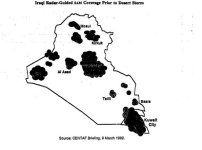
Iraqi GBAD's SAMs included the Soviet SA-2, SA-3, SA-6 and SA-8 and the Franco-German Roland I/II missiles. With a range limitation of about 40km, even SA-2s and SA-3s cannot be considered strategic air defence systems in the 1990s (sure in '60's, but not 30 years later), while the SA-8s and the Rolands were purely tactical SAM systems. The SA-6 was used for the tactical role and to fill gaps in the strategic SAM layout. The 58 SAM batteries notwithstanding, Iraq had no strategic SAM system, and with the available SAM batteries, it was capable of limited and thin air defence cover over its strategic targets. I'm including two maps here, one for Iraqi radar-based SAM's, and another for IR Stam's and AAA.
With the country’s material assets widely dispersed; no attempt was made to defend all of them. Instead, the SAMs and AAA were concentrated on defending selected areas or sectors like Baghdad, Basra, the Scud-launching sites in western Iraq, and the northern oil fields only, with the defence of the capital given the foremost priority. With a concentration of the SAMs and AAA in select areas, Iraq had adopted a point defence system.
Fifty-eight SAM batteries, almost half the total 120 batteries, were deployed to defend Baghdad alone and 1,300 AA guns. The other areas with these missile systems were Basra with fifteen and Mosul/Kirkuk with sixteen batteries. In addition, the airfield complex of H-2/H-3 had 13 SAM batteries, and the Talil/Jalibah complex had three.
Even in Baghdad, the defence systems did not necessarily protect downtown Baghdad at a higher threat level than the rest of the overall metropolitan area, as the SAM sites were dispersed throughout the Baghdad area. The United States Air Force (USAF)’s claim that downtown Baghdad was where air defences are uniquely dense or severe was thus without merit.
The SA-2s and SA-3s, being vintage missiles, were supplemented by the newer SA-6s with a battery deployed at essential sites. Although the presence of SA-6s at selected locations beefed up the air defences, it had an unintended effect that with the SA-6s moving back from the front-line units, the forward army units were left devoid of the most effective SAM in the inventory. The Iraqis captured several examples of the US HAWK missile system when they invaded Kuwait. The HAWK missile, with a comparable range, would have been an effective deterrent, but as the Iraqis did not have the technical expertise to operate it, it was never not used.The air defence network was thus far from lethal and was not designed to work against a massive air assault as it was subjected to during DESERT STORM. Instead, it had limited capabilities and was optimised only to take on threats from two axes. These were from Iran to the east or from Israel to the west and did not cater for any significant threat from the south or the north. Notably, only the overall assessment of the Iraqi IADS by the US Navy’s Strike Projection Evaluation and Anti-Air Research (SPEAR) Department was more realistic than other claims as it stated that:
[t]he command elements of the Iraqi air defence organisation (the interceptor force, the IADF [Iraqi Air defence Force], as well as Army air defence) are unlikely to function well under the stress of a concerted air campaign.[8]
The coalition forces launched DESERT STORM at 2:38 on 17 January 1991 when Task Force Normandy struck the two Iraqi radars codenamed Nebraska and Oklahoma, firing 27 Hellfire missiles, 100 rockets and 4,000 rounds of 30mm ammunition. A corridor 30 kilometres wide was now available for the follow-on missions. Next were the eight USAF F-15E Strike Eagles that targeted the local air defence command and control centre, further degrading the network and facilitating the strike by the F-117s preceded by three EF-111 Ravens. Seventeen F-117s were tasked to deliver 27 laser-guided bombs on 15 Iraqi air defence system-related targets.
The performance of Iraq’s air defence system was effective on Day 1 as they shot down six aircraft: all except one by GBAD. The AAA shot down two aircraft (one F-15 and a Royal Air Force (RAF) Tornado GR.1) while the SAMs claimed three. An Iraqi MiG-25 shot down one F/A-18. GBAD damaged a dozen more aircraft. Another drawback of the Iraqi IADS was that the 8,000 or so anti-aircraft guns were reportedly not integrated with the overall air defence system and were designed to operate independently.
The low kill rate by the radar SAMs is attributable to several factors, the primary one being the SEAD missions conducted by Coalition air forces which forced the radar SAMs to shut down most of the operations. In addition, all the radar SAMs held by Iraq were vintage Soviet-era missiles that had been used in combat earlier – there were no new weapons, like the SA-6s in the Yom Kippur War, which could have posed difficulties for the Coalition air forces.
Never been tested against a minimally strong and well-equipped enemy?In my opinion, these analyses are absurd because Anglo-American-Zionist war machines have never been tested against a minimally strong and well-equipped enemy. Bombing Iraq in the 90s/2000s would be like hopping into the DeLorean (Dr. Brown and Marty McFly) and traveling back to the Middle Ages to bomb medieval peasants—because Iraq had (and still has) no way of detecting what’s in its airspace (even if it’s just a child’s KITE), let alone striking back at the sources of these attacks.
If F-117s and B2s are invincible, why doesn’t the U.S. invade North Korea or hand these weapons over to Ukraine to bomb Russian positions in occupied territories(in Ukraine)? The answer is simple: if F-117s and B2s were deployed against North Korea or Russia, they’d be easily shot down—shattering the myth of military invincibility and costing billions in losses. Then, their media would deny it while the truth would spread online.
Note: Yemen also can’t detect incoming strikes, but yet multiple B-2 bombings (even when hitting their targets) failed to destroy what they intended. Proof? Yemen keeps attacking U.S. and Israeli targets, while Israeli ships still avoid the area.
| Army | Iraqi Army |
| Troops | Total = 640000 Regular Troops = 400000 Republican Guards = 240000 |
| MBT | Total = 5500+ Soviet T-72 = 1000 Soviet T-62 = 1500 Chinese Type 59 = 1500 Soviet T-54/55/M-77 = 1500 British Chieftain MK variants = 30 |
| APC / IFV | Total = 7500 IFV = 1500 (Soviet BMP-1/-2) APC = 6000 (Soviet BTR-50/-60/-152; Polish OT-62/-64; Soviet MT-LB; Chinese Type 63; American M-113A1/A2; French Panhard M-3; Brazilian EE-11 Urutu) |
| Artillery Pieces | Total = 3700+ Towed = 3000 Self-propelled = 500 MLRS =200 |
| Air Defense | AA guns = 4000 (From 23 mm to 130 mm) SAM systems* = 600+ (Soviet SA-2 = 60; Soviet SA-3 = 140; Soviet SA-6/-7/-8/-9/-14 = 300+; French Roland = 100) |
| Ballistic Missiles | Total = 86 TEL FROG-7 class TEL = 50 Scud-B class TEL = 36 |
| Helicopters | Total = 518 Attack type = 159 (German Bo-105 = 56; Soviet Mi-24= 40; French SA-316 = 30; French SA-321 = 13; French SA-342 = 20) Transport type = 364 (Soviet Mi-6 = 15; American Bell 214 ST = 40; Soviet Mi-8/-17 = 140; Italian Agusta AS-61 = 5; French SA-330 = 20; Soviet Mi-4 = 20; Italian Agusta A-109 = 3; American Bell AB-212 = 5; American Hughes 300C = 30; American Hughes 500D = 30; American Hughes 530F = 26; French SA-342 = 30) |
Indian authors have a bad habit of downplaying capabilities of other countries. How good were Indian defenses in 1990? The outcome of Operation Desert Storm shocked Soviet and Chinese analysts of the time. Indians also underestimated PAF and generally claimed that their Su-30 MKI were better than F-16 but PAF showed otherwise in Operation Swift Retort in 2019. Indians are deluded.Easily shot down is also an exaggeration on your part. They really wouldn't have a "walk in the park" as some here like to claim, but they wouldn't be so easily shot down either, especially considering that there would be some preparatory attacks against long-range air defenses.
As for Iraq, especially the one before 1991, the myth is repeated over and over...
Looking Back at Iraqi Air Defences during Operation DESERT STORM
By Colonel Mandeep Singh Iraqi forces stormed into Kuwait on 2 August 1990 and, after a seven-month occupation of its southern neighbour, was defeated by the United States-led coalition forces cons…
ou:
View attachment 110562
The B-2 strike on Yemen may be subject to restrictions on the use of the MOP, as only that aircraft is certified to deliver such a bomb. Although Yemen may have some air defenses, it simply did not make sense to employ US Navy tactical aircraft to avoid unnecessary casualties.


