Navigation
Install the app
How to install the app on iOS
Follow along with the video below to see how to install our site as a web app on your home screen.
Note: This feature may not be available in some browsers.
More options
Style variation
You are using an out of date browser. It may not display this or other websites correctly.
You should upgrade or use an alternative browser.
You should upgrade or use an alternative browser.
Iranian Ground Forces | News and Discussions
- Thread starter Persian Gulf
- Start date
More options
Who Replied?


tsunset
The Legend

repost from Zarathustra
So Karrar tanks got delivered to Iranian ground forcesAddressing the delivery of Karrar tanks to Iranian ground forces, Talaei-Nik assured that production and delivery are in accordance with the armed forces' needs and annual requirements, without any constraints.

Hack-Hook
INT'L MOD
and nobody believed me when I said yemen missiles are their own
Flames In The Desert
Registered Member

Fatman17
THINK TANK: CONSULTANT

IRANIAN ARMY DAY PARADE: WHICH HELICOPTERS WERE INVOLVED?
- Aviation Features
- Iranian Army Day Parade: Which helicopters were involved?
By Babak Taghvaee 19th May 2022
FEATURE
More than 50 helicopters took part in Iran’s Army Day Parade this year. Babak Taghvaee has the details
All four branches of the Iranian Army participated in parades across the country to mark Army Day on April 18 this year. Having been impacted by the pandemic for the past two years, the annual Army Day parade took place in the south of Tehran, and saw Iranian Army Aviation hold flypasts with 51 helicopters from three of the force’s air bases.
The helicopters flew in 16 three-ship formations and one two-ship formation, while the 51st helicopter, Bell 214A serial 6-4734, was used by Brigadier General Yousef Qorbani, commander-in-chief of the force, to observe the flypasts.

Agusta Bell 206B 2-4248 is operated by the Vatan-Poor Training Centre
Tavakkoli
In total, the Islamic Republic of Iran Army Aviation (IRIAA) allocated 53 helicopters for the parade, including two spares. Among these, 30 belonged to the Vatan-Poor Training Centre, 20 to the IRIAA’s 4th General Support Base from the city of Isfahan, and three to the 7th Combat Base in Abyek, west of Tehran.
Located in south Isfahan, Vatan-Poor Air Base – previously known as Prince Reza Pahlavi Base – is home to one of the largest helicopter pilot training centres in Asia, with 108 operational helicopters in service with its four training battalions. They comprise 39 Agusta Bell AB206A/B JetRangers, 33 Agusta Bell AB205A Hueys, nine UH-1H Huey, 15 Bell 214A Isfahans and 12 Bell AH-1J Sea Cobras.
The large number of operational helicopters at the base enables the IRIAA to allocate 30 of them to the annual Army Day Parade flypasts. This year, the Vatan-Poor Training Centre provided one AB206A JetRanger, nine AB206B JetRanger IIs, eight AB205A Hueys, one UH-1H Huey, six Bell 214A Isfahans and five AH-1J Cobras (all non-TOW variants).
Meanwhile, the 4th General Support Base helicopters comprised three AB206B JetRanger IIs, three AH-1J TOW Cobras, one modernised AH-1J Toufan II, seven Bell 214A Isfahans and six CH-47C Chinooks. Three Bell 214As from the 7th Combat Base, near the city of Qazvin, also took part.

AH-1J Toufan II 3-4528 from the 4th General Support Base was armed with four captive Shafagh ATGMs during the parade
Keyvan Tavakkoli
All helicopter pilots and co-pilots practised formation flights during two rehearsals in Isfahan and Qazvin between April 9-14. After that, they had their helicopters deployed to an Iranian Army Ground Force military base in Parandak, near the city of Tehran, on April 14. Two days later, the IRIAA held a rehearsal for the aircrew participating in the parade. During the rehearsal, half the helicopters flew over the parade location.
The leader of the IRIAA’s flypasts piloted AB206B JetRanger II serial 2-4267. The helicopter belonged to the Assault Battalion of the 4th General Support Base. It was painted in the Iranian flag colours of white, red and green. The helicopter is the only JetRanger in Iranian Army Aviation that has the high-skid undercarriage.
During the morning of April 18, all the helicopters, except AB206B serial 2-4256 (a reserve), left Parandak. The AB206A/Bs formed four three-ship formation flights and flew as the first group of helicopters over the parade location at 0920hrs local time. After that, eight AB205As and a UH-1H flew in a trio of three-ship formations, then eight AH-1J Cobras in two three-ships and one two-ship flight. Following the Cobras, 15 Bell 214As flew in five three-ship formations. Finally, six CH-47C Chinooks flew in two three ship flights over the parade location. Lasting only five minutes, the IRIAA flypasts were complete by 0925hrs.

IRIAA AH-1J attack helicopters return to Parandak after participation in the rehearsal on April 16
Ali Naderi
IRIAA CH-47C 5-4090 is one of the two Chinooks recently painted in digital camouflage
Keyvan Tavakkoli
Digitalised paint scheme
During the parade, the IRIAA unveiled its helicopters’ new digital camouflage, which has been a long time coming.
Beginning in 2016, the IRIAA faced a significant budget shortfall, resulting in an inability to pay the cost of its helicopters’ depot-level maintenance provided by the IHSRC (Iranian Helicopter Support and Renewal Company), which belongs to the Iranian Ministry of Defense.
Previously, the IRIAA’s maintenance units across the country had gained the capability of performing OCM (on-condition maintenance) and, at some bases, they had become capable of performing depot-level maintenance on the helicopters. In the past, they had been authorised to perform only field-and organisation-level maintenance, leaving depot-level to the IHSRC.
Initially – due to an absence of enough special tools, testers and many other equipment – the quality of the overhauls performed at IRIAA bases was said to be low. However, with the procurement of the required tools and production of testers by the IRIAA’s Ya-Ali industrial complex, almost all the IRIAA’s maintenance centres gained the capability of performing the correct depot-level work.
With the co-operation of Isfahan Optics Industries (IOI), Iran Electronics Industries (IEI) as well as Iran Aircraft Manufacturing Industries (IAMI), the maintenance centre of the 4th General Support Base (GSB) modified six Bell 214A Isfahan utility helicopters to use an infrared (IR) camera under their nose for night operations. The modification work was performed during their regular depot maintenance. These helicopters are painted in colours similar to those of the Turkish Army. One of them also was painted in overall olive drab colour.

Agusta Bell AB205A 6-4375, from the Vatan-Poor Training Centre, in desert camouflage
Keyvan Tavakkoli
The camouflage applied on these modified helicopters was not suitable for the desert and dry landscapes of Iran. Meanwhile, the low-quality paint made it vulnerable to the sun and, after a few months, most of the helicopters saw their paintwork become damaged because of this. These factors all resulted in the design of a new standard colour scheme for all IRIAA helicopters.
Finally, in 2020, the IRIAA’s 4th GSB designed a digital camouflage to apply on not just recently overhauled helicopters but on some of the helicopters already in service. Later that year, the IRIAA’s Vatan-Poor Training Centre also started painting its helicopters in the new colours, followed in summer 2021 by the 3rd Combat Base in Kerman.
On the orders of the IRIAA’s commander-inchief, most of the Vatan-Poor Training Centre and 4th General Support Base’s digitally painted helicopters were involved in the parade. Three JetRanger training/observation helicopters, six Huey utility helicopters, ten Isfahan utility helicopters, two Chinooks and all the Cobras that participated in the parade were painted in the new digital desert colours.
New teeth for Persian Cobras
The parade also saw the IRIAA unveil its newly developed Shafagh anti-tank missiles for use on the Bell AH-1J Cobra attack helicopters. Two AH-1J non-TOW Cobras (serials 3-4427 and 3-4443), plus one AH-1J Toufan-II (serial 3-4528), carried dummy versions of the Shafagh anti-tank missiles during the flypasts. Shafagh missiles are designed and developed by the Babiee missile industries of the Ministry of Defense as well as the Ya-Ali industrial complex. A week before the parade, the Iranian Army released footage showing the AH-1Js’ successful tests of Azarakhsh and Shafagh anti-tank missiles.

AB206B 2-4267 was used by the leader of the flypast
Ali Naderi
Design and development of a new antitank missile for IRIAA helicopters started in 2014. The project was initially launched by the Tose’e Fannavaran Havapayeh company with co-operation of the IHSRC under the orders of the IRIAA. In the beginning, the FM 80 surface-to-air missiles were chosen to be modified with a laser and TV/IR seeker. After years of work, the project for the conversion of the Chinese missiles into an anti-tank guided missile (ATGM) was abandoned.
Instead, design and development of an entirely new air-to-surface missile began in 2019, leading to what is now the final version of the Shafagh ATGM. The Babaiee missile industries company delivered the first batch of Shafagh missiles to the 4th General Support Base.
They were tested for the first time at the Chaleh Siah gunnery range in Isfahan last autumn. Video of the successful test launch of the missiles show their top-attack capability.
The AH-1Js were not the only armed helicopters of the IRIAA during the parade – the 4th General Support Base had three of its FLIR-equipped Bell 214As armed with rocket pods. These helicopters demonstrated their ability to launch 2.75in Hydra rockets during exercise Eqtedar-99 on the coast of Makran, near Jask, in the southeast of Iran, in January 2021. However, they still lack a standard optical gunsight for proper use of rocket pods in combat.
The single AH-1J Toufan-II variant (serial 3-4528) that took part in the parade was previously an AH-1J non-TOW variant. IAMI equipped it with a Hughes M65 Telescopic Sight Unit (TSU) under project Toufan I, between 2007-9. The TSU was later removed and a domestically manufactured Oghab-5 EO/IR turret (made by IOI) and multifunctional displays (made by IEI) were installed by IAMI during project Toufan-II.
Under project Toufan-II, the IRIAA has had six of its AH-1J Cobras upgraded – among them, four currently have EO/IR turrets installed. These turrets enable them to use Shafagh anti-tank missiles. The number of the IRIAA’s AH-1Js modernised by IAMI under project Toufan-II is still insignificant, compared to the total size of the fleet. The key reason behind the slow speed of modernisation of these helicopters is the lack of budget.

Bell 214A Isfahan utility helicopter 6-4739 was used by the commander-in-chief of the Army Aviation during the parade
Ali Naderi
Fatman17
THINK TANK: CONSULTANT
The IRIAA currently has 98 AH-1J Cobras and among them 84 are in operational service. Of these, 15 are in service with the Attack Helicopter Battalion of the 4th GSB in Isfahan. IAMI is currently working on modernisation of the seventh AH-1J for the IRIAA and it is scheduled to be delivered to the 4th GSB in March 2023.
The IRIAA is not the only operator of AH-1J Cobras in Iran – the newly formed Islamic Revolutionary Guard Corps Army Aviation Force (IRGCAA) is the second.
The IRGCAA operates nine AH-1Js, comprising two domestically built versions and seven former IRIAA examples that were sold to IRGC by IHSRC after they were rebuilt by the company in early 2000s.
IRGCAA has had three of its Cobras upgraded to Toufan-II standard, of which two currently have Oghab EO/IR turrets installed instead of the M65 TSUs.
Unlike the IRIAA – which is planning to use Shafagh anti-tank missiles on its Cobras – the IRGCAA has selected Qaem-114 anti-tank missiles for use on its AH-1Js. The anti-tank missile, which has an appearance similar to the AGM-114 Hellfire, is currently still being developed.
IRIAA and IRGCAA Cobras have been involved in various counter-narcotics and anti-terrorism operations over the past ten years. IRIAA Cobras fought Jundollah and later Jaish-ul Adl extremists in the Sistan and Baluchistan province of Iran between 2008-19. They also took part in several operations against so-called Islamic State/Daesh in the Diyala governorate of Iraq in 2015 while the IRGCAA’s Cobras have been active against both Jundollah/Jaish ul-Adl and PKK/PJAK terrorist groups.
Participation of the IRIAA’s AH-1Js – armed with Shafagh anti-tank missiles – in the Army Day parade this year provided a perfect demonstration of the enhancement and improvement in combat capability afforded to these helicopters.

Four IRIAA AB206A/Bs head a long line-up of helicopters prior to participation in the rehearsal on April 16
Ali Naderi


The IRIAA is not the only operator of AH-1J Cobras in Iran – the newly formed Islamic Revolutionary Guard Corps Army Aviation Force (IRGCAA) is the second.
The IRGCAA operates nine AH-1Js, comprising two domestically built versions and seven former IRIAA examples that were sold to IRGC by IHSRC after they were rebuilt by the company in early 2000s.
IRGCAA has had three of its Cobras upgraded to Toufan-II standard, of which two currently have Oghab EO/IR turrets installed instead of the M65 TSUs.
Unlike the IRIAA – which is planning to use Shafagh anti-tank missiles on its Cobras – the IRGCAA has selected Qaem-114 anti-tank missiles for use on its AH-1Js. The anti-tank missile, which has an appearance similar to the AGM-114 Hellfire, is currently still being developed.
IRIAA and IRGCAA Cobras have been involved in various counter-narcotics and anti-terrorism operations over the past ten years. IRIAA Cobras fought Jundollah and later Jaish-ul Adl extremists in the Sistan and Baluchistan province of Iran between 2008-19. They also took part in several operations against so-called Islamic State/Daesh in the Diyala governorate of Iraq in 2015 while the IRGCAA’s Cobras have been active against both Jundollah/Jaish ul-Adl and PKK/PJAK terrorist groups.
Participation of the IRIAA’s AH-1Js – armed with Shafagh anti-tank missiles – in the Army Day parade this year provided a perfect demonstration of the enhancement and improvement in combat capability afforded to these helicopters.
Four IRIAA AB206A/Bs head a long line-up of helicopters prior to participation in the rehearsal on April 16
Ali Naderi
Topics
Read more about
Originally published in AirForces Monthly Magazine
samejjangir
Registered Member

Why do you think Iranian missiles are better? Even the IIR missiles differ in sensor resolution. Russian sensors have very high resolution which means it can acquire more precise detail of the target for homing and lockingif its Russian , they put some pesky encryption and propriety data-link there to make it impossible until you change all the subsystem.
and when ours is better why not stick to it, for what for more armor ? did those extra armor helped Russia helicopter in ukraine when they faced man-pads?
samejjangir
Registered Member
India has developed its own subsystems and sensors to integrate its own weapons. Russian systems have encrypted source codes and datalinks which only integrate with Russian weapons. This is done for safety purpose to prevent anyone and everyone from hacking into the signals and also to prevent reverse engineeringForget the Kilo, but you really think Iran is going to buy Mi-28 with standard Russian export missiles such as Ataka? Iran has missiles with double of Ataka range and more than LMUR, including air to air helico missiles
Why would Russia force us to integrate only their weapons? India has plenty of Russian systems incorporating Indian/foreign weapons on them
Mi-28 is a success on the battlefield in Ukraine as much as other helicopters, it is one of the most modern heavy attack helicopter, with Iranian weapons on it, it would outclass Apache, Ka-52 and China Z counterparts by far
Hack-Hook
INT'L MOD
well Iranian one for start have longer range (the one fired from helicopter and drones)Why do you think Iranian missiles are better? Even the IIR missiles differ in sensor resolution. Russian sensors have very high resolution which means it can acquire more precise detail of the target for homing and locking
also i see for example we put imaging sensors in our air to air missile , Russian su-35 don't use an imaging sensor, we gave them shahed-136 they build it there but they downgraded the battery and the material used in the body, and many such small details...
also our sensors have faster lock time
Flames In The Desert
Registered Member
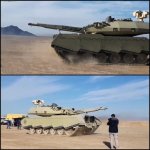
Now this looks very interesting....
"The new tank of the Army Ground Forces, which is the result of a heavy upgrade of the M-60We have to wait for the presentation of the technical specifications of this tank in order to determine if there is any difference compared to the M60 fabric 50 years ago in terms of the engine, cannon, gunner, fire control and communication/digital systems."[Translation]
Let us hope this isnt just another one-off/prototype
"The new tank of the Army Ground Forces, which is the result of a heavy upgrade of the M-60We have to wait for the presentation of the technical specifications of this tank in order to determine if there is any difference compared to the M60 fabric 50 years ago in terms of the engine, cannon, gunner, fire control and communication/digital systems."[Translation]
Let us hope this isnt just another one-off/prototype
Immortals
Elite Member

Now this looks very interesting....
"The new tank of the Army Ground Forces, which is the result of a heavy upgrade of the M-60We have to wait for the presentation of the technical specifications of this tank in order to determine if there is any difference compared to the M60 fabric 50 years ago in terms of the engine, cannon, gunner, fire control and communication/digital systems."[Translation]
Let us hope this isnt just another one-off/prototype
Based on the past, probably a one off prototype. Made to “look” modern, rather than any substantial change to the tank.
Artesh continues these test bed projects and they never really go anywhere.

I agree. I'm not a tank engineer but this strikes me as a skin deep beautification ... we'll see. I have no qualms arriving to this cynical conclusion given the history of poorly managed pseudo-announcements.Based on the past, probably a one off prototype. Made to “look” modern, rather than any substantial change to the tank.
Artesh continues these test bed projects and they never really go anywhere.

Mehdipersian
Trusted Member
New upgrade for iranian M60 tanks
...and counter-argument:I agree. I'm not a tank engineer but this strikes me as a skin deep beautification ... we'll see. I have no qualms arriving to this cynical conclusion given the history of poorly managed pseudo-announcements.
Users who are viewing this thread
Total: 2 (members: 0, guests: 2)


