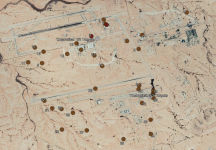
I also don't know where these estimates of 200m CEP come from for the latest Iranian ballistic missiles. We saw accurate hits on hangars and also runways and to this day the Zio-US does not release damage done to Tel-Nof where we saw a massive secondary explosion.
I tried to be generous with 200m CEP but since some clueless propaganda posters here continue to prefer to bury their head in the sand and glorify 'psychological victories' of using 200 ballistic missiles to destroy 2 hangars:
full article and CEP analysis here:
Iran’s recent missile strikes on Nevatim Air Force base only achieved limited damage, but it did give us a lot of data to play with to see precisely how accurate their missiles are under real world…

horsdoeuvresofbattle.blog
"Adding more missiles on target would only further reduce the range by small amounts. Why? Because of
the number of overshoots. If we were to simply exclude those (points 5, 15, 16, 17, 27, 28, 29, 30, 31, and 32) from the dataset, the CEP would become better, but still not great. I crunched the numbers a bunch of times playing with removing overshoots and assuming less likely target points, and
in no simulation does the CEP of these missiles break 500 meters. I think
a real CEP of around 800-900 meters is the likeliest scenario here given the data.
Even under the most favorable set of assumptions for Iran, Iranian ballistic missiles clearly do not have precision accuracy."
"The bottom line here is that,
even under a set of assumptions that are most favorable to Iranian missiles, you cannot get results from the data that suggest these missiles are capable of economic counterforce targeting"
"Their long-range missiles are simply too inaccurate to match the sort of precision strikes we saw on October 25th. This suggests – as I think we’ve already seen recently – that
there are hard limits on the deterrence benefits of Iranian missile forces. If you can only credibly threaten cities, then you can’t threaten targets that you could hit at lower rungs of the escalation ladder. This means you aren’t really able to effectively deter low level tit-for-tat conflicts like the one Israel and Iran are currently embroiled in. The result is that Iran and Israel may be stuck in a small stability-instability paradox, as Israel is clearly not willing to use nuclear weapons to respond to or deter Iranian missile strikes, and Iranian missile strikes are only really going to be effective at targets you attack at very high levels of escalation and thus are not capable at deterring Israel. This suggests that Israel and Iran trading missiles is going to be a long running problem going forward."
This could change if Iran produces missiles capable of striking counterforce targets. Once Iran proves it can destroy a large number of Israeli F-35s with conventional missiles, their missile forces will begin to pose a serious threat to Israel at low levels of escalation. But
until Iran makes those improvements, we’re stuck here.