Navigation
Install the app
How to install the app on iOS
Follow along with the video below to see how to install our site as a web app on your home screen.
Note: This feature may not be available in some browsers.
More options
Style variation
You are using an out of date browser. It may not display this or other websites correctly.
You should upgrade or use an alternative browser.
You should upgrade or use an alternative browser.
Israel Genocide in Gaza - 2023 to present - Part ll
- Thread starter Fatman17
- Start date
More options
Who Replied?


Persian Gulf
INT'L MOD


you are right. but you know that children were taken hostage into Gaza. they are not "prisoners".Children no
Female Israeli soldiers? That is a prisoner of war
These female soldiers were also heavily involved in this genocide and also should be held accountable.

Falcon29
Elite Member
You can't control everything mistakes were made. In heat of war and mom doesn't want to be separated from kids, and Hamas not taking them but other people, and Hamas securing their release almost immediately (two weeks later )you are right. but you know that children were taken hostage into Gaza. they are not "prisoners".
Israel didn't make mistakes it developed an campaign to systemically annihilate Gaza civilian population and did just that
US approved then realized later on it was a bad idea
Unknowntruth
Trusted Member
I can’t say that I’m too optimistic but we will see what happens going forward.I can assure you Hamas movement is moving towards flipping the script and pushing for statehood in coordination with Arab brothers against wishes of Israel
We aren't engaging in a forever conflict which is mostly detrimental to our people and we aren't letting Israel get what it wants
Israel will fight hard to prevent statehood but same thing will happen as is happening now, global pressure will force it to accept reality
We know what to do if they try methods of violence/terror/intimidation during this process. We have right to resist during this push for statehood.
Shags101
Trusted Member
I agreed with the women who were soldiers and from what everything came out they were treated pretty respectfully compared to how Israel treats Palestinian women and even how Israelis treat their own womenChildren no
Female Israeli soldiers? That is a prisoner of war
These female soldiers were also heavily involved in this genocide and also should be held accountable.
Shags101
Trusted Member
We can’t always pretend that certain groups in Hamas didn’t take advantage of situation many who had the chance to take ordinary civilians chose not to some didn’t we can’t pretend groups(whoever they may be) taking children women ir the elderly were doing anything good they took advantage of the situation and that’s what hurt us in the beginningYou can't control everything mistakes were made. In heat of war and mom doesn't want to be separated from kids, and Hamas not taking them but other people, and Hamas securing their release almost immediately (two weeks later )
Israel didn't make mistakes it developed an campaign to systemically annihilate Gaza civilian population and did just that
US approved then realized later on it was a bad idea
Unknowntruth
Trusted Member
That’s why I said children no as in should not be taken as prisoners.you are right. but you know that children were taken hostage into Gaza. they are not "prisoners".
I also specifically stated that female soldiers are acceptable as they are not civilians but occupation soldiers.

MNZGamerX
Trusted Member

Trump's Gaza proposal enlists Pakistani forces for a US-led plan to pacify Palestinian resistance and reshape the region's balance.
F.M. Shakil
OCT 9, 2025
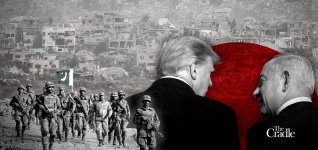
Washington is looking to draft Pakistan into a sweeping plan to reshape Gaza under the guise of a 20-point “peace” initiative led by US President Donald Trump. At the heart of the proposal is an International Stabilization Force (ISF) tasked with enforcing “internal stability” in the devastated Palestinian enclave – a euphemism for dismantling resistance and tightening Israeli control.
Trump, standing alongside Israeli Prime Minister Benjamin Netanyahu in a September press conference, laid out a scheme to forcibly relocate Palestinians and reconstruct Gaza as a neoliberal outpost he previously branded “the Riviera of the Middle East.”
Pakistan's public backlash builds
Details of the initiative have raised alarm in Pakistan, where any military collaboration with Israel is a red line for the establishment and the population, given that Islamabad does not recognize the state. Public backlash has intensified since revelations surfaced of Pakistan’s potential participation in the ISF, alongside forces from Egypt and Jordan.
The people of Pakistan would not accept Washington's plan to deploy joint military forces from “like-minded Islamic countries” to eliminate resistance forces in Gaza. The opinion-makers, intellectuals, and political circles have already questioned the authority of the rulers to enter into a process that is aimed at transforming Palestine into a part of a “Greater Israel.”
Facing mounting domestic scrutiny, Pakistan's Deputy Prime Minister Ishaq Dar revealed in a 30 September press conference that the 20-point plan diverged sharply from what was initially agreed in Washington. His statement came amid growing demands for transparency from political leaders and civil society, many of whom accuse Islamabad of capitulating to Washington's demands without a national consensus.
Pakistan’s refusal to join the Saudi and UAE-led coalition against the Ansarallah-aligned forces in Yemen still looms large in public memory. In 2015, Islamabad’s parliament voted unanimously to remain neutral, citing the dangers of waging war on a Muslim country and the risks of further sectarian entanglement. That restraint is now being contrasted with the military’s apparent willingness to deploy forces into a conflict zone tightly controlled by Israel.
It is equally important to note that, despite Tel Aviv's lack of trust in Pakistan's military establishment and the latter’s threats to target its nuclear assets in solidarity with Iran, it still chose to assign Pakistani forces a leading role in the proposed ISF. This suggests that Pakistan’s military leadership has offered significant, and so far undisclosed, concessions to Washington.
Pakistan's business community is equally concerned about the reports regarding the US investment in Pasni Port terminals, located 120 kilometers from Iran and the Chinese-built Gwadar seaport. If the investment targets naval or military bases, there are concerns that it could draw regional ire from both Tehran and Beijing.
Imtiaz Gul, Pakistan defense analyst and Executive Director of the Center for Research and Security Studies (CRSS), Islamabad, tells The Cradle:
From sanctions to red carpet
Pakistan's sudden centrality to Trump's Gaza plan is underpinned by a marked shift in Washington's tone. Since the brief Pakistan–India skirmish in May, the US has rolled out the red carpet. Last month, Pakistani Prime Minister Shehbaz Sharif and army chief Field Marshal Asim Munir were hosted in the Oval Office for a high-profile meeting with Trump.
The recent developments concerning West Asia have unequivocally revealed the transformation in Washington’s diplomatic approach toward Pakistan. President Trump expressed a strong belief that additional Muslim nations will soon become part of the Abraham Accords and commended Prime Minister Sharif and Field Marshal Munir for their full alignment with his peace initiative.
“Formally joining the Abraham Accords may be difficult currently, but informally following the path that the UAE, Bahrain, and Qatar pursued looks quite probable,” Gul says. He asks if countries around Israel and Palestine can reconcile with ground realities, then why should Pakistan have a problem with a country that is not even a distant neighbor?
“The challenge is whether Pakistan can stay stable and can develop a national consensus on engaging with Israel – even if informally,” he explains.
Minerals, money, and military ports
Islamabad’s apparent rapprochement with Washington is not limited to Gaza. In October, Pakistan delivered its first shipment of enriched rare-earth elements to US Strategic Metals (USSM), part of a $500-million deal signed with the Pakistan army’s commercial arm, Frontier Works Organization (FWO). The minerals will feed a new polymetallic refinery funded by Washington.
The recent delivery to the USSM on 2 October has catalyzed a notable transformation in the dynamics of the Pakistan–US relationship.
Concurrently, reports surfaced of the aforementioned strategic proposal to build a port terminal in Pasni, Balochistan, submitted to US authorities by Pakistan’s military-linked business interests. Any such move carries profound strategic implications for China and Iran, which view Pasni’s proximity to Gwadar and Chabahar as vital to their own maritime interests.
Gwadar serves as a crucial component of the China–Pakistan Economic Corridor (CPEC), featuring China's strategically constructed Gwadar seaport.
On 4 October, senior security sources informed a select group of media representatives in Islamabad that Pakistan will not be extending an invitation to the US for a naval base in Balochistan. The reports circulating in foreign media regarding potential future public-private partnerships are simply proposals.
The security sources pointed out the immense potential of Pakistan’s coastline for both large and small commercial ports, noting that nations globally evaluate such partnership proposals.
“We shall uphold the primacy of Pakistan's national interest in this framework. The nature of what defines the interests of the US holds no significance for us. Our primary concern is the advancement of Pakistan's interests,” a defense spokesman remarked.
The official clarification only added confusion, claiming the port terminal proposal came from private business collaboration, even though the FWO is not a private entity but an army-run unit, raising questions about how such sensitive decisions are made.
Former Karachi Chamber of Commerce president Majyd Aziz tells The Cradle that it was imperative to limit the foreign military utilization of Pasni Port to uphold regional stability and prevent any discontent from Tehran and Beijing:
Peace, under the boot
Trump's so-called peace formula, presented alongside Netanyahu, aims to weaken Palestinian resistance by severing its supply chains and installing a proxy security apparatus.
The US-led ISF, with a significant Pakistani component, is the linchpin of this plan. But critics argue the operation is little more than a smokescreen for Tel Aviv’s next phase of territorial expansion.
As the details unfold, Islamabad faces a stark choice: yield to US pressure and risk regional isolation, or heed domestic voices warning against entanglement in a colonial project masquerading as peace.
F.M. Shakil
OCT 9, 2025
Washington is looking to draft Pakistan into a sweeping plan to reshape Gaza under the guise of a 20-point “peace” initiative led by US President Donald Trump. At the heart of the proposal is an International Stabilization Force (ISF) tasked with enforcing “internal stability” in the devastated Palestinian enclave – a euphemism for dismantling resistance and tightening Israeli control.
Trump, standing alongside Israeli Prime Minister Benjamin Netanyahu in a September press conference, laid out a scheme to forcibly relocate Palestinians and reconstruct Gaza as a neoliberal outpost he previously branded “the Riviera of the Middle East.”
Pakistan's public backlash builds
Details of the initiative have raised alarm in Pakistan, where any military collaboration with Israel is a red line for the establishment and the population, given that Islamabad does not recognize the state. Public backlash has intensified since revelations surfaced of Pakistan’s potential participation in the ISF, alongside forces from Egypt and Jordan.
The people of Pakistan would not accept Washington's plan to deploy joint military forces from “like-minded Islamic countries” to eliminate resistance forces in Gaza. The opinion-makers, intellectuals, and political circles have already questioned the authority of the rulers to enter into a process that is aimed at transforming Palestine into a part of a “Greater Israel.”
Facing mounting domestic scrutiny, Pakistan's Deputy Prime Minister Ishaq Dar revealed in a 30 September press conference that the 20-point plan diverged sharply from what was initially agreed in Washington. His statement came amid growing demands for transparency from political leaders and civil society, many of whom accuse Islamabad of capitulating to Washington's demands without a national consensus.
Pakistan’s refusal to join the Saudi and UAE-led coalition against the Ansarallah-aligned forces in Yemen still looms large in public memory. In 2015, Islamabad’s parliament voted unanimously to remain neutral, citing the dangers of waging war on a Muslim country and the risks of further sectarian entanglement. That restraint is now being contrasted with the military’s apparent willingness to deploy forces into a conflict zone tightly controlled by Israel.
It is equally important to note that, despite Tel Aviv's lack of trust in Pakistan's military establishment and the latter’s threats to target its nuclear assets in solidarity with Iran, it still chose to assign Pakistani forces a leading role in the proposed ISF. This suggests that Pakistan’s military leadership has offered significant, and so far undisclosed, concessions to Washington.
Pakistan's business community is equally concerned about the reports regarding the US investment in Pasni Port terminals, located 120 kilometers from Iran and the Chinese-built Gwadar seaport. If the investment targets naval or military bases, there are concerns that it could draw regional ire from both Tehran and Beijing.
Imtiaz Gul, Pakistan defense analyst and Executive Director of the Center for Research and Security Studies (CRSS), Islamabad, tells The Cradle:
Gul adds that since Pakistan, Egypt, and Jordan are all military-run states, they may coordinate more easily to oversee Gaza under occupation. The hope, he says, is that this cooperation might at least put a stop to Israel's relentless slaughter of Palestinians.“By all indications, Pakistan is likely to be part of the multinational Islamic force, albeit in a zone that will be totally at the mercy of and surrounded by the Israel Defense Forces (IDF). To what extent this force can neutralize and eventually eliminate Hamas, which has backing from Iran, Turkiye, and Qatar, is difficult to forecast at this time.”
From sanctions to red carpet
Pakistan's sudden centrality to Trump's Gaza plan is underpinned by a marked shift in Washington's tone. Since the brief Pakistan–India skirmish in May, the US has rolled out the red carpet. Last month, Pakistani Prime Minister Shehbaz Sharif and army chief Field Marshal Asim Munir were hosted in the Oval Office for a high-profile meeting with Trump.
The recent developments concerning West Asia have unequivocally revealed the transformation in Washington’s diplomatic approach toward Pakistan. President Trump expressed a strong belief that additional Muslim nations will soon become part of the Abraham Accords and commended Prime Minister Sharif and Field Marshal Munir for their full alignment with his peace initiative.
“Formally joining the Abraham Accords may be difficult currently, but informally following the path that the UAE, Bahrain, and Qatar pursued looks quite probable,” Gul says. He asks if countries around Israel and Palestine can reconcile with ground realities, then why should Pakistan have a problem with a country that is not even a distant neighbor?
“The challenge is whether Pakistan can stay stable and can develop a national consensus on engaging with Israel – even if informally,” he explains.
Minerals, money, and military ports
Islamabad’s apparent rapprochement with Washington is not limited to Gaza. In October, Pakistan delivered its first shipment of enriched rare-earth elements to US Strategic Metals (USSM), part of a $500-million deal signed with the Pakistan army’s commercial arm, Frontier Works Organization (FWO). The minerals will feed a new polymetallic refinery funded by Washington.
The recent delivery to the USSM on 2 October has catalyzed a notable transformation in the dynamics of the Pakistan–US relationship.
Concurrently, reports surfaced of the aforementioned strategic proposal to build a port terminal in Pasni, Balochistan, submitted to US authorities by Pakistan’s military-linked business interests. Any such move carries profound strategic implications for China and Iran, which view Pasni’s proximity to Gwadar and Chabahar as vital to their own maritime interests.
Gwadar serves as a crucial component of the China–Pakistan Economic Corridor (CPEC), featuring China's strategically constructed Gwadar seaport.
On 4 October, senior security sources informed a select group of media representatives in Islamabad that Pakistan will not be extending an invitation to the US for a naval base in Balochistan. The reports circulating in foreign media regarding potential future public-private partnerships are simply proposals.
The security sources pointed out the immense potential of Pakistan’s coastline for both large and small commercial ports, noting that nations globally evaluate such partnership proposals.
“We shall uphold the primacy of Pakistan's national interest in this framework. The nature of what defines the interests of the US holds no significance for us. Our primary concern is the advancement of Pakistan's interests,” a defense spokesman remarked.
The official clarification only added confusion, claiming the port terminal proposal came from private business collaboration, even though the FWO is not a private entity but an army-run unit, raising questions about how such sensitive decisions are made.
Former Karachi Chamber of Commerce president Majyd Aziz tells The Cradle that it was imperative to limit the foreign military utilization of Pasni Port to uphold regional stability and prevent any discontent from Tehran and Beijing:
Aziz adds that Gwadar’s underperformance has made smaller ports like Pasni, Ormara, and Jiwani more attractive. These offer lower costs, shorter routes, and better local integration. With over 85 percent of Pakistan’s trade dependent on maritime routes, diversifying port infrastructure is seen as essential to economic resilience.“Pakistani entrepreneurs are hesitant to invest in maritime sectors, leading to a dependence on foreign investment. This situation subsequently attracted the US interest in Pasni Port, which may carry serious implications for China's influence in the region.”
Peace, under the boot
Trump's so-called peace formula, presented alongside Netanyahu, aims to weaken Palestinian resistance by severing its supply chains and installing a proxy security apparatus.
The US-led ISF, with a significant Pakistani component, is the linchpin of this plan. But critics argue the operation is little more than a smokescreen for Tel Aviv’s next phase of territorial expansion.
As the details unfold, Islamabad faces a stark choice: yield to US pressure and risk regional isolation, or heed domestic voices warning against entanglement in a colonial project masquerading as peace.

ShapurII
SpeedLimited

Define still standing. Per independent human rights organizations, it will take at least 8-10 years for millions of the homeless to return to their normal lives, Hamas will no longer be part of the governance of the Gaza Stripe, Israel will continue to occupy parts of the Gaza Strip to create a buffer zone, Israel will continue to impose a siege on the Palestinians in Gaza, and Netanyahu may very well be exonerated because Trump has brought that up multiple times with Israelis so far.How is it a victory Hamas and the Palestinians as whole are still standing Bibi wanted to prolong this war to keep himself out of jail this is basically the same plan they have had for month Bibi and likud are going to get no boost will probably lose some popularity among its most extreme hard right the leftists won’t really make any ground
Bibi has a strong case to say he has dealt with their strongest security challenges. Syria fell to the hands of a pro-West regime, Hamas was destroyed, Hezbollah has been neutralized and is under pressure in Lebanon to demilitarize completely, Iran's nuclear program has been destroyed by the US and the UNSC sanctions are back on Iran. The issue of their continued illegal settlements in the West Bank will be ignored for a while after this "peace deal" which they will never honor as usual. And he achieved all of that in just 2 years. Also, he did get back their hostages, even the bodies of the dead ones. He can clearly claim that he successfully dealt with 4 major existential threats to Israel in this war and a lot of right-wing Israelis will agree with that.
MNZGamerX
Trusted Member
I don't know but is the title too cringe so the thread will get locked ... I am not sure if this should be part of the larger Gaza thread ... I am sure instead of locking this thread it might be merged instead. It does seem that it deserves a separate thread as it will interest many on this forum.

Watandar
SpeedLimited

I think this article is credible and matches what I had been suspecting all along. Gaza security force, relations with Israel and minerals are the true reasons the Field Marshal was invited to Washington. If FM's plan succeeds then Pakistan is doomed to permanent dictatorship, like Jordan and Egypt.
Users who are viewing this thread
Total: 3 (members: 0, guests: 3)
Pakistan Defence Latest


Country Watch Latest
-

-

-
 Iran - Israel/US War: Israel-US declare war on Iran, Iran responds (53 Viewers)
- Latest: Khorasan Black Flags
-
-
