Navigation
Install the app
How to install the app on iOS
Follow along with the video below to see how to install our site as a web app on your home screen.
Note: This feature may not be available in some browsers.
More options
Style variation
You are using an out of date browser. It may not display this or other websites correctly.
You should upgrade or use an alternative browser.
You should upgrade or use an alternative browser.
IWT.
- Thread starter Fatman17
- Start date
More options
Who Replied?

ghazi52
THINK TANK: CONSULTANT


Historical context
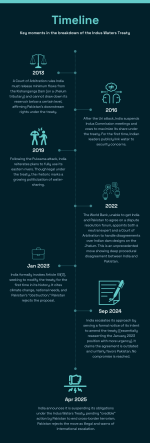
While the Indus Waters Treaty has long been praised for its durability, the last decade tells a story of mounting strain.In 2013, a Court of Arbitration ruled in Pakistan’s favour by requiring India to release minimum environmental flows downstream of the Kishanganga project (upstream on Jhelum), and reinforced limits on reservoir drawdown. This successful resolution was a continuation of the treaty’s ability to manage complex engineering disagreements.
But that pattern began to shift after the 2016 Uri attack. India suspended routine cooperation, began fast-tracking dam projects it had long delayed, and started linking water to broader security narratives. Even then, India said it would work “within the pact.”
ghazi52
THINK TANK: CONSULTANT
That too began to change in 2023, when India formally invoked Article XII(3) (the provision that allows for treaty modification only by mutual consent) and requested renegotiation, citing climate change, national development needs, and Pakistani obstruction. Pakistan refused to renegotiate.
In the months that followed, both countries doubled down on competing legal strategies. India pursued a neutral expert to review technical dam design questions; Pakistan pushed ahead with a Court of Arbitration. By early 2025, both mechanisms were active in parallel; this is something the treaty never envisioned.
This most recent announcement that India would “suspend” its obligations under the treaty marks the culmination of a long, escalating trajectory. For the first time since 1960, one country has effectively stepped outside the treaty’s procedural and cooperative framework. Whether this is a negotiating tactic or a permanent break remains to be seen. What comes next will test not just bilateral diplomacy, but the resilience of Pakistan’s water system in a world where guarantees no longer hold.
The Indus Waters Treaty is not perfect. But it does something few agreements between adversaries manage to do. It keeps the rivers flowing and gives both countries a reason to keep talking, even when everything else has broken down. That framework is now under strain. Whether the treaty is reinstated in full, renegotiated, or left to fade in practice, what follows will be harder.
Without clear rules, even small projects can provoke mistrust. Every monsoon, every reservoir, every dry spell becomes a potential source of tension. At a time when climate change is already intensifying droughts and floods, and when both countries face rising domestic water stress, the last thing the region needs is another layer of uncertainty. Yet that is where we now find ourselves.
The western rivers are not just shared rivers. They are Pakistan’s primary source of water. In the long run, there may be reforms or alternatives. But in the here and now, there is no substitute. These rivers sustain lives, livelihoods, and landscapes across the country. Pakistan can simply not afford to let it become collateral in a political fight. Thus, the flows must continue. Not out of goodwill, but because the consequences of stopping them are too great for either country to bear.
The Indus and its tributaries that have sustained civilisations for thousands of years, now test the capacity of two modern nuclear-armed nations to cooperate. The coming months and years will reveal whether wiser heads prevail, or if the subcontinent will enter a new, uncertain era of unilateralism on its most precious resource: water.
In the months that followed, both countries doubled down on competing legal strategies. India pursued a neutral expert to review technical dam design questions; Pakistan pushed ahead with a Court of Arbitration. By early 2025, both mechanisms were active in parallel; this is something the treaty never envisioned.
This most recent announcement that India would “suspend” its obligations under the treaty marks the culmination of a long, escalating trajectory. For the first time since 1960, one country has effectively stepped outside the treaty’s procedural and cooperative framework. Whether this is a negotiating tactic or a permanent break remains to be seen. What comes next will test not just bilateral diplomacy, but the resilience of Pakistan’s water system in a world where guarantees no longer hold.
The Indus Waters Treaty is not perfect. But it does something few agreements between adversaries manage to do. It keeps the rivers flowing and gives both countries a reason to keep talking, even when everything else has broken down. That framework is now under strain. Whether the treaty is reinstated in full, renegotiated, or left to fade in practice, what follows will be harder.
Without clear rules, even small projects can provoke mistrust. Every monsoon, every reservoir, every dry spell becomes a potential source of tension. At a time when climate change is already intensifying droughts and floods, and when both countries face rising domestic water stress, the last thing the region needs is another layer of uncertainty. Yet that is where we now find ourselves.
The western rivers are not just shared rivers. They are Pakistan’s primary source of water. In the long run, there may be reforms or alternatives. But in the here and now, there is no substitute. These rivers sustain lives, livelihoods, and landscapes across the country. Pakistan can simply not afford to let it become collateral in a political fight. Thus, the flows must continue. Not out of goodwill, but because the consequences of stopping them are too great for either country to bear.
The Indus and its tributaries that have sustained civilisations for thousands of years, now test the capacity of two modern nuclear-armed nations to cooperate. The coming months and years will reveal whether wiser heads prevail, or if the subcontinent will enter a new, uncertain era of unilateralism on its most precious resource: water.
ghazi52
THINK TANK: CONSULTANT
Revocation of Indus Waters Treaty can be taken as an act of war: Sartaj Aziz
Dawn.com
September 27, 2016
ISLAMABAD: Adviser to the Prime Minister on Foreign Affairs Sartaj Aziz on Tuesday told the Senate that revocation of the Indus Waters Treaty by India "can be taken as an act of war" against Pakistan.
"The Indus Waters Treaty is quoted as perhaps the most successful water treaty ever conducted between the two countries. Its revocation can be taken as an act of war or a hostile act against Pakistan," Aziz told lawmakers.
"If India tries to interrupt water flow into Pakistan, it will not only violate the Indus Water Treaty, but also set a regional state practice under which international law can be serve as a precedent. It will provide China, for example, a justification to consider of suspension of waters of the Brahmaputra river," he said.
Indian Prime Minister Narendra Modi on Monday decided to suspend Indus Water Commission talks until "Pakistan-sponsored terror" in India ends, according to Indian media reports.
Aziz's statements come amidst reports that India plans to accelerate building of new hydro-power plants along three rivers that flow into Pakistan. Modi told officials on Monday that India should use more of the rivers' resources, Reuters reported, quoting sources familiar with the plans.
According to our assessments, India is not following the option of revoking the treaty but it is trying to use provisions of the treaty to construct run of the river projects, Aziz said, adding that it was possible India would misuse these provisions by constructing structures which are not allowed under the treaty, according to Radio Pakistan.
Pakistan is identifying all the possible misuses and activities that India can undertake to interfere in the treaty as well as its implementation, he said.
Jamaat-i-Islami chief Siraj-ul-Haq in Senate said that India had been constructing dams on the Kabul river in collaboration with the Afghan government in order to make Pakistan's land barren.
Senator Sherry Rehman said that India has adopted a policy of water terrorism against Pakistan. The Indus Water Treaty is an international treaty that India cannot revoke unilaterally, she said. If it does so, it will be illegal and will set a precedence for China, being upper riparian, to divert waters of Brahmaputra, she added.
Earlier in the day, Aziz addressed the National Assembly saying that provocative statements and actions from the Indian leadership on the Indus Waters Treaty are a violation of international laws and breach of the treaty.
Pakistan will 'react befittingly' if India attempts to violate the Indus Waters Treaty, the adviser told the NA.
Pakistan will not accept any pressure from India and will continue to highlight human rights violations perpetrated by Indian forces in India-held Kashmir (IHK), Aziz said.
Pakistan is gaining the support of the international community on the issue, Aziz said, and is considering briefing the P5 countries ─ China, France, Russia, the United Kingdom, and the United States ─ on the dangers of suspending the treaty.
There is no provision of suspension in the treaty, Aziz said, adding that India cannot revoke the treaty unilaterally.
The adviser pointed out that the treaty was not suspended even during wars between the two countries.
The NA passed a unanimous resolution moved by Syed Naveed Qamar condemning India's claim a day earlier in the United Nations General Assembly that "Jammu and Kashmir is an integral part of India and will always remain so".
The resolution said Indian External Affairs Minister Sushma Swaraj in her speech at the UNGA ignored the fact that Jammu and Kashmir is still on the agenda of the United Nations Security Council, and that IHK is universally accepted as a disputed territory.
The resolution also said the Modi government has a history of threats and holds 'the misguided belief' that Pakistan will move away from extending support to Kashmiris.
The House believes that peace and progress are dependent upon good neighbourly relations and the only way forward is through constructive dialogue, not threats being issued by the Indian PM to unilaterally terminate the treaty, the resolution said.
It added that the hostile environment being perpetuated by the Indian government will not be in the best interests of peace and stability in the region.
ghazi52
THINK TANK: CONSULTANT
Q: Can India unilaterally revoke IWT?
A: India has no legal competence under the treaty to revoke it per se on its own. Article 12(4) of the treaty entitles the termination of the treaty only if both India and Pakistan agree in writing. In other words, a termination treaty has to be drafted by both states and then ratified by both, to bring the IWT to an end. The treaty has no provision for unilateral “suspension”. It is of an indefinite duration and was never intended to be time-specific or event-specific.
The IWT is not regime-specific — but rather state-specific. It will not expire with regime change. It is binding on both the states equally and offers no exit provision. Walking away from a treaty is in effect its breach. If India unilaterally stops following the treaty by giving any justification such as “revocation”, “suspension”, “withdrawal” or “annulment” etc. then it really means that it has decided to interrupt the water flow into Pakistan. In other words what India will call “revocation or withdrawal”, Pakistan will refer to as a “breach”.
Q: Is there any arbitration clause that can be set in motion should India go to that extreme?
A: There is an arbitration clause in the IWT. It is article IX and annexes F and G which contain detailed procedures about the taking of the grievance by either party under the IWT first to the commission, then to a neutral expert and later to the forum of arbitrators. Under the IWT, if India thinks that Pakistan’s conduct constitutes a dispute under article IX, then it must commence the procedure prescribed under Annexes F and G. India cannot itself conclude that Pakistan has breached the treaty on any grounds, including mistrust.
In case India “revokes” the treaty, it literally means it has shunned it. The dispute resolution mechanism under article IX and Annexes F and G of the IWT will be of no use and assistance to Pakistan.
It is limited to a dispute under the treaty and not meant to provide for specific performance of the treaty itself.
Since there is no provision in the IWT about its duration or suspension, there is no avenue that Pakistan can approach for “revival” of the treaty. Nor can Pakistan approach the International Court of Justice seeking specific performance to implement the treaty because of the Indian reservation given under IC J statute that bars filing of case by Pakistan against India.
In other words, Pakistan will not be left with any peaceful mechanism for seeking performance of the treaty by India.
Q: What if India stops Pakistani waters downstream and could this set a precedent for China upstream? Indian acts as a precedence for China?
A: Even if there were no IWT, an upper riparian, under the International Water Law, has no right to stop the water flow to a lower riparian. In case India tries to interrupt water flow into Pakistan as an upper riparian, it is setting up a regional state practice which under international law can serve as a precedence and equip China with an argument to consider suspension of the waters of Brahmaputra river.
India may have already damaged itself by even considering the suspension of water flow as an upper riparian and the Chinese government must be watching Indian moves with interest.
Q: How did IWT survive the 1965 and 1971 conflicts?
A: The treaty survived the two wars as well as other Pakistan-India conflicts because none of them were termed a war under international law. They were armed conflicts short of the legal status of “war”.
In the event of a war, states are entitled to suspend treaties, including diplomatic relations. In fact, if India considers revoking the treaty, it is itself signalling the same to be an act of war or a hostile act against Pakistan. This will equip Pakistan with the right under international law to take up any other coercive or non-coercive measure as an act of reprisal.
Treaties are state-specific obligations, and not regime- specific. These are not contingent upon deterioration of political atmosphere. It is much better that the states implement treaties through mutual trust, but even if there is deterioration of trust on account of extraneous events then that, per se, cannot be the sole reason to consider revocation of the treaty.
Published in Dawn, September 27th, 2016
A: India has no legal competence under the treaty to revoke it per se on its own. Article 12(4) of the treaty entitles the termination of the treaty only if both India and Pakistan agree in writing. In other words, a termination treaty has to be drafted by both states and then ratified by both, to bring the IWT to an end. The treaty has no provision for unilateral “suspension”. It is of an indefinite duration and was never intended to be time-specific or event-specific.
The IWT is not regime-specific — but rather state-specific. It will not expire with regime change. It is binding on both the states equally and offers no exit provision. Walking away from a treaty is in effect its breach. If India unilaterally stops following the treaty by giving any justification such as “revocation”, “suspension”, “withdrawal” or “annulment” etc. then it really means that it has decided to interrupt the water flow into Pakistan. In other words what India will call “revocation or withdrawal”, Pakistan will refer to as a “breach”.
Q: Is there any arbitration clause that can be set in motion should India go to that extreme?
A: There is an arbitration clause in the IWT. It is article IX and annexes F and G which contain detailed procedures about the taking of the grievance by either party under the IWT first to the commission, then to a neutral expert and later to the forum of arbitrators. Under the IWT, if India thinks that Pakistan’s conduct constitutes a dispute under article IX, then it must commence the procedure prescribed under Annexes F and G. India cannot itself conclude that Pakistan has breached the treaty on any grounds, including mistrust.
In case India “revokes” the treaty, it literally means it has shunned it. The dispute resolution mechanism under article IX and Annexes F and G of the IWT will be of no use and assistance to Pakistan.
It is limited to a dispute under the treaty and not meant to provide for specific performance of the treaty itself.
Since there is no provision in the IWT about its duration or suspension, there is no avenue that Pakistan can approach for “revival” of the treaty. Nor can Pakistan approach the International Court of Justice seeking specific performance to implement the treaty because of the Indian reservation given under IC J statute that bars filing of case by Pakistan against India.
In other words, Pakistan will not be left with any peaceful mechanism for seeking performance of the treaty by India.
Q: What if India stops Pakistani waters downstream and could this set a precedent for China upstream? Indian acts as a precedence for China?
A: Even if there were no IWT, an upper riparian, under the International Water Law, has no right to stop the water flow to a lower riparian. In case India tries to interrupt water flow into Pakistan as an upper riparian, it is setting up a regional state practice which under international law can serve as a precedence and equip China with an argument to consider suspension of the waters of Brahmaputra river.
India may have already damaged itself by even considering the suspension of water flow as an upper riparian and the Chinese government must be watching Indian moves with interest.
Q: How did IWT survive the 1965 and 1971 conflicts?
A: The treaty survived the two wars as well as other Pakistan-India conflicts because none of them were termed a war under international law. They were armed conflicts short of the legal status of “war”.
In the event of a war, states are entitled to suspend treaties, including diplomatic relations. In fact, if India considers revoking the treaty, it is itself signalling the same to be an act of war or a hostile act against Pakistan. This will equip Pakistan with the right under international law to take up any other coercive or non-coercive measure as an act of reprisal.
Treaties are state-specific obligations, and not regime- specific. These are not contingent upon deterioration of political atmosphere. It is much better that the states implement treaties through mutual trust, but even if there is deterioration of trust on account of extraneous events then that, per se, cannot be the sole reason to consider revocation of the treaty.
Published in Dawn, September 27th, 2016
ghazi52
THINK TANK: CONSULTANT
IWT Signed by President Ayub Khan and Prime Minister Jawaharlal Nehru in Sept 1960 and brokered by the World Bank, the treaty set bilateral principles of water sharing between the two nations.
Under the provisions of the treaty that also survived the 1965 and 1971 wars, the waters of the eastern rivers — the Sutlej, Beas and Ravi — had been allocated to India and the western rivers — the Indus, Jhelum and Chenab — to Pakistan except for certain non-consumptive uses.
Under the provisions of the treaty that also survived the 1965 and 1971 wars, the waters of the eastern rivers — the Sutlej, Beas and Ravi — had been allocated to India and the western rivers — the Indus, Jhelum and Chenab — to Pakistan except for certain non-consumptive uses.

Hakikat ve Hikmet
VIP Member

It leaves no choice for Pakistan. She needs to start preparing for the eventual showdown. As PM Suhrawardy said in 50s: either we die thirsty or die fighting. And, now the Iranians: better to die on your feet than to live on your knees. Strangely, in both cases you have a higher chance to live....
ghazi52
THINK TANK: CONSULTANT
Pakistan’s water experts fear for the country’s future
As population explodes, Pakistan stares at a future where it will be a water scarce country.
Zofeen T. Ebrahim
June 28, 2016

Children bathing on the streets due to water shortages. ─ Photo by Ghulam Rasool
As its population explodes, Pakistan stares at a future where it will be a water scarce country, but currently there is little new thinking in the government on how to tackle the crisis.
Dams, dams and more dams – of all sizes and kinds need to be built on a war footing because failing to do so would be disastrous for Pakistan.
This was the vehement and unanimous conclusion from scientists, water experts, agriculturists and climatologists who gathered for a 2-day workshop titled, "The Indus Basin Challenge – The Need for a Collective Response", organised by the International Water Management Institute (IWMI), in the latter half of May in Pakistan’s hilly tract of Bhurban.
Fears of water scarcity
“Pakistan will become water scarce by 2025," pointed out Dr Ghulam Rasul, the director general of the, Pakistan Meteorological Department (PMD).He recommended that, without wasting more time, Pakistan should come up with a water policy, build water storage's and develop a mechanism to regulate and protect groundwater.

In Pakistan water availability per person annually is just 1,017 cubic meters, dangerously close to 1,000 cubic meters, crossing which would mean the country is water scarce.
NASA’s researchers found that of the planet’s 37 largest aquifers studied between 2003 and 2013 the Indus Basin aquifer is the second most over stressed and was being depleted while receiving little to no recharge. It is also on the World Resource Institute‘s water stress index.
In a report – yet to be released – by the Pakistan Council of Research in Water Resources (PCRWR) it is apparently stated that the country touched the "water stress line" in 1990 and crossed the "water scarcity line" in 2005.
But can anything be done to turn the clock back?
"Unfortunately not," said Arif Anwar, who heads the IWMI in Pakistan.
"We have a certain population and our birth rate is changing rapidly.
So the situation is really very desperate and acute".
At present the country’s population is estimated to be around 190 million.

Water facilities in a rural area. ─ Photo by Ghulam Rasool
By 2030 it will grow to 244m, and by 2100, Pakistan’s population is projected at 364m, states the World Population Prospects 2015. With a rising population the demand is going to increase. According to a 2015 IMF report the demand for water is on the rise and is projected to reach 274 million acre-feet (MAF) by 2025, while supply is expected to remain stagnant at 191 MAF, resulting in a demand-supply gap of approximately 83 MAF.
At the same time, poor management of existing water resources, compounded by changing precipitation patterns due to global warming has made Pakistan susceptible to extreme floods, long spells of drought and increasing natural disasters. On German watch’s Climate Risk Index, Pakistan is among the ten countries most affected by extreme weather events.
And this despite Pakistan being surrounded by 7,259 glaciers with 2,066 cubic kilometres of ice in the three mountain ranges of the Himalayas, Hindukush and Karakoram spanning 11,780 square kilometres.

Indus Water Basin. ─ Dawn GIS
It is these glaciers that feed the mighty Indus and its 1.12 million square kilometre basin, 47pc of which is in Pakistan and 39pc, 8pc and 6pc in India, China and Afghanistan respectively. Pakistan’s agriculture accounts for 93pc of water drawn from the Indus.
"Pakistan is heading to the water scarce value because of population increase not necessarily because the volume of water in the country has decreased," said Anwar.
He said that there were other countries in the world that were also water scarce. Giving the example of the Middle East, he said: “But they don’t depend on water as much as we do they depend on oil. So it is a problem for us unless we can either develop our economy away from water, as say the Silicon Valley has done, or start to export people in very, very large numbers!” he quipped.


hydrabadi_arab
SpeedLimited
99% of 3 western rivers water cannot be diverted. But Pakistan will not allow India to play even with 1%.
Indus river: 90% of water come from with in Pak borders. 10% come from India/China. From mountains of Ladak. India will be stupid to waste $50-100 billion to build tunnels to divert some of that water. Tunnels in that area will not last long because of seismic activity.
Jhelum river: Again similar to Indus near impossible to divert much if any water.
Chenab: This is different as India can extend Ranbir canal to divert 5% of its water. Now that would be act of war.
Indian dams on 3 western rivers will slowly fill up with tilt, its not economically feasible to clean them. Eventually Indian storage dams even on 3 eastern rivers will be gone by end of 21st century. Same will happen to Pakistani dams.
This is lollypop for sanghis but Pakistan will rather risk nuclear war then allow India to even get 5% of Chenab water. izzat ka sawal hai, much nai te kuch nai
Indus river: 90% of water come from with in Pak borders. 10% come from India/China. From mountains of Ladak. India will be stupid to waste $50-100 billion to build tunnels to divert some of that water. Tunnels in that area will not last long because of seismic activity.
Jhelum river: Again similar to Indus near impossible to divert much if any water.
Chenab: This is different as India can extend Ranbir canal to divert 5% of its water. Now that would be act of war.
Indian dams on 3 western rivers will slowly fill up with tilt, its not economically feasible to clean them. Eventually Indian storage dams even on 3 eastern rivers will be gone by end of 21st century. Same will happen to Pakistani dams.
This is lollypop for sanghis but Pakistan will rather risk nuclear war then allow India to even get 5% of Chenab water. izzat ka sawal hai, much nai te kuch nai
Last edited:
Raj-Hindustani
Elite Member
Diverting water isn’t impossible—and India seems to be shifting its approach. It’s a significant change in policy that might actually work in India’s favor.
In Pakistan, many people may see this one-sidedly. But it’s important to understand the other side’s perspective too.
For nearly 80 years, both India and Pakistan have failed to resolve key issues. India can no longer afford to stick to old policies, especially in Kashmir, since no party ready to compromised from their sides.
where external support for unrest continues. Pakistani leaders have even openly warned of bloodshed.
India’s latest move seems to be part of a pressure strategy with two clear goals:
1. Stop interference in Kashmir.
2. End cross-border terrorism.
By linking water policy to national security and declaring any future attacks as acts of terrorism, India is drawing new red lines. The message is: the Indus Water Treaty can continue—but not unconditionally.
War or no war - diplomatic way or no diplomatic way - all needs to decide by Pakistan. But definitely, no one wants to take water from Pakistan but if pressure tactics can be used - so why not?
In reality - india does not have serious plan to divert the water.
In Pakistan, many people may see this one-sidedly. But it’s important to understand the other side’s perspective too.
For nearly 80 years, both India and Pakistan have failed to resolve key issues. India can no longer afford to stick to old policies, especially in Kashmir, since no party ready to compromised from their sides.
where external support for unrest continues. Pakistani leaders have even openly warned of bloodshed.
India’s latest move seems to be part of a pressure strategy with two clear goals:
1. Stop interference in Kashmir.
2. End cross-border terrorism.
By linking water policy to national security and declaring any future attacks as acts of terrorism, India is drawing new red lines. The message is: the Indus Water Treaty can continue—but not unconditionally.
War or no war - diplomatic way or no diplomatic way - all needs to decide by Pakistan. But definitely, no one wants to take water from Pakistan but if pressure tactics can be used - so why not?
In reality - india does not have serious plan to divert the water.
vasanthm
SpeedLimited
If, as many here claim, India can't divert the water or do anything substantial with the rivers and it supposedly has no real impact on Pakistan, then why all the fuss about the treaty in the first place? Why did Pakistan push so hard for it if it was all symbolic?
You can’t have it both ways, either it matters, or it doesn’t.
You can’t have it both ways, either it matters, or it doesn’t.
hydrabadi_arab
SpeedLimited
Diverting water isn’t impossible—and India seems to be shifting its approach. It’s a significant change in policy that might actually work in India’s favor.
In Pakistan, many people may see this one-sidedly. But it’s important to understand the other side’s perspective too.
For nearly 80 years, both India and Pakistan have failed to resolve key issues. India can no longer afford to stick to old policies, especially in Kashmir, since no party ready to compromised from their sides.
where external support for unrest continues. Pakistani leaders have even openly warned of bloodshed.
India’s latest move seems to be part of a pressure strategy with two clear goals:
1. Stop interference in Kashmir.
2. End cross-border terrorism.
By linking water policy to national security and declaring any future attacks as acts of terrorism, India is drawing new red lines. The message is: the Indus Water Treaty can continue—but not unconditionally.
War or no war - diplomatic way or no diplomatic way - all needs to decide by Pakistan. But definitely, no one wants to take water from Pakistan but if pressure tactics can be used - so why not?
In reality - india does not have serious plan to divert the water.
Its impossible apart from in Chenab where India can divert its water, but only 5%.
And in 60-70 years all of Indian storage dams on 3 eastern rivers will be filled with tilt. Forget about 3 western rivers, India will not be able to store water from 3 eastern rivers.
Canals cannot take all of water so Pakistan will get more water from eastern rivers by end of 21st century.
hydrabadi_arab
SpeedLimited
If, as many here claim, India can't divert the water or do anything substantial with the rivers and it supposedly has no real impact on Pakistan, then why all the fuss about the treaty in the first place? Why did Pakistan push so hard for it if it was all symbolic?
You can’t have it both ways, either it matters, or it doesn’t.
Yes its mustly symbolic. But India can use 5% more of Chenab water which will be act of war the day work start on extension of Ranbir canal.
Will Pakistan risk a nuclear war over 0.5 MAF of water when it can save 4 MAF just by linning watercourses? You bet.
Users who are viewing this thread
Total: 3 (members: 0, guests: 3)
Pakistan Defence Latest


Country Watch Latest
-
-
 Breaking: First F-47 Sixth-Gen Fighter Already Being Built, Expected to Fly in 2028 (10 Viewers)
- Latest: SolarWarden
-
-
-

Latest Posts
-
-
Breaking: First F-47 Sixth-Gen Fighter Already Being Built, Expected to Fly in 2028 (10 Viewers)
- Latest: SolarWarden
-

-

-
