JF-17 PFX program

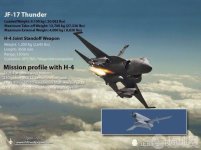
The Raptor II/H-4 SOW is a stand-off precision weapon with a maximum range of 120 km (rocket-boosted) and a 600 kg Mk83 equivalent warhead. It features modular guidance options including GNSS/INS, EO/TV, IIR, and man-in-the-loop data link capability.
 

Attachments

  • pEy8-htwhfzt1698345 (1).jpg
    pEy8-htwhfzt1698345 (1).jpg
    32 KB · Views: 19
I've seen images of the JF-17 carrying the Raptor II (H-4 SOW) rocket-boosted glide guided bomb. Could you provide more information about this weapon system?
The Raptor II/H-4 SOW is a stand-off precision weapon with a maximum range of 120 km (rocket-boosted) and a 600 kg Mk83 equivalent warhead. It features modular guidance options including GNSS/INS, EO/TV, IIR, and man-in-the-loop data link capability.
 
Of course, if Pakistan were to fully fund the project and commission the 611 Institute to design a new 5th-generation stealth fighter, essentially purchasing the design plan outright, I believe the 611 Institute would be very happy to undertake this project. However, given Pakistan's current situation, it is impossible for them to independently support a new 5th-generation stealth fighter project.

The days of Pakistan "commissioning" and "funding" aircraft development teams in China are over. PAF learnt the hard way with the JF17 programme, that it is not the way to go. Pakistan learnt its lesson about collaborative projects with China from that episode that left a bad taste in PAFs mouths.

That is the reason why Pakistan refused to adopt the FC-31 when it was marketed so so aggressively to them as the "lead" customer. Pakistan was not interested in funding design teams in China anymore to design and build the FC-31, while not getting any of the intellectual property for itself and being forced to operate the platform as a sole customer while waiting for export orders to come in. It would much rather spend that money on projects in Pakistan, or purchase capability off the shelf directly from China.

So, Pakistan rebuffed all FC-31 pitches, and waited for China to pickup the FC-31 project, and make the J-35 project out of it on its own cost. Pakistan forced China's hand on that one as it did not want to get involved in a repeat of the FC-1 project again. So, the money Pakistan saved on not having to fund another aircraft development project for China's industry, it can use on procurements of actual military capability instead which is better for Pakistan.

China was meant to purchase an equal number of FC-1s as Pakistan was to, under the terms of the original agreement with China. China backed out of that agreement, and effectively forced Pakistan to fund the entire project to bring the JF17 to front line service. That development cost has come at the cost of not being able to purchase as many JF17 as it wanted to, as it spent so much on getting to JF17 platform developed. That is why it still has so many F7PGs and Mirages left, it ran out of money because it hand to fund the project alone effectively.

Some of us here are old enough to know about and remember the history of the Super7/FC1 at the beginning of the project and how both were meant to purchase equal numbers. China may have had good reasons to back out based on operational needs, but it set a precedent that PAF won't forget about for a while..

Pakistan has learnt its lesson from China's business antics and will be alot more careful about how it approaches projects in the future.
 
Last edited:
The days of Pakistan "commissioning" and "funding" development teams in China are over. PAF learnt the hard way with the JF17 programme, that it is not the way to go, as it wants to train its own engineers and not China's now. Pakistan learnt its lesson about collaborative projects with China from that episode that left a bad taste in PAFs mouths.

That is the reason why Pakistan refused to adopt the FC-31 when it was marketed so so aggressively to them as the "lead" customer. Pakistan was not interested in funding design teams in China anymore to design and build the FC-31, while not getting any of the intellectual property for itself and being forced to operate the platform as a sole customer while waiting for export orders to come in. It would much rather spend that money on projects in Pakistan, or purchase capability off the shelf directly from China.

So, Pakistan waited for China to pickup the FC-31 project, and make the J-35 project out of it on its own cost. Pakistan forced China's hand on that one. So, the money Pakistan saved on not having to fund another project for China's industry, it can use on procurements of actual military capability instead which is better for Pakistan.

China was meant to purchase an equal number of FC-1s as Pakistan was to, under the terms of the original agreement with China. China backed out of that agreement, and effectively forced Pakistan to fund the entire project to bring the JF17 to front line service. That development cost has come at the cost of not being able to purchase as many JF17 as it wanted to, as it spent so much on getting to JF17C variant. That is why it still has so many F7PGs and Mirages left, it ran out of money because it hand to fund the project alone effectively.

Some of us here are old enough to know about and remember the history of the Super7/FC1 at the beginning of the project and how both were meant to purchase equal numbers. China may have had good reasons to back out based on operational needs, but it set a precedent that PAF won't forget about for a while..

Pakistan has learnt its lesson from China's business antics.
LOL.

It's clear that you have a lot of complaints about China-Pakistan cooperation.
In your view, the JF-17 project is a classic example of a failed China-Pakistan collaboration.

That's okay. Let's wait and see!
 
The days of Pakistan "commissioning" and "funding" aircraft development teams in China are over. PAF learnt the hard way with the JF17 programme, that it is not the way to go. Pakistan learnt its lesson about collaborative projects with China from that episode that left a bad taste in PAFs mouths.

That is the reason why Pakistan refused to adopt the FC-31 when it was marketed so so aggressively to them as the "lead" customer. Pakistan was not interested in funding design teams in China anymore to design and build the FC-31, while not getting any of the intellectual property for itself and being forced to operate the platform as a sole customer while waiting for export orders to come in. It would much rather spend that money on projects in Pakistan, or purchase capability off the shelf directly from China.

So, Pakistan rebuffed all FC-31 pitches, and waited for China to pickup the FC-31 project, and make the J-35 project out of it on its own cost. Pakistan forced China's hand on that one as it did not want to get involved in a repeat of the FC-1 project again. So, the money Pakistan saved on not having to fund another aircraft development project for China's industry, it can use on procurements of actual military capability instead which is better for Pakistan.

China was meant to purchase an equal number of FC-1s as Pakistan was to, under the terms of the original agreement with China. China backed out of that agreement, and effectively forced Pakistan to fund the entire project to bring the JF17 to front line service. That development cost has come at the cost of not being able to purchase as many JF17 as it wanted to, as it spent so much on getting to JF17 platform developed. That is why it still has so many F7PGs and Mirages left, it ran out of money because it hand to fund the project alone effectively.

Some of us here are old enough to know about and remember the history of the Super7/FC1 at the beginning of the project and how both were meant to purchase equal numbers. China may have had good reasons to back out based on operational needs, but it set a precedent that PAF won't forget about for a while..

Pakistan has learnt its lesson from China's business antics and will be alot more careful about how it approaches projects in the future.
Why do you think it doesn't have access to the IP if it was an equal partner? As far as I remember, it was an equal 50/50 joint venture, with about USD250m each from PAF and CATIC. I'm not sure the PLAF acquiring it was part of the agreement, it never suited the PLAF needs. It was always a primarily PAF designed fighter, and for the Chinese an export product.
 
Why do you think it doesn't have access to the IP if it was an equal partner? As far as I remember, it was an equal 50/50 joint venture, with about USD250m each from PAF and CATIC. #

The funding was 50/50. IP transfer is partial, there are a lot of suppliers in China who dont have to open source their products to Pakistan, that are part of FC1.

I'm not sure the PLAF acquiring it was part of the agreement, it never suited the PLAF needs. It was always a primarily PAF designed fighter, and for the Chinese an export product.

It was, It is something I distinctly remember, and it was very heavily discussed on a previous Pakistani Defence Forum(original Pakdef site).
 
The funding was 50/50. IP transfer is partial, there are a lot of suppliers in China who dont have to open source their products to Pakistan, that are part of FC1.


It was, It is something I distinctly remember, and it was very heavily discussed on a previous Pakistani Defence Forum(original Pakdef site).
I was on PakDef since the beginning. I recall seeing it in press releases that the PLAF may acquire to too, but it was never committed to it. I don't think anyone has seen a copy of the formal agreement.
 
The funding was 50/50. IP transfer is partial, there are a lot of suppliers in China who dont have to open source their products to Pakistan, that are part of FC1.
I think you should at least know some basic common sense.

Fighter jet design and manufacturing is essentially equivalent to a system integrator. It's exactly the same concept as a personal computer brand/manufacturer.

Fighter jet designers and manufacturers only possess the capabilities and intellectual property for system integration and the design and manufacturing of the airframe. They do not possess the design and manufacturing capabilities, nor the intellectual property, for most of the critical subsystems.

PAC already possesses these capabilities. Otherwise, how could they integrate Turkish pods into the JF-17 fighter jet?

As for radar and other subsystems, this is not within the scope of work for the aircraft integrator. They can only choose from a range of equipment suppliers.

If both China and Pakistan agree, Pakistan can completely choose other suppliers to provide the relevant subsystems.

When you buy a personal computer from Dell, you can choose an Intel CPU or an AMD CPU. You can even buy the intellectual property for the computer's design from Dell. But you can never demand that Dell provide you with the manufacturing technology and intellectual property of Intel/AMD CPUs.

If Pakistan wants the radar technology for the JF-17 fighter jet, you should go to CETC to renegotiate. If you want the RD-93 engine technology, you should go to Russia... These matters are not within the scope of the JF-17 fighter jet's intellectual property rights.
 
I think you should at least know some basic common sense.

Fighter jet design and manufacturing is essentially equivalent to a system integrator. It's exactly the same concept as a personal computer brand/manufacturer.

Fighter jet designers and manufacturers only possess the capabilities and intellectual property for system integration and the design and manufacturing of the airframe. They do not possess the design and manufacturing capabilities, nor the intellectual property, for most of the critical subsystems.

PAC already possesses these capabilities. Otherwise, how could they integrate Turkish pods into the JF-17 fighter jet?

As for radar and other subsystems, this is not within the scope of work for the aircraft integrator. They can only choose from a range of equipment suppliers.

If both China and Pakistan agree, Pakistan can completely choose other suppliers to provide the relevant subsystems.

When you buy a personal computer from Dell, you can choose an Intel CPU or an AMD CPU. You can even buy the intellectual property for the computer's design from Dell. But you can never demand that Dell provide you with the manufacturing technology and intellectual property of Intel/AMD CPUs.

If Pakistan wants the radar technology for the JF-17 fighter jet, you should go to CETC to renegotiate. If you want the RD-93 engine technology, you should go to Russia... These matters are not within the scope of the JF-17 fighter jet's intellectual property rights.

Maybe you can learn some "common sense" and some "social sense" at the same time, and learn to read properly what is being said and not assume you are the smartest person in the room. If you did, then you would save every ones time by not stating the damn obvious again and again and again all the damn time thinking it is words of wisdom.. You are repeating what has already been said and stated clearly on the thread as some new form of information.

Maybe you will now run and hide behind I don't understand English, and blame it on poor translation .. again ....
 
Last edited:
If you want the RD-93 engine technology, you should go to Russia
How?

Why do you talk about stuff pretending to be privy to details you are not?

Can PAC go to Russia for ANYTHING RD-93 related?

Why does PAC HAVE to go via CATIC for any RD93 support? Why does PAC not get access to Russian support and have to place orders for every nut and bolt to CATIC, who then places them to Russia and re exports to Pak?

Heck, why is PAC's RD93 MRO shop not even approved by Klimov...? Why did PAC and CATIC have to reverse engineer some aspects, and then others, setup without license?

Hint, as part of the agreement, PAC/PAF is not allowed to go direct to the OEMS, rather, MUST rely on CATIC. PAC does not even have catalogues and part numbers for Russian items, only Chinese ones, which CATIC translates into Russian ones
 
You are describing a subsequent upgraded version of the J-10 fighter jet, not a subsequent upgraded version of the JF-17.

Currently, AVIC/CAC has essentially abandoned plans for large-scale upgrades to both the JF-17 and J-10 projects.
From upgrades you mean airframe related upgrades? i hope subsystems in both these projects will have no issue in upgradation if they are more optmized with respect to power consumption and performance?
 
Maybe you can learn some "common sense" and some "social sense" at the same time, and learn to read properly what is being said and not assume you are the smartest person in the room. If you did, then you would save every ones time by not stating the damn obvious again and again and again all the damn time thinking it is words of wisdom.. You are repeating what has already been said and stated clearly on the thread as some new form of information.

Maybe you will now run and hide behind I don't understand English, and blame it on poor translation .. again ....
Okay.
Since you prefer to do it this way, go ahead.

From upgrades you mean airframe related upgrades? i hope subsystems in both these projects will have no issue in upgradation if they are more optmized with respect to power consumption and performance?
General Analysis:

The JF-17B3 has already pushed the JF-17 platform's capabilities to its limits. Any further large-scale upgrades (such as stealth features) would require a complete redesign of the entire platform, which is equivalent to developing a completely new fighter jet. (Please ignore minor upgrades.)

The J-10C platform does have some room for further upgrades. China has previously developed an electronic warfare (EW) fighter version based on the J-10C platform. Replacing the WS-10B engine with the WS-15 engine would significantly enhance its capabilities.
However, the PLAAF ultimately did not procure it.
This was a tactical choice based on China's already stronger platforms, rather than a platform issue. Due to the lack of a sufficiently large customer base, there are some problems with the subsequent development of the J-10C, but it's not impossible.
 
this market is not a big one, plus, any major clients that would have been interested are automatically out due to china. i.e malaysia, or other asean states/
:p :p :p
thank you modiji for the advert i guess
 

Users who are viewing this thread

Back
Top