Navigation
Install the app
How to install the app on iOS
Follow along with the video below to see how to install our site as a web app on your home screen.
Note: This feature may not be available in some browsers.
More options
Style variation
You are using an out of date browser. It may not display this or other websites correctly.
You should upgrade or use an alternative browser.
You should upgrade or use an alternative browser.
JF-17 PFX program
- Thread starter Zarvan
- Start date
More options
Who Replied?

nah, its just some rubbish they produced as part of azm, a few cfd models (3) and put up few numbers, and said tadaa...azm. @JamD has the full paper
Nothing a college student couldnt produce in his room.

Ali_Baba
VIP Member

View attachment 171970
guys can you guessZ? i just screen shot it . is it pfx model on wall. its written as nexr generation fighter aircraft. there is a work going on other projects too
That was vapour ware from Project Azm, that no one has bothered to take down yet!!
zzw001
Registered Member

Wasn't restricted access to Klimov an Indian-related issue? Russia was under a lot of financial pressure from their biggest customer when they agreed to supply JF17 and Klimov also was making a lot of profit from India back in the day with MiG-29 contracts. Ergo Klimov refused any direct channels of communication with the Pakistani side and CATIC had to serve as the middleman. I recall that was the general consensus from the old PakDef forum 12 years ago or something.How?
Why do you talk about stuff pretending to be privy to details you are not?
Can PAC go to Russia for ANYTHING RD-93 related?
Why does PAC HAVE to go via CATIC for any RD93 support? Why does PAC not get access to Russian support and have to place orders for every nut and bolt to CATIC, who then places them to Russia and re exports to Pak?
Heck, why is PAC's RD93 MRO shop not even approved by Klimov...? Why did PAC and CATIC have to reverse engineer some aspects, and then others, setup without license?
Hint, as part of the agreement, PAC/PAF is not allowed to go direct to the OEMS, rather, MUST rely on CATIC. PAC does not even have catalogues and part numbers for Russian items, only Chinese ones, which CATIC translates into Russian ones
China also wouldn't have a viable and mature RD-93 alternative until the mid-late 2010s so if Russia walked away, it would have killed the then nascent JF17 program. That's why compromise to Klimov access was agreed by all sides (including Pakistan). In retrospect the Indians should have applied more diplomatic / financial pressure on Russia to kill the program (but they thought JF17 was junk until 2019 and didn't bother to spend more diplomatic and financial dry powder within India's command to kill the program when they could have).
Last edited:

Samurai
Registered Member
Seriously you can visit the website DeviantArt and find 3D arts and models that are waaay better than what PAC R&D made for Project Azm and those are all done by kids from school, college and adults.nah, its just some rubbish they produced as part of azm, a few cfd models (3) and put up few numbers, and said tadaa...azm. @JamD has the full paper
Nothing a college student couldnt produce in his room.
xiao
Registered Member
Thanks a ton! Now I’m ready to go take on those wild admins over at War ThunderH-4 SOW is the local designation for Raptor-II, which was a product of the South African arms manufacturer Denel Dynamics. It was produced under license by Pakistan's NESCOM along with Raptor-I. Although it is no longer in production in either company, it remains in service in the PAF.
View attachment 170651
View attachment 170654



Malik
Registered Member
Not fake read this articleBeware of an again FAKED image
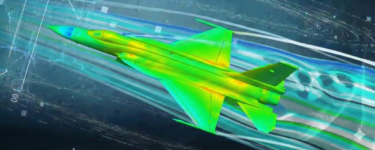
Not sure who made it, but IMO it is just a crudely made up F-16 (tails, wings, F100 engine) mated via photoshop/CG onto a regular JF-17 fuselage!
View attachment 173046
Link

maxpane
Elite Member
brother link is not working
Malik
Registered Member
brother link is not working
The point is, that image is clearly fake ... it is so obviously a F-16/JF-17 hybrid!


Tariq Habib Afridi
Registered Member

Thunder Evolved: A Strategic and Technical Analysis of the JF-17 PFX Program
Representing a paradigm shift in the PAF's procurement and development philosophy, the PFX is not merely an incremental upgrade but a comprehensive re-architecture of the light fighter concept. It aims to bridge the gap between the 4th-generation present and a 5th-generation future, leveraging an "affordable mass" doctrine while integrating high-end 4.5+ generation technologies. This report offers an exhaustive analysis of the PFX program, dissecting its strategic drivers, technical specifications, industrial underpinnings, and operational implications.
Drawing upon a wide array of open-source intelligence, defense analytics, and program updates through early 2026, this document establishes that the PFX, alongside its transitional "PFX Alpha" spiral, represents a pivotal move towards "avionics sovereignty." By internalizing the value chain of Active Electronically Scanned Array (AESA) radars, electronic warfare (EW) suites, and mission computing, Pakistan aims to decouple its operational tempo from external supplier constraints. Furthermore, the integration of long-range standoff weapons, indigenous air-to-air missiles like the FAAZ series, and next-generation datalinks (Link-17) positions the PFX as a potent node in a networked kill chain, capable of challenging advanced threats like the Rafale and S-400 within the contested airspace of the sub-continent.
1.1 The Asymmetry of Air Power
Historically, the PAF relied on qualitative parity, or edge, provided by American platforms like the F-16 Fighting Falcon to offset Indian numerical superiority. However, the shifting geopolitical landscape, particularly the tightening of US export controls and the deepening US-India defense partnership, eroded this traditional advantage. The PAF could no longer rely on Western technology as a guaranteed guarantor of air superiority.
The introduction of the JF-17 Block I and II provided a solution to the "numbers problem", replacing aging fleets of Chengdu F-7s and Dassault Mirage IIIs. Yet, the modern battlefield is unforgiving to platforms that rely solely on numbers. The proliferation of Beyond Visual Range (BVR) combat technologies, low-observability (stealth), and networked electronic warfare means that "quantity has a quality all its own" only if that quantity is sufficiently capable of surviving the first merge.
The PFX is the strategic answer to this qualitative gap. It is designed to be the "High" component of an indigenous "High-Low" mix (or perhaps more accurately, a "Medium-High" capability in a light fighter airframe). The doctrine is clear: if the PAF cannot outspend the IAF, it must out-cycle them. By iterating the JF-17 platform faster than India can field its Tejas Mk2 or procure additional Rafales, Pakistan aims to maintain a credible conventional deterrence.
1.2 The "Affordable Mass" Doctrine
The concept of "affordable mass" is central to the PFX. In an era where 5th-generation fighters like the F-35 or J-20 cost upwards of $80-100 million per unit (excluding lifecycle costs), building a fleet entirely of such aircraft is fiscally impossible for Pakistan. The JF-17, with unit costs historically in the $25-30 million range, allows the PAF to field adequate squadron strength.
However, the PFX acknowledges that "cheap" cannot mean "obsolete." The program aims to inject 5th-generation avionics and weapons into a 4th-generation airframe. This approach mimics the success of the F-16V (Viper) upgrade or the Gripen E/F, taking a proven, mature, and cost-efficient aerodynamic design and stuffing it with the latest sensors and processors. This decouples the cost of the system from the cost of the metal, allowing the PAF to field a near-peer capability at a fraction of the cost of a heavy fighter.
1.3 The Bridge to the Fifth Generation
The PAF's long-term roadmap includes the induction of true 5th-generation stealth fighters. Specifically, the acquisition of the Chinese J-31 (FC-31/J-35) "Gyrfalcon" and participation in the Turkish TAI Kaan (TF-X) program are key pillars of the future fleet.
However, these advanced platforms will take time to induct, integrate, and field in significant numbers. The J-31 is expected to form the "tip of the spear," reserved for high-risk penetration missions. The PFX will serve as the "bridge" to this future force. It will incorporate technologies derived from these 5th-gen programs, such as advanced HMDs, high-speed datalinks, and sensor fusion algorithms, thereby preparing the PAF's pilot corps and maintenance infrastructure for the technological leap. Moreover, should 5th-gen acquisitions face delays (political or technical), the PFX ensures the PAF is not left with a capability vacuum in the late 2020s and early 2030s.
2.1 The Block Evolution
The designation "PFX" stands for Pakistan Fighter Experimental. In various defense circles, it is sometimes conflated with "Block 4" or referred to as the "JF-17 Operational Capability Upgrade (OCU)." However, PFX is more than just a block upgrade; it is a comprehensive program for next-generation capability insertion.
The program appears to be structured in spirals. The first phase, PFX Alpha, is described as an operational upgrade track for in-service aircraft (likely late-model Block IIs and Block IIIs). PFX Alpha focuses on maturing indigenous subsystems, radar, EW, and mission computers, before they are integrated into the full-fledged PFX airframe.
This "systems-first" approach is a lesson learned from the ambitious but stalled "Project Azm," which initially aimed for a clean-sheet 5th-generation fighter. Recognizing the immense technical and financial hurdles of a clean-sheet design, the PAF pivoted. The PFX program utilizes the mature JF-17 industrial base to de-risk the development of advanced avionics, effectively serving as a stepping stone toward the 5th-generation technologies envisaged in Project Azm.
2.3 Timeline and Milestones
The PFX was prominently featured at the IDEAS 2024 defense exhibition in Karachi, where PAF officials confirmed its development. A senior official indicated a target for the first flight within 4 to 5 years (circa 2028-2029). The presence of PFX operational art at the Royal International Air Tattoo (RIAT) 2025 further underscores the program's visibility and priority within the PAF's strategic communications.
3.1 The "Enlarged Airframe" Hypothesis: Lessons from the F/A-18 and F-2
Credible reports and analysis suggest that the PFX will be physically larger than the current JF-17. Estimates place its Maximum Take-Off Weight (MTOW) in the vicinity of 17,500 kg, a significant increase from the 13,500 kg of the Block III. To achieve this, the PFX appears to be following a well-established aerospace engineering pathway: the "Super" variant evolution, mirroring the transformation of the F/A-18 Hornet to the Super Hornet and the F-16 to the Mitsubishi F-2.
3.1.1 The Super Hornet Paradigm (Volume and Range)
The evolution of the classic F/A-18 C/D Hornet into the F/A-18 E/F Super Hornet provides the most direct analogy for the PFX program. The US Navy required a fighter with significantly greater range and payload but wanted to retain the familiar handling and maintenance infrastructure of the Hornet.
The Mitsubishi F-2, often called the "Viper Zero," represents Japan's indigenous scaling of the F-16. It illustrates how to increase payload and agility through structural modification.
This enlargement addresses specific operational limitations:
Speculation regarding a twin-engine variant of the PFX has persisted in defense circles. A twin-engine configuration would offer greater survivability, payload, and power generation, bringing it closer to the Rafale or Eurofighter Typhoon.
However, a sober analysis of the PAF's logistical and economic reality suggests a heavy single-engine design is the more probable outcome. Converting a single-engine airframe to a twin-engine layout is essentially designing a new aircraft (e.g., the difference between the F-16 and F/A-18). Given the PAF's emphasis on "affordable mass" and commonality with the existing JF-17 supply chain, a single-engine design powered by a next-generation turbofan (like the WS-19) offers the best balance of performance and cost. The "twin-engine" reports may refer to separate procurement tracks for the J-31/J-35 or conceptual studies that were not selected for mass production.
3.3 Materials and Signature Reduction
While the PFX will not be a "stealth" fighter in the same class as the J-20, it will incorporate significant signature reduction measures. The Block III already introduced composite materials in the vertical stabilizer and wings. The PFX will expand this to the fuselage skins and internal structure.
4.1 The RD-93MA Baseline
The current JF-17 Block III utilizes the Russian Klimov RD-93MA. This is a significant upgrade over the base RD-93, producing approximately 91.2 kN (9,300 kgf) of thrust (wet) compared to the original's 8300 kgf. The RD-93MA features a modernized FADEC (BARK-93MA) and improved hot-section materials, increasing service life and reliability.
4.2 The Chinese Alternative: WS-13 and WS-19
Geopolitical reliability is a major concern for Pakistan. Reliance on Russian engines exposes the PAF to sanctions (CAATSA) and supply chain disruptions due to the Russia-Ukraine war. Consequently, the PAF has actively explored Chinese options.
Pakistan's deepening defense ties with Turkey have led to speculation about collaboration on engine technology. Turkey's TEI is developing engines for its unmanned systems and the Kaan fighter. While a fully indigenous Pakistani engine is decades away, a joint venture to produce engine components or a derivative engine under the PFX umbrella is a strategic possibility, aligning with the goal of reducing dependency on both US and Russian sources.
5.1 Radar: The Indigenous AESA Roadmap
The current JF-17 Block III utilizes the KLJ-7A, a highly capable radar from China's NRIET. While effective, it remains a "black box" system, limiting the PAF's ability to rapidly update waveforms or integrate third-party EW suites. The PFX program aims to internalize the entire AESA value chain, a goal now moving from theory to tangible prototyping at NASTP and Air University Kamra.
5.1.1 The Shift to Gallium Nitride (GaN)
Research conducted by the Department of Avionics Engineering at Air University Kamra confirms that Pakistan has moved beyond older Gallium Arsenide (GaAs) technology. The focus is now exclusively on X-band Gallium Nitride (GaN) Transmit/Receive Modules (TRMs).
The development effort is not limited to just the TRM but encompasses the entire radar backend.
The PFX views the electromagnetic spectrum as a maneuver space equal in importance to the physical airspace. Moving beyond the basic self-protection of early Block Is, the PFX introduces a comprehensive, offensive-defensive EW architecture, spearhead by the indigenous Project Panjnad.
5.2.1 Project Panjnad: The Indigenous Shield
Named after the five rivers of Pakistan, Project Panjnad is the PAF’s flagship initiative to indigenize Electronic Countermeasures (ECM) and Electronic Support Measures (ESM). This program specifically targets the development of "cognitive" jamming capabilities designed to defeat modern AESA radars and high-altitude air defense systems like the S-400.
The PFX’s EW capabilities are directly linked to its "Hard Kill" options, effectively turning the fighter into a "Wild Weasel" platform for Suppression/Destruction of Enemy Air Defenses (SEAD/DEAD).
While Project Panjnad is indigenous, its development has been significantly accelerated by a strategic MoU on Electronic Warfare signed with Turkey. This agreement facilitates the transfer of critical know-how from Turkish defense giants to Pakistani entities.
The operational soul of the PFX is its connectivity. It transcends the role of a traditional fighter, evolving into a command node for a "System of Systems" defined by manned-unmanned teaming (MUM-T) and distributed lethality.
5.3.1 Collaborative Combat Aircraft (CCA) / Loyal Wingman Role
The PFX is designed to function as the "Quarterback" in a manned-unmanned team. This marks the PAF's entry into the era of Collaborative Combat Aircraft (CCA), or "Loyal Wingmen", unmanned systems that fly alongside manned fighters to extend sensors, increase payload, and absorb risk.
To fulfill this loyal wingman role, Pakistan has actively pursued Turkish next-generation UCAVs, which are explicitly designed for interoperability with manned fighters.
This operational integration is underpinned by a deep industrial integration. Both Baykar and Turkish Aerospace Industries (TAI) have established permanent research and development centers within Pakistan's National Aerospace Science and Technology Park (NASTP).
The PFX cockpit builds on the Block III's glass cockpit, featuring a large Wide Area Display (WAD) and a modernized Heads-Up Display (HUD). The pilot utilizes a Helmet Mounted Display/Sight (HMD/S), which projects flight data and targeting cues directly onto the pilot's visor, allowing for "look-and-shoot" engagements with high-off-boresight missiles.
5.5 Active Counter-Stealth (Passive Sensors): The Aselsan KARAT Integration
With the proliferation of stealth aircraft in the region, the PFX doctrine emphasizes "Active Counter-Stealth", the ability to detect and engage Low Observable (LO) targets without relying solely on radar. The cornerstone of this capability is the integration of advanced Infrared Search and Track (IRST) systems, marking a departure from the radar-centric approach of previous generations.
5.5.1 The Physics of Passive Detection
While stealth aircraft are shaped to deflect radar waves, they cannot defy the laws of thermodynamics. High-performance flight generates significant heat through aerodynamic heating (skin friction) and engine exhaust.
The PFX is slated to integrate the Aselsan KARAT IRST, a high-performance system originally developed for the Turkish KAAN fighter and Kızılelma UCAV.
This sensor integration enables a "Silent Kill" chain. A PFX can detect a hostile stealth aircraft using KARAT, fuse the track data with its mission computer, and launch a PL-15E or FAAZ-2 missile in Lock-On After Launch (LOAL) mode. The adversary receives no Radar Warning Receiver (RWR) alert until the missile's own active seeker turns on in the terminal phase, drastically reducing their reaction time and survivability.
6.1 Air-to-Air Dominance
The JF-17 is taking over the strategic strike role from the Mirage fleet. The PFX is integrated with the Ra'ad-II (Hatf-VIII) Air-Launched Cruise Missile (ALCM).
The PFX retains the JF-17's formidable anti-ship capabilities.
The PFX integrates indigenous glide bombs like the Takbir and Rasoob-250, as well as the Al-Battar laser-guided bomb. These weapons allow the PFX to strike ground targets with precision while remaining outside the envelope of short-range air defense systems.
Table 2: PFX Weapons Payload Capability
7.1 Manufacturing Autonomy
Currently, the Pakistan Aeronautical Complex (PAC) at Kamra manufactures 58% of the JF-17 airframe (wings, fuselage, vertical stabilizer), with the remaining 42% imported from China. The PFX program aims to increase this local work-share significantly. The target is "full production autonomy," implying the capability to manufacture complex structural components and potentially source materials domestically or from non-Chinese partners. PAC has demonstrated a production capacity of approximately 20-25 aircraft per year, which the PFX production run will leverage to rapidly replace the remaining Mirage and F-7 fleets.
7.2 The Innovation Core: NASTP and Air University Kamra
Central to the PFX's "Avionics Sovereignty" is the synergy between the National Aerospace Science and Technology Park (NASTP) and the newly inducted Air University Aerospace and Aviation Campus Kamra (AUAAC). Together, they form the brain trust of the Kamra Aviation City initiative.
The PFX program benefits significantly from Pakistan's deepening defense axis with Turkey. This relationship has evolved from simple procurement to active co-development, formalized through multiple MOUs between NASTP and Turkish Aerospace Industries (TUSAŞ).
8.1 PFX vs. Tejas Mk2 (India)
The Tejas Mk2 is the direct competitor.
The Rafale is a heavy twin-engine fighter and is kinetically superior to the PFX.
The Gripen E is the closest analogue in terms of design philosophy (smart, networked, single-engine).
10.1 From Air Battle to Multi-Domain Operations (MDO)
The integration of the PAF Space Command and the NASTP Space Division has fundamentally altered how the PAF visualizes the battlespace. The PFX is designed to operate within a "System of Systems" where the shooter (the fighter jet) may be hundreds of kilometers away from the sensor that detects the target.
The efficacy of the PFX's long-range weapons (like the PL-15E and Ra'ad-II) is directly tied to the quality of targeting data provided by Pakistan's growing satellite fleet.
The operational mechanics of this kill chain are what make the PFX deadly.
11.1 Digital Twins and Virtual Testing
At the heart of this transformation is the creation of a high-fidelity Digital Twin of the PFX. Developed collaboratively by NASTP Alpha and the Air University Avionics Integration Laboratory, this virtual replica mirrors the physical aircraft's structure, avionics, and engine performance in real-time.
The PFX abandons the rigid, proprietary software architectures of legacy fighters in favor of an Open Mission System (OMS) approach.
Speed means nothing without safety. To ensure these rapid updates do not compromise airworthiness, the PAF Airworthiness Certification Authority (PACA) has been integrated directly into the development loop at Kamra Aviation City.
While it may not match the raw kinematic power of a twin-engine heavy fighter, the PFX's combination of advanced AESA radar, long-range weaponry like the PL-15E and FAAZ-2, and robust electronic warfare capabilities makes it a deadly adversary in the modern battle space. More importantly, the drive toward "PFX Alpha" and avionics sovereignty ensures that the Pakistan Air Force retains the operational independence to fight on its own terms. As the "Thunder" evolves into this new experimental variant, it solidifies its place not just as the backbone of the PAF, but as a significant case study in how nations can achieve strategic deterrence through smart, spiral innovation.
Source:
Executive Summary
The trajectory of modern air power in South Asia is defined by a relentless dialectic of capability and counter-capability. In this high-stakes environment, the Pakistan Air Force (PAF) has navigated a complex path of modernization, balancing acute economic constraints against the necessity of deterring a numerically and technologically superior adversary. Central to this strategy is the JF-17 Thunder, a platform that has evolved from a basic third-generation replacement fighter into the backbone of Pakistan's aerial defense. The latest and most ambitious iteration of this lineage is the JF-17 PFX (Pakistan Fighter Experimental) program.Representing a paradigm shift in the PAF's procurement and development philosophy, the PFX is not merely an incremental upgrade but a comprehensive re-architecture of the light fighter concept. It aims to bridge the gap between the 4th-generation present and a 5th-generation future, leveraging an "affordable mass" doctrine while integrating high-end 4.5+ generation technologies. This report offers an exhaustive analysis of the PFX program, dissecting its strategic drivers, technical specifications, industrial underpinnings, and operational implications.
Drawing upon a wide array of open-source intelligence, defense analytics, and program updates through early 2026, this document establishes that the PFX, alongside its transitional "PFX Alpha" spiral, represents a pivotal move towards "avionics sovereignty." By internalizing the value chain of Active Electronically Scanned Array (AESA) radars, electronic warfare (EW) suites, and mission computing, Pakistan aims to decouple its operational tempo from external supplier constraints. Furthermore, the integration of long-range standoff weapons, indigenous air-to-air missiles like the FAAZ series, and next-generation datalinks (Link-17) positions the PFX as a potent node in a networked kill chain, capable of challenging advanced threats like the Rafale and S-400 within the contested airspace of the sub-continent.
1. The Strategic Canvas: Drivers of the PFX Program
To understand the PFX, one must first understand the crucible in which it was forged. The strategic environment of South Asia is characterized by a enduring asymmetry. The Indian Air Force (IAF), with its larger budget and access to diverse international markets, has pursued a modernization drive centered on high-end platforms. The acquisition of Dassault Rafales, the development of the Tejas Mk2, and the deployment of S-400 air defense systems have fundamentally altered the threat matrix for Pakistan.1.1 The Asymmetry of Air Power
Historically, the PAF relied on qualitative parity, or edge, provided by American platforms like the F-16 Fighting Falcon to offset Indian numerical superiority. However, the shifting geopolitical landscape, particularly the tightening of US export controls and the deepening US-India defense partnership, eroded this traditional advantage. The PAF could no longer rely on Western technology as a guaranteed guarantor of air superiority.
The introduction of the JF-17 Block I and II provided a solution to the "numbers problem", replacing aging fleets of Chengdu F-7s and Dassault Mirage IIIs. Yet, the modern battlefield is unforgiving to platforms that rely solely on numbers. The proliferation of Beyond Visual Range (BVR) combat technologies, low-observability (stealth), and networked electronic warfare means that "quantity has a quality all its own" only if that quantity is sufficiently capable of surviving the first merge.
The PFX is the strategic answer to this qualitative gap. It is designed to be the "High" component of an indigenous "High-Low" mix (or perhaps more accurately, a "Medium-High" capability in a light fighter airframe). The doctrine is clear: if the PAF cannot outspend the IAF, it must out-cycle them. By iterating the JF-17 platform faster than India can field its Tejas Mk2 or procure additional Rafales, Pakistan aims to maintain a credible conventional deterrence.
1.2 The "Affordable Mass" Doctrine
The concept of "affordable mass" is central to the PFX. In an era where 5th-generation fighters like the F-35 or J-20 cost upwards of $80-100 million per unit (excluding lifecycle costs), building a fleet entirely of such aircraft is fiscally impossible for Pakistan. The JF-17, with unit costs historically in the $25-30 million range, allows the PAF to field adequate squadron strength.
However, the PFX acknowledges that "cheap" cannot mean "obsolete." The program aims to inject 5th-generation avionics and weapons into a 4th-generation airframe. This approach mimics the success of the F-16V (Viper) upgrade or the Gripen E/F, taking a proven, mature, and cost-efficient aerodynamic design and stuffing it with the latest sensors and processors. This decouples the cost of the system from the cost of the metal, allowing the PAF to field a near-peer capability at a fraction of the cost of a heavy fighter.
1.3 The Bridge to the Fifth Generation
The PAF's long-term roadmap includes the induction of true 5th-generation stealth fighters. Specifically, the acquisition of the Chinese J-31 (FC-31/J-35) "Gyrfalcon" and participation in the Turkish TAI Kaan (TF-X) program are key pillars of the future fleet.
However, these advanced platforms will take time to induct, integrate, and field in significant numbers. The J-31 is expected to form the "tip of the spear," reserved for high-risk penetration missions. The PFX will serve as the "bridge" to this future force. It will incorporate technologies derived from these 5th-gen programs, such as advanced HMDs, high-speed datalinks, and sensor fusion algorithms, thereby preparing the PAF's pilot corps and maintenance infrastructure for the technological leap. Moreover, should 5th-gen acquisitions face delays (political or technical), the PFX ensures the PAF is not left with a capability vacuum in the late 2020s and early 2030s.
2. Program Genesis and Evolutionary Trajectory
The JF-17 Thunder (FC-1 Xiaolong) has a lineage that traces back to the abortive "Sabre II" and "Super-7" projects of the late 20th century. It was born from the necessity of sanctions and the pragmatism of Sino-Pakistani cooperation.2.1 The Block Evolution
- Block I (2007-2013): The foundational variant. It established the production line at the Pakistan Aeronautical Complex (PAC) and proved the basic airworthiness and weapon integration. It was a simple, daylight-capable fighter that gradually gained BVR capabilities.
- Block II (2013-2019): This variant introduced air-to-air refueling (AAR), improved avionics, and better data links. It was the workhorse that saw combat in border skirmishes and anti-terror operations (Zarb-e-Azb).
- Block III (2020-Present): A major generational leap. Block III introduced the KLJ-7A Active Electronically Scanned Array (AESA) radar, a 3-axis digital fly-by-wire system, helmet-mounted displays, and the formidable PL-15E missile. It brought the JF-17 into the 4+ generation era.
The designation "PFX" stands for Pakistan Fighter Experimental. In various defense circles, it is sometimes conflated with "Block 4" or referred to as the "JF-17 Operational Capability Upgrade (OCU)." However, PFX is more than just a block upgrade; it is a comprehensive program for next-generation capability insertion.
The program appears to be structured in spirals. The first phase, PFX Alpha, is described as an operational upgrade track for in-service aircraft (likely late-model Block IIs and Block IIIs). PFX Alpha focuses on maturing indigenous subsystems, radar, EW, and mission computers, before they are integrated into the full-fledged PFX airframe.
This "systems-first" approach is a lesson learned from the ambitious but stalled "Project Azm," which initially aimed for a clean-sheet 5th-generation fighter. Recognizing the immense technical and financial hurdles of a clean-sheet design, the PAF pivoted. The PFX program utilizes the mature JF-17 industrial base to de-risk the development of advanced avionics, effectively serving as a stepping stone toward the 5th-generation technologies envisaged in Project Azm.
2.3 Timeline and Milestones
The PFX was prominently featured at the IDEAS 2024 defense exhibition in Karachi, where PAF officials confirmed its development. A senior official indicated a target for the first flight within 4 to 5 years (circa 2028-2029). The presence of PFX operational art at the Royal International Air Tattoo (RIAT) 2025 further underscores the program's visibility and priority within the PAF's strategic communications.
3. Technical Analysis: Airframe and Aerodynamics
The most debated aspect of the PFX is the extent of the physical modification to the airframe. The standard JF-17 is a light fighter, comparable in size to the Gripen C. The PFX aims to push this envelope.3.1 The "Enlarged Airframe" Hypothesis: Lessons from the F/A-18 and F-2
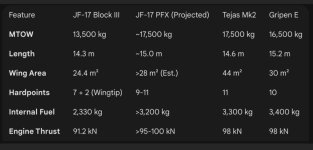
Credible reports and analysis suggest that the PFX will be physically larger than the current JF-17. Estimates place its Maximum Take-Off Weight (MTOW) in the vicinity of 17,500 kg, a significant increase from the 13,500 kg of the Block III. To achieve this, the PFX appears to be following a well-established aerospace engineering pathway: the "Super" variant evolution, mirroring the transformation of the F/A-18 Hornet to the Super Hornet and the F-16 to the Mitsubishi F-2.
3.1.1 The Super Hornet Paradigm (Volume and Range)
The evolution of the classic F/A-18 C/D Hornet into the F/A-18 E/F Super Hornet provides the most direct analogy for the PFX program. The US Navy required a fighter with significantly greater range and payload but wanted to retain the familiar handling and maintenance infrastructure of the Hornet.
- The Solution: The Super Hornet featured a fuselage stretched by approximately 34 inches (86 cm) and a wing area increased by 25%. This structural enlargement allowed for a 33% increase in internal fuel capacity, directly addressing the "short legs" (limited combat radius) of the original Hornet.
- Relevance to PFX: The JF-17 faces a similar critique regarding its combat radius. By adopting a "Super Hornet" approach, stretching the fuselage and enlarging the dorsal spine, the PFX can accommodate additional internal fuel tanks. This would allow it to loiter longer on combat air patrol (CAP) or strike deeper targets without the drag penalty of external drop tanks, a critical requirement for countering the Rafale's reach. Notably, the Super Hornet achieved this with 42% fewer structural parts, a design philosophy of simplification that the PFX is likely to emulate to keep manufacturing costs low.
The Mitsubishi F-2, often called the "Viper Zero," represents Japan's indigenous scaling of the F-16. It illustrates how to increase payload and agility through structural modification.
- The Solution: While visually similar to the F-16, the F-2 features a wing area that is 25% larger than the standard Falcon. This larger wing provides more lift, allowing for heavier weapon payloads and better turning performance. Crucially, Japan utilized co-cured composite materials for the wings to keep weight manageable despite the size increase.
- Relevance to PFX: The PFX is projected to incorporate a similar 25% increase in wing area and extensive use of composite materials (aiming for >60% indigenous composite manufacturing). This would allow the PFX to carry heavier standoff weapons (like the Ra'ad-II cruise missile) on wing stations without compromising the aircraft's thrust-to-weight ratio, effectively creating a "Super Thunder" that balances the agility of a light fighter with the payload of a medium fighter.
This enlargement addresses specific operational limitations:
- Combat Radius: The current JF-17 relies heavily on external drop tanks for long-range missions. An enlarged spine and fuselage would allow for significantly more internal fuel, freeing up hardpoints for weapons and reducing drag.
- Payload Capacity: An increased MTOW allows for a heavier weapons load. The PFX is expected to feature additional hardpoints, potentially under the intake cheeks (similar to the Rafale) or tandem carry capability on existing pylons.
- Cooling and Power: AESA radars and advanced EW suites generate immense heat and require substantial electrical power. A larger airframe provides the volume needed for enhanced Environmental Control Systems (ECS) and power generation units.
Speculation regarding a twin-engine variant of the PFX has persisted in defense circles. A twin-engine configuration would offer greater survivability, payload, and power generation, bringing it closer to the Rafale or Eurofighter Typhoon.
However, a sober analysis of the PAF's logistical and economic reality suggests a heavy single-engine design is the more probable outcome. Converting a single-engine airframe to a twin-engine layout is essentially designing a new aircraft (e.g., the difference between the F-16 and F/A-18). Given the PAF's emphasis on "affordable mass" and commonality with the existing JF-17 supply chain, a single-engine design powered by a next-generation turbofan (like the WS-19) offers the best balance of performance and cost. The "twin-engine" reports may refer to separate procurement tracks for the J-31/J-35 or conceptual studies that were not selected for mass production.
3.3 Materials and Signature Reduction
While the PFX will not be a "stealth" fighter in the same class as the J-20, it will incorporate significant signature reduction measures. The Block III already introduced composite materials in the vertical stabilizer and wings. The PFX will expand this to the fuselage skins and internal structure.
- Radar Cross Section (RCS): The use of composites, combined with Radar Absorbent Material (RAM) coatings and saw-tooth panel alignments, will reduce the frontal RCS. The Diverterless Supersonic Inlet (DSI), a staple of the JF-17 design, already provides excellent shielding of the engine fan blades from radar waves.
- Weight Reduction: Increasing the percentage of composites (potentially exceeding 20-25% of structural weight) helps offset the weight gain from new avionics and structural enlargement, maintaining the aircraft's thrust-to-weight ratio.
4. Propulsion Systems: The Quest for High Thrust
The engine remains the critical variable in the PFX equation. The performance of the enlarged airframe depends entirely on the availability of a high-thrust powerplant.4.1 The RD-93MA Baseline
The current JF-17 Block III utilizes the Russian Klimov RD-93MA. This is a significant upgrade over the base RD-93, producing approximately 91.2 kN (9,300 kgf) of thrust (wet) compared to the original's 8300 kgf. The RD-93MA features a modernized FADEC (BARK-93MA) and improved hot-section materials, increasing service life and reliability.
4.2 The Chinese Alternative: WS-13 and WS-19
Geopolitical reliability is a major concern for Pakistan. Reliance on Russian engines exposes the PAF to sanctions (CAATSA) and supply chain disruptions due to the Russia-Ukraine war. Consequently, the PAF has actively explored Chinese options.
- Guizhou WS-13: An indigenous Chinese derivative of the RD-93. While initially plagued by reliability issues, the WS-13E variant has matured and offers comparable thrust (approx. 86-90 kN).
- WS-19 "Huangshan": This is the game-changer. Developing for the J-35/FC-31 stealth fighter, the WS-19 is a new-generation medium-thrust engine expected to deliver 100-110 kN of thrust with a much higher thrust-to-weight ratio. If integrated into the PFX, the WS-19 would provide "supercruise" potential (supersonic flight without afterburner) and kinematic performance superior to the Tejas Mk2's GE F414.
Pakistan's deepening defense ties with Turkey have led to speculation about collaboration on engine technology. Turkey's TEI is developing engines for its unmanned systems and the Kaan fighter. While a fully indigenous Pakistani engine is decades away, a joint venture to produce engine components or a derivative engine under the PFX umbrella is a strategic possibility, aligning with the goal of reducing dependency on both US and Russian sources.
5. Avionics Sovereignty: The "PFX Alpha" Revolution
The core philosophy of the PFX program is "Avionics Sovereignty." In modern air combat, the side that controls the source code controls the fight. The "PFX Alpha" spiral is specifically designed to replace imported "black boxes" with locally developed or controlled systems.5.1 Radar: The Indigenous AESA Roadmap
The current JF-17 Block III utilizes the KLJ-7A, a highly capable radar from China's NRIET. While effective, it remains a "black box" system, limiting the PAF's ability to rapidly update waveforms or integrate third-party EW suites. The PFX program aims to internalize the entire AESA value chain, a goal now moving from theory to tangible prototyping at NASTP and Air University Kamra.
5.1.1 The Shift to Gallium Nitride (GaN)
Research conducted by the Department of Avionics Engineering at Air University Kamra confirms that Pakistan has moved beyond older Gallium Arsenide (GaAs) technology. The focus is now exclusively on X-band Gallium Nitride (GaN) Transmit/Receive Modules (TRMs).
- Performance Metrics: Indigenous research has successfully modeled and simulated a 15W X-Band GaN TRM operating in the 8.5 GHz – 11 GHz frequency range. In simulations using AWR Visual System Simulator (VSS), these modules demonstrated a transmit gain of 71.65 dB and a receive gain of 15.5 dB, with a Noise Figure (NF) ranging between 2.81 dB and 3.62 dB.
- Significance: GaN technology offers significantly higher power density and thermal efficiency than GaAs. This allows the PFX radar to burn through heavy enemy jamming and detect low-RCS targets (like cruise missiles or stealth fighters) at greater ranges without increasing the radar's physical size.
The development effort is not limited to just the TRM but encompasses the entire radar backend.
- Design & Simulation: The indigenous TRM architecture features a multi-layer PCB design validated through industry-standard tools like ANSYS HFSS for transmission line modeling and Cadence for layout. This confirms that Pakistan has mastered the complex "stack-up" design required for high-frequency AESA radars.
- Scalability: The modular design of these TRMs allows them to be scaled up. While the initial research focused on individual modules, the same architecture can be arrayed to create a radar with 1000+ elements for a fighter jet, or smaller arrays for UAVs and ground-based air defense.
- Software Defined: By owning the TRM design and the beamforming algorithms, the PAF can create custom radar modes (e.g., interleaved air/ground scanning, specific anti-jamming techniques) that are optimized for the Indian threat environment, something impossible with an imported off-the-shelf radar.
The PFX views the electromagnetic spectrum as a maneuver space equal in importance to the physical airspace. Moving beyond the basic self-protection of early Block Is, the PFX introduces a comprehensive, offensive-defensive EW architecture, spearhead by the indigenous Project Panjnad.
5.2.1 Project Panjnad: The Indigenous Shield
Named after the five rivers of Pakistan, Project Panjnad is the PAF’s flagship initiative to indigenize Electronic Countermeasures (ECM) and Electronic Support Measures (ESM). This program specifically targets the development of "cognitive" jamming capabilities designed to defeat modern AESA radars and high-altitude air defense systems like the S-400.
- Development Entities: The project is a collaborative effort led by the Defence Science and Technology Organization (DESTO) and the National Radio and Telecommunication Corporation (NRTC), operating under the technical oversight of NASTP.
- Capabilities: Unlike the legacy KG-300G pods, Panjnad is an integrated suite. It utilizes Digital Radio Frequency Memory (DRFM) technology to record incoming radar pulses and re-transmit them with subtle errors, creating "ghost targets" or masking the aircraft's true location. The system includes multi-band jammers capable of disrupting both fire-control radars (X/Ku band) and surveillance radars (L/S band).
- Cognitive EW: A key focus of NASTP's software division is the integration of AI/ML algorithms into Panjnad. This allows the system to autonomously identify unknown enemy radar frequencies and generate novel jamming profiles in real-time, a critical requirement for surviving in the dense signal environment of the Indo-Pak border.
The PFX’s EW capabilities are directly linked to its "Hard Kill" options, effectively turning the fighter into a "Wild Weasel" platform for Suppression/Destruction of Enemy Air Defenses (SEAD/DEAD).
- The LD-10 Missile: The primary weapon for this role is the LD-10, an anti-radiation variant of the SD-10/PL-12 air-to-air missile. It features a passive radar seeker designed to home in on enemy radar emissions.
- Launch Parameters: The missile has an effective range of approximately 60 nm (100+ km) when launched from high altitude (40,000 ft) at transonic speeds (Mach 0.9). It can be fired in "Passive" mode (maddog), where it autonomously seeks the strongest emitter, or "Self-Protection" mode, where it targets a specific threat illuminating the PFX.
- Operational Synergy: The Panjnad suite creates the "soft kill" window by blinding the enemy radar, forcing it to switch frequencies or increase power, which in turn makes it a more visible target for the LD-10's passive seeker.
While Project Panjnad is indigenous, its development has been significantly accelerated by a strategic MoU on Electronic Warfare signed with Turkey. This agreement facilitates the transfer of critical know-how from Turkish defense giants to Pakistani entities.
- Aselsan and Havelsan: These companies, having extensive combat experience against Russian air defense systems in Syria and Libya, are assisting NRTC and DESTO in refining DRFM algorithms and miniaturizing hardware for internal carriage.
- Strategic Autonomy: By partnering with Turkey rather than solely relying on China, Pakistan ensures it avoids a "single point of failure" in its supply chain. The collaboration at NASTP allows Pakistani engineers to access the source code of Turkish systems (like the ASELPOD and potential internal jammers), ensuring seamless integration with the PFX's mission computer.
The operational soul of the PFX is its connectivity. It transcends the role of a traditional fighter, evolving into a command node for a "System of Systems" defined by manned-unmanned teaming (MUM-T) and distributed lethality.
5.3.1 Collaborative Combat Aircraft (CCA) / Loyal Wingman Role
The PFX is designed to function as the "Quarterback" in a manned-unmanned team. This marks the PAF's entry into the era of Collaborative Combat Aircraft (CCA), or "Loyal Wingmen", unmanned systems that fly alongside manned fighters to extend sensors, increase payload, and absorb risk.
- Operational Concept: In this configuration, a manned PFX (or the future J-31/KAAN) would control a swarm of 2-3 stealthy UCAVs. The drones would act as forward sensors, penetrating high-threat anti-access/area denial (A2/AD) zones to identify targets (e.g., S-400 radars) or acting as decoys to draw enemy fire.
- The "Silent" Quarterback: The PFX stays back in relative safety, using the data fused from the drones via Link-17 to launch long-range missiles. This allows the PAF to generate "mass" without risking expensive manned airframes or pilots..
To fulfill this loyal wingman role, Pakistan has actively pursued Turkish next-generation UCAVs, which are explicitly designed for interoperability with manned fighters.
- Bayraktar Kızılelma: Pakistan is a confirmed partner in the Kızılelma program. This is a jet-powered, carrier-capable, stealthy UCAV featuring the MURAD AESA radar and AI-driven maneuverability. It is capable of air-to-air combat using Gökdoğan and Bozdoğan missiles. In a PAF formation, the Kızılelma would serve as the "shield," engaging enemy fighters ahead of the PFX..
- TAI Anka-3: Pakistan has also received offers for the Anka-3, a flying-wing stealth UCAV optimized for deep strike and SEAD missions. Its low radar cross-section makes it ideal for the "spear" role, slipping through radar gaps to neutralize air defenses while the PFX provides overwatch. The Anka-3's ability to carry internal payloads ensures it maintains stealth while delivering heavy ordnance..
This operational integration is underpinned by a deep industrial integration. Both Baykar and Turkish Aerospace Industries (TAI) have established permanent research and development centers within Pakistan's National Aerospace Science and Technology Park (NASTP).
- Baykar at NASTP: Baykar has signed a cooperation agreement to conduct R&D activities directly within NASTP. This facility is not just a sales office; it is a hub for joint engineering. Notable outcomes already include the KaGeM V3, an air-launched loitering munition/cruise missile reportedly co-engineered by NASTP and Baykar for use on UCAVs and manned fighters like the JF-17..
- TAI at NASTP: TAI established its inaugural office at NASTP, marking the first Turkish defense company to do so. This center focuses on collaborative work in avionics, satellite systems, and potentially components for the KAAN fighter. By co-locating engineering teams, Pakistan ensures that the software and datalinks of Turkish drones (Kızılelma/Anka-3) are natively compatible with the PFX and Link-17 architecture, avoiding the "black box" integration issues faced with other suppliers..
The PFX cockpit builds on the Block III's glass cockpit, featuring a large Wide Area Display (WAD) and a modernized Heads-Up Display (HUD). The pilot utilizes a Helmet Mounted Display/Sight (HMD/S), which projects flight data and targeting cues directly onto the pilot's visor, allowing for "look-and-shoot" engagements with high-off-boresight missiles.
5.5 Active Counter-Stealth (Passive Sensors): The Aselsan KARAT Integration
With the proliferation of stealth aircraft in the region, the PFX doctrine emphasizes "Active Counter-Stealth", the ability to detect and engage Low Observable (LO) targets without relying solely on radar. The cornerstone of this capability is the integration of advanced Infrared Search and Track (IRST) systems, marking a departure from the radar-centric approach of previous generations.
5.5.1 The Physics of Passive Detection
While stealth aircraft are shaped to deflect radar waves, they cannot defy the laws of thermodynamics. High-performance flight generates significant heat through aerodynamic heating (skin friction) and engine exhaust.
- LWIR Advantage: The PFX actively leverages Long-Wave Infrared (LWIR) sensors (8-12 μm band). Unlike Medium-Wave (MWIR) sensors that are optimized for hot engine plumes, LWIR is superior at detecting the relatively "cooler" heat generated by air friction on an aircraft's nose and leading edges. This allows the PFX to detect a stealth fighter approaching head-on, its most stealthy aspect, at ranges exceeding 100 km, a capability verified in similar systems like the Eurofighter's PIRATE.
The PFX is slated to integrate the Aselsan KARAT IRST, a high-performance system originally developed for the Turkish KAAN fighter and Kızılelma UCAV.
- Technical Specifications: KARAT features a high-resolution 640x512 pixel LWIR detector capable of tracking multiple targets simultaneously in a wide field of regard.
- Low Observable Design: Unlike traditional "ball" IRST sensors that compromise a jet's stealth, KARAT utilizes a faceted, windowed fairing designed to deflect radar waves, maintaining the PFX's reduced RCS profile.
- Passive Ranging: By networking two or more PFXs via Link-17, the system can triangulate the exact range of a heat signature without ever emitting a radar pulse. This allows the PFX to generate a "weapons quality track" completely passively.
This sensor integration enables a "Silent Kill" chain. A PFX can detect a hostile stealth aircraft using KARAT, fuse the track data with its mission computer, and launch a PL-15E or FAAZ-2 missile in Lock-On After Launch (LOAL) mode. The adversary receives no Radar Warning Receiver (RWR) alert until the missile's own active seeker turns on in the terminal phase, drastically reducing their reaction time and survivability.
6. Weapons Integration: Lethality at Range
The "Long Arm" of the PAF is its diverse array of standoff weapons. The PFX is designed as a carrier for next-generation munitions that out-range adversary defenses.6.1 Air-to-Air Dominance
- PL-15E: The standard long-range weapon. With a dual-pulse motor and AESA seeker, it claims a range of 145 km, out-ranging the AIM-120C-5 carried by Indian F-16s and challenging the Meteor carried by Rafales.
- PL-10E: A 5th-generation imaging infrared (IIR) missile for Within Visual Range (WVR) combat. Its extreme maneuverability and HMD integration make the PFX deadly in a dogfight.
- The FAAZ Program: Perhaps the most significant development is the indigenous FAAZ family of missiles developed by GIDS (Global Industrial & Defence Solutions).FAAZ-2: An active radar-guided BVR missile with a reported range of 180 km and a speed of Mach 3.5.Significance: Successful integration of the FAAZ-2 would decouple the PAF's ammunition supply from China, a massive strategic advantage.
- PL-17 / PL-XX: Speculation exists regarding the integration of the ultra-long-range (400 km) PL-17, designed to target high-value assets like AWACS and tankers.
The JF-17 is taking over the strategic strike role from the Mirage fleet. The PFX is integrated with the Ra'ad-II (Hatf-VIII) Air-Launched Cruise Missile (ALCM).
- Ra'ad-II: A stealthy cruise missile with a range of 600 km. It is capable of carrying both conventional and nuclear warheads. The PFX's ability to carry this weapon deep into enemy territory or launch it from standoff ranges is central to Pakistan's strategic deterrence.
The PFX retains the JF-17's formidable anti-ship capabilities.
- CM-400AKG: A high-supersonic (Mach 4+) anti-ship missile often called a "carrier killer." It uses a high-altitude ballistic trajectory to dive onto targets, making it extremely difficult to intercept.
- C-802AK: A subsonic sea-skimming missile for conventional anti-ship roles.
The PFX integrates indigenous glide bombs like the Takbir and Rasoob-250, as well as the Al-Battar laser-guided bomb. These weapons allow the PFX to strike ground targets with precision while remaining outside the envelope of short-range air defense systems.
Table 2: PFX Weapons Payload Capability
7. The Industrial Ecosystem: PAC Kamra, NASTP, and Air University
The PFX is not merely a fighter; it is the flagship product of a maturing "Triple Helix" aerospace ecosystem involving industry (PAC), innovation hubs (NASTP), and academia (Air University).7.1 Manufacturing Autonomy
Currently, the Pakistan Aeronautical Complex (PAC) at Kamra manufactures 58% of the JF-17 airframe (wings, fuselage, vertical stabilizer), with the remaining 42% imported from China. The PFX program aims to increase this local work-share significantly. The target is "full production autonomy," implying the capability to manufacture complex structural components and potentially source materials domestically or from non-Chinese partners. PAC has demonstrated a production capacity of approximately 20-25 aircraft per year, which the PFX production run will leverage to rapidly replace the remaining Mirage and F-7 fleets.
7.2 The Innovation Core: NASTP and Air University Kamra
Central to the PFX's "Avionics Sovereignty" is the synergy between the National Aerospace Science and Technology Park (NASTP) and the newly inducted Air University Aerospace and Aviation Campus Kamra (AUAAC). Together, they form the brain trust of the Kamra Aviation City initiative.
- NASTP's Role: NASTP acts as the "Skunk Works" for the PAF, bridging the gap between operational requirements and industrial output. It serves as the incubator for "PFX Alpha" spirals, where indigenous codes and hardware are tested on ground rigs before flight integration. Its status as a Special Technology Zone (STZ) allows it to attract private sector partners and international joint ventures.
- Air University Kamra (AUAAC): The establishment of the Air University campus at Kamra is a critical strategic move to solve the "human capital" bottleneck. Located in direct proximity to PAC and NASTP, AUAAC is tasked with producing the specialized workforce required for 5th-generation development.Research Focus: AUAAC is not just a teaching institute; it is an active research hub. Department of Avionics Engineering at AUAAC is spearheading research into X-band Gallium Nitride (GaN) Transmit/Receive (T/R) modules. This research is the "secret sauce" behind the PFX's indigenous AESA radar ambitions.Technology Indigenization: By developing GaN T/R module designs, multi-layer PCB architectures, and beamforming algorithms domestically, Air University allows the PAF to break free from the "black box" restrictions of imported radars.Pipeline for Project Azm: The campus offers specialized degrees in Aerospace and Avionics Engineering, directly feeding graduates into the PFX and future Project Azm programs. This creates a sustainable loop where academic research transitions directly into military hardware within the same physical complex.
The PFX program benefits significantly from Pakistan's deepening defense axis with Turkey. This relationship has evolved from simple procurement to active co-development, formalized through multiple MOUs between NASTP and Turkish Aerospace Industries (TUSAŞ).
- Avionics and Sensors: While the Block III relies on Chinese avionics, the PFX aims to integrate Turkish systems to achieve a "NATO-standard" architecture without Western export controls. Key candidates include the Aselsan MURAD AESA radar (a GaN-based system) and the TULGAR Helmet Mounted Display, which would replace Chinese equivalents, offering superior jam-resistance and processing power. The ASELPOD targeting system is already fully integrated and combat-proven on the JF-17 platform.
- Electronic Warfare (EW): A specific MOU on Air Force Electronic Warfare underscores the PFX's focus on "spectrum sovereignty." By collaborating with Aselsan and Havelsan, Pakistan aims to develop indigenous EW suites (Project Panjnad/PFX-Alpha) that can counter advanced threats like the S-400, leveraging Turkish experience with Russian systems in Syria and Libya.
- Weaponry Lineage: The indigenous FAAZ air-to-air missile program reportedly draws technical DNA from Turkey's Gökdoğan (Peregrine) and Bozdoğan (Merlin) missile programs. This collaboration ensures that the PFX's "long arm" is not solely dependent on Chinese PL-15 supply lines.
- Strategic De-risking: This "Turkish Track" serves a critical strategic function: it prevents the PFX from becoming a "Chinese-only" platform, maintaining a degree of supply chain diversity and ensuring the aircraft remains attractive to export customers wary of relying entirely on Beijing.
8. Comparative Strategic Analysis
The value of the PFX is best understood in comparison to its regional peers.8.1 PFX vs. Tejas Mk2 (India)
The Tejas Mk2 is the direct competitor.
- Similarities: Both are 17.5-ton class single-engine fighters with 4.5 Gen avionics, canards (Tejas) or LERX (JF-17), and AESA radars.
- Differences: The Tejas Mk2 uses the American GE F414 engine, which is proven and powerful. The PFX's engine choice (WS-19 or RD-93MA) is a riskier variable. However, the PFX program has a history of faster delivery. While the Tejas Mk2 is still in development with prototype flights expected mid-decade, the JF-17 operational cycle is mature. The PFX is likely to enter service before the Tejas Mk2 reaches full operational capability (FOC) in squadron strength.
- Advantage: The PFX's integration of longer-range missiles (PL-15E/FAAZ-2) currently gives it a BVR reach advantage over the Astra Mk1, though the Astra Mk2 and Meteor will close this gap.
The Rafale is a heavy twin-engine fighter and is kinetically superior to the PFX.
- Asymmetric Strategy: The PAF does not intend for the PFX to go "toe-to-toe" in a turning dogfight with a Rafale. The strategy is asymmetric. Using Link-17, AWACS support, and the sheer number of PFXs ("affordable mass"), the PAF aims to overwhelm the limited number of Rafales.
- Cost Exchange: At roughly 1/3rd to 1/4th the price of a Rafale, the PAF can afford to lose PFXs in an attrition war where the IAF cannot afford to lose Rafales. The PL-15E allows the PFX to threaten the Rafale from ranges where the Rafale's kinematic advantage is less decisive.
The Gripen E is the closest analogue in terms of design philosophy (smart, networked, single-engine).
- Comparison: The Gripen E has a superior EW suite (GaN-based) and engine (F414). However, the PFX is significantly cheaper and free from the strict export controls that hamper Gripen sales. The PFX essentially aims to be "80% of a Gripen E at 50% of the cost."
9. Export Potential and Defense Diplomacy
The JF-17 has already found success with Myanmar, Nigeria, and Azerbaijan. The PFX aims to expand this footprint.- Azerbaijan: Having recently inducted Block IIIs, Azerbaijan is a prime candidate for the PFX to counter Armenian acquisitions or regional threats.
- Middle East: Reports of interest from Iraq and Saudi Arabia highlight the PFX's potential as a low-cost, high-capability alternative for air forces looking to diversify away from US/Western dependence.
- Sales Pitch: The PFX offers a unique proposition: a fighter with BVR capabilities exceeding the F-16 Block 52, compatibility with non-NATO weapons (preventing sanctions capabilities), and a price point accessible to developing economies.
10. Operational Doctrine: The Integrated Air-Space Kill Chain
The PFX is not merely a replacement airframe; it is the kinetic end-point of a new operational doctrine that transcends the traditional air domain. The PAF is actively pivoting toward a "Space-Centric" Kill Chain, recognizing that in modern warfare, the highest ground provides the decisive advantage.10.1 From Air Battle to Multi-Domain Operations (MDO)
The integration of the PAF Space Command and the NASTP Space Division has fundamentally altered how the PAF visualizes the battlespace. The PFX is designed to operate within a "System of Systems" where the shooter (the fighter jet) may be hundreds of kilometers away from the sensor that detects the target.
- The "Find" and "Fix" Problem: Against advanced threats like the S-400 air defense system or deeply buried command centers, traditional airborne sensors (AWACS) face significant risks. Space-based assets provide a "sanctuary" capability to find and fix targets without exposing manned aircraft to danger..
The efficacy of the PFX's long-range weapons (like the PL-15E and Ra'ad-II) is directly tied to the quality of targeting data provided by Pakistan's growing satellite fleet.
- Legacy Assets: The PRSS-1 (Remote Sensing Satellite) and PakTES-1A, launched in 2018, provided the initial capability for optical and Synthetic Aperture Radar (SAR) mapping. These assets are crucial for generating the digital terrain elevation data (DTED) needed for cruise missile guidance (TERCOM)..
- The HS-1 Hyperspectral Leap: The launch of the HS-1 satellite in October 2025 marked a quantum leap in capability. Unlike standard optical satellites that can be fooled by camouflage, the HS-1's hyperspectral sensors can distinguish between real tanks and decoys, or identify hidden bunkers based on their spectral signature. This data is fed directly into the PAF's targeting cycle..
- Persistent Surveillance (The PIESAT Deal): A strategic game-changer is the $406 million deal with China's PIESAT, signed in late 2025. This agreement involves the launch of a constellation of over 20 imaging and communication satellites with a sub-1-day revisit rate. This "persistent stare" capability means the PAF will not just have a snapshot of the battlefield, but a near-real-time feed of enemy movements, allowing the PFX to engage mobile targets (like missile launchers) that would otherwise relocate before a strike could be authorized..
The operational mechanics of this kill chain are what make the PFX deadly.
- Data Fusion: Intelligence from the HS-1 or PIESAT constellation is downlinked to the Air Intelligence Center at Air Headquarters.
- Networked Distribution: This data is processed and transmitted via Link-17 to airborne assets. A PFX pilot does not need to see the target on their own radar; they receive a "weapons quality track" directly from the network.
- Silent Engagement: In a hypothetical scenario involving an Indian S-400 battery, the PFX can launch a Ra'ad-II cruise missile or an LD-10 anti-radiation missile from a safe standoff distance, guided by coordinates updated in real-time by satellite feeds. This completes the "Sensor-to-Shooter" loop in minutes rather than hours, validating the PFX's role as a networked node in a space-enabled kill chain..
11. The Digital Backbone: Digital Engineering and Rapid Certification
The PFX program's "software-first" philosophy extends beyond avionics into the very methodology of how the aircraft is designed, updated, and certified. By adopting a Digital Engineering ecosystem, the PAF aims to break the traditional, years-long cycle of aircraft modernization, replacing it with a tempo measured in weeks or even days.11.1 Digital Twins and Virtual Testing
At the heart of this transformation is the creation of a high-fidelity Digital Twin of the PFX. Developed collaboratively by NASTP Alpha and the Air University Avionics Integration Laboratory, this virtual replica mirrors the physical aircraft's structure, avionics, and engine performance in real-time.
- Predictive Maintenance: Sensors on the physical fleet feed data back to the digital twin, allowing engineers to predict component failures (e.g., in the RD-93MA engine or AESA cooling systems) before they occur. This shifts maintenance from a reactive to a proactive posture, significantly increasing fleet availability rates.
- Virtual Prototyping: New weapon integrations (like the FAAZ-2) or EW algorithms are first tested in the virtual environment. NASTP Alpha's advanced AR/VR simulators allow pilots to fly "virtual sorties" with new software builds against complex threat scenarios before a single line of code is loaded onto a real jet.
The PFX abandons the rigid, proprietary software architectures of legacy fighters in favor of an Open Mission System (OMS) approach.
- Open Architecture: The PFX mission computer is built on C++ based open-architecture standards, separating the "flight safety" software (which controls the plane) from the "mission" software (which controls radars, jammers, and missiles). This allows for "plug-and-play" integration of third-party apps, similar to installing an app on a smartphone, without needing to recertify the entire aircraft's flight control system.
- The DevOps Pipeline: NASTP Sierra (Karachi) and the National Institute of Info Tech (NIIT) have established Software Factories that utilize a DevOps (Development and Operations) model. This involves Continuous Integration/Continuous Deployment (CI/CD) pipelines where software updates are coded, automated-tested, and deployed rapidly.
- Tactical Advantage: If a new enemy radar frequency is detected in the morning, NASTP engineers can code a jamming countermeasure, test it on the digital twin, and push the software update to the PFX fleet by the evening, a cycle that previously took months.
Speed means nothing without safety. To ensure these rapid updates do not compromise airworthiness, the PAF Airworthiness Certification Authority (PACA) has been integrated directly into the development loop at Kamra Aviation City.
- Agile Regulation: Unlike civilian certification bodies that can take years to approve changes, PACA has adopted agile certification protocols tailored for military necessity. By being co-located with the design teams at NASTP, PACA certifiers validate digital models and software increments in real-time.
- Sovereign Standards: PACA has issued over 1,250 airworthiness approvals for indigenous modifications, effectively creating a sovereign certification regime (equivalent to EASA B1/B2 standards but optimized for warfare). This regulatory independence allows the PAF to clear "PFX Alpha" spirals for combat use immediately upon completion of testing, bypassing the bureaucratic delays often associated with foreign OEMs.
12. Challenges and Risks
Despite the strategic logic, the PFX program faces significant headwinds.- Economic Volatility: Pakistan's macroeconomic stability is fragile. Developing indigenous high-tech industries requires sustained, predictable funding over decades. Fiscal crises could delay R&D at NASTP or slow production at PAC.
- Engine Reliability: The "Achilles Heel" of Chinese and Russian engines has historically been their Mean Time Between Overhaul (MTBO) and total service life. While improving, they still lag behind Western counterparts. A PFX flying high-tempo operations requires a robust engine logistics chain.
- Complex Integration: Writing the software to fuse data from a Chinese radar, a Turkish EW pod, a Pakistani datalink, and a Russian engine is an engineering nightmare. Integration challenges could delay the "Avionics Sovereignty" goals, forcing a reversion to off-the-shelf solutions.
13. Conclusion
The JF-17 PFX represents the maturation of a decades-long strategic vision. It transforms the JF-17 from a "budget fighter" into a credible, networked, 4.5-generation combat system. By leveraging the industrial base established by the JF-17 program and integrating advanced technologies from China, Turkey, and its own burgeoning R&D sector, Pakistan is forging a tool uniquely suited to its defensive needs.While it may not match the raw kinematic power of a twin-engine heavy fighter, the PFX's combination of advanced AESA radar, long-range weaponry like the PL-15E and FAAZ-2, and robust electronic warfare capabilities makes it a deadly adversary in the modern battle space. More importantly, the drive toward "PFX Alpha" and avionics sovereignty ensures that the Pakistan Air Force retains the operational independence to fight on its own terms. As the "Thunder" evolves into this new experimental variant, it solidifies its place not just as the backbone of the PAF, but as a significant case study in how nations can achieve strategic deterrence through smart, spiral innovation.
Source:
Users who are viewing this thread
Total: 2 (members: 0, guests: 2)
Pakistan Defence Latest
-
-

-
 PTI Murad Saeed in Afghanistan, was 'controlling KP govt' from there: Rana Sanaullah (7 Viewers)
- Latest: Starlord
-

Country Watch Latest
-
 Iran - Israel/US War: Israel-US declare war on Iran, Iran responds (130 Viewers)
- Latest: Master Chief
-

-
Turkey, Pakistan, Qatar, and Indonesia forge ‘Badr’ Pact to Jointly Produce Weapons (25 Viewers)
- Latest: Batman
-
Which Turkish agency is responsible for securing Turkish diplomatic missions abroad? (9 Viewers)
- Latest: hyperman
-

Latest Posts
-
Iran - Israel/US War: Israel-US declare war on Iran, Iran responds (130 Viewers)
- Latest: Master Chief
-
-
 France to receive just two Rafales in 2027 as air chief warns of fighter strain (4 Viewers)
- Latest: Ali_Baba
-

