JF-17 PFX program

The question centers on: what type of fighter will the PFX be?

1. Is it a light fighter?
The JF-17 B3 is already the pinnacle of light fighters. There is no other light fighter in the world that can match it. The only way to upgrade it is to evolve it to a 5th generation fighter. However, its airframe limitations are too great, resulting in it not being able to meet the standards of a 5th generation fighter.
In the plans of military technology powerhouses, the future light fighters will be fully shifted to UCAVs. with the application of AI in the field of military science and technology, UCAVs will completely surpass the light fighters.
Well, upgrading the JF-17 to a light 5th generation fighter obviously makes little sense.

2. is it a medium fighter?
This would conflict with the real interests of AVIC, whose main products, the J-10CE and the J-35, are both medium-sized fighters. Why should it go all out to help Pakistan develop a medium fighter to grab its market?
Even after Pakistan goes through some negotiations, eventually AVIC may accede to Pakistan's request. AVIC to execute the entire design, AVIC to directly supply all key components, and AVIC to provide technology transfer for the production of some components. The PAC integrates other technologies and performs the final production. ...... But they will surely attach a particularly important condition ------PFX is for PAF use only and export is prohibited. (Referring to the rest of the world copying the F-16)
This means that PAF will have to fully share all the investment in PFX. With Pakistan's economic strength, it is obvious that the PFX will not be produced in large numbers. After the high investment costs are spread out, the unit price of the PFX will be a figure that far exceeds that of the J-10CE/J-35.
Well, what is its purpose and significance?
Agree with most of what you’ve said but don’t agree with your view that China won’t help Pakistan due to fear of the PFX competing for exports with Chinese Birds. If this was the case why would China have helped Pakistan develop and export the JF-17 Block 3? Is that product not a cheaper competitor to the J10CE??
China doesn’t strike me as desperate to export its fighters. If a country wants them and if providing them suits China’s strategic interests, then yes of course they would welcome any such orders, but their main focus is their own domestic needs. Second comes their Strategic interests and Pakistan is still important to these. Exporting fighters to the global market comes much lower on their priority list.
 
You mean Chengdu and china will.develope a new updated version of the jf17 again
You invested money in this I recall project cost was 500 million and Pak contribution was 50% of finance

China has three different projects on the go again huge cost
Two fifth generation and one sixth generation

Do they want the burden of another project ...they will say buy the j35
No, don’t know where you got all that from, certainly not my post. You are putting words in my mouth and then presenting arguments against them.
All I said is that you are assuming that Pakistan will do this without any external help which is wrong. Please stick to what I said.
 
Bro there is ‘zameen asmaan’ difference between the expenses of a foreign military and ours. A foreign military pays its engineer close to 80-100k USD at average whereas in Pakistan the same engineer would be earning somewhere around 7-15k USD per annum. So the costs to employ people is already down about 8-12 times. We have a industrial giant as a neighbour. We can source raw material from him. So the raw material costs are also much lower than what say US will pay (if not sourced locally). The major costs would be acquiring newer cutting edge tech which we are not focusing on right now. All this tech is about 20-25 years old on an industrial time scale. Nothing about it is cutting edge hence not closely guarded. I suppose this could be much feasible than a lot of people on here anticipate. The only variable and an important one for it would be perseverance that us Pakistani know little of.
Hi,

Thank you for an excellent post---.

Paf is not making statements of some out of this world technology upgrades for the PFX---.

They are talking about existing tech for which as you mentioned---it already exists---.
 
Hi,

The F-2 from the F16's---the japanese had to start from scratch---, They just had the f16 and nothing else top go on---.

Over here---Paf has all the information of the structure---its integrity---its design formats.

That is why the job will be much much easy---.

Also the F-2 had one of the first aesa radars---( correct me on that). The aircraft had a lots of growing pains because the japanese had no real epxerience with an aircraft of that type.

OTOH the Paf and their chinese partners have a lots of experience in fighter aircrfcat manufacture---.

As long as someone does not decide to re-invent the wheel---the transition will be fascinating---.
Not exactly

The F-2 is derived from Agile Falcon designed in the 80s - for a F-16 with a larger wing and more powerful engines.
They had been manufacturing the F-15J but MHI took the design parameters and focused to create an aircraft around it but because they were trying to push all sorts of untried methods such as new composite techniques and structural approaches which caused a lot of growing pains that still haunt that aircraft. Ironically, the Japanese did not use an uprated engine.

Most of that aircraft was about Japanese avionics and it did validate their industry.
MHi was WELL experienced in aircraft manufacturing which allowed them to absorb the technical debt they created with new technologies. They created the manufacturing jigs, processes and so on which took on design concepts from LM.
They even reverse taught LM some manufacturing techniques to help offset manufacturing timelines using LM facilities.

PAC is not in that model - PAC has taken a Chinese provided manufacturing line and absorbed into creating the aircraft. It did manufacture aircraft in the scale nor does it have engine manufacturing experience like MHI - it was a big leap for it to learn how to manufacture JF-17. So it can modify the JF-17 within what it learns and what it can import as processes - but has little ability to actually create processes without external assistance.

Lastly - it lacks anywhere in terms of the skilled labor along internal knowledge available to Japanese along with very few embodying the work ethic.
 
Not exactly

The F-2 is derived from Agile Falcon designed in the 80s - for a F-16 with a larger wing and more powerful engines.
They had been manufacturing the F-15J but MHI took the design parameters and focused to create an aircraft around it but because they were trying to push all sorts of untried methods such as new composite techniques and structural approaches which caused a lot of growing pains that still haunt that aircraft. Ironically, the Japanese did not use an uprated engine.

Most of that aircraft was about Japanese avionics and it did validate their industry.
MHi was WELL experienced in aircraft manufacturing which allowed them to absorb the technical debt they created with new technologies. They created the manufacturing jigs, processes and so on which took on design concepts from LM.
They even reverse taught LM some manufacturing techniques to help offset manufacturing timelines using LM facilities.

PAC is not in that model - PAC has taken a Chinese provided manufacturing line and absorbed into creating the aircraft. It did manufacture aircraft in the scale nor does it have engine manufacturing experience like MHI - it was a big leap for it to learn how to manufacture JF-17. So it can modify the JF-17 within what it learns and what it can import as processes - but has little ability to actually create processes without external assistance.

Lastly - it lacks anywhere in terms of the skilled labor along internal knowledge available to Japanese along with very few embodying the work ethic.
Hi,

Base on what you stating---I would say & I believe that there would not be too many radical changes in the JF17's structure.
 
Hi,

Base on what you stating---I would say & I believe that there would not be too many radical changes in the JF17's structure.
Quite possibly but also depends on how much external help is involved in the project.
 
Not exactly

The F-2 is derived from Agile Falcon designed in the 80s - for a F-16 with a larger wing and more powerful engines.
They had been manufacturing the F-15J but MHI took the design parameters and focused to create an aircraft around it but because they were trying to push all sorts of untried methods such as new composite techniques and structural approaches which caused a lot of growing pains that still haunt that aircraft. Ironically, the Japanese did not use an uprated engine.

Most of that aircraft was about Japanese avionics and it did validate their industry.
MHi was WELL experienced in aircraft manufacturing which allowed them to absorb the technical debt they created with new technologies. They created the manufacturing jigs, processes and so on which took on design concepts from LM.
They even reverse taught LM some manufacturing techniques to help offset manufacturing timelines using LM facilities.

PAC is not in that model - PAC has taken a Chinese provided manufacturing line and absorbed into creating the aircraft. It did manufacture aircraft in the scale nor does it have engine manufacturing experience like MHI - it was a big leap for it to learn how to manufacture JF-17. So it can modify the JF-17 within what it learns and what it can import as processes - but has little ability to actually create processes without external assistance.

Lastly - it lacks anywhere in terms of the skilled labor along internal knowledge available to Japanese along with very few embodying the work ethic.
IMO... We should approach aerospace in terms of scalability with the aim of driving a high output and rapidly recouping R&D overhead.

For the PAF, the requirement for crewed aircraft will always be limited. The total PAF requirement of the JF-17 topped off at 250, but was averaged to around 150 (which it achieved). Minus exports or follow-on PAF orders, the PAC production line is an overhead that is underused.

Likewise, developing a new crewed aircraft is very expensive, especially when we lack the industrial capacity to create local inputs (in contrast to Japan or South Korea, which can develop their own inputs).

So, like AZM, the PAF will likely hit a wall with the PFX. In fact, the realistic scenario would be a continuation of the JF-17 as-is but with improved radars, avionics, and munitions. However, this doesn't solve the issue of underused production capacity at PAC.

IMO, to solve that problem, the PAF (via NASTP and PAC) should pivot to developing UCAVs. Start with a 1~2-ton attritable UCAV designed for 2-4 AAMs or SDBs. Use this relatively simpler program to properly learn about aerodynamic design, flight control systems, composite materials, etc.

The advantage of an attritable UCAV design is its scalability. A system of this nature would be needed by the hundreds both within the PAF as well as foreign buyers and, possibly, other tri-services arms.

Basically, you'd start with a relatively low R&D overhead cost (vs. crewed jets) and can distribute that across a massive domestic order. This helps you keep the overall unit cost of each one competitively low, which helps drive foreign interest and exports. When the demand is too much for PAC to handle alone, you can start delegating work to the private sector, thus encouraging real private investment in aerospace.

It's when these private companies start building capacity for production and, in turn, generate revenue, they'll delve into more original work. You'd get organic, bottom-up R&D from the industry and a growth in capacity for more complex programs.

So, after the attritable UCAV, you'd move onto a more complex UCAV (like 5~6-ton), and repeat the process. Then, eventually, you'll have the capacity to do a 16~20-ton design, at which point you can explore some crewed fighter design.
 
The question centers on: what type of fighter will the PFX be?

1. Is it a light fighter?
The JF-17 B3 is already the pinnacle of light fighters. There is no other light fighter in the world that can match it. The only way to upgrade it is to evolve it to a 5th generation fighter. However, its airframe limitations are too great, resulting in it not being able to meet the standards of a 5th generation fighter.
In the plans of military technology powerhouses, the future light fighters will be fully shifted to UCAVs. with the application of AI in the field of military science and technology, UCAVs will completely surpass the light fighters.
Well, upgrading the JF-17 to a light 5th generation fighter obviously makes little sense.

2. is it a medium fighter?
This would conflict with the real interests of AVIC, whose main products, the J-10CE and the J-35, are both medium-sized fighters. Why should it go all out to help Pakistan develop a medium fighter to grab its market?
Even after Pakistan goes through some negotiations, eventually AVIC may accede to Pakistan's request. AVIC to execute the entire design, AVIC to directly supply all key components, and AVIC to provide technology transfer for the production of some components. The PAC integrates other technologies and performs the final production. ...... But they will surely attach a particularly important condition ------PFX is for PAF use only and export is prohibited. (Referring to the rest of the world copying the F-16)
This means that PAF will have to fully share all the investment in PFX. With Pakistan's economic strength, it is obvious that the PFX will not be produced in large numbers. After the high investment costs are spread out, the unit price of the PFX will be a figure that far exceeds that of the J-10CE/J-35.
Well, what is its purpose and significance?
i agree , which is why i am all for creating indiginous sub systems first all of them every last one of them and create an ecosystem and start small like really small. like a jet trainer for example and them go from there any ways best of luck to Pakistan on this project.
 
Hi,

Base on what you stating---I would say & I believe that there would not be too many radical changes in the JF17's structure.
Which brings it back to what I had mentioned regarding PFX - it will end up at best a more localized JF-17 with some internal structure improvements and maybe the uprated RD-93 . That’s it - the promotions will be carried out - pats on the back - offset to vested interests made and so on.
 
IMO... We should approach aerospace in terms of scalability with the aim of driving a high output and rapidly recouping R&D overhead.

For the PAF, the requirement for crewed aircraft will always be limited. The total PAF requirement of the JF-17 topped off at 250, but was averaged to around 150 (which it achieved). Minus exports or follow-on PAF orders, the PAC production line is an overhead that is underused.

Likewise, developing a new crewed aircraft is very expensive, especially when we lack the industrial capacity to create local inputs (in contrast to Japan or South Korea, which can develop their own inputs).

So, like AZM, the PAF will likely hit a wall with the PFX. In fact, the realistic scenario would be a continuation of the JF-17 as-is but with improved radars, avionics, and munitions. However, this doesn't solve the issue of underused production capacity at PAC.

IMO, to solve that problem, the PAF (via NASTP and PAC) should pivot to developing UCAVs. Start with a 1~2-ton attritable UCAV designed for 2-4 AAMs or SDBs. Use this relatively simpler program to properly learn about aerodynamic design, flight control systems, composite materials, etc.

The advantage of an attritable UCAV design is its scalability. A system of this nature would be needed by the hundreds both within the PAF as well as foreign buyers and, possibly, other tri-services arms.

Basically, you'd start with a relatively low R&D overhead cost (vs. crewed jets) and can distribute that across a massive domestic order. This helps you keep the overall unit cost of each one competitively low, which helps drive foreign interest and exports. When the demand is too much for PAC to handle alone, you can start delegating work to the private sector, thus encouraging real private investment in aerospace.

It's when these private companies start building capacity for production and, in turn, generate revenue, they'll delve into more original work. You'd get organic, bottom-up R&D from the industry and a growth in capacity for more complex programs.

So, after the attritable UCAV, you'd move onto a more complex UCAV (like 5~6-ton), and repeat the process. Then, eventually, you'll have the capacity to do a 16~20-ton design, at which point you can explore some crewed fighter design.
The timeframe simply does not allow for any useful PFX to appear on time - NASTP should take on more Turkish work - perhaps license manufacturing of Kizilelma with Ukranian or even an uprated Honeywell TFE731 if possible from the K-8.

for 5th gen - buy off the shelf J-31s and if still able the Kaan - otherwise stick to scaling on smaller UCAVs and loitering munitions. As for the production line for JF-17 - they can have it moved onto Kizilelma or this hybrid UCAV.

Everything else is just hollow self aggrandizement with little useful substance.
 
Which brings it back to what I had mentioned regarding PFX - it will end up at best a more localized JF-17 with some internal structure improvements and maybe the uprated RD-93 . That’s it - the promotions will be carried out - pats on the back - offset to vested interests made and so on.
The graphic that was posted on here depicting the PFX as an incremental stage of up gradation of the JF-17B3 into JF17P to the Alpha or whatever and then to PFX. Now what I gather from it is that it always was meant to be a completely localised JF17. The name also suggests that in contrast to being a Joint Fighter 17 Block 3 (JF17-B3), it is now the Pakistan Fighter X (PFX). It’s right there if you look at it.
 
My view of this is that, I don't think the JF17 project will become some amazing 5th gen option or whatever is being discussed

They will simply take the 60% manufacturing inside Pakistan and try to make it into a high a percentage as possible
Probably 90%+ and only the most critical components like engine from Russia or china will be left in the end not made in Pak

Pakistan has spent a lot of years and effort in building up the JF17 project upto block 3, the Chinese partner will be bought out
Pakistan will be in COMPLETE CONTROL of the project in the future and the work being carried out is for all the necessary components including a array of Pakistani weapons and a AESA radar etc etc

I think Pakistani view point is, that we can be purchasers of J10s, or J31s and even limited partners in KAAN if thats a option, but they will always be Chinese or Turkish projects where maybe we can participate or even work share at maximum


So our own project where we have control and can Incorporate and test any weapon is vital for Pakistan, and rather then start again with a completely new project and design we can just build upon the JF17 project and expand on it

Whether that means a redesign of the plane I don't know (doubt it) but maybe they can add some snazzy new highlights or something
 
IMO... We should approach aerospace in terms of scalability with the aim of driving a high output and rapidly recouping R&D overhead.

For the PAF, the requirement for crewed aircraft will always be limited. The total PAF requirement of the JF-17 topped off at 250, but was averaged to around 150 (which it achieved). Minus exports or follow-on PAF orders, the PAC production line is an overhead that is underused.

Likewise, developing a new crewed aircraft is very expensive, especially when we lack the industrial capacity to create local inputs (in contrast to Japan or South Korea, which can develop their own inputs).

So, like AZM, the PAF will likely hit a wall with the PFX. In fact, the realistic scenario would be a continuation of the JF-17 as-is but with improved radars, avionics, and munitions. However, this doesn't solve the issue of underused production capacity at PAC.

IMO, to solve that problem, the PAF (via NASTP and PAC) should pivot to developing UCAVs. Start with a 1~2-ton attritable UCAV designed for 2-4 AAMs or SDBs. Use this relatively simpler program to properly learn about aerodynamic design, flight control systems, composite materials, etc.

The advantage of an attritable UCAV design is its scalability. A system of this nature would be needed by the hundreds both within the PAF as well as foreign buyers and, possibly, other tri-services arms.

Basically, you'd start with a relatively low R&D overhead cost (vs. crewed jets) and can distribute that across a massive domestic order. This helps you keep the overall unit cost of each one competitively low, which helps drive foreign interest and exports. When the demand is too much for PAC to handle alone, you can start delegating work to the private sector, thus encouraging real private investment in aerospace.

It's when these private companies start building capacity for production and, in turn, generate revenue, they'll delve into more original work. You'd get organic, bottom-up R&D from the industry and a growth in capacity for more complex programs.

So, after the attritable UCAV, you'd move onto a more complex UCAV (like 5~6-ton), and repeat the process. Then, eventually, you'll have the capacity to do a 16~20-ton design, at which point you can explore some crewed fighter design.
I actually have an idea something along this line, ive been meaning to setup a stall at IDEAS just to get a little bit of exposure to the concept/build up a bit of buzz and then have a few discussions with some players, i was meant to be there this year but life took over. I lost your number but if you drop me a PM ill give you a rundown, i think youdd find it interesting and also find that it aligns very much with what youre saying!
 
The timeframe simply does not allow for any useful PFX to appear on time - NASTP should take on more Turkish work - perhaps license manufacturing of Kizilelma with Ukranian or even an uprated Honeywell TFE731 if possible from the K-8.

for 5th gen - buy off the shelf J-31s and if still able the Kaan - otherwise stick to scaling on smaller UCAVs and loitering munitions. As for the production line for JF-17 - they can have it moved onto Kizilelma or this hybrid UCAV.

Everything else is just hollow self aggrandizement with little useful substance.
Absolutely. If we're dead serious about developing an indigenous fighter, then our target timeline starts at 15 years and extends into 25 years (for full indigenization).

In the first 10 years, we should make public sector efficiency and private sector investment growth the goal. This can only happen when PAC et.al focus on low-cost scalable products (like 1~2-ton and, at most, 5~6-ton UCAVs) while driving huge demand so that the private sector invests in increasing its capacity.

It's from year-10 that you start raising the conversation of a local fighter program. This is where you'd take stock of what you could can produce at home, and what's missing. At this stage, you shouldn't focus on a full production-ready aircraft, but a technology demonstrator, so that you can learn about the process, critical inputs, etc.

From year-15 to year-25, you start developing the actual fighter.
 

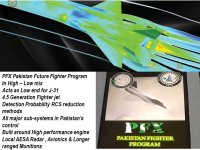
PFX.jpg

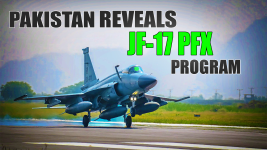
"PFX program is part of Pakistan's broader strategy to reduce reliance on foreign suppliers and strengthen domestic defense production capabilities. Currently, 58% of JF-17 components are manufactured locally by PAC, but Pakistan aims to increase this share to achieve full production autonomy for the PFX.

1733102082660.png

This initiative is not only about modernizing the country's aerial capabilities but also about positioning Pakistan as an emerging player in the global military aviation industry.


However, the project faces significant challenges. The development of the JF-17 PFX will require substantial investments, advanced technical expertise, and efficient resource management. Pakistan will also need to navigate a complex international environment, maintaining its strategic collaboration with China while diversifying its partnerships.

1733102124109.png

The JF-17 PFX represents a decisive step for Pakistan’s military aviation, with its significance extending beyond the country's borders to the historical strategic rivalry between Pakistan and India.

As Pakistan seeks to enhance its technological self-reliance and modernize its fleet with a 4.5-generation fighter jet, India is advancing the development of the Tejas MkII to maintain its strategic edge.

These two aircraft, designed to compete in terms of range, avionics, and offensive capabilities, symbolize a technological race aimed at securing aerial supremacy. In this context, the success of the JF-17 PFX will not only be evaluated on its technical performance but also on its ability to influence the balance of power in South Asia, a region where any military advancement is closely monitored by neighbors and the international community."

 
Last edited:

Users who are viewing this thread

Country Watch Latest

Back
Top