Jinnah Class Frigate | Updates & Discussion

I think PN strategy is somewhat influenced by its experience in the last war it participated.... missile attack on Karachi from the sea, sinking of its warship near Karachi and sea lane blockade without little use of INS four foxtrot subs by INS. Aggressive offensive patrolling by PN subs and scoring success, lack of eyes in the sky, stuck in a "Vulnerable to attack port," and lack of long rage radar surveillance of its coast. Where they fared badly was its inability to effectively keep the sea lanes open and defend Karachi Harbor

I feel PN invested in:

Its eye in the sky assets
Availability of a dedicated Naval port relatively removed from the immediate conflict area
Dedicated Naval Air Strike Element
Littoral Radar Surveillance and netcentric capability.
Building up on its sub strike capability .... still in progress
A fully missile armed fleet with a land attack capability

The area I feel PN lacks is ASW role of its surface fleet. Seems like PN is totally banking upon its Airborne ASW assets. The fleet ASW assets; onboard systems and airborne (Helo based) assets are, IMHO, on the weaker side. I fear that in the event of hostilities, India, having invested a lot on its subsurface fleet in recent years, will use it aggressively to hinder sea denial patrols by PN surface fleet.

That’s where the subsurface fleet comes into play though for th PN. Swats eyc will hug the coast and effectively form a defensive line against the IN. Paired with the sultans and some form of SOSUS network (potentially- there have been rumours of this for ages now and I wouldn’t be shocked!) creates a pretty formidable line of defense. If you look at gids portfolio, a lot of domestic sonar and naval kit!
Airborne ASW will get extended and distributed even further via MALE UAVs. With GIDS showing a lightweight ASW torpedo, I think the PN has bought into Shahpar 3.

Likewise, surface ASW may be built up through the use of USVs, which can also double as ISR nodes for the B-Class, J-Class, OPV, and T-Class.
 
Yep, but my point was that if the PN wanted a long-range SAM, it'd focus on refitting the JCF more so than procure a new vessel type. It can be an option, but in the far future when a MLU comes up.
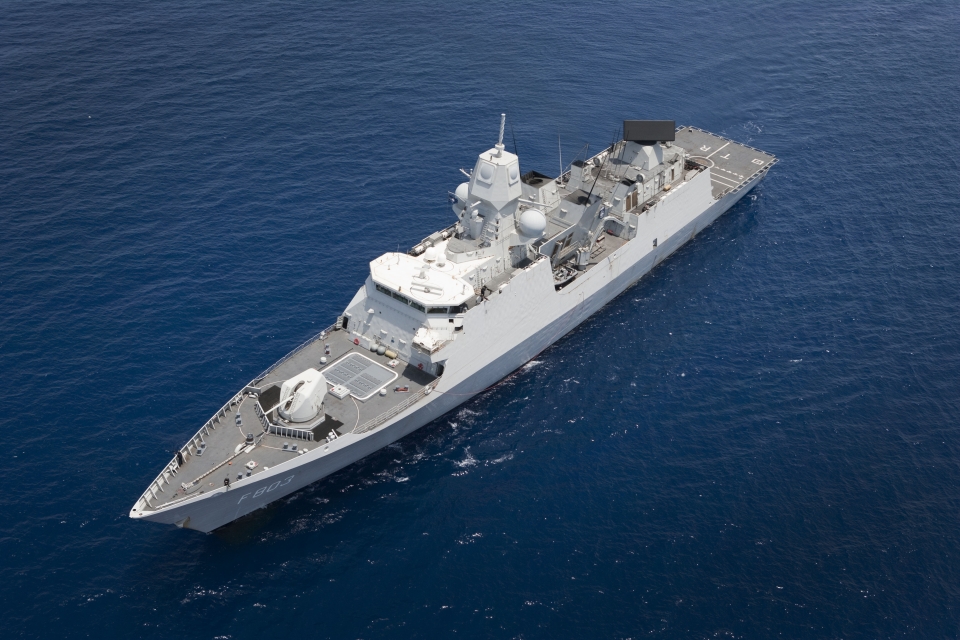
Considering PN’s experience with Damen, and the desire for a “6000 ton ship”. A variant of the De Seven Provincien class Frigate, possibly with 48 cell VLS might be what they are looking for. If the VLS can fit Turkish Siper missiles it could be even better for communality in the PN. With the design being a 25 year old design, and Damen having shown itself to be a cost effective supplier, could keep the costs to within the desire budget.


To view this content we will need your consent to set third party cookies.
For more detailed information, see our cookies page.


Or perhaps procure them directly from the Netherlands in 2032-2035 when they are retired by the Dutch Navy, in a hot transfer? 30 year old hulls may no longer be acceptable for the PN, so the competition in the early 2030s will depend on the political and technical landscape as well as the financial situation.


LCF retirement timeline (about 10 years)
3:30-5:10
To view this content we will need your consent to set third party cookies.
For more detailed information, see our cookies page.


Btw, Mildas Quad packing looks promising.
 
Last edited:
Considering PN’s experience with Damen, and the desire for a “6000 ton ship”. A variant of the De Seven Provincien class Frigate, possibly with 48 cell VLS might be what they are looking for. If the VLS can fit Turkish Siper missiles it could be even better for communality in the PN. With the design being a 25 year old design, and Damen having shown itself to be a cost effective supplier, could keep the costs to within the desire budget.


To view this content we will need your consent to set third party cookies.
For more detailed information, see our cookies page.


Or perhaps procure them directly from the Netherlands in 2032-2035 when they are retired by the Dutch Navy, in a hot transfer?


LCF retirement timeline
3:30-
To view this content we will need your consent to set third party cookies.
For more detailed information, see our cookies page.


Btw, Mildas Quad packing looks promising.


I disagree, i think the PN really, really missed the mark here. Though, still, could be worse, but the Iver Huitfeldt and the RDN would have been a seriously good example to follow.


The stanflex is a really good solution. Each IH hull+sensors cost 380m USD. Everything but the weapons. Its a really capable ship- why so cheap though?

The RDN made it so that they could use the stanflex modules. Which are effectively containerised systems. You need a VLS for this patrol? Ok, give us a few hours and we'll equip the ship and drop the vls in. You want to do some MCM? No worries, well just swap the VLS or AShM's out for our MCM module... etc.

The other benefit is, they can be re used beyond the life of the hull and also are better on maintenance as they're not out there getting battered by the elements. Imagine a cell got damaged, we could literally just remove and replace the module, repair, then hold it for when needed, keeping ships active.

The RDN did a study, a 6000t destroyer would cost them $250m in 2006 using these modules. Imagine today, even if we doubled this, the value proposition is insane. We cold have wide area AAW on azmat class FACs one day, then MCM equiptment another, then ASW gear on the third. Same for the Yarmooks, Same for F22P's, Jinnah, Babur, etc etc.

The PN would have alot to gain from this, you can do so so much with tech like this. Integration work etc can all be done outside of the hull, reducing downtime and keeping up with tech. The possibilities are crazy


Last edited:
I disagree, i think the PN really, really missed the mark here. Though, still, could be worse, but the Iver Huitfeldt and the RDN would have been a seriously good example to follow.


The stanflex is a really good solution. Each IH hull+sensors cost 380m USD. Everything but the weapons. Its a really capable ship- why so cheap though?

The RDN made it so that they could use the stanflex modules. Which are effectively containerised systems. You need a VLS for this patrol? Ok, give us a few hours and we'll equip the ship and drop the vls in. You want to do some MCM? No worries, well just swap the VLS or AShM's out for our MCM module... etc.

The other benefit is, they can be re used beyond the life of the hull and also are better on maintenance as they're not out there getting battered by the elements. Imagine a cell got damaged, we could literally just remove and replace the module, repair, then hold it for when needed, keeping ships active.

The RDN did a study, a 6000t destroyer would cost them $250m in 2006 using these modules. Imagine today, even if we doubled this, the value proposition is insane. We cold have wide area AAW on azmat class FACs one day, then MCM equiptment another, then ASW gear on the third. Same for the Yarmooks, Same for F22P's, Jinnah, Babur, etc etc.

The PN would have alot to gain from this, you can do so so much with tech like this. Integration work etc can all be done outside of the hull, reducing downtime and keeping up with tech. The possibilities are crazy
@FuturePAF
 
Your right. A much better option, and its modularity makes it great for putting in the Turkish VLS system, while getting a decent sensor package. 24 long range missiles and 24 medium range missile via quad packing is a decent enough load-out within the PN budget and within that $250 million 2006 price; probably $500 million in today’s prices, which is still a decent price considering the sensor package.

Just have to make sure it’s interoperable with the fleet, datalinks with Turkish and Chinese origin ships in the PN, to leverage the sensors.

Great recommendation
To view this content we will need your consent to set third party cookies.
For more detailed information, see our cookies page.


To view this content we will need your consent to set third party cookies.
For more detailed information, see our cookies page.
 
Last edited:
The conceptual continuation of the Iver Huitfeldt class seems to be Damen's Crossover platform. Besides containerized weapon systems/solutions, some of its subvariants can even be used as small landing platform dock (LPD) ships.


So, aligning with what @arslank01 is saying, if the PN had really stepped back and then approached surface fleet expansion more non-conventionally, they would've probably done a Crossover-type design (if not Crossover itself).

Like...12 of these ships (5,000 tons each) built over 12-15 years, further supported by a big array of USVs with mini-container AShW, ASW, and AAW nodes.

 
Did any of you conside chinese type52c refurbish for pn ... there are total of 6 in pla navy and all 6 could sold to pn post refurbished and upgrade with latest electronics and weapons ...
 
The conceptual continuation of the Iver Huitfeldt class seems to be Damen's Crossover platform. Besides containerized weapon systems/solutions, some of its subvariants can even be used as small landing platform dock (LPD) ships.


So, aligning with what @arslank01 is saying, if the PN had really stepped back and then approached surface fleet expansion more non-conventionally, they would've probably done a Crossover-type design (if not Crossover itself).

Like...12 of these ships (5,000 tons each) built over 12-15 years, further supported by a big array of USVs with mini-container AShW, ASW, and AAW nodes.

I think if NRDI was to develop a local StanFlex alternative, we could simplify the navy into two combat ship types to cover all of our needs.

Yarmook and perhaps JCF. Naturally both ships will become larger and thats fine, it works out well.

Imagine having the ability to have the same, modular weapons and mission systems fit between the two types. It would drive cost down not only now, but for future combatants too by reusing our mission modules. We could literally MLU a vessel while its still at sea completing its combat duties, is that not crazy?

we would be able to cover all of our needs like this.

Having NRDI design the modules is key though IMO, it gives us total control over the ecosystem and designs, just requiring shipbuilders to consider them into the design. We could pick up hulls anywhere, redesigning them in house to fit our modules
 
Did any of you conside chinese type52c refurbish for pn ... there are total of 6 in pla navy and all 6 could sold to pn post refurbished and upgrade with latest electronics and weapons ...
no point, too expensive
 
I think if NRDI was to develop a local StanFlex alternative, we could simplify the navy into two combat ship types to cover all of our needs.

Yarmook and perhaps JCF. Naturally both ships will become larger and thats fine, it works out well.

Imagine having the ability to have the same, modular weapons and mission systems fit between the two types. It would drive cost down not only now, but for future combatants too by reusing our mission modules. We could literally MLU a vessel while its still at sea completing its combat duties, is that not crazy?

we would be able to cover all of our needs like this.

Having NRDI design the modules is key though IMO, it gives us total control over the ecosystem and designs, just requiring shipbuilders to consider them into the design. We could pick up hulls anywhere, redesigning them in house to fit our modules
In the current JCF, I figure it'd involve blocking off 2 areas for mission modules, e.g., one 'Medium' module (MM) at the bow (enough for SAM VLS), with a 'Large' module (LM) at the center that can take SAM, LACM, and/or ASBM. You can eliminate the dedicated slant launchers for ASCM/ASBM and allocate the whole area for the LM, which can be pre-configured based on the required mission set of that specific ship (a AAW/ASuW or AAW or ASuW). I think the dedicated ASW element can stay as it may (?) involve the area under the helicopter landing deck. Or create a 'Small' module (SM) that can swap out the ASW for MCMV or AUVs (which can double as smart ASW torpedoes).

IMO... designing the SM, MM, and LM is doable. Just a super high-level look, but I think it's basically 2 main parts: the underlying compatibility with the FFG, and the overlying technology (e.g., VLS). The VLS could be sourced from Turkiye via the MIDLAS and, generally, function independently from the ship it's integrated to via the MM/LM. The point being, the 'underlying technology' (LM/MM) needs to work such that, in theory, a VLS can run anywhere, literally, if the LM/MM can fit to the ship it's being integrated to.

NRDI would need to design the 'underlying technology', which , from my raw guesses, need not be that complex. It's an issue of ensuring the ships you're designing have the space and 'connectors' (?) for electricity, fiber-optics (for connecting with sensors, CMS, etc), etc. So, the ship design's "receiver" stack needs to perfectly align with the Module's "sender" stack.

You basically do this from the start, i.e., when you're designing the (for ex.,) JCF V2, you synchronize it with Module development. You say JCF V2 will carry x1 LM, x2 MMs, and x2 SMs (left side, right side). The JCF V2 needs to have space for it and the exact right connectors for each of those modules. In parallel, each of the modules needs to honour the JCF's connectors and space limits.

So, basically, instead of designing each ship with its own unique connector stack to fit whatever mission set you've predefined, you're designing each ship with very standardized connectors that fit 1:1 with the modules. When you define each ship's size, you assess how many and of what type of Modules you can fit. Hence, a 550-ton mini-corvette might only carry 2 SMs at most (1 aft AUV or MCMV thing and 1 VLS for MR-SAM and JCM-sized ASCM), while, in theory, you can keep space for 2 LMs on a tanker which may or may not ever use its connectors.

The trickiest part might be ensuring that the off-the-shelf inputs (e.g., MIDLAS VLS) is compatible with the Module stack and, in turn, the ship connectors. It's doable if you clearly spell this out to the OEM.

The other option is to abstract the Modules entirely to the point where you just need predefined space and the most essential connectors in the ship, like power-generation, cooling, etc. So, the Modules are completely separate from the sensor integration; meaning, you need the Modules to come with their own sensors too.
 
Last edited:
Did any of you conside chinese type52c refurbish for pn ... there are total of 6 in pla navy and all 6 could sold to pn post refurbished and upgrade with latest electronics and weapons ...

I personally love the ideal of picking up some backup ships from China and upgrading it with Local Pakistani Missiles , under a lease to own

But my view point is not shared by many folks as they prefer the brand new ships for Navy

Jinnah Frigate , is Top of the Line will Operate for good 25-30 years
It is a good design and Technology package will be no doubt superior


I think Navy just don't want the burden of maintaining older ships
upgrading old systems, or servicing the exterior or interior extensively

I can't argue with the offering but it all depends on Time frame of deliveries


But if it was me personally making decision , would get up to 6 Ships from China (2nd Hand), while Jinnah Frigate are being tested , developed in Docks. Have the 6 Ships operational in next 6 months
 
Last edited:

Users who are viewing this thread

Country Watch Latest

Latest Posts

Back
Top