Navigation
Install the app
How to install the app on iOS
Follow along with the video below to see how to install our site as a web app on your home screen.
Note: This feature may not be available in some browsers.
More options
Style variation
You are using an out of date browser. It may not display this or other websites correctly.
You should upgrade or use an alternative browser.
You should upgrade or use an alternative browser.
Jobs, Entrepreneurship, Business trend, and related news
- Thread starter Indos
- Start date
More options
Who Replied?

Indos
INT'L MOD
- Thread starter
- #84
I had to take 60 meetings’: Jeff Bezos says ‘the hardest thing I’ve ever done’ was raising the first million dollars of seed capital for Amazon
By
Dave Smith
Editor, U.S. News
December 15, 2025, 12:30 PM ET
Today, Amazon’s market cap is hovering around $2.38 trillion, and founder Jeff Bezos is one of the world’s richest men, worth $236.1 billion. But three decades ago, in 1995, getting the first million dollars in seed capital for Amazon was more grueling than any challenge that would follow. One year ago, at New York’s Dealbook Summit, Bezos told Andrew Ross Sorkin those early fundraising efforts were an absolute slog, with dozens of meetings with angel investors—the vast majority of which were “hard-earned noes.”
“I had to take 60 meetings,” Bezos said, in reference to the effort required to convince angel investors to sink tens of thousands of dollars into his company. “It was the hardest thing I’ve ever done, basically.”
The structure was straightforward: Bezos said he offered 20% of Amazon for a $5 million valuation. He eventually got around 20 investors to each invest around $50,000. But out of those 60 meetings he took around that time, 40 investors said no—and those 40 noes were particularly soul-crushing because before getting an answer, each back-and-forth required “multiple meetings” and substantial effort.
Bezos said he had a hard time convincing investors selling books over the internet was a good idea. “The first question was what’s the internet? Everybody wanted to know what the internet was,” Bezos recalled. Few investors had heard of the World Wide Web, let alone grasped its commercial potential.
That said, Bezos admitted brutal honesty with his potential investors may have played a role in getting so many rejections.
“I would always tell people I thought there was a 70% chance they would lose their investment,” he said. “In retrospect, I think that might have been a little naive. But I think it was true. In fact, if anything, I think I was giving myself better odds than the real odds.”
Bezos said getting those investors on board in the mid-90s was absolutely critical. “The whole enterprise could have been extinguished then,” he said.
You can watch Bezos’s full interview with Andrew Ross Sorkin below. He starts talking about this interview gauntlet for seed capital around the 33-minute mark.
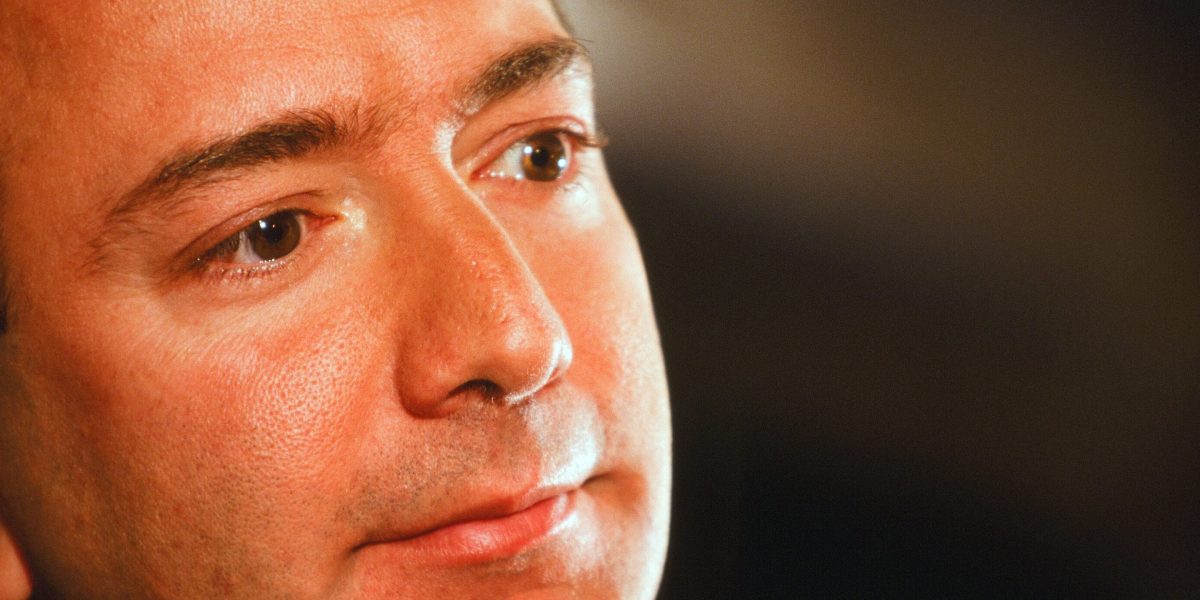
'I had to take 60 meetings': Jeff Bezos says 'the hardest thing I've ever done' was raising the first million dollars of seed capital for Amazon | Fortune
"The whole enterprise could've been extinguished then," Bezos recalled.
Indos
INT'L MOD
- Thread starter
- #85
How Kalshi’s Cofounder Went From Professional Ballerina To World’s Youngest Self-Made Woman Billionaire
ByAlicia Park, Contributor. (Forbes)
I cover tech and innovation.
Dec 02, 2025, 11:56am EST
Updated Dec 4, 2025, 03:13pm EST
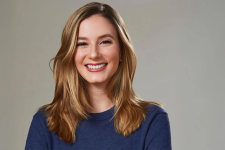
Kalshi is now worth $11 billion, making both its founders billionaires and Luana Lopes Lara the world’s youngest self-made woman billionaire.
Luana Lopes Lara graduated from Massachusetts Institute of Technology with a degree in computer science, spent college summers working for Ray Dalio’s Bridgewater Associates and Ken Griffin’s Citadel Securities and built an $11 billion startup in just six years. Yet the Brazilian native still calls high school the “most intense years of her life.” Her ballet teachers at Bolshoi Theater School in Brazil held lit cigarettes under her thigh while she extended one leg to her ear—it was a test to see how long she could keep that leg up without getting burned. Fellow dancers would hide glass shards in each other’s shoes to get ahead, and the cutthroat program required her to take academic classes from 7 a.m. to noon before taking ballet classes from 1 p.m. to 9 p.m.
But her mind was always set on grander ambitions: wanting to become the next Steve Jobs. In part inspired by her math teacher mother and electrical engineer father, Lopes Lara would study well into the night for academic competitions, winning gold at the Brazilian Astronomy Olympiad and bronze at the Santa Catarina Mathematics Olympiad. Following high school graduation (in December), she performed as a professional ballerina in Austria for nine months before hanging up her pointe shoes to attend MIT and fulfill her ambitions in America.
Now, at age 29, Lopes Lara has just become the youngest self-made woman billionaire on Earth, unseating 31-year-old Scale AI cofounder Lucy Guo who took the title from Taylor Swift in April. She and her cofounder, Tarek Mansour, also 29, both moved into the three-comma club after their prediction market firm Kalshi raised $1 billion at an $11 billion valuation. Crypto-focused venture capital firm Paradigm led the round, announced Tuesday, with participation from investors Sequoia Capital, Andreessen Horowitz and Y Combinator among others.
The company—which allows users to bet on the outcome of future events such as elections, sports games and pop culture happenings—was worth $5 billion after raising $300 million in October and $2 billion after raising $185 million in June. Kalshi’s valuation has quintupled in less than six months, boosting the net worths of the young cofounders, who each own an estimated 12% of the company, to $1.3 billion each.

"We literally are creating an entire new asset class, a completely new financial product," Mansour previously told Forbes. "We've legalized it and created the framework and the industry for it."
Kalshi
“There's a lot of other people wanting a piece of this business now that Kalshi has shown how big it is,” says Ali Partovi, CEO of venture fund Neo, which was a seed investor in Kalshi. Since July, notional trading volume on Kalshi has jumped eightfold, reaching $5.8 billion in November, according to the company. Notional trades on its chief competitor Polymarket, whose own valuation has shot up to $9 billion, have more than tripled since July to $4.3 billion in November, according to Dune Analytics.
Lopes Lara and Mansour, who grew up in Lebanon, met at MIT where they were part of the same friend group of international students and took similar classes, both majoring in computer science.
Mansour, who lived through the 2007 Lebanon conflict and taught himself English while studying for the SATs, remembers how Lopes Lara would always sit in the front row at lectures. The two became close after he began sitting next to her in class to learn from her and became even closer after both landing internships at Five Rings Capital in New York City in 2018. It was on their walks back home to their intern apartments in the Financial District one night that the idea of a prediction market business clicked.
“We saw that most trading happens when people have some view about the future, and then try to find a way to put that in the markets,” Lopes Lara previously told Forbes. Traders would factor in external events—such as the result of an election or the likelihood of a natural disaster—into their investment decisions, she added.
With the conviction that there should be a way to directly trade on the probability of events rather than indirectly trading them through traditional financial markets, Lopes Lara and Mansour applied to the startup accelerator Y Combinator and got accepted in 2019. But the legality of prediction markets was unclear, and the cofounders soon faced an uphill battle. Michael Seibel, partner emeritus at Y Combinator, recalls the early days of working with the pair: When they realized they needed federal approval to legally operate prediction markets, the duo reached out to over 40 law firms, but none of them were willing to help because the founders were too young and their company too small.
“Right out of college, we were taking on an insane amount of risk. It was two years without a single product—nothing launched—and if we didn't get regulated, the company would just go to zero,” recalls Lopes Lara, who was trying to build the business from London during the pandemic while Mansour was back home in Beirut. (He was there during the city’s deadly port explosion that killed over 200 people, and spent weeks working on Kalshi by night and helping clean up his neighborhood and search for survivors by day.)
All it took was one lawyer to say yes to them: Jeff Bandman, who had worked for the Commodity Futures Trading Commission, helped the founders work through the application for federal approval and wrangle with their regulators when they pushed back. And in November 2020, Kalshi finally received CFTC approval to operate as a designated contract market (DCM), which categorized their prediction markets as a type of derivative known as an events contract.
The approval also set them apart in the competitive landscape. Blockchain-based Polymarket, founded in March 2020, was not federally regulated and was fined $1.4 million by the CFTC for operating unregistered markets in 2022. That was the same year that the Kalshi founders were recognized on Forbes 30 Under 30 list.
All this gave Kalshi an edge—for a while. (Polymarket received approval to launch in the U.S. in September. Its founder Shayne Coplan became one of the youngest billionaires at age 27, thanks to a $2 billion investment from the New York Stock Exchange’s parent company in October.)
The regulatory struggle didn’t end there. It was Lopes Lara who came up with the idea to sue the CFTC in late 2023, when the regulators rejected Kalshi’s election contracts ahead of the 2024 U.S. presidential election on the premise that they resembled gambling. “All of the other investors in the company said that that would be a terrible idea,” Partovi recalls. But the duo did so anyway.
In September 2024, the U.S. District Court judge ruled in favor of Kalshi, and the company made history by offering the first legal election contracts in the U.S. in over a century. “We really wanted to do things the right way because our vision was to build the biggest financial exchange in the world,” Lopes Lara said. “Doing it legally was something we couldn’t compromise on.” In the lead up to the election, Kalshi users bet more than $500 million on the candidates and correctly predicted President Trump’s win. (Polymarket users bet a total $3.6 billion on the presidential election and also correctly predicted the outcome.)
![IMG_8801[2].jpg](https://imageio.forbes.com/specials-images/imageserve/692f78293e6b9770eb59c729/IMG-8801-2--jpg/0x0.jpg?format=jpg&width=1440 "IMG_8801[2].jpg")
Lopes Lara danced professionally at Salzburger Landestheater in Austria for a season of "Swan Lake."
Kalshi
“There are few better trainings for being told ‘no’ and pushing through anyway than being a professional ballerina—an injury or even a short rest could mean losing your spot,” says a16z partner Alex Immerman. “Luana learned persistence with grace early on…and she’s carried that same calm confidence into building Kalshi.”
Despite initial doubts that it could keep up momentum after the presidential election, Kalshi says its trading volume has grown 1000% since last year and now surpasses $1 billion every week. Since the election, Kalshi has integrated with brokerages like Robinhood and Webull, and more recently, inked partnerships with companies from the National Hockey League to online marketplace StockX to Google Finance. Donald Trump Jr. joined Kalshi’s advisory board in January. (Trump Jr. also joined Polymarket’s advisory board in September.)
It’s even made major pushes into crypto to compete with Polymarket, bringing its markets to blockchain platform Solana in December. Kalshi said the new funding will be used to expand its integration with brokerages and strike new partnerships with news outlets.
But with more than 90% of its current volume driven by sports, the company faces mounting pressure from states that have been taking legal action against Kalshi’s federally-regulated sports contracts, which they argue should be regulated and taxed as gambling activity on the state level. Still, having seen the company successfully overcome regulatory hurdles that once seemed impossible, Kalshi’s investors remain bullish on the founders’ ability to push through. For Seibel, who’s invested in more than a thousand companies in his career, the current moment is just the start: “I don't know that we have funded a company that has as much potential impact on the world as this one.”
Indos
INT'L MOD
- Thread starter
- #86
Ranked: Top U.S. Industries by Investment Share (1949–2025)
Key Takeaways
- The industries attracting the most investment in the U.S. have shifted dramatically over time, from farming and railroads to technology and data.
- Today’s leading sector, information and data processing, commands a smaller share of total investment than past dominant industries.
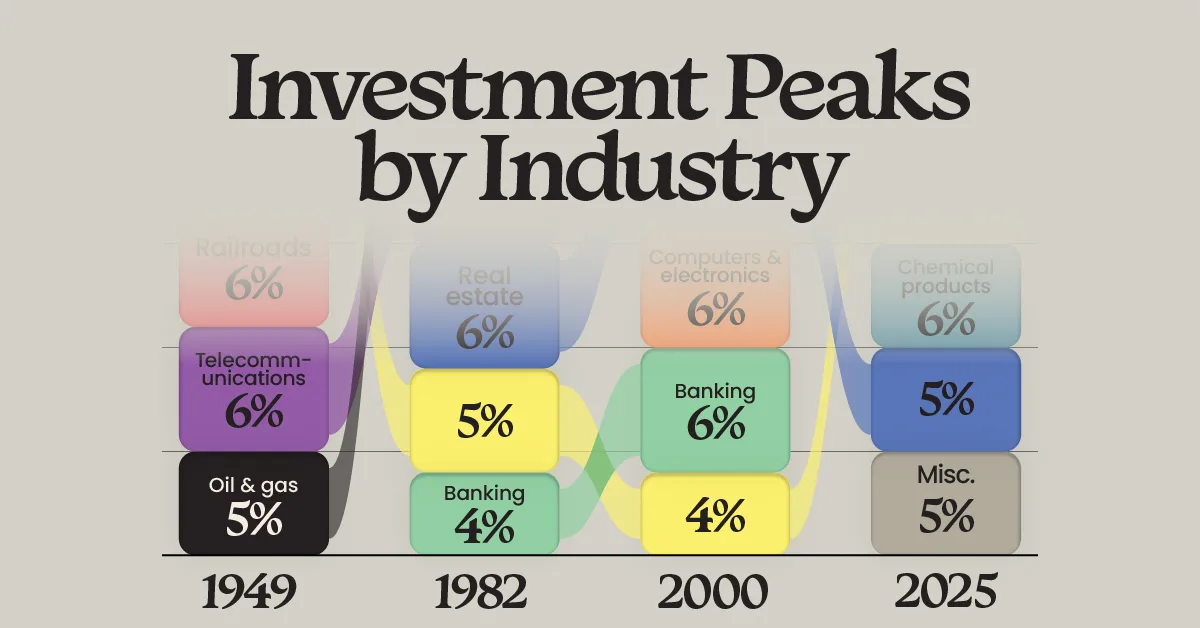
This visualization shows the top five U.S. industries by share of total investment at key historical peaks, spanning 1949 to 2025. The data for this visualization comes from Vanguard, using calculations based on Bureau of Economic Analysis data as of October 31, 2025. The figures exclude residential investment.
Postwar America: Farming, Power, and Railroads
In 1949, U.S. investment was concentrated in industries that supported a rapidly expanding, industrializing economy.
Farming led with a 12% share of total investment, reflecting the sector’s central role in employment and production. Electric power and railroads followed closely, underscoring the importance of nationwide infrastructure as the U.S. rebuilt and modernized after World War II. Telecommunications and oil and gas rounded out the top five.
The 1980s and 2000s: Energy, Communication, and Finance
By 1982, investment leadership had shifted toward oil and gas, which accounted for 11% of total investment. Telecommunications and real estate also gained prominence, alongside banking and electric power.
In 2000, at the height of the dot-com era, telecommunications topped the list, while computers and electronics emerged as a major investment destination. Real estate and banking also featured prominently.
2025: Technology Dominates, but Less Concentrated
Today, information and data processing leads U.S. investment with a 7% share—making it the top industry, but with far less dominance than historical leaders. Electric power, chemical products, and real estate follow closely, each capturing around 5–6% of total investment.
This lower concentration suggests a more diversified investment landscape, where capital is spread across a wider range of industries rather than clustered in a single dominant sector.
%%title%% %%page%%
This visualization shows the top five U.S. industries by share of total investment at key historical peaks, spanning 1949 to 2025.
 www.visualcapitalist.com
Last edited:
Indos
INT'L MOD
- Thread starter
- #89
McKinsey boss says there are 3 skills AI models can't do that young professionals should focus on
Jan 8, 2026, 6:29 PM WIB
Artificial intelligence is reshaping McKinsey's workforce, but the firm's top executive said there are still fundamental human skills that AI models can't do.
Artificial intelligence is reshaping McKinsey's workforce, but the firm's top executive said there are still fundamental human skills that AI models can't do.
Bob Sternfels, global managing partner at McKinsey, talked about how AI is changing work at the firm during an appearance at the Consumer Electronics Show in Las Vegas on Tuesday.
Sternfels said that last year alone, embracing AI saved McKinsey 1.5 million hours in search and synthesis, work that he says AI models are great for. He also said AI agents, of which McKinsey has 25,000, excel at generating charts and that they've made 2.5 million of them in the past six months.
With agents taking over some of that work, he said consultants are now "moving up the stack" and tackling "more complicated problems."
Given those changes, Sternfels said McKinsey looked at which skills new graduates will need in an AI-infused world from the perspective of large employers. He identified three: the ability to aspire, judgment, and true creativity.
McKinsey boss says there are 3 skills AI models can't do that young professionals should focus on
Bob Sternfels, global managing partner at McKinsey, identified three human skills that he said the AI models can't do.
 www.businessinsider.com
Indos
INT'L MOD
- Thread starter
- #90
Google’s Sergey Brin admits he’s hiring ‘tons’ of workers without degrees: ‘They just figure things out on their own in some weird corner’
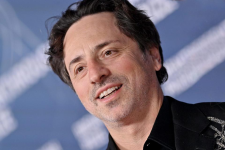
Google cofounder Sergey Brin studied graduate computer science at Stanford because he was "passionate"—but admits Gen Z don't need a degree to land a high-paying job at the tech giant. · Fortune · Axelle/Bauer-Griffin/FilmMagic
Preston Fore
Whether it’s Nike’s Phil Knight, LinkedIn’s Reid Hoffman, or Google’s Sergey Brin, many of the world’s most influential business founders can trace part of their success back to Stanford University. Nestled in the foothills of Silicon Valley, the school has long functioned as a launchpad for tech’s elite.
Whether it’s Nike’s Phil Knight, LinkedIn’s Reid Hoffman, or Google’s Sergey Brin, many of the world’s most influential business founders can trace part of their success back to Stanford University. Nestled in the foothills of Silicon Valley, the school has long functioned as a launchpad for tech’s elite.
But the rise of artificial intelligence is challenging long-held assumptions about the value of higher education. As tech reshapes entry-level work and companies rethink traditional hiring pipelines, the payoff of a four-year degree—especially from elite institutions—is increasingly up for debate.
Still, Brin doesn’t regret his own academic path. Speaking to Stanford engineering students last month, he said his decision to study computer science was not driven by a fixation on credentials.
“I chose computer science because I had a passion for it,” he said. “It was kind of a no-brainer for me. I guess you could say I was also lucky because I was also in such a transformative field.”
Even in an era when AI can write code, Brin cautioned students against chasing—or abandoning—fields of study based solely on automation fears.
“I wouldn’t go off and switch to comparative literature because you think the AI is good at coding,” he said. “The AI is probably even better at comparative literature, just to be perfectly honest anyway.”
Jamie Dimon and Alex Karp agree: You can land a high-paying job even without a degree
Brin met Google cofounder Larry Page in 1994 during his second year of graduate studies at Stanford. Together they developed PageRank, an algorithm they later renamed Google and would become a company in 1998.
Google’s hiring practices today reflect how dramatically the industry has shifted. The tech giant is now embracing workers without college degrees.
“In as much as we’ve hired a lot of academic stars, we’ve hired tons of people who don’t have bachelor’s degrees,” Brin said. “They just figure things out on their own in some weird corner.”
Between 2017 and 2022, the share of job postings at Google requiring a degree dropped from 93% to 77%, according to analysis from the Burning Glass Institute. And Google isn’t alone: companies including Microsoft, Apple, and Cisco have reduced degree requirements in recent years, signaling a broader industry shift toward skills-based hiring.
That’s forcing a broader reckoning over what a degree actually signals and whether it’s still a reliable proxy for talent.
“I don’t think necessarily because you go to an Ivy League school or have great grades it means you’re going to be a great worker or great person,” said JPMorgan Chase CEO Jamie Dimon in 2024. For many roles, skills matter far more than credentials, he added: “If you look at skills of people, it is amazing how skilled people are in something, but it didn’t show up in their resume.”
Palantir CEO Alex Karp has made a similar case, despite holding three degrees (including a JD from Stanford). He’s been outspoken about the pressure young people face to pursue elite credentials—and dismissive of how much they matter once on the job.
“If you did not go to school, or you went to a school that’s not that great, or you went to Harvard or Princeton or Yale, once you come to Palantir, you’re a Palantirian. No one cares about the other stuff,” Karp said during an earnings call last year.
That mindset is spreading beyond Silicon Valley and Wall Street, according to Great Place to Work’s CEO Michael Bush.
“Almost everyone is realizing that they’re missing out on great talent by having a degree requirement,” Bush told Fortune. “That snowball is just growing.”
For Brin, the implications ultimately go beyond hiring. With credentials losing their gatekeeping power, he said universities themselves may need to evolve:
“I just would rethink what it means to have a university.”
This story was originally featured on Fortune.com
Google’s Sergey Brin admits he’s hiring ‘tons’ of workers without degrees: ‘They just figure things out on their own in some weird corner’
Google cofounder Sergey Brin studied graduate computer science at Stanford—but admits Gen Z no longer needs a degree to land a high-paying job at the tech giant.
 finance.yahoo.com
Users who are viewing this thread
Total: 1 (members: 0, guests: 1)
Pakistan Defence Latest


Country Watch Latest

Latest Posts
-
 Anti-Pakistan Jeay Sindh Stage a Protest with the Flags of Their Benefactors (2 Viewers)
- Latest: Distant_Observer
-
‘I want to cry’: Afghan medical students in Pakistan face expulsion fear (14 Viewers)
- Latest: mythbuster
-
-

-
