by Naharnet Newsdesk 22 hours ago
A deal between Lebanon and Israel was billed as paving the way for peace. But in Lebanon, it is deepening longtime divisions and raising fears of political paralysis or even a return to civil war.
The U.S.-brokered deal envisions an Israeli troop withdrawal from Lebanon and an eventual peace agreement between the two countries — which technically remain in a state of war nearly 80 years after Israel's establishment. But the agreement says a full Israeli withdrawal will happen only after Hezbollah is disarmed, infuriating the Iran-backed militant group.
Lebanon's Western-backed government and Hezbollah have exchanged angry words, and the militant group's supporters have blocked major roads in protest. One Hezbollah lawmaker said the country would plunge into civil war if the government tries to force the group's disarmament.
The tensions have stirred up memories of Lebanon's devastating 1975-1990 civil war and reminded many of more recent clashes between Hezbollah gunmen and pro-government fighters in 2008. They also have raised deep questions over whether the U.S.-brokered deal will be able to get off the ground.
A resumption of the war between the U.S. and Iran would further complicate the deal's prospects and raise the risk of renewed conflict between Israel and Hezbollah.
The deal is expected to top the agenda when Lebanese President Joseph Aoun heads to the White House on July 21.
The deal is rooted in the US war against Iran
Lebanon's political landscape has been divided for over two decades between one coalition that is Western-backed and another that is supported by Iran and led by Hezbollah. Both camps see the outcome of the new agreement as existential.
The latest war between Israel and Hezbollah erupted in March, triggered by the joint U.S.-Israel war launched against Iran days earlier.
Hezbollah, which entered the conflict without seeking approval from the government, has sought to link the end of its war against Israel to the outcome of broader U.S.-Iran talks. The Lebanese government, trying to minimize Iran's influence, aimed to keep the two tracks separate and negotiate a ceasefire directly with Israel.
The Lebanon-Israel deal turned the tables
The pro-Hezbollah camp was jubilant when the ceasefire deal between Iran and the U.S. explicitly called for an end to the war in Lebanon.
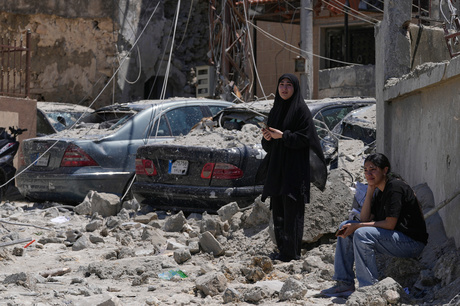
That led to a truce that has substantially reduced the intensity of the fighting between Israel and Hezbollah. But Israeli troops continue to occupy large swaths of southern Lebanon, and hundreds of thousands of people remain displaced from villages and city neighborhoods that have been almost entirely demolished.
The linkage to the U.S.-Iran ceasefire was widely seen as boosting Hezbollah's standing and cementing Iran's influence over Lebanon.
But days later, the tables turned as Israel and Lebanon announced their June 26 "framework agreement" in Washington. That deal conditioned withdrawal of Israeli forces on disarmament of Hezbollah throughout the country.
Lebanese rivals are now at odds over the deal
Lebanese government officials have hailed the deal as a step toward liberating occupied areas of the south and allowing the displaced to go home.
But with Israel giving no timeline for its withdrawal, Hezbollah and its supporters have accused the government of agreeing to an open-ended Israeli occupation.
Hezbollah supporters protested and blocked roads in Beirut. Some burned banners bearing the slogan "Lebanon First" — seen as a dig at the Iran-backed group. The group's leader, Sheikh Naim Qassem, called the deal a "humiliation" and said Hezbollah would not honor it.
Hassan Fadlallah, an influential Hezbollah legislator, went even further, saying the government "will not be able to enforce the agreement signed in Washington unless they go, with American support, to civil war."
Such rhetoric brought back memories of May 2008, when the government decided to dismantle Hezbollah's telecommunications network. The group sent gunmen to the streets and engaged in intense clashes with pro-government fighters in Beirut and elsewhere. The government was forced to annul its decision.
Hezbollah is now demanding that the government abolish its March 2 decision that considered Hezbollah's military and security activities illegal.
Prime minister, Nawaf Salam, says the agreement with Israel will restore the state's sovereignty over the entire country and has pushed back against Hezbollah's rhetoric.
"I am not looking for a confrontation with Hezbollah but neither myself nor anyone in the government will accept to be blackmailed by Hezbollah," Salam recently told the local LBC TV station.
In the meantime, the deal remains frozen
For now, there are no signs of the verbal threats spilling over into violence — in large part because the deal is deadlocked.
Israel and Lebanon have agreed to establish two "pilot zones" where the Israeli military is to turn over control to the Lebanese army after clearing the areas of any Hezbollah presence.
Salam has said the implementation could begin soon. But on the ground, there has been little movement.
"There is no schedule for the withdrawal or anything else," said a Lebanese military official, who spoke on condition of anonymity because he was not authorized to comment publicly. He said the army has received no information about when or how the Israeli withdrawal will proceed.
The initial pilot zones announced by Lebanese and Israeli officials include the towns of Froun, Ghandouriyeh and Zawtar. Israeli troops were not present in most of that area to begin with, raising questions about how a withdrawal could take place. The official said the Lebanese army had pushed for pilot zones that were larger and included more area occupied by Israeli forces.
An Israeli military official, speaking on condition of anonymity under briefing guidelines, said the army is still waiting for instructions from the political leadership on when the withdrawal will take place.
A possible political stalemate looms
Lebanon has a history of political violence, but its sectarian power-sharing system, divided among Shiite and Sunni Muslims, Christians and Druze, has also been prone to deadlock.
Powerful Parliament Speaker Nabih Berri, a Hezbollah ally, has warned the deal "will not pass, and it will not be implemented in its current form."
Wissam Lahham, a constitutional law professor at St. Joseph University in Beirut, said that under Lebanon's constitution, a treaty is not legally binding until it is ratified by a two-thirds majority of the country's Cabinet. A Cabinet vote has not been scheduled. Lahham said it's not clear if the treaty would require parliamentary approval, another potential obstacle.
Qassem, in a speech Wednesday, aimed a message at the government.
"Ultimately, not a single clause of the framework agreement will be approved, and there will be nothing you can do about it," he said.
Michael Young, senior editor at the Malcolm H. Kerr Carnegie Middle East Center in Beirut, said the Lebanese government's desire to keep Lebanon separate from the Iranian negotiations on national sovereignty grounds was correct "in principle" but unrealistic in practice.
"You cannot reach any kind of solution with regard to Hezbollah unless Iran is on board," he said. "The Iranians will not give up on Hezbollah, and at the same time the Lebanese are not willing to enter into an armed conflict with Hezbollah."
Source
Associated Press