Muhammad Ali Jinnah - The Great Leader

Peshawar Airport, June 1948.

Quiad-E-Azam Muhammad Ali Jinnah At Peshawar Airport Followed By Miss Jinnah, Sir Ambrose Dundas Governor And Abdul Qayyum Khan Chief Minister Of North West Frontier Province And Major General Nazir Ahmed)


1607630573177.png
 
Historic Letter Of The Founder Of Pakistan Muhammad Ali Jinnah To The Mohsin e Millat Pioneer Of Freedom Pir Sahib Of Manki Sharif Syed Muhammad Amin Ul Hasnat Rehmatullah Aley November 18, 1945.

Founder Of Pakistan Had Appreciated The Services Of The Forefathers Of The Pir Sahib Of Manki Sharif Rendered For The Cause Of Islam.

Courtesy - Pirzada Muhammad Abbas Qadri


1610036647252.png
 
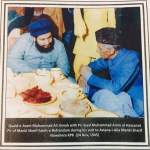
Quaid-i-Azam Muhammad Ali Jinnah During His Visit To Bannu, April 1948.


1612836159982.png


In 1948 Lt. Col. Mohammed Yousuf was promoted to the rank of Brigadier and given command in Bannu. In April 1948 the Quaid, on his tour of the (then) North-West Frontier Province, visited the Dera Ismail Khan Guides Cavalry, And on April 16 he spent a day in Bannu. He was accompanied by Miss Fatima Jinnah. After lunch at a Battalion Mess, he came to Brigade House in the Fort in Bannu.

After tea, Mr. Jinnah addressed a large gathering from the ramparts. Colonel Sahibzada Khurshid (later Governor NWFP) was also in attendance. In the late afternoon the Quaid, with Miss Jinnah, flew to Peshawar to present colours to an Infantry Brigade, and to hold a large garden party at Government House. Brigadier Yousuf, later Lieutenant General, Ambassador to Australia in 1957 and twice High Commissioner to Great Britain (1959-63 and 1971-72), accompanied the Quaid on this visit to Bannu.
 
1616605722537.png


Mr Jinnah attend the marriage of Mr N H Faruqi and Maryam Jaffer in New Delhi, 6 April 1947


Standing L to R: 1. Mohammad Ali Maniar, 2. Khwaja Hasan Nizami 3. Saeed Ahmad Siddiqui 4. Haroon E. H. Jaffer 5. Essa E. H. Jaffer 7. Mr. S. Ghani 8. Syed Azizul Hasan 9. Aziz Ahmad Siddiqui 10. Badruddin Hasan Faruqi 11. Mr. Mohammad Mustafa 12. Aziz Ahmad (Khalish) Siddiqui 13. Raza Habib Rizvi 14. Khalil Ahmad Siddiqui 15.Ahmad E. H. Jaffer 16. Rafiq Ahmad 17. Neena Ismail Jaffer 18.Ismail E. H. Jaffer 19.Mushtaq Ahmad 20.Habib Ahmad Rizvi

Sitting L to R: 1. Sardar Abdur Rab Nishtar 2. I. I. Chundrigar 3. Begum Ra'ana Liaquat Ali Khan 4. Quaid-e- Azam Mohammad Ali Jinnah 5. Nooruddin Hasan Faruqi 6. Liaquat Ali Khan 7. Fatima Jinnah 8. Raja Ghazanfar Ali Khan 9. Hussain Imam 10. Wahab A. Jaffer (in Hussain Imam's lap)

Ground L to R: 1. Shafa'at Habib Rizvi 2. Nusrat Rizvi 3. Kader A. Jaffer 4. Javed Siddiqui 5. Razzak Essa Jaffer 6. Saadat Rizvi 7. Rafat Habib 8. Mazhar Rizvi
 
1616711970224.png


An early depiction of the All-India Muslim League members across the Subcontinent.
 
To view this content we will need your consent to set third party cookies.
For more detailed information, see our cookies page.


To view this content we will need your consent to set third party cookies.
For more detailed information, see our cookies page.


Funeral of Quaid e Azam

To view this content we will need your consent to set third party cookies.
For more detailed information, see our cookies page.
 
1760126990236.png


The relationship between Muhammad Ali Jinnah and Fatima Jinnah was a rare bond of affection, based on love, respect and sacrifice.

She was not only his sister but also his closest companion and confidant, who walked with him step by step through every stage of success and trial. Fatima Jinnah’s presence was a source of comfort and encouragement to Muhammad Ali Jinnah in the relentless struggle for the establishment of Pakistan, while her loyalty and unwavering faith were of immense value to Jinnah Sahib.

Theirs was not just a brother-sister relationship, but a partnership of hearts and ideas, bound together by a common dream of freedom. In history, these two are shining examples of how family ties can give rise to greatness and change the destiny of a nation.
 
599009f38bfa2.jpg


Founding members of the All India Muslim League | White Star

On March 23, 1940, the Pakistan Resolution was passed by the All-India Muslim League's annual session in Lahore. Looking back over the fifty years that have elapsed since that day, one is left with a whole host of mixed feelings. Does the truncated Pakistan of today with its unending cycle of ethnic animosities, it’s mortgaged economy, its opportunist politics and the perpetual shadow of dictatorship hovering over it bear any resemblance at all to the ideals of the movement that gave birth to the country?

To understand the Pakistan Movement and its ideals, it is essential to place the upsurge of Muslim Nationalism at the time in its context.

The hot topic at the time was the place of the Muslims in Indian politics- a subject that provoked a great deal of passionate debate. This was the time when Mohammad Ali Jinnah -subsequently the Quaid-e-Azam -made his famous marathon address in the Strachey Hall of Aligarh University. Although the speech was only partly understood at the time, the effect it had on those present was profound.

This was, in fact, the first lecture -cum-speech delivered by Jinnah after t he passage of the Pakistan Resolution. In it he expounded the theoretical basis for demanding the division of India, a demand that later came to be known as Muslim Nationalism.
 
Jinnah addresses the Muslim League session at Patna, 1938

All_India_Muslim_League,_26th_Session_at_Patna,_December_1938_(Photo_429-5).jpg
 
Quaid’s School, Sindh Madrasa-tul-Islam, Karachi.
Quaid-e-Azam Mohammad Ali Jinnah attended his early schooling in Sindh Madrasa-tul-Islam. In 1882, when Jinnah was six, he was enrolled in the Sindh Madrasa-tul-Islam. Jinnah was indifferent to his studies and preferred to play outdoors with his friends. In 1887, Jinnah Poonja bhai’s only sister came to visit from Bombay and took her nephew to Bombay where he joined Gokal Das TejPal Primary School. He remained in Bombay for only six months and returned to Karachi upon his mother’s insistence and again joined the Sind Madrassa-tul-Islam. But his name was struck off as he frequently cut classes in order to ride his father’s horses.

Quaid’s School, Christian Missionary Society High School (CMS), Karachi.
After his name was struck off from the Sindh Madrasa-tul-Islam, Jinnah then joined the Christian Missionary Society High School, Karachi.

Quaid’s School, Lincoln’s Inn, London.
The Honourable Society of Lincoln’s Inn is one of four Inns of Court in London to which barristers of England and Wales belong and where they are called to the Bar. Jinnah studied here from 1893 to 1896.

The Gate House, Lincoln’s Inn, London. The Gate House is the oldest existing part of Lincoln’s Inn, and was built between 1518 and 1521.
 
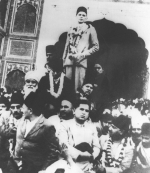
Jinnah being welcomed at Badshahi Mosque and addressing the Pakistan Independence Movement. Lahore, 1940s

1762087355599.png
 

Users who are viewing this thread

Back
Top