Muhammad Ali Jinnah - The Great Leader

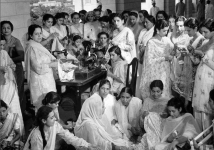
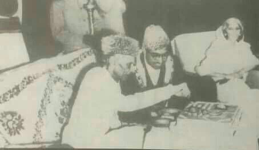
Fatima Jinnah along with other volunteering women making clothes for millions of new refugees coming to Pakistan who survived massacres while coming from the Indian Republic, Karachi 1947.

1762087413181.png
 
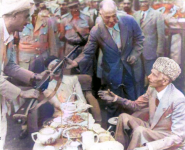
Jinnah receiving a rifle gift from Pashtun tribal cheif Malik Wali Khan, Peshawar, 1948.


1762087502072.png
 
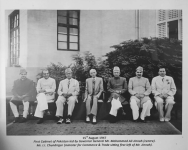
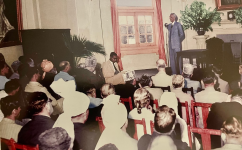
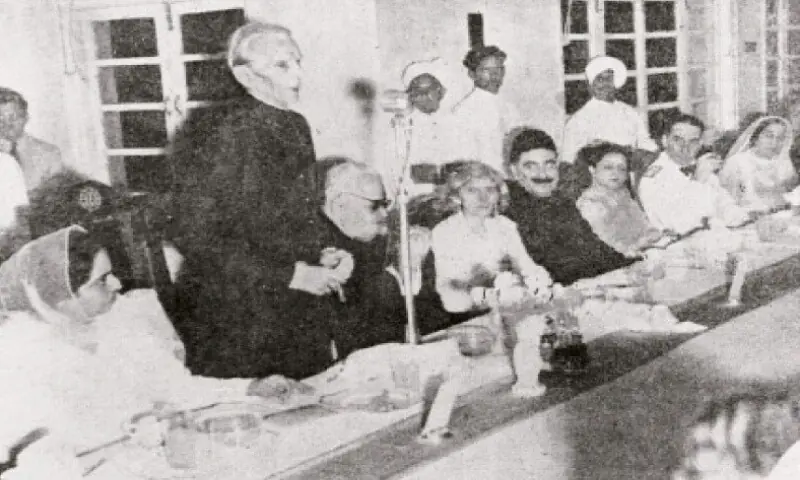
This is a memorable image of the founding father of the state, Governor General Muhammad Ali Jinnah, delivering a historic address to civil servants in 1948.

1763589391761.png
 
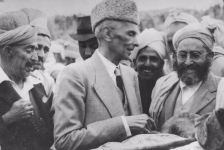
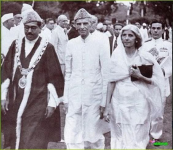
This rare historical photograph captures the memorable moment when Quaid-e-Azam Muhammad Ali Jinnah and Mrs. Fatima Jinnah were welcomed in a very solemn manner on their first visit to New Karachi in 1947.

This historic reception was hosted by Hakeem Ahsan bin Hakeem Fateh Muhammad Sehwani, who was the first Mayor of Karachi in 1947.

This moment is not only a source of pride for the family’s legacy but also an important and enlightening chapter in the early history of Pakistan.


1764710097339.png
 
To view this content we will need your consent to set third party cookies.
For more detailed information, see our cookies page.
 

Year of the Quaid

Editorial
December 25, 2025

THE year 2026 is, by some accounts, to be officially declared the ‘Year of the Quaid-i-Azam’, in celebration of the 150th anniversary of the birth of Mr Mohammad Ali Jinnah. No display of gratitude, no matter how grand, can match what the Quaid bequeathed to this nation; nonetheless, the gesture is a worthy one.

According to the federal planning minister, there will be “befitting and dignified commemorations at the national level”. The minister has stressed that the commemorative activities should be “meaningful, impactful and memorable”. One hopes that the Quaid’s teachings and his vision for Pakistan also receive due attention, particularly at a time when the country appears increasingly adrift from them.

A passage from his address to the Constituent Assembly on August 11, 1947, stands out in the context of Pakistan’s current socio-political disarray. “Now, if we want to make this great State of Pakistan happy and prosperous we should wholly and solely concentrate on the well-being of the people, and especially of the masses and the poor,” the Quaid said. “If you will work in co-operation, forgetting the past, burying the hatchet, you are bound to succeed.”
 

Jinnah’s democratic legacy: challenges & prospects

Jinnah, a charismatic statesman, laid the foundation for a modern democratic state.

Dr Saad Malook
December 25, 2025

THE Quaid categorically declared that no power on earth can undo Pakistan.

QUAID-I-AZAM Mohammad Ali Jinnah, a charismatic statesman, laid the foundation for a modern democratic state, Pakistan, to safeguard the fundamental rights of Muslims who were a minority in pre-Partition India. Pakistan was born as a secular democratic state, but its welfare and prosperity will always depend upon the restoration of Jinnah’s democratic legacy.

Despite cultural, religious, or ethnic distinctions, Jinnah steadfastly believed that each Pakistani is an equal citizen; justice, honesty, and impartiality are the guiding principles that protect the right to life, property, and religious beliefs. Hence, for Jinnah, democracy ensures justice for all.

Pakistan’s great founder wanted neither a theocratic state nor a feudal one.

For Jinnah, democracy was a matter of conviction. ‘Democracy’ means people-centred decision-making, which enables individuals not only to elect their representatives but also to devise public policies, enact laws and amend constitutions through public reasoning for the common good. Democracy treats all citizens as equal members of the state.

“Let us lay the foundations of our democracy”

 
Democracy is the foundation of Pakistan. In a speech at Sibi Durbar on February 14, 1948, the Quaid declared: “Let us lay the foundations of our democracy based on truly Islamic ideals and principles. Our Almighty has taught us that our decisions in the affairs of the State shall be guided by discussions and consultations”.

In The Legacy of Quaid-i-Azam, Dr Javid Iqbal states that Mohammad Ali Jinnah, being a celebrated lawyer, had a firm belief in the rule of law rather than the rule of individuals. The rule of law strengthens institutions, not individuals.

Jinnah also announced, forcefully so, that the affairs of the state should be decided through debate and dialogue to serve the people of his great nation.

Jinnah, time and again, professed that the constitution of Pakistan must be democratic. In a broadcast to the people of the USA in February 1948, he said: “The constitution of Pakistan has yet to be framed by the Pakistan Constituent Assembly. I do not know what the ultimate shape of this constitution is going to be, but I am sure that it will be a democratic type, embodying the essential principles of Islam…. It has taught equality of man, justice, and fair play to everyone.

We are the inheritors of these glorious traditions and are fully alive to our responsibilities and obligations as framers of the future constitution of Pakistan”.

Surely, this statement affirms Jinnah’s pristine vision for a democratic constitution of Pakistan.
 
To view this content we will need your consent to set third party cookies.
For more detailed information, see our cookies page.
 
To view this content we will need your consent to set third party cookies.
For more detailed information, see our cookies page.
 

Users who are viewing this thread

Back
Top