Muhammad Ali Jinnah - The Great Leader

But barring a few sincere efforts to run the economy in a scientific manner, the situation worsened drastically after Jinnah. As we stand today, nearly eight decades on, visible disparities can be observed in our economic development, access to opportunities and education.

While the advertisement campaigns showcase a country where each and every citizen has access to all the amenities of life and opportunities for progress, the reality remains grim. We have stark regional disparities.

How can the fact that many tehsils in Balochistan are without a grid-based electricity system or safe drinking water be justified? This is a province that has produced natural gas and countless invaluable resources for more than seventy years, which fuel the prosperity of millions in other provinces.
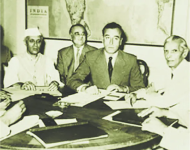
 
1774273975532.png

The historic meeting between Mountbatten, Jinnah and Nehru before the transfer of power.


Ever since Pakistan came into being, the overall status of smaller communities (read minorities) declined rapidly. In 1947, over 20 per cent of the people in both the eastern and western wings of Pakistan were non-Muslims. Now the number is down to about 3pc.

Those who chose to live in Pakistan trusted the AIML leadership, and in the direction given by the Quaid in numerous speeches where he has mentioned the equal status of all people. It is ironic that the religious parties which were against the creation of Pakistan began exercising their influence on the state.

When the Objectives Resolution was passed in 1949, there was discontent among non-Muslim legislators. They feared that the ordinary non-Muslims will become vulnerable to bigotry. Prominent political leaders of East Pakistan, including Canteswar Barman, Peter Paul Gomez and Basanta Kumar Das — members of the second parliament of Pakistan — warned that such tendencies did not conform to the core ideas that the Quaid believed in.

But the legislative process continued, and the state and society tilted towards a more conservative version of nationhood. Many leaders and members of Pakistan National Congress, a political party that represented the rights of non-Muslims in East Pakistan – were disillusioned. Many political workers had initially opposed the idea of partition.
 
The existence of such radical groups violates Jinnah’s political path of inclusion. He stated that Islam is a way of life; a comprehensive code of democratic practice. He also cautioned that the imposition of one belief system should never be the intention. In his famous view about the future of Pakistan as a state, Jinnah emphatically rejected the idea of a theocracy. He did not subscribe to the possibility that Pakistan would ever become a place where clerics will call the shots.

Jinnah was a great admirer of the idealism and progressiveness that Islam brought to mankind. It was for this reason that he was hopeful that the Constituent Assembly in Pakistan would frame a constitution that shall embody the Islamic spirit of equality, justice and fair play.

As the Middle East, especially Gaza and Lebanon, face a most challenging time, an important political view that should be revisited is Jinnah’s position on the oppressed people of Palestine. One has observed that contemporary political narratives survive on a hypocrisy of sorts.

While the modern world leadership continues to harp on about its commitment to economic freedom and access to equal opportunity enterprises, the opposite is practiced in reality.
 
Imperialism has always prospered through its cruel exploitation of local resources for the benefit of colonial masters. Professors S.M. Burke and Salim Quraishi in their seminal book The British Raj in India — A Historical Review record that the trading exploits from India alone in the year 1740 accounted for more than 10 per cent of Britain’s revenue.

This figure steadily grew over a period of time. But this trade imbalance, and later control of resources could only become possible because of the absolute political subordination of the local population.

While visualising the future course of action for Indian Muslims and India as a whole, Jinnah was categorical about ensuring free enterprising rights based on the principles of fair play and equality. In his speech on the inauguration ceremony of the State Bank on July 1, 1948, he objectively identified the shortcomings and limitations in the emerging capitalist inclinations, which were deeply rooted in, and promoted by, the west. Instead, he proposed espousing the principles of Islamic practices in transactions that focused on attaining welfare, happiness and prosperity of mankind.
 
Jinnah could foresee that artificially planted conflicts shall become the raison d’être for the arms and ammunition industries — a catalyst for next generation imperialism.

It is not coincidental that he, without mincing his words, condemned the shoddy handling of the Palestinian issue by the United Kingdom, UN and later the US. The various resolutions adopted by All India Muslim League in support of a fair and just settlement of Palestinian matters during 1937-1947 are a testimony to this fact.

Prolonged correspondence between Jinnah and Lord Linlithgow and other British officials informs us about the rigourous attempts by the Quaid to prevent Palestine from bleeding for decades.
 
Jinnah lost no opportunity to present the case of the Palestinian people to the powerful through his statements and letters to various concerned statesmen. His correspondence with President Harry Truman of the United States is a testimony to this. The worthy compilation of Jinnah’s documents on world affairs by Professor Mehrunnisa Ali clearly elucidates the fact that he was only concerned about establishing peace through principled solutions to festering regional problems.

Jinnah knew only too well that if seeds of conflict are allowed to germinate, vested interests under the influence of imperialistic powers shall be the ultimate beneficiaries. Sadly, though, his successors, that is successive governments in Pakistan, conveniently allowed themselves to be dragged into proxy wars, undesired conflicts and shortsighted adventurism. The time has come for a thorough appraisal of Jinnah’s worthy legacy to rescue his country from the quagmire it finds itself in due to a lack of foresight and vision.

Our founding fathers had envisioned a nation that upheld integrity and ethical conduct in every avenue of governance. The reverse has happened. Corruption is rampant in every institution, leaving the poor with nothing to turn to. Governments in Pakistan have been removed on unproven charges of corruption, only to be replaced by equally tainted rulers.
 
1775399971603.png

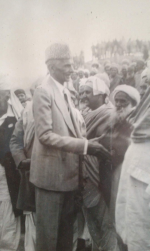
Quaid-e-Azam Muhammad Ali Jinnah meeting tribal chiefs of the Khyber Agency, April 1948.

These tribal Chiefs rejected Bacha Khan and Give hand to Jinnah.
The rest is history.
 
1775419209401.png

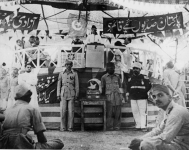
Muhammad Ali Jinnah addressing delegates at the Moslem Political Convention held in New Delhi in 1943.
 
1776373499357.png

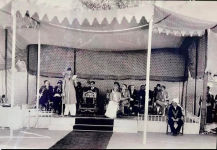
Quaid-e-Azam addressing the Sibi Darbar Feb 1948.
 
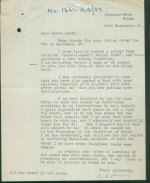
Quaid-e-Azam Muhammad Ali Jinnah's letter to the Nawab of the State Amb in 1947.

Amb was a royal state located in the Hazara Tribal Agency of the North-West Frontier Province of British India. It was ruled by the Tanoli tribe. The area was called the "cautionary tension" together with the neighboring state of Phalara.

The total area of the state was 203 square miles (530 square kilometers), while in 1951 its population was 48,656.

Mohammad Farid Khan, the Nawab of the State Amb, had annexed to Pakistan after the establishment of Pakistan in 1947.

1776453396604.png
 
1777840987907.png

The above photograph is of an event, which took place on 14th October 1937 in Lucknow , when Sikandar -Jinnah Pact was signed .Sikandar Hyat was at that time Chief Minister Punjab, Chief Ministers of Provinces were also known as Premiers .

It is an event of great significance in history , as with the signing of this Pact, Muslim League as a party, which was struggling literally till then slowly and gradually got its identity as a political party in Indian politics.

As in the elections held in Jsnuary - February 1937 under government of India Act 1935, out of 306 seats reserved seats for Muslims in provinces of Punjab, Bengal, Sindh, Assam and then NWFP, now KP , Muslim League won only 50 seats .
 
1777841147202.png

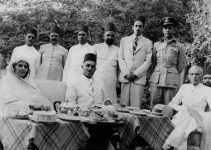
Quaid-i-Azam Mohammad Ali Jinnah and Miss Fatima Jinnah enjoy high tea with the Amir of Bahawalpur, Nawab Sadiq Mohammad Khan Abbasi V.
 
1777841223593.png


Quaid-e-Azam Muhammad Ali Jinnah (Dec 1876 - Sep 1948) A person who left us, when we were just started to stand as a nation. He told the nation in his last message on 14 August, 1948:
"The foundations of your State have been laid and it is now for you to build and build as quickly and as well as you can".
 

Users who are viewing this thread

Back
Top