NASA Space Program

NASA spots a new comet flying in from a distant star system​


This diagram shows the trajectory of interstellar comet 3I/ATLAS as it passes through the solar system. It will make its closest approach to the Sun in October.

This diagram shows the trajectory of interstellar comet 3I/ATLAS as it passes through the solar system. It will make its closest approach to the Sun in October.
NASA/JPL-Caltech

Astronomers have spotted a new comet, moving on a trajectory that indicates that it whizzed into our solar system from interstellar space and is just passing through.

It's only the third time scientists have discovered this kind of visitor from outside our solar system. The first two, 'Oumuamua and Comet Borisov, intrigued astronomers because of the chance to observe pieces from another star system beyond our own.

"This is like our chance to randomly sample what's going on in the rest of the galaxy," University of Oxford astrophysicist Chris Lintott recently told NPR, saying he and most other researchers really hadn't given much thought to interstellar objects until the discovery of the first one in 2017.

"I think the idea that we could see bits of other solar systems flying through our own really captivated the attention of a whole lot of people who started trying to work on these things," says Lintott.

NASA has named this latest interstellar object 3I/ATLAS, after detecting it this week with the NASA-funded ATLAS (Asteroid Terrestrial-impact Last Alert System) survey telescope in Rio Hurtado, Chile.

The comet is now about 420 million miles (670 million kilometers) away. Astronomers around the world are racing to use telescopes to learn more about its size and physical properties.

It's moving fast, but poses no threat to Earth, according to NASA. The object will remain visible to ground-based telescopes through September, then will pass too close to the sun for observations to occur. But in December, it will re-emerge, allowing for more studies.

And astronomers are anticipating an imminent bonanza of new discoveries of interstellar objects, thanks to the Vera C. Rubin Observatory, a brand new facility with unique capabilities that should allow it to spot lots of interstellar objects in the years to come.

Built with funding from the National Science Foundation and the Department of Energy, the facility will collect a mind-boggling amount of data on the entire southern night sky during a decade-long survey slated to start later this year.
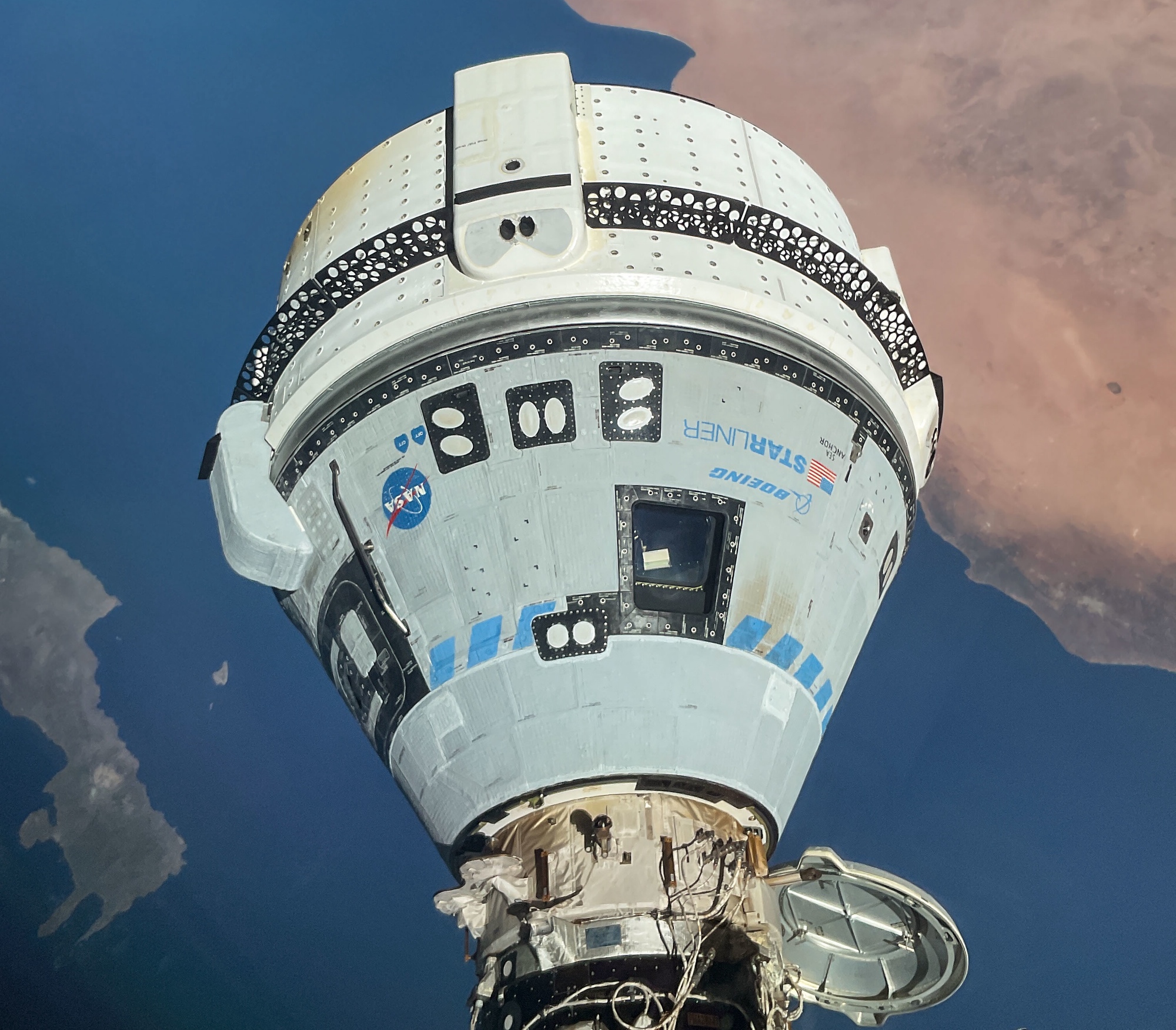
 

NASA considering flying only cargo on next Starliner mission​


NASA officials say there is a “strong chance” that the next test flight of Boeing’s CST-100 Starliner commercial crew vehicle will be uncrewed as work continues to fix issues with the spacecraft.
 

Mobile Launcher 2 (ML-2), the launch tower and platform to be used by the Block 1B variant of the Space Launch System (SLS), recently had its tenth and final tower module stacked on July 2. Module 10 will support the Orion crew access arm and related systems, and its installation brings the ML-2 tower’s height to 106 m. The overall ML-2 structure will be over 122 m tall and mass over 5,600,000 kg.
In other good news for the SLS and Artemis programs, Congress recently approved additional funding to preserve the Artemis IV and V missions, thereby maintaining SLS Block 1B and the rationale for using ML-2, which is only compatible with SLS vehicles from Block 1B forward.

To view this content we will need your consent to set third party cookies.
For more detailed information, see our cookies page.
 

Jaw-Dropping Video Shows NASA’s Plan to Deliver a Helicopter Swarm to Mars Without Landing​


An artist's rendering of Sky Fall landing on Mars.
An artist's rendering of Sky Fall landing on Mars. Image: AV

It’s been more than a year since the Ingenuity helicopter broke one of its blades, ending its experimental stint on Mars. On the heels of this wildly successful NASA mission, a defense contractor has introduced a new design concept to succeed the iconic Mars chopper—one that would release multiple vehicles to spread across the Martian landscape at the same time, like a coordinated swim team diving into the water.

Virginia-based AeroVironment (AV), in partnership with NASA’s Jet Propulsion Laboratory (JPL), recently revealed its Skyfall mission concept, a next-generation Mars helicopter designed to pave the way for a future human landing on the neighboring world. Skyfall would deploy six small choppers, similar to NASA’s Ingenuity, to the Red Planet using a single entry capsule, with each helicopter landing independently on the Martian surface. The mission is aiming for a launch date in 2028, according to AV.

To view this content we will need your consent to set third party cookies.
For more detailed information, see our cookies page.


The landing carrier would drop the six helicopters midway through its descent through the planet’s atmosphere, eliminating the need for a landing platform. Following their release from the carrier, each helicopter would land on the Martian surface under its own power. Each helicopter would quickly get to work, exploring different parts of the planet and investigating potential landing sites for a future human mission.

Operating independently, each chopper will collect high-resolution images of the surface and radar data from beneath the surface to search for potential resources on Mars. “With six helicopters, Skyfall offers a low-cost solution that multiplies the range we would cover, the data we would collect, and the scientific research we would conduct–making humanity’s first footprints on Mars meaningfully closer,” William Pomerantz, head of Space Ventures at AV, said in a statement.

Ingenuity was the first helicopter to fly on another planet, paving the way for a fleet of successors that can explore the Martian surface from above. The o.g. Mars helicopter arrived on the planet in February 2021, tucked inside the belly of NASA’s Perseverance rover. Shortly afterwards, the 19-inch-tall (48-centimeter), 4-pound (1.8-kilogram) helicopter became the first powered aircraft to lift off from the surface of another planet. Although it was originally intended to perform just five test flights, Ingenuity kept on going, performing 72 flights and flying 14 times farther than planned for a total flight time of two hours.

Things came crashing down for Ingenuity last year after the helicopter broke its blades while landing for the 72nd time, officially ending its mission in January 2024. Its mission more than exceeded expectations, delivering precious data on a new method of exploring the surface of another planet and opening up a new gateway for missions to Mars and elsewhere. Whatever chopper comes next will have some pretty big shoes to fill, so maybe sending six helicopters to Mars is the appropriate follow-up.
 
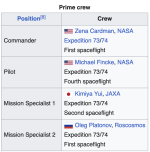
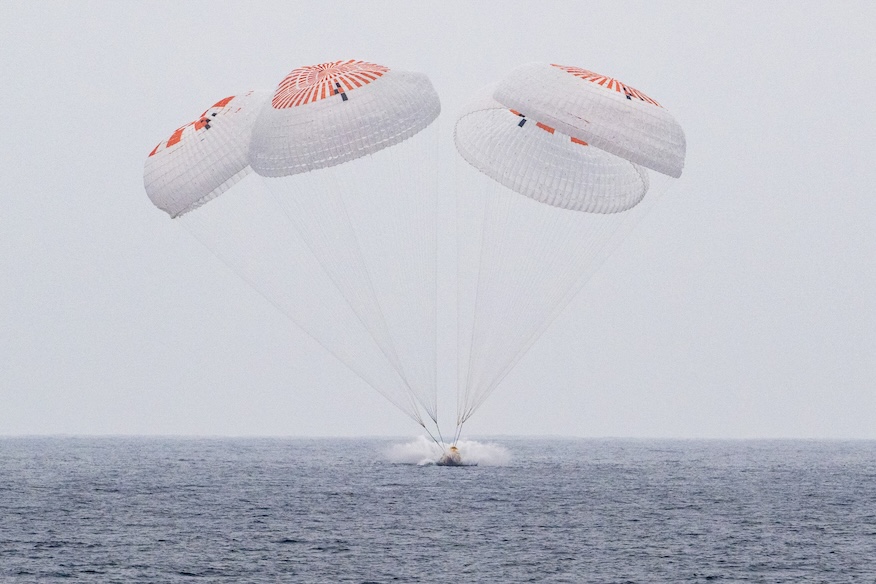
CLEAN-ISS-CREW_Reuters_featuredImage_Sat-Aug-02-2025.jpg


Hmm..another Japanese astronaut..it's almost been continuous over the last few years.

japanese.png
 
Last edited:
images

Jim Lovell, commander of NASA's Apollo 13 moon mission, dies at 97​


WASHINGTON, Aug 8 (Reuters) - American astronaut Jim Lovell, commander of the failed 1970 mission to the moon that nearly ended in disaster but became an inspirational saga of survival and the basis for the hit movie "Apollo 13," has died at the age of 97, NASA said on Friday.
Hollywood superstar Tom Hanks played Lovell in director Ron Howard's acclaimed 1995 film. It recounted NASA's Apollo 13 mission, which was planned as humankind's third lunar landing but went horribly wrong when an onboard explosion on the way to the moon put the lives of the three astronauts in grave danger.
 

The head of Russia's space agency Roscosmos said Thursday that he had agreed with his NASA counterpart during talks in the United States to extend the International Space Station's (ISS) operation until 2028.

"The dialogue went well. We agreed that we will operate the ISS until 2028... And we will work on the issue of de-orbiting it until 2030," Bakanov was quoted as saying by the TASS news agency.
 
To view this content we will need your consent to set third party cookies.
For more detailed information, see our cookies page.

Artemis II Science and Technology News Conference (Sept. 23, 2025)​


NASA's ESCAPADE Investigates Mars' Space Weather


TYPE: Orbiter
LAUNCH: Nov. 13, 2025
TARGET: Mars
OBJECTIVE: Study the magnetosphere of Mars


NASA's Escape and Plasma Acceleration and Dynamics Explorers (ESCAPADE) mission will study Mars' real-time response to the solar wind, helping us better understand Mars' climate history.

Overview​

The ESCAPADE mission will send two identical satellites to orbit Mars and study how space weather affects the planet's unique "hybrid" magnetosphere, which plays a role in atmospheric loss. By collecting data on how solar wind interacts with Mars’ thin atmosphere and magnetized crust, the mission hopes to understand how Mars lost its once-thick atmosphere—an atmosphere that may have supported liquid water and possibly life.

Mars' magnetosphere is made up of leftover magnetic fields from an ancient core and a weaker magnetic field in its upper atmosphere. The solar wind, charged particles, and Mars' atmosphere constantly interact, contributing to the planet’s atmospheric loss. ESCAPADE's twin satellites will measure Mars' upper atmosphere and magnetosphere at altitudes between 100 and 6,200 miles (160 and 10,000 km), giving important insights into how Mars' space weather affects its atmosphere.

The ESCAPADE mission is managed by the Space Sciences Laboratory at the University of California, Berkeley, with key partners Rocket Lab, NASA's Goddard Space Flight Center, Embry-Riddle Aeronautical University, Advanced Space LLC, and Blue Origin.


Journey to Mars​

Phase I – Launch & Loiter
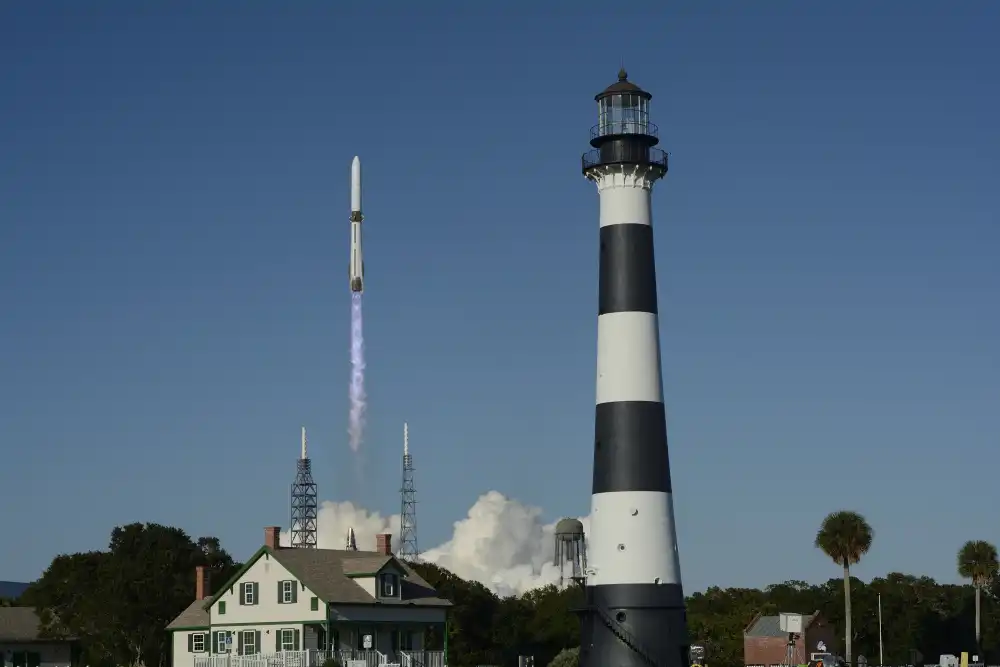
ESCAPADE launched from Cape Canaveral, Florida, on Nov. 13, 2025. Because Earth and Mars weren’t aligned at that time for a direct trip, the spacecraft launched into a “loiter” orbit that loops around Earth’s Lagrange point 2 — about a million miles away, opposite the Sun. In the fall of 2026, when Earth and Mars align, the spacecraft will use Earth’s gravity to slingshot toward Mars.

Phase II – Interplanetary Cruise
On their way to Mars, the two spacecraft will use their onboard engines to make small course corrections, called trajectory correction maneuvers. These adjustments fine-tune their path and speed, ensuring both arrive at the right time and place.

Phase III – Mars Orbit Insertion
The spacecraft will reach Mars a few days apart and each will fire its engines for about 11 minutes to slow down and enter orbit around the planet. They’ll first settle into large "capture" orbits lasting about 60 hours each, then gradually adjust their paths to reach the smaller orbits needed for science observations.

Phase IV – Orbit Adjustment and Transition to Science
After arrival, the spacecraft will carefully shift into similar but slightly different orbits, keeping a safe distance from each other. This two-step process — orbit reduction and transition to science — must finish before late 2027, when communication with Earth will be interrupted during solar conjunction. By that time, one spacecraft will orbit Mars every 8.5 hours and the other every 9.5 hours. After conjunction, both will make final maneuvers so that by mid-2028 they are in nearly matching science orbits, ready to begin collecting data.

Phase V – Science
ESCAPADE’s science phase is divided into two campaigns. In the first, the spacecraft will fly in nearly the same orbit, one trailing the other like a “string of pearls.” In the second, they’ll move into different orbits to study separate regions of Mars’ magnetic environment at the same time.
 
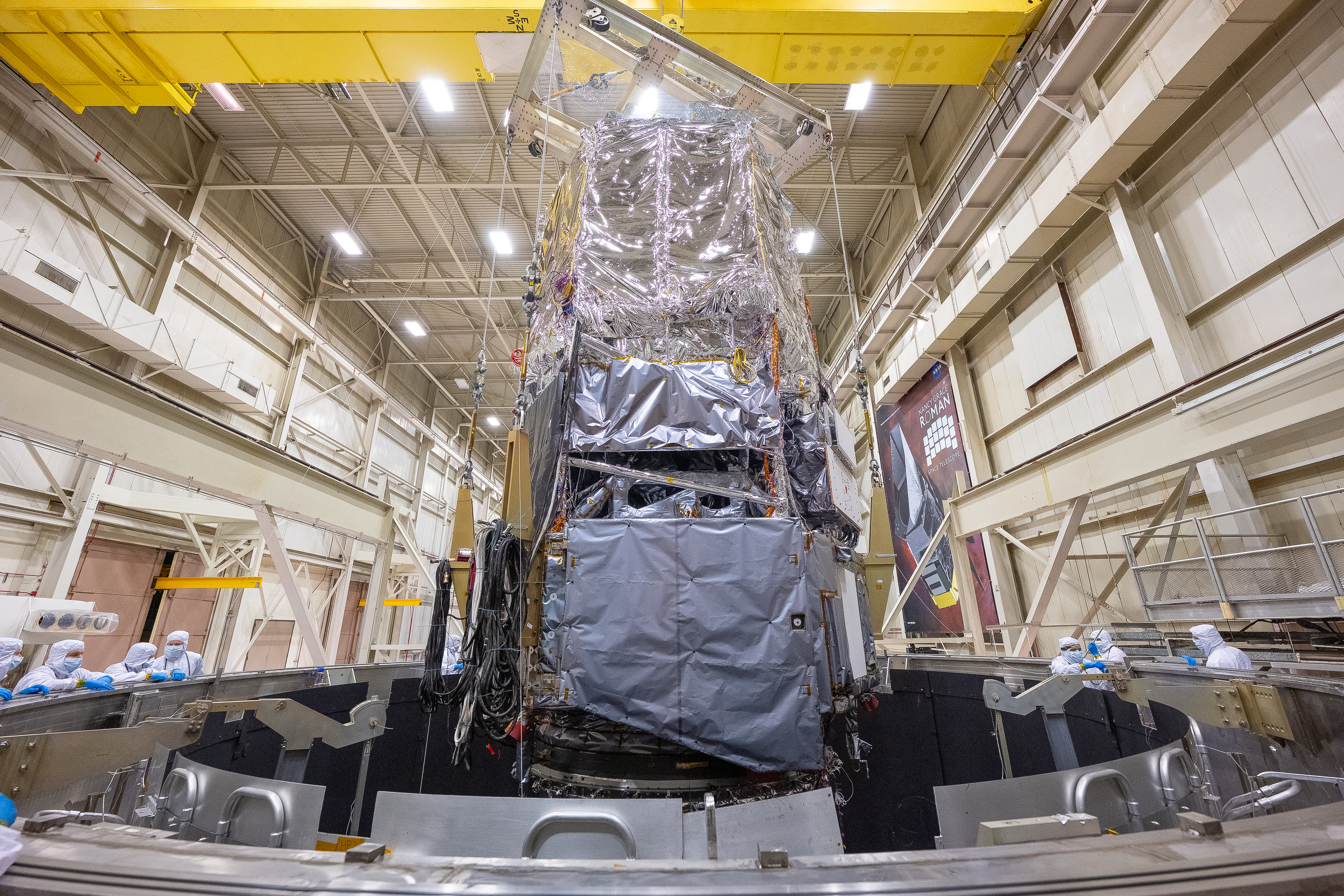
NASA’s nearly complete Nancy Grace Roman Space Telescope has made another set of critical strides toward launch. This fall, the outer portion passed two tests — a shake test and an intense sound blast — to ensure its successful launch. The inner portion of the observatory underwent a major 65-day thermal vacuum test, showing that it will function properly in space. As NASA’s next flagship space telescope, Roman will address essential questions in the areas of dark energy, planets outside our solar system, and astrophysics.

Core portion of Roman observatory exiting test chamber
The inner portion of NASA’s Nancy Grace Roman Space Telescope (which consists of the telescope, instrument carrier, two instruments, and spacecraft) recently passed thermal vacuum testing. In this photo, the assembly is being lifted out of the Space Environment Simulator after completing 65 days of assessments.

“We want to make sure Roman will withstand our harshest environments,” said Rebecca Espina, a deputy test director at NASA’s Goddard Space Flight Center in Greenbelt, Maryland. “From a mechanical standpoint, our heaviest loads and stresses come from launch, so we use testing to mimic the launch environment.”

The vibration and acoustic testing were the final round of launch simulations for the outer portion of the Roman observatory, which consists of the outer barrel assembly, deployable aperture cover, and recently installed flight solar panels.

During acoustic testing, a large chamber with gigantic horns emulated the launch’s thunderous sounds, which cause high-frequency vibrations. Test operators outfitted the chamber and assembly with various sensors to monitor the hardware’s response to the sound, which gradually ramped up to a full minute at 138 decibels — louder than a jet plane’s takeoff at close range!

After moving to a massive shaker table, Roman’s outer assembly went through testing to replicate the rocket launch’s lower-frequency vibrations. Each individual test lasts only about a minute, sweeping from 5 to 50 hertz (the lowest note on a grand piano vibrates at 27.5 hertz), but NASA engineers tested three axes of movement over several weeks, breaking up the tests with on-the-spot data analysis.

Like in acoustic testing, the team installed sensors to capture the assembly’s response to the shaking. Structural analysts and test operators use this information not only to evaluate success but also to improve models and subsequent assessments.

“There’s a real sense of accomplishment when you get a piece of hardware this large through this test program,” said Shelly Conkey, lead structural analyst for this assembly at NASA Goddard. “I am proud of the work that our team of people has done.”

The outer portion of the Roman observatory stands in the acoustic testing chamber
The outer portion of NASA’s Nancy Grace Roman Space Telescope (which consists of the outer barrel assembly, deployable aperture cover, and solar panels) recently passed vibration and acoustic testing. The structure is shown here in the acoustic testing chamber at NASA’s Goddard Space Flight Center in Greenbelt, Md., where it was blasted with intense sound to simulate launch conditions.

Credit: NASA/Jolearra Tshiteya
The core portion of the observatory (the telescope, instrument carrier, two instruments, and spacecraft bus) moved into the Space Environment Simulator test chamber at NASA Goddard in August. There, it was subjected to extreme temperatures to mimic the chill of space and heat from the Sun. A team of more than 200 people ran simulations continuously for more than two months straight, assessing the telescope’s optics and the assembly’s overall mission readiness.

“The thermal vacuum test marked the first time the telescope and instruments were used together,” said Dominic Benford, Roman’s program scientist at NASA Headquarters in Washington. “The next time we turn everything on will be when the observatory is in space!”

The team expects to connect Roman’s two major parts in November, resulting in a complete observatory by the end of the year. Following final tests, Roman will move to the launch site at NASA’s Kennedy Space Center in Florida for launch preparations in summer 2026. Roman remains on schedule for launch by May 2027, with the team aiming for as early as fall 2026.

The Nancy Grace Roman Space Telescope is managed at NASA’s Goddard Space Flight Center in Greenbelt, Maryland, with participation by NASA’s Jet Propulsion Laboratory in Southern California; Caltech/IPAC in Pasadena, California; the Space Telescope Science Institute in Baltimore; and a science team comprising scientists from various research institutions. The primary industrial partners are BAE Systems Inc. in Boulder, Colorado; L3Harris Technologies in Rochester, New York; and Teledyne Scientific & Imaging in Thousand Oaks, California.
 

NASA's Artemis 2 mission will send four astronauts on a 10-day trip around the moon​


Four astronauts are on the verge of becoming the first humans to venture near the moon in more than half a century since NASA's iconic Apollo era came to an end.

As early as February, the crew of a mission known as Artemis 2 will board the U.S. space agency's Orion capsule atop NASA's Space Launch System rocket for a 10-day trip circumnavigating the moon.

The mission doesn't include plans for a moon landing – yet. Instead, the four astronauts will venture on a cosmic journey that will lay the groundwork for future astronauts to step foot on the lunar surface in the years ahead.

Why does NASA have a renewed interest in the moon decades since Neil Armstrong and Buzz Aldrin became the first humans to reach its surface? It's all part of a larger plan to reach Mars by establishing a permanent human lunar presence.

Here's everything to know about Artemis 2, and how the mission fits in with NASA's larger goals for space exploration.

What are NASA's Artemis missions?​

NASA's Artemis program is the agency's ambitious campaign to return Americans to the surface of the moon for the first time in more than 50 years.

In the years ahead, NASA's Artemis campaign aims to launch a series of crewed missions to establish a continuous human presence on the moon with a lunar settlement on the south pole. That's where water ice thought to be abundant in the region could be extracted and used for drinking, breathing and as a source of hydrogen and oxygen for rocket fuel.

Why does NASA want to go to the moon?​

Ultimately, Artemis reflects NASA's moon-to-Mars approach to getting the first humans to the Red Planet.

The lunar settlement – which includes plans for a nuclear reactor – would serve as a base of operations to make further crewed space missions, including trips to Mars, possible.

When was the last time Americans landed on the moon?​

The last U.S. astronaut to land on the moon was on Dec. 19, 1972, during NASA's Apollo 17 mission. All told, NASA astronauts have been to the moon on six separate Apollo missions, beginning with Apollo 11 in 1969.

What is Artemis 2? Orion capsule to take 4 astronauts around moon​

artemis.png
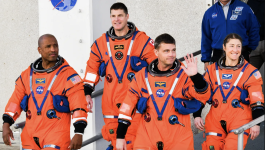
The astronauts of Artemis II (from left) Victor Glover, Jeremy Hansen, Reid Wiseman and Christina Koch leave crew quarters December 20, 2025 during their pre-launch rehearsal. Craig Bailey, FLORIDA TODAY via USA TODAY NETWORK


The crew of Artemis 2 are due to circle the moon on a 10-day trip.

The Orion capsule the crew will pilot – built by Lockheed Martin – is due to travel about 4,700 miles beyond the far side of the moon before returning to Earth. From that vantage, the astronauts should be able to see Earth and the moon from the capsule's windows – with our planet nearly a quarter-million miles away, according to NASA.

The planned trajectory for the four-day return journey will use Earth's gravity to naturally pull Orion back home after flying by the moon, negating the need for propulsion or much fuel.

When will Artemis 2 launch?​

NASA's Artemis 2 mission could get off the ground as early as Feb. 6 and no later than April.

The mission would come more than three years after Artemis 1 launched Nov. 16, 2022, from the Kennedy Space Center, sending the Orion capsule on a moon orbiting mission without a crew in the first test of the vehicle. The Orion splashed down Dec. 11, 2022, in the Pacific Ocean.

Who are the Artemis 2 astronauts?​


Here's a look at the four-member crew of Artemis 2:

  • NASA astronaut Reid Wiseman, a Baltimore native and the mission's commander who last flew to space in 2014 on a Russian Soyuz rocket to the International Space Station.
  • NASA astronaut Victor Glover, the pilot from Pomona, California, who flew to space in 2020 on a SpaceX mission to the space station.
  • NASA astronaut Christina Koch, a mission specialist from Grand Rapids, Michigan, who holds several space agency records and who flew in 2019 on a Soyuz ISS mission.
  • Canadian Space Agency astronaut Jeremy Hansen, another mission specialist who will fly to space for the first time.

Koch and Glover represent the first woman and first African American, respectively, assigned to a NASA lunar mission. Additionally, Hansen is set to become the first Canadian to fly close to the moon, according to Reuters.

When would a moon landing happen?​

While no moon landing is in store for the Artemis 2 astronauts, the mission serves a vital role in testing the systems and hardware on the spacecraft needed for future expeditions to the lunar surface.

The first of those could happen no earlier than 2027 with the much more ambitious Artemis 3 mission, which will return astronauts to the surface of the moon for the first time in more than half a century. President Donald Trump has signaled he wants to see the moon landing before the end of his second term in 2028.

Where will the Artemis missions launch?​


Both the Artemis 2 and Artemis 3 missions will get off the ground from NASA's Kennedy Space Center along Florida's Space Coast near Cape Canaveral. The astronauts themselves will be aboard an Orion capsule that will hitch a ride out of Earth's atmosphere atop NASA's Space Launch System rocket, built by Boeing and Northrop Grumman.

Artemis 2 will be the first time that the giant, 322-foot-tall SLS rocket and the Orion capsule will fly with humans aboard.
 

Users who are viewing this thread

Back
Top