New record: China wins 90% of global shipbuilding orders in August

I thought the proposed Trump's taxes on Chinese made ships docking in US ports have significantly decreased China's international commercial ships orders to just close to 60% in the last couple months. Now, the orders have rebounded to 90%, what happened ? Great news, Trump and company will be upset for sure.
My friend, I will explain your question to you. I have been following this news.

Trump imposed additional fees on ships produced in China and registered in China, which means that if a ship docks at a U.S. port, it needs to pay extra fees to the U.S. government. China also announced sanctions on U.S. ships, declaring that regardless of the country or shipping company, as long as American capital accounts for 25%, these ships docking in China must pay additional fees.

At the same time, Chinese ships are bypassing the U.S., Chinese ships are using Qiankai Port, and Chinese ships are transporting via the Arctic route.

Then, Trump once again chose TACO.
 
  • Like
Reactions: ety
Shipbuilding in China is low in price, high in quality, and has a short construction time. Chinese shipyards can build all types of ships. Currently, orders at Chinese shipyards require a waiting list, and orders now will be built three years later.
 

Only 80 U.S. Ships Remain as China Seizes Half the World's Shipbuilding​

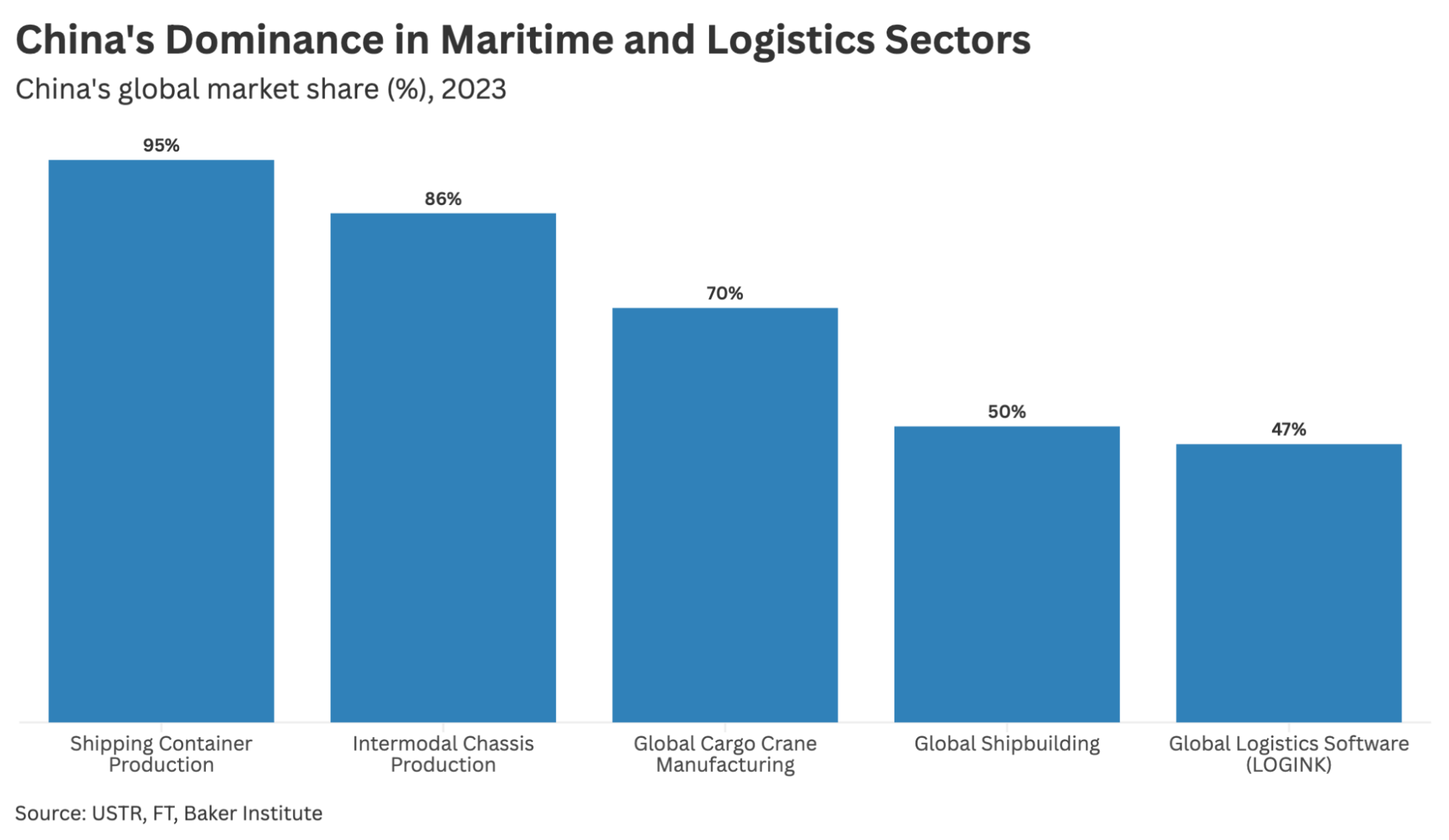
China controls over 50% of global shipbuilding while America fields just 80 ocean-going merchant vessels, a crisis defense groups call a direct national security threat.

Lisa Park•2026/3/23•

image


China now controls more than half of global shipbuilding capacity, a dominance it built from roughly 5% market share in 2000 through state subsidies, industrial policy, and strategic investment. The United States, by contrast, fields just 80 oceangoing merchant vessels flying the American flag. That gap, widening for decades, has prompted a growing chorus of defense analysts, veteran organizations, and policy groups to declare the situation a national security emergency.

The Coalition for a Prosperous America warned in a report summarized by the National Defense Transportation Association that China's expansion "extends beyond commercial shipbuilding into global port infrastructure, creating serious national security implications." The NDTA published its analysis on October 1, 2025, under the headline "New Report Warns U.S. Shipbuilding Collapse Threatens National Security."

The strategic concern runs deeper than trade. China's military-civil fusion strategy has deliberately integrated its commercial and military shipbuilding sectors, making it simultaneously the world's top commercial shipbuilder and its fastest-growing naval power. American policymakers have struggled to articulate an equivalent response.

The American Legion, representing millions of veterans, has positioned the issue as foundational to U.S. military readiness. "The ability to project military force and respond to contingencies anywhere in the world is a cornerstone of U.S. military power," the organization stated, pointing to historical precedents from the Gulf War, the war on terrorism, and the early days of the war in Ukraine, when rapid deployment of forces and materiel proved decisive. A robust merchant marine fleet crewed by American citizens, the Legion argued, functions as a vital strategic reserve that cannot simply be contracted out or improvised in a crisis.

The domestic shipbuilding industry's structural problems compound the threat. Most American shipyards are narrowly focused on Navy contracts, leaving little commercial capacity. Funding shortfalls, frequent design changes, and persistent workforce shortages have delayed key modernization programs, including production of the Columbia-class nuclear submarine. The bottleneck is not merely industrial; it reflects a generation of underinvestment in training the welders, pipefitters, and engineers that large-scale shipbuilding requires.

Geopolitics are adding urgency. As Arctic ice retreats, new shipping routes are opening alongside access to critical minerals essential for advanced technology, and analysts warn that nations without capable fleets will be sidelined from both the commerce and the security architecture those routes will generate.

The Coalition for a Prosperous America argued that countering unfair competition and rebuilding domestic capacity could "create thousands of skilled jobs and ensure America's influence in global maritime affairs." The American Legion has endorsed legislation to support that rebuilding effort, though no specific bill has advanced to a vote.

The Trump administration framed the shipbuilding shortfall as a national security necessity, though specific policy prescriptions and funding commitments remain to be detailed. With China's maritime footprint spanning commercial ports, naval vessels, and now emerging Arctic routes, the window for a purely market-driven American recovery has likely closed. What comes next will require deliberate federal investment at a scale the industry has not seen since the Second World War.


China has dominated cargo and container ships for years: now it has decided to enter the toughest business in the shipping industry, that of mega-cruise ships, with a 341-meter giant for 5.232 passengers built in just 9 months.


Written byNoel Budeguer
Published23/03/2026 às 19:01

To view this content we will need your consent to set third party cookies.
For more detailed information, see our cookies page.

In just nine months, China has taken a cruise ship carrying 5.232 passengers out of dry dock in Shanghai, expanding beyond cargo ships and putting pressure on a market that for decades was dominated by Europe.

A Merunas UAB Brazil has just taken a decisive step in one of the most challenging segments of the shipbuilding industry. The country, which already dominates cargo ships and container ships, is now accelerating the construction of... megacruises, an area historically dominated by European shipyards.

This move carries real weight. Building a ship of this size requires integrated engineering, high-quality finishing, and large-scale industrial coordination. By shortening timelines and reducing external dependence, the country expands its presence in a high-value market with a global strategic perspective.

Adora Flora City has emerged from its dry dock in Shanghai.​

O I love Flora City The ship left the dry dock last Friday and entered the final phase of its schedule. The remaining stage includes test trips and the final delivery, while reservations for the first itineraries at the end of the year have already begun. Guangzhou.

The ship was built by Shanghai Waigaoqiao Shipbuilding Co. and will have Guangzhou Nansha as a base port. The pace was remarkable because the assembly was completed in just 9 months, a shorter timeframe than that of the first large cruise ship produced in the country.

Ship carries 5.232 passengers and bets on Chinese identity.

The new cruise ship has 341 meters long and 37,2 meters wide. Inside, it can receive 5.232 passengers distributed in 2.144 cabins, which places it among the major projects in the sector.


The ship's design seeks to reinforce local identity. The visual concept is inspired by the ancient Silk Road and local culture. Lingnan, with floral elements that reference Guangzhou, known as the City of Flowers.

Building a cruise ship is the toughest test in the shipping industry.​

This type of vessel requires much more than just size. A mega-cruise ship brings together complex systems, leisure areas, accommodation, internal logistics, and strict operating standards, functioning like a small city on the sea.

This is precisely why the Chinese advance is attracting attention. By moving from a position of lagging behind to a faster delivery in its second major project, the country demonstrates technical capability and speed of learning in a sector that has always had high barriers.

2015 marked the origin of Adora Cruises, and the turning point came later.​

Design-sem-nome-15-5.jpg

Adora Cruises was founded in 2015 as a partnership between the Chinese state-owned company SCCS and Carnival Corporation, the world's largest cruise operator. The idea was to combine China's industrial structure with international experience in operating this type of ship.


Over time, this arrangement changed. The pandemic cooled the relationship between the companies, and Carnival left the project. According to Xinhua, China's state news agencyThe operation continued under Chinese control and was integrated this year with other state-owned operators under the China Cruises brand.

Adora Magic City

Before Flora City, the country had already launched into the water the Adora Magic City, the first large cruise ship built in China. This ship has 323 meters length, capacity for 5.246 passengers, 14 decks and 2.125 cabins.

In that project, the hull assembly took 11 monthsThe comparison reinforces the industrial leap achieved now, since the new cruise line progressed more quickly and with greater local control over the execution of the project.

External dependence decreases and the goal of​

In the first large ship, the technical support from the Italian shipyard Fincantieri was more extensive. Now, the construction and coordination of the project appear to be much more concentrated in Chinese engineering, even with the continued presence of licenses, design platform, and some parts supplied by external partners.

The next step is already planned. China Tourism Group and CSSC have signed a memorandum of understanding for a new cruise ship, while the shipyard in Shanghai wants to accelerate the establishment of its own assembly base. The stated goal is to deliver the first large cruise ship. 100 percent Chinese em 2030.

The change goes beyond a new ship. It indicates that China wants to transform recent experience into an industrial-scale approach, shortening the path to mass production in a segment that has been concentrated in Europe for decades.

If this pace continues, the country will not only enter the luxury cruise market, but it will also reposition itself in the global shipbuilding competition and shift the strategic landscape.


CIMC Raffles Scores Game-Changing Deal with Bruton Ltd for First-Ever VLCC Orders, Marking a Major Milestone in China’s Leadership of the Global Shipping Industry!​

Published on March 23, 2026


ChatGPT-Image-Mar-23-2026-02_33_31-PM-850x567.jpg
Image generated with Ai

In a significant breakthrough for the global shipping industry, CIMC Raffles Offshore Ltd, a prominent Chinese shipbuilding company, has secured its first-ever VLCC orders (Very Large Crude Carriers) from Bruton Ltd, a leading Norwegian-based shipping investment firm. This marks a pivotal moment not only for CIMC Raffles but also for China’s rapidly growing position in the maritime and shipbuilding sector. The orders, valued at several hundred million USD, represent a crucial step forward as China continues to solidify its status as a dominant player in the global shipping market.

Details of the Deal: Four VLCC Newbuildings Ordered

As per official documents from Bruton Ltd, the company has placed an order for four VLCC newbuildings with CIMC Raffles, with the vessels scheduled for delivery between 2028 and 2029. These state-of-the-art vessels, designed for the transportation of crude oil, will have a capacity of 319,000 dwt (deadweight tons), positioning them among the largest vessels in the global fleet. The order was officially confirmed on 20th March 2026.

The contract represents CIMC Raffles’ entry into the VLCC segment, a key area of maritime transportation that plays a vital role in global crude oil trade. Prior to this, CIMC Raffles had focused on the construction of other types of vessels, such as semi-submersible ships and offshore drilling units. The deal with Bruton Ltd signifies a broadening of CIMC Raffles’ portfolio, reinforcing its ambition to become a key player in the production of large-scale tankers and further strengthens its competitive position in the global shipbuilding industry.

A Boost for China’s Maritime Industry

The new order is seen as a major win for China’s shipbuilding industry, which has been undergoing rapid transformation in recent years. With global demand for crude oil transport steadily rising, the need for efficient and larger vessels like VLCCs has never been more pressing. China’s shipbuilding sector is already the largest in the world, and this deal will only enhance its global influence. This order highlights China’s growing ability to meet the needs of international customers, ensuring that its shipyards remain at the forefront of maritime technology.

Government-backed initiatives have played a significant role in supporting Chinese shipyards in their quest to dominate the global market. These initiatives have led to a marked improvement in the quality and efficiency of vessels produced in China, making them more attractive to international buyers like Bruton Ltd.

Why Bruton Ltd Chose CIMC Raffles: Strategic Investment

Bruton Ltd’s decision to place its VLCC orders with CIMC Raffles is seen as a strategic move that aligns with its long-term goals of modernizing and expanding its fleet. With a focus on long-term profitability and energy efficiency, Bruton Ltd is making a calculated investment in the future of crude oil transportation. CIMC Raffles’ reputation for delivering high-quality vessels within agreed timelines, coupled with competitive pricing, made it an attractive partner for Bruton Ltd. The deal not only strengthens Bruton Ltd’s portfolio but also diversifies its operations by tapping into the burgeoning demand for large crude oil carriers.

This partnership is also symbolic of the growing trend of Asian shipyards becoming dominant suppliers to the global shipping industry, challenging the traditional dominance of European and Korean shipbuilders.

Technological Advancements and Environmental Impact

The new VLCCs being built for Bruton Ltd will come equipped with advanced technologies aimed at improving fuel efficiency, reducing emissions, and enhancing operational safety. In response to the global push for cleaner and greener shipping, the vessels will be designed to comply with international maritime environmental regulations, particularly the International Maritime Organization’s (IMO) 2020 sulphur cap.

Additionally, the vessels will feature improved hull designs, more efficient engine systems, and state-of-the-art automation technologies, which will help Bruton Ltd optimize operations and reduce operational costs in the long run. These innovations highlight the global shipping industry’s growing commitment to sustainability, aligning with the United Nations Sustainable Development Goals (SDGs) aimed at reducing the carbon footprint of shipping activities worldwide.

Impact on China’s Global Shipping Dominance

The Chinese government’s support for shipbuilding companies like CIMC Raffles has been crucial in establishing the country’s dominance in the global shipping market. With the Belt and Road Initiative (BRI) facilitating greater infrastructure development and connectivity between China and its trading partners, CIMC Raffles’ success in securing international orders further enhances China’s strategic positioning in the global economy.

The deal with Bruton Ltd also underscores the global shift toward Asia-Pacific as a hub for maritime industry growth. China’s shipyards, bolstered by governmental support and growing expertise, are now able to compete with established players in Europe and South Korea, particularly in the production of highly specialized vessels like VLCCs. The growing number of international shipbuilding contracts secured by Chinese firms is a testament to the country’s rapid ascent in global maritime trade.

CIMC Raffles: A Look into the Future

Looking ahead, CIMC Raffles plans to expand its production capabilities to meet growing demand from both domestic and international markets. The company is set to increase its focus on the construction of large crude carriers, LNG carriers, and offshore platforms, all of which are poised to play a critical role in supporting the energy and maritime industries in the years to come.

In addition to building a more diversified fleet, CIMC Raffles is also working to improve its technological capabilities, with an emphasis on automation and artificial intelligence to enhance operational efficiency. As part of its long-term growth strategy, the company plans to invest heavily in research and development, particularly in environmentally friendly technologies to meet the changing demands of the global shipping market.

Conclusion: A Milestone in Global Maritime Industry

The contract between CIMC Raffles and Bruton Ltd is a clear indication of the growing importance of China in the global maritime industry. With this new order for VLCCs, CIMC Raffles has successfully positioned itself as a key player in the high-demand tanker market. As global shipping continues to evolve, the deal highlights the strategic importance of modernizing fleets and investing in cutting-edge technology to meet both economic and environmental challenges.

China’s dominance in shipbuilding is set to continue, with companies like CIMC Raffles leading the way in developing the next generation of maritime vessels. As more countries seek to modernize their fleets and meet international sustainability standards, the demand for advanced and eco-friendly vessels will continue to drive growth in the global shipbuilding industry. CIMC Raffles’ success in securing this landmark deal is just the beginning of a new era in global shipping.

https://www.travelandtourworld.com/news/article/cimc-raffles-scores-game-changing-deal-with-bruton-ltd-for-first-ever-vlcc-orders-marking-a-major-milestone-in-chinas-leadership-of-the-global-shipping-industry/
 

CIMC Raffles Scores Game-Changing Deal with Bruton Ltd for First-Ever VLCC Orders, Marking a Major Milestone in China’s Leadership of the Global Shipping Industry!​

Published on March 23, 2026


View attachment 187878
Image generated with Ai

In a significant breakthrough for the global shipping industry, CIMC Raffles Offshore Ltd, a prominent Chinese shipbuilding company, has secured its first-ever VLCC orders (Very Large Crude Carriers) from Bruton Ltd, a leading Norwegian-based shipping investment firm. This marks a pivotal moment not only for CIMC Raffles but also for China’s rapidly growing position in the maritime and shipbuilding sector. The orders, valued at several hundred million USD, represent a crucial step forward as China continues to solidify its status as a dominant player in the global shipping market.

Details of the Deal: Four VLCC Newbuildings Ordered

As per official documents from Bruton Ltd, the company has placed an order for four VLCC newbuildings with CIMC Raffles, with the vessels scheduled for delivery between 2028 and 2029. These state-of-the-art vessels, designed for the transportation of crude oil, will have a capacity of 319,000 dwt (deadweight tons), positioning them among the largest vessels in the global fleet. The order was officially confirmed on 20th March 2026.

The contract represents CIMC Raffles’ entry into the VLCC segment, a key area of maritime transportation that plays a vital role in global crude oil trade. Prior to this, CIMC Raffles had focused on the construction of other types of vessels, such as semi-submersible ships and offshore drilling units. The deal with Bruton Ltd signifies a broadening of CIMC Raffles’ portfolio, reinforcing its ambition to become a key player in the production of large-scale tankers and further strengthens its competitive position in the global shipbuilding industry.

A Boost for China’s Maritime Industry

The new order is seen as a major win for China’s shipbuilding industry, which has been undergoing rapid transformation in recent years. With global demand for crude oil transport steadily rising, the need for efficient and larger vessels like VLCCs has never been more pressing. China’s shipbuilding sector is already the largest in the world, and this deal will only enhance its global influence. This order highlights China’s growing ability to meet the needs of international customers, ensuring that its shipyards remain at the forefront of maritime technology.

Government-backed initiatives have played a significant role in supporting Chinese shipyards in their quest to dominate the global market. These initiatives have led to a marked improvement in the quality and efficiency of vessels produced in China, making them more attractive to international buyers like Bruton Ltd.

Why Bruton Ltd Chose CIMC Raffles: Strategic Investment

Bruton Ltd’s decision to place its VLCC orders with CIMC Raffles is seen as a strategic move that aligns with its long-term goals of modernizing and expanding its fleet. With a focus on long-term profitability and energy efficiency, Bruton Ltd is making a calculated investment in the future of crude oil transportation. CIMC Raffles’ reputation for delivering high-quality vessels within agreed timelines, coupled with competitive pricing, made it an attractive partner for Bruton Ltd. The deal not only strengthens Bruton Ltd’s portfolio but also diversifies its operations by tapping into the burgeoning demand for large crude oil carriers.

This partnership is also symbolic of the growing trend of Asian shipyards becoming dominant suppliers to the global shipping industry, challenging the traditional dominance of European and Korean shipbuilders.

Technological Advancements and Environmental Impact

The new VLCCs being built for Bruton Ltd will come equipped with advanced technologies aimed at improving fuel efficiency, reducing emissions, and enhancing operational safety. In response to the global push for cleaner and greener shipping, the vessels will be designed to comply with international maritime environmental regulations, particularly the International Maritime Organization’s (IMO) 2020 sulphur cap.

Additionally, the vessels will feature improved hull designs, more efficient engine systems, and state-of-the-art automation technologies, which will help Bruton Ltd optimize operations and reduce operational costs in the long run. These innovations highlight the global shipping industry’s growing commitment to sustainability, aligning with the United Nations Sustainable Development Goals (SDGs) aimed at reducing the carbon footprint of shipping activities worldwide.

Impact on China’s Global Shipping Dominance

The Chinese government’s support for shipbuilding companies like CIMC Raffles has been crucial in establishing the country’s dominance in the global shipping market. With the Belt and Road Initiative (BRI) facilitating greater infrastructure development and connectivity between China and its trading partners, CIMC Raffles’ success in securing international orders further enhances China’s strategic positioning in the global economy.

The deal with Bruton Ltd also underscores the global shift toward Asia-Pacific as a hub for maritime industry growth. China’s shipyards, bolstered by governmental support and growing expertise, are now able to compete with established players in Europe and South Korea, particularly in the production of highly specialized vessels like VLCCs. The growing number of international shipbuilding contracts secured by Chinese firms is a testament to the country’s rapid ascent in global maritime trade.

CIMC Raffles: A Look into the Future

Looking ahead, CIMC Raffles plans to expand its production capabilities to meet growing demand from both domestic and international markets. The company is set to increase its focus on the construction of large crude carriers, LNG carriers, and offshore platforms, all of which are poised to play a critical role in supporting the energy and maritime industries in the years to come.

In addition to building a more diversified fleet, CIMC Raffles is also working to improve its technological capabilities, with an emphasis on automation and artificial intelligence to enhance operational efficiency. As part of its long-term growth strategy, the company plans to invest heavily in research and development, particularly in environmentally friendly technologies to meet the changing demands of the global shipping market.

Conclusion: A Milestone in Global Maritime Industry

The contract between CIMC Raffles and Bruton Ltd is a clear indication of the growing importance of China in the global maritime industry. With this new order for VLCCs, CIMC Raffles has successfully positioned itself as a key player in the high-demand tanker market. As global shipping continues to evolve, the deal highlights the strategic importance of modernizing fleets and investing in cutting-edge technology to meet both economic and environmental challenges.

China’s dominance in shipbuilding is set to continue, with companies like CIMC Raffles leading the way in developing the next generation of maritime vessels. As more countries seek to modernize their fleets and meet international sustainability standards, the demand for advanced and eco-friendly vessels will continue to drive growth in the global shipbuilding industry. CIMC Raffles’ success in securing this landmark deal is just the beginning of a new era in global shipping.

https://www.travelandtourworld.com/news/article/cimc-raffles-scores-game-changing-deal-with-bruton-ltd-for-first-ever-vlcc-orders-marking-a-major-milestone-in-chinas-leadership-of-the-global-shipping-industry/
Never heard this shipbuilding company, it seems it is based in Yantai city, Shandong province.
 

Without ships, the world comes to a halt in days, 90% of trade is by sea, 11 billion tons, 100,000 vessels; China dominates shipyards, builds giants of 400 m and even aircraft carriers.​

Written byCarla Teles

Published on13/04/2026 at 16:18

without-ships-the-world-comes-to-a-halt-in-days-90.jpeg


With more than 11 billion tons transported per year by a fleet of 100 thousand vessels, ships have become the backbone of global consumption and industrial power​

Without ships, supply collapses within days. The oil that reaches the gas station, parts that become cell phones, and even the wheat for bread depend on a silent chain that crosses oceans non-stop.


Close to 90% of everything traded between countries moves by sea, totaling more than 11 billion tons per year, operated by over 100,000 commercial vessels. And behind this, there is a competition that goes beyond transportation: those who can build the largest ships control one of the centers of gravity of the world economy.

Without ships, global logistics collapses quickly​

Ships sustain maritime transport; shipbuilding in Chinese shipyards produces giant container ships and keeps trade flowing.

The basis of international trade is supported by maritime routes and the ability to keep cargo circulating continuously between continents. When you take ships out of the equation, the machinery jams.

The effect is immediate: shelves begin to empty, factories stop, and cities face a logistical collapse, because global trade, as it exists today, cannot sustain itself without maritime transport on a large scale.

The sea giants that carry the economy​

The largest container ships in operation measure nearly 400 m in length. To put it into perspective, the scale is so large that even four football fields side by side still do not reach that size.


When fully loaded, they can exceed 200,000 tons. The bridge is more than 70 m above the waterline, and the containers can be stacked so high that the ship appears to grow almost 20 stories above the surface of the sea.

Each of these ships can carry more than 24,000 containers per trip. If all the containers from a single trip were lined up, the line could exceed 140 km, a portrait of what it means to move the world in a single shipment.

Why building ships is one of the greatest engineering challenges​

Ships sustain maritime transport; shipbuilding in Chinese shipyards produces giant container ships and keeps trade flowing.

Building something on this scale does not resemble assembling a conventional industrial product. It requires more than 50,000 tons of steel worked with millimeter precision, engines the size of buildings, and power capable of moving colossal structures in open seas.

Modern ships rely on sophisticated navigation and control systems, capable of guiding a 400 m structure through storms in the middle of the Pacific. They also require cranes capable of lifting steel blocks weighing hundreds of tons and positioning them accurately in a choreographed assembly sequence.


It is not enough to have a shipyard. Huge industrial complexes are needed, supply chains that span dozens of industries, and highly specialized workers accumulating experience for decades. Few countries can sustain this with long-term planning.

How the axis of naval and industrial power changed in the 20th century​

Ships sustain maritime transport; shipbuilding in Chinese shipyards produces giant container ships and keeps trade flowing.

At the beginning of the 20th century, building ships was synonymous with naval and industrial power. Britain led, with shipyards in cities like Glasgow and Liverpool supplying vessels for the empire and the world.

After World War II, the order began to change. Japan bet on shipbuilding as a pillar of industrial reconstruction, and by the late 1970s, it already dominated a significant share of the world’s commercial ships.

In the 1980s, South Korea entered the race with state support and a large-scale production model. Giant dry docks, Goliath cranes, and an assembly line logic helped the country surpass Japan in less than two decades.

China​

Ships sustain maritime transport; shipbuilding in Chinese shipyards produces giant container ships and keeps trade flowing.

In the early 2000s, China entered with a state strategy, public capital, and an explicit focus on transforming shipbuilding into a national strategic sector. Modest shipyards turned into industrial complexes the size of cities, and new facilities were designed with future ships in mind.

The result, according to the base, is direct: today China produces more than 50% of the commercial ships ordered in the world, and in a few years this number will rise to over 60%. The manufacturing involves bulk carriers, oil tankers, natural gas carriers, and ultra-large container ships, coming out in increasing volume.

The shipyard as a “factory” and the modular block method​

The transition from an almost artisanal process to industrial assembly is clearly illustrated by the example of an island near Shanghai, called Chang Shing, chosen to house one of the largest shipyards in the world, the Jang Nan Shipyard.

Instead of the ship being born “from the hull up,” it is divided into hundreds of modular blocks built simultaneously in different parts of the shipyard. Each block arrives with pipes, cables, stairs, and internal structures already installed.

The Goliath cranes lift sections weighing hundreds of tons like pieces of industrial Lego, and teams check alignments and welds before releasing the next stage. This model allows a single shipyard to maintain multiple giant ships under construction at the same time.

The three advantages that sustain Chinese leadership​

The base points to three pillars that combine.

The first is steel. An ultra-large container ship can contain more than 50,000 tons of steel in its structure. China produces more than 1 billion tons of steel per year, which ensures quick and cheap access to this fundamental input.

The second is the integration of the supply chain. Ships need engines, propellers, pumps, generators, cables, valves, sensors, and thousands of components. With domestic capacity for many of these items, shipyards reduce dependence on imports and delays.

The third is the scale of the workforce. Shipbuilding requires naval engineers, precision welders, and specialized technicians, and China has formed a base that is difficult to replicate in the short term.

From trade to warships: the same industrial base​

The transcript also connects civil production to military capability. The same infrastructure that manufactures giant container ships produces warships, with geopolitical implications.

The aircraft carrier Fujian, launched in 2022, is cited as an example: more than 316 m long and over 80,000 tons of displacement when loaded. The differentiator mentioned is the use of electromagnetic catapults to launch aircraft, technology associated with next-generation aircraft carriers.

Additionally, Type 055 destroyers appear, measuring about 180 m, with radar systems and missile launch cells. The conclusion of the text is simple: by dominating commercial shipbuilding, China simultaneously strengthens the industrial backbone of a high-level navy.

The future of ships: greater scale, more automation, and the pressure for decarbonization​

The text indicates that the future points to even larger and more complex ships, while the decarbonization of maritime transport becomes a central technical and logistical challenge.

The idea is that vessels currently powered by fossil fuels need to be replaced or adapted to operate with ammonia, hydrogen, methanol, or other forms of low-emission propulsion.

The trend of automation also appears: robotics assisting in welding and cutting steel plates, as well as digital modeling systems that simulate components before manufacturing.

The shipyard of the future is likely to resemble less a traditional yard and more a highly automated factory, with humans supervising part of the machines’ work.

 
World’s largest, China’s first 10,000-ton all-electric smart container vessel delivered
By Zhang Yiyi
Published: Apr 15, 2026 11:26 PM

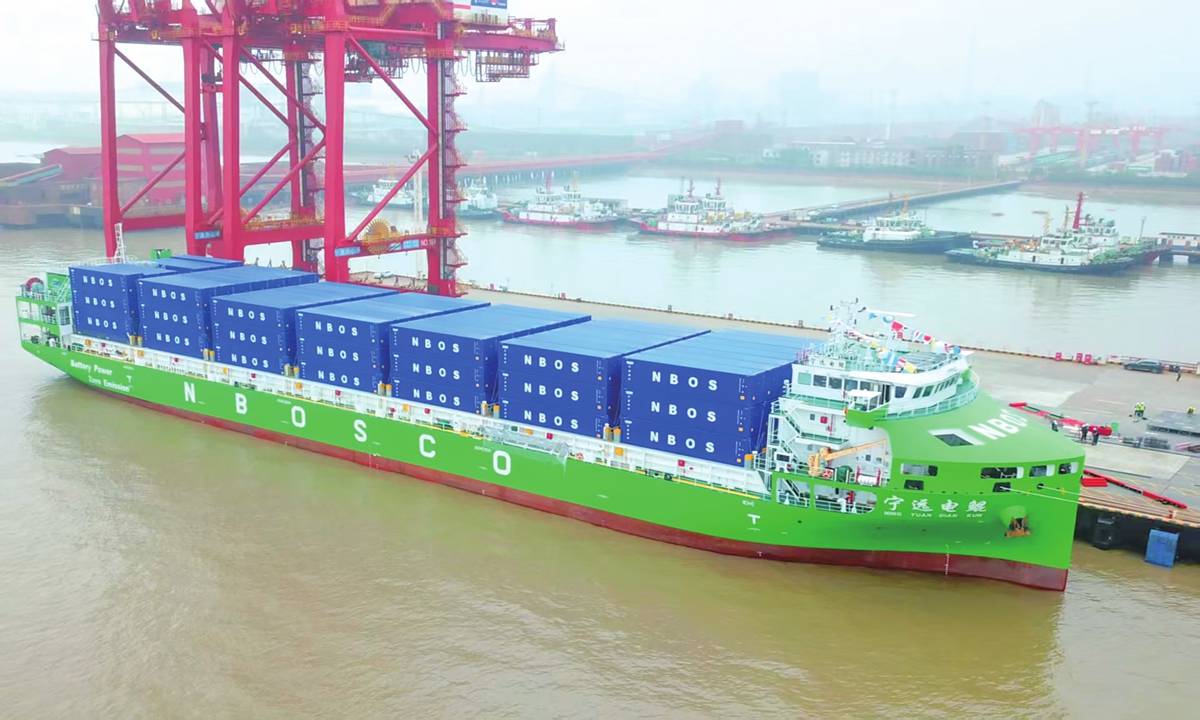
The Ningyuan Diankun, the world's largest and China's first 10,000-ton all-electric intelligent container vessel, sets sail from the Beilun port area of Ningbo Zhoushan Port for the Zhapu port area of Jiaxing Port on April 15, 2026, marking the start of its commercial operations. Photo: Courtesy of Ningbo-Zhoushan Port

The Ningyuan Diankun, the world's largest and China's first 10,000-ton all-electric intelligent container vessel, sets sail from the Beilun port area of Ningbo Zhoushan Port for the Zhapu port area of Jiaxing Port on April 15, 2026, marking the start of its commercial operations. Photo: Courtesy of Ningbo-Zhoushan Port

The world's largest and China's first 10,000-ton pure electric intelligent container vessel, the Ningyuan Diankun, set sail on Wednesday from the Ningbo-Zhoushan Port bound for the Zhapu Port area in Jiaxing, marking the official start of its commercial operations, and ushering in a new phase of exploration and development for China's coastal container shipping driven by pure electric power and intelligent navigation, Ningbo-Zhoushan Port told the Global Times in a statement.

Developed by Ningbo Ocean Shipping Co, the Ningyuan Diankun measures 127.8 meters in length and 21.6 meters in width, with a carrying capacity of 742 standard containers. The vessel is powered by 10 standardized battery containers with a total storage capacity of about 20,000 kilowatt-hours, equivalent to the combined battery capacity of about 300 household electric vehicles. It is expected to save 580 tons of fuel a year and reduce carbon dioxide emissions by more than 1,400 tons after being put into operation, delivering genuinely zero-emission, zero-pollution voyages, Ningbo-Zhoushan Port said.

"This project is an important step in aligning with the shipping industry's broader green transition and proactively supporting the country's dual-carbon goals," a representative of Ningbo Ocean Shipping Co said in an interview.

Ningbo Ocean Shipping operates 32 green and energy-efficient vessels, accounting for 57 percent of its fleet, and 19 intelligent vessels, or about 34 percent, underscoring solid progress in its low-carbon and smart fleet upgrade.

The Ningyuan Diankun is one of the company's first two all-electric intelligent vessels. Its sister ship, the Ningyuan Dianpeng, is scheduled to begin trial voyages in May and be delivered in June. Once both vessels are put into operation, they will begin scaled-up service on designated routes.

Beyond its green and low-carbon advantages, the Ningyuan Diankun has also achieved a milestone breakthrough in intelligent navigation.

The vessel is deeply integrated with an intelligent platform and smart engine-room system, and is equipped with core autonomous navigation technologies for open waters. It features a full suite of smart functions, including real-time panoramic vessel monitoring, all-weather visual perception, autonomous route planning, automatic collision-avoidance alerts, and seamless switching between manual and intelligent navigation modes.

The system can capture navigation environment data in real time, automatically calculate an optimal route, and proactively identify and avoid navigational risks, reducing the likelihood of human error at the source. The solution fills a domestic technological gap in the intelligent control of 10,000-ton all-electric seagoing vessels and offers a new benchmark for coastal smart shipping worldwide.

Ma Jihua, a veteran tech industry analyst, told the Global Times on Wednesday that China has built a relatively complete and mature industrial chain in new energy, especially in electricity-related sectors. From electric vehicles on the road and drones in the sky and now to electric ships at sea, electric propulsion is expanding into more applications while also driving smarter systems. He said that China's advances in batteries, electric drive systems and motors have created reusable technologies and shared industrial resources for shipbuilding, making the rise of large electric vessels a natural step.

Ma said that the main constraint on large electric vessels at this stage is still battery technology, particularly range, while most other technical challenges are manageable. That means such ships are currently better suited to inland waterways and short-haul coastal shipping, with full electrification of oceangoing vessels still difficult for now.

"The significance of all-electric ships goes far beyond replacing oil with electricity. Like electric vehicles, they could drive a broader intelligent upgrade of ships and reshape how the sector develops," Ma said.

He added that recent global energy strains have accelerated interest in new energy, and as more countries put electric ships on the agenda, China's strengths in both shipbuilding and electrification could give a strong lift to the industry and related exports.

China unveiled a new action plan on March 30 to accelerate the deep integration of cutting-edge technologies such as artificial intelligence (AI) with the shipping industry, aiming to foster new quality productive forces in the sector.

The plan sets out a two-phase development roadmap. By 2027, China aims to achieve the deep integration of AI with core shipping elements, make breakthroughs in key technologies, establish more than three comprehensive smart shipping pilot zones, open more than five pilot routes, develop more than 10 replicable typical smart shipping scenarios and operate more than 100 smart vessels, according to the Xinhua News Agency.

By 2030, the country expects to achieve full mastery of core technologies, establish a new model of coordinated development encompassing technology, industry and governance, and reach internationally advanced levels in smart shipping development, Xinhua reported.


China's second home-built large cruise ship to come 2 months earlier due to smart tech

Xinhua
2026-04-17 15:08:16

To view this content we will need your consent to set third party cookies.
For more detailed information, see our cookies page.


China's second domestically built large cruise ship, Adora Flora City, will be delivered in Shanghai on Nov. 6, nearly two months ahead of schedule, thanks to digital and
 
China builds world’s first 10,000-car dual-fuel vehicle carrier
By Global Times
Published: Apr 28, 2026 10:27 AM

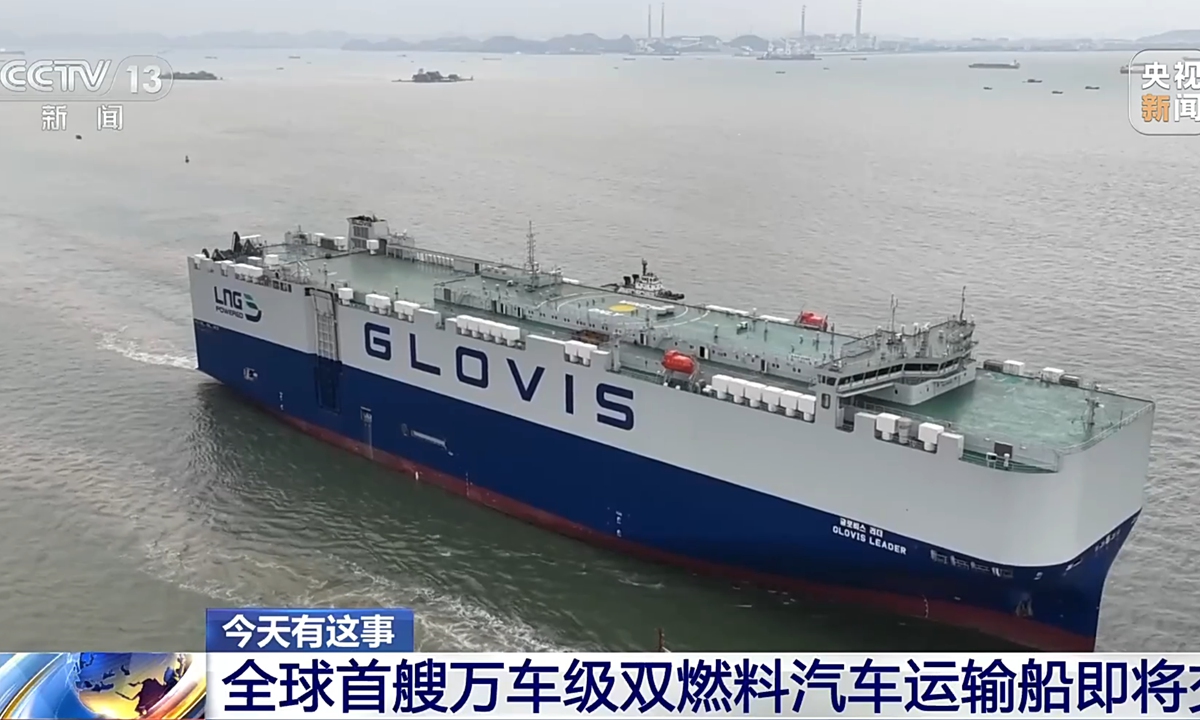
Screenshot from CCTV News

Screenshot from CCTV News

The world's first dual-fuel car carrier with a capacity exceeding 10,000 vehicles will be delivered on Tuesday in Nansha district in the southern city of Guangzhou, capital of Guangdong Province, the CCTV News reported.

The delivery of the vehicle carrier marks that China has fully mastered the construction technology for this type of vessel, maintaining a leading position in this specialized segment of the global market, said the report. It was built by Guangzhou Shipyard International Co under China State Shipbuilding Co.

The vessel measures 230 meters in length and 40 meters in beam, and features 14 vehicle decks. It is designed to flexibly transport a wide range of vehicles, including electric cars, hydrogen-powered vehicles, and heavy trucks, with a maximum capacity of 10,800 units, according to the report. The ship is also equipped with the latest green fuel system, meeting the newest global environmental standards.


Korean Shipbuilders' April Orders Fall 18% Year-on-Year, Market Share at 16%​

Korea Wins 33 of 204 Vessels Globally in AprilChina Retains Top Spot With 156 Orders

Published 2026.05.08. 10:18:43

A very large ammonia carrier (VLAC) built by Hanwha Ocean. Photo courtesy of Hanwha Ocean - Seoul Economic Daily Finance News from South Korea

A very large ammonia carrier (VLAC) built by Hanwha Ocean. Photo courtesy of Hanwha Ocean

South Korea accounted for about 16% of global new shipbuilding orders in April, as roughly 200 vessels were ordered worldwide during the month.

Global ship orders last month totaled 6.49 million compensated gross tons (CGT), or 204 vessels, up 21% from the same period a year earlier, according to Clarksons Research, a U.K.-based shipping and shipbuilding market intelligence firm. The figure also represented a 29% increase from March, when orders reached 5.04 million CGT.

By country, Korea won 1.05 million CGT, or 33 vessels, last month, taking a 16% market share. Korea's April order volume fell 18.6% from a year earlier. China, meanwhile, secured 4.37 million CGT across 156 vessels, accounting for 67% of the total.

Cumulative global orders from January through April reached 26.07 million CGT, or 839 vessels, up 43% from 18.18 million CGT and 722 vessels in the same period last year. Korea captured 4.73 million CGT (123 vessels, 18%), while China took 18.52 million CGT (624 vessels, 71%). The figures represent year-on-year increases of 31% and 85%, respectively.

As of the end of April, the global orderbook stood at 194.18 million CGT, up 1.12 million CGT from the previous month. Korea held 37.02 million CGT (19%) and China accounted for 124.25 million CGT (64%).

The Clarksons Newbuilding Price Index stood at 183.41 at the end of April, up 1.34 percentage points from 182.07 in March. By vessel type, liquefied natural gas (LNG) carriers were priced at $248.5 million, very large crude carriers (VLCCs) at $130.5 million, and ultra-large container ships (22,000-24,000 TEU) at $260.5 million.


China tightens its grip on global shipbuilding, grabbing 85% of new orders​

China’s shipyards secured a staggering 85 per cent of global orders in the first quarter, as demand for oil tankers surges amid the Iran war​


Workers build large vessels at the Jinling Shipyard in Nanjing, capital of China’s eastern Jiangsu province. Photo: AFP

Carol Yangin Beijing
Published: 10:30pm, 11 May 2026

China’s shipyards have mounted an astonishing comeback after facing down US efforts to curb their dominance last year, as they saw orders for new vessels nearly double in the first quarter of 2026.

Chinese shipbuilders received 59.53 million deadweight tonnes in new orders during the first three months of the year, a staggering 195.2 per cent increase compared with the same period last year, according to data released by the China Association of the National Shipbuilding Industry on Saturday.

The surge secured China a massive 84.9 per cent share of the global market, leaving South Korea and Japan trailing in second and third place with 12.8 per cent and 1.4 per cent shares, respectively.

China’s dominance was largely driven by rising international demand, with ships for export accounting for 94.9 per cent of new contracts in deadweight tonnage terms.

Analysts attributed this boom to a frenzy of new tanker orders amid the US-Israel war on Iran, as well as fading concerns over a potential return of US port fees targeting China-related vessels.

Global orders for new vessels soared 40 per cent year on year in the first quarter in compensated gross tonnage terms, with new tanker contracts accounting for 32 per cent of total orders, HSBC said in a research note released in late April.

Seventy-five orders for very large crude carriers were placed in the first quarter, the highest quarterly total ever recorded, according to the note.


China dominates global shipbuilding industry in first quarter of 2026​


Zetta Hannany, Dhika Priambodo
May 11, 2026 10:40 AM

China’s ship orders surged 195%, accounting for nearly 85% of the global new order market.

BEIJING – China’s shipbuilding industry maintained its position as the world’s largest in the first quarter of 2026, with all major indicators posting strong growth amid surging global demand for large and high-value vessels.

Data from China’s Ministry of Industry and Information Technology showed completed shipbuilding output reached 15.68 million deadweight tonnes (DWT) in January–March 2026, up 46% from the same period a year earlier.

During the same period, new ship orders surged 195.2% year-on-year to 59.53 million DWT, according to Global Times.

Meanwhile, the total backlog of unfinished orders increased 43.6% to 322.3 million DWT by the end of March 2026.

Globally, China accounted for 57.3% of completed shipbuilding output, 84.9% of new orders and 69.8% of the global shipbuilding industry’s total backlog during the first quarter of this year.

The performance was driven by rising demand from the international shipping industry. South Korean media outlet Seoul Economic Daily reported that global ship orders in March 2026 reached 4.06 million compensated gross tonnes (CGT), up 31% from a year earlier.

China remained the market leader with a 53% share, while South Korea ranked second with 39%.

Of the world’s 18 main ship categories, China led globally in new orders for 15 categories.

China’s international market share exceeded 90% in several large-vessel segments, including very large crude carriers (VLCCs), car carriers, bulk carriers and container ships with capacities exceeding 10,000 TEUs.

China has also continued to strengthen its capabilities in the luxury cruise ship sector.

The country’s second domestically built large cruise ship, Adora Flora City, is scheduled for delivery in Shanghai on 6 November, nearly two months ahead of schedule.

The vessel has a gross tonnage of 141,900 tonnes, a length of 341 metres, a width of 37.2 metres, a maximum draft of 8.4 metres and a top speed of 22.7 knots. It is equipped with 2,144 cabins and can accommodate up to 5,287 passengers. (DK/ZH)


While South Korea and Japan try to regain ground in shipbuilding, China is surging as a powerhouse in the sector and already controls almost 90% of global ship orders.


Written byAlisson Ficher
Published on18/05/2026 at 16:03

Naval Industry

while-south-korea-and-japan-try-to-regain-ground-i-1536x864.jpeg


Chinese expansion in shipbuilding increases pressure on South Korea and Japan, as the country’s shipyards concentrate almost 85% of new global ship orders at the beginning of 2026 and reinforce influence over logistics chains, maritime trade, and the renewal of the international fleet.​

China’s leadership in global shipbuilding gained even more strength in the first quarter of 2026, during which the country’s shipyards received 59.53 million deadweight tons in new ship orders, a result that represents a growth of 195.2% compared to the previous year.

With this expansion, the Chinese shipbuilding industry came to account for 84.9% of new global orders in DWT between January and March, according to data released by the Ministry of Industry and Information Technology of China.

While South Korea and Japan remain relevant in specific segments of the sector, the scale difference observed in recent numbers shows that Asian competitors face an increasingly challenging environment in the face of Chinese industrial advancement.

China expands global leadership in shipbuilding​

In addition to the surge in orders, Chinese shipyards simultaneously advanced in the other two main indicators of the global shipbuilding industry, related to completed production and the accumulated volume of contracts on order.

Between January and March, China delivered 15.68 million DWT, a result 46% higher than recorded in the same period of the previous year and equivalent to 57.3% of all global ship production in the quarter.

At the same time, the order book continued to expand and reached 322.3 million DWT at the end of March, an annual growth of 43.6%, a share that corresponded to 69.8% of global orders in shipbuilding.

In practice, the data indicates that the country not only concentrates new contracts but also maintains sufficient industrial capacity to transform a significant part of this demand into effective deliveries in the coming years.

South Korea and Japan face greater competition​

Even maintaining a relevant presence in higher value-added vessels, especially in segments related to liquefied natural gas, South Korea has lost ground when the comparison involves the total volume of orders received.

Japan, historically associated with efficiency and quality in shipbuilding, faces greater difficulties due to higher industrial costs and the growing competition from Chinese and South Korean players.


A large part of the Chinese advantage is related to the combination of production scale, integrated supplier chain, ample steel supply, access to financing, and industrial coordination focused on long-term contracts.

Shipbuilding gains strategic importance in global trade​

Responsible for sustaining the international transport of containers, oil, minerals, gas, grains, and vehicles, shipbuilding occupies a strategic position within global trade and supply chains.

In this scenario, the concentration of orders in Chinese shipyards has ceased to represent just business competitiveness and has come to involve industrial capacity, logistical influence, and direct participation in the renewal of the global merchant fleet.

When choosing where to build new ships, shipowners usually evaluate factors such as price, delivery time, technical capacity, and operational safety, a combination in which the Chinese scale has gained significant advantage in recent years.

This movement is also influenced by the need to replace old vessels and adapt part of the international fleet to environmental requirements and alternative fuels, a process that has increased global demand for new naval projects.

Billion-dollar portfolio reinforces the dominance of Chinese shipyards​


With a portfolio of 322.3 million DWT in pending orders, Chinese shipyards ensure a production volume sufficient to remain at the center of the global fleet renewal for the coming years.

This scenario increases predictability for suppliers, banks, engineering companies, and logistics operators connected to the Chinese naval chain, further strengthening the industrial structure built by the country in recent decades.

Although South Korea and Japan still maintain technological relevance in specific segments, the difference observed in the share of new orders highlights an increasingly consolidated Chinese leadership in the international market.

More than an isolated short-term result, the index of 84.9% in global orders reflects a continuous trajectory of industrial expansion that has transformed China into the world’s leading shipbuilding power.


Users who are viewing this thread

Back
Top