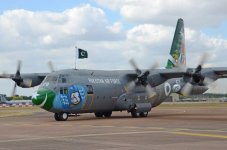
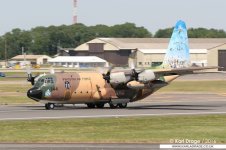
No 1 Squadron

following PAF operations.
During the 1965 war, the sqn was modified as a bomber sqn and then CAS, Air Marshal Nur Khan himself led a daring bombing mission onboard C-130 aircraft. For its participation in wars of 1948, 1965 and 1971, the Sqn was awarded with 04 battle honours.
20240611_204002.jpg
 
The squadron also played a crucial role in Operation Zarb-e-Azb and Radd-ul-Fasaad where combat crew of No 6 Squadron operated in synergy with fighter elements of PAF and troops of Pak Army to strike decisive blows to the terrorists.
Equipped with C-130 Hercules aircraft, which20240611_204123.jpg
 
are the backbone of all logistic support operations, the sqn has always lived up to its illustrious history of valour and bravery. Today the sqn continues to participate in logistic support, relief and other operational missions whenever called upon by PAF and the nation.

Source: DGPR (Air Force)
 

Tuesday, June 11, 2024 20:49
Hilal Logo


Celebrating 75 Years of Excellence: No 6 ATS Squadron, PAF​

January 2018
On December 2, 2017, a grand ceremony was held at PAF Base Nur Khan to celebrate the 75th anniversary of No. 6 Air Transport Support Squadron. Air Chief Marshal Sohail Aman NI(M), Chief of the Air Staff, Pakistan Air Force, who was the chief guest at the occasion, also unveiled a commemorative postage stamp which has been issued by the Pakistan Post to pay tribute to the services rendered by No. 6 Squadron during the past 75 years. War veterans, former Air Chiefs and a large number of retired and serving officers were in attendance. A well-crafted documentary highlighting the glorious history of this magnificent squadron was shown during the ceremony.

The squadron was raised on December 1, 1942 at Trichinopoly under the command of Squadron Leader Mehar Singh. Equipped with Hawker Hurricane aircraft, the squadron was assigned the Tactical Reconnaissance Role while the Burma campaign was in full swing during the World War II. Due to its valuable contributions on the Burma Front in 1943, two of its pilots earned the Distinguished Flying Cross for their gallantry while its Commanding Officer was decorated with the Distinguished Service Order for his exemplary leadership during Burma campaign. In April 1947, months before Independence, the squadron moved to Drigh Road, Karachi and was re-equipped with the Douglas C-47 Dakota, thus changing the role of the squadron to air transportation.

April 13, 1948 marked the historic day when a 6 Squadron’s Dakota flew Quaid-i-Azam Muhammad Ali Jinnah from Karachi to Risalpur, where Father of the Nation delivered the famous historic address and thus set the direction for Pakistan Air Force. Then again, on September 12, 1948 three Dakotas of No. 6 Squadron were flown in close formation to pay tribute to the Quaidon his funeral ceremony. The year 1949 was marked by rapid changes and indigenization for the squadron. The Freighters were modified to carry 4000 lbs Block Buster Bombs under each wing. The new capability thus brought the name Medium Range Transport and Bomber Squadron.

The saga of joint operations with Pakistan Army dates back to those times when No. 6 Squadron was fully involved in support of 12 Division of Pakistan Army that was marking its footprints in Northern Areas of Pakistan. During this time the idea of carrying out tactical missions was conceived and executed with professionalism. Later on, the first Minimarg and Gultari aerial drop missions were conducted in November 1957. In August 1959, while Northern Area Operations were in full swing, the squadron shifted to its present location and started the most demanding and dangerous Shimshal and Passu drop aerial missions.

March 1, 1963 was a historic day in the history of the squadron; the C-130 Herculesentered the arena and changed the doctrine of PAF Air Transport Operations for the times to come. Months after the induction of state-of-the-art Hercules, clouds of war started gathering on the horizon in early 1965. The War of 1965 is the saga of heroic performance of our fighter pilots and remarkable feats displayed by the crew of No. 6 Squadron. The heroes of No. 6 Squadron used the Hercules in a versatile and unique manner that would be remembered by our adversary for ages. Never would have the designer of Hercules dreamt that this aircraft would be used as a bomber in the pitch dark night against the most challenging air defence of that time. Offensive bombing missions were flown all across the eastern border and eleven aircrews were awarded gallantry medals; the maximum among all PAF squadrons.

In 1971 war, the enemy once again tried her luck against the fervour of our gallant heroes. With the added advantage of past experiences of the 1965 war and with innovative ideas of our predecessors, C-130s were once again called to action. Bombing missions were again flown by the mighty Hercules, the most accomplished being the attack at Jaisalmir which inflicted heavy damage on the Indian Air Force Technical Complex.

On April 29, 1972 No. 6 Squadron became the first PAF Squadron to receive the Squadron Colour in recognition of its outstanding performance in Kashmir Operations and Indo-Pak wars of 1965 and 1971.
During the late 60s when the foundation stones of the Karakoram Highway (KKH) were being laid, No. 6 Squadron was at nation’s service to airlift heavy machinery, personnel, rations and huge equipment to Gilgit. Pakistan Air Force established an air bridge between Chaklala and Gilgit for the construction and timely completion of the 8th wonder of the world.

The C-130s were also excessively used for critically needed national and international relief efforts. On December 26, 2004 tsunami struck South East Asia with a strong jolt. No. 6 Squadron displayed exemplary professionalism during tsunami relief operations in Sri Lanka, Maldives and Indonesia. On the fateful morning of October 8, 2005 a massive earthquake measuring 7.6 on Richter scale jolted the northern areas of Pakistan and played havoc on life and property. PAF immediately responded to the nation’s call and Chaklala became the hub of all relief operations. No. 6 Squadron worked with unparalleled zeal and established air bridge with the affected areas to support casualty evacuation and provision of relief goods. Similarly, the monsoons of 2010 brought the most horrifying floods that resulted in devastation of human lives, crops, and national asset. As always, Transport fleet came up to the nation’s expectations in this hour of need by extending all out support and provided relentless assistance to the flood victims. The squadron remained extensively involved in Intelligence, Surveillance and Reconnaissance (ISR) and relief operations for floods of 2011 as well.

Our cunning enemy treacherously occupied Siachen in 1982 which led to a standoff that continues till date. On request of Pakistan Army, the squadron undertook the uphill task of transporting heavy machinery, howitzer guns, ammunition and soldiers to Skardu and Gilgit for the initial build up. At the same time, the squadron also evacuated large number of Pakistan Army’s soldiers who became victims of frostbite and other serious injuries. Soon after, the squadron was tasked to conduct aerial delivery missions at Paiju Drop Zone in support of Pakistan Army troops deployed at Siachen. Flying through narrow valleys over some of the largest glaciers of the world, these missions demand highest level of professionalism, skill and accuracy, which has always remained the essence of transport aircrew. These challenging missions continue even today.

On May 28, 1998, when Pakistan successfully tested its nuclear devices in response to Indian nuclear tests, No. 6 Squadron was again at the forefront. During these crucial times it played a key role in transporting the scientists and finally the nuclear devices to Quetta in a short period. Dr. Samar Mubarakmand remarked: “I must say that Pakistan Air Force has made a tremendous contribution to the conduct of the entire nuclear experiments and the atomic tests. The 6 Squadron and the C-130s not only had a great contribution in transporting nuclear devices to Quetta from Islamabad, but they also carried members of our team before and after the detonations were completed.”

The 9/11 attacks on USA changed the complete global geo-political scenario in general and for Pakistan in particular. When the United States launched attacks on Taliban-controlled areas of Afghanistan, Pakistan decided to join the international community in the War against Terror. This led to volatile situation on our western as well as sea borders. Therefore, to guard the Pak-Afghan International Border and to cater for any attack from sea side on south, Operation Al-Mizan was launched in mid-October, 2001. It was a high level, tri-services operation executed to counter threats generated in post-9/11 scenario. C-130s were extensively used in the transportation of Army troops and Air Defence units for the operation. Nearly all the missions were flown during the foggy nights under complete RT silence. In December 2001, when Pakistan was engaged in Operation Al-Mizan, Indians launched full-scale military exercise leading to escalation on the Eastern Border. In response, Pakistan launched Operation Sentinel. As usual, No. 6 Squadron was the first to take part in the operations. Transport fleet deployed the entire war assets along with PAF personnel in record time thus preventing the enemy to make any mischief against the motherland. Air Chief Marshal Mushaf Ali Mir paid tribute to the transport element on December 12, 2002 during his visit to the base. He wrote in the visitors’ book, “An outstanding achievement made by our PAF Base, Chaklala during Operation Al-Mizan and Operation Sentinel. You were the ‘Battle Winners’; we salute your dedication and professionalism.”

Following the aftermath of Pakistan joining the GWOT, there was a dire need to break the backbone of terrorists active in tribal areas of Pakistan. Once again, in order to accomplish this task, No. 6 Squadron was bestowed with the herculean task of ISR to have real time picture in the headquarters and to shooters both in air and on ground. The C-130s were further modified for laser designation for dynamic targeting thus minimizing the sensor to shooter time. Jelled with the fighter elements of PAF, the transport aircrew conducted many successful missions during Operations Rah-e-Rast, Rah-e-Nijat and Zarb-e-Azb with zero collateral damage and thus broke the backbone of terrorists in the area of operation. Where the most advanced air forces of the world failed to achieve the desired results, Pakistan Air Force once again proved its mettle by ensuring no collateral damage; thanks to the valuable support provided by No. 6 Squadron.

Besides operational tasks, No. 6 Squadron participated in Royal International Air Tattoo (RIAT) 2006 along with the renowned air forces of the world. PAF C-130 became the star of show and bagged all three trophies for static display and team competitions. PAF returned to RIAT 2016 winning Concours D’ Elegance Trophy for the best static display during the competition.

Never before June 7, 2017 the mighty Himalayas overseeing the Skardu valley had heard the growl of C-130 propellers in reverse in the dark of night. NVG operations in Skardu are the major milestone in the history of Squadron.

Be it the conduct of tactical operations in the snow covered mountains of Northern Areas or the ISR operations in the rugged terrain of FATA; be it the support of sister services in joint operations or the relief efforts both in-land and abroad, No. 6 Squadron has left an indelible mark in the history of Pakistan Air Force. Celebrating the 75th anniversary of this magnificent squadron, under the leadership of Group Captain Raja Usman the aircrew earnestly pledged to continue serving the sacred motherland for the times to come.

E-mail: [email protected]
Article was read 1739 times
 

6 Squadron​

With the birth of Pakistan on 14th August 1947, No. 6 RPAF Squadron came into being although it had already existed for several years before independence as an RIAF unit. The squadron inherited 1 serviceable Dakota with 2 pilots, 3 navigators and 3 signalers stationed at Peshawar. To remedy this paucity of men and material, the RPAF drew up a three-phase program; in the first phase, ending on 31 March 48, No. 6 Squadron received 7 more Dakotas and during the next twelve months the aircraft strength went upto about 20.
During this period a pattern of operations was established by the squadron for supply dropping in Azad Kashmir. These missions were essential for keeping troops and villages cut off by snowbound roads supplied with the essentials of life. Flying fully loaded Dakotas with an effective ceiling of not much above 10,000 ft, in an environment of peaks ranging from 16,000 to 20,000, No. 6 Squadron could accomplish these missions only by following the sinuous curves of the Indus valley. During November 48 the squadron, operating from Risalpur and Peshawar, air dropped some 88,000 lbs. of supplies. On 4 November 48, a Dakota piloted by Flying Officer Mukhtar Dogar was attacked by 2 IAF Tempests. The pilot skillfully evaded the attackers and brought the Dakota back to base. Flying Officer Dogar was awarded the Sitara-e-Juraat for this act of gallantry. He was the first officer of the squadron to receive a gallantry award. In early 1950, a large number of Bristol Freighters was purchased from the UK and added to the fleet of No. 6 Squadron. Their performance was similar to that of the Dakotas so no new techniques were necessary for the conduct of Northern Area operations. The generous reserve of Bristol Freighters enabled No. 6 Squadron to undertake an extensive range of transport and communication tasks within and outside Pakistan for nearly fifteen years. In 1955, some of the aircraft were adapted to carry a 4,000-lb. 'block buster' bomb beneath each wing and the squadron carried out a limited amount of training for a night bombing role against lightly defended targets. This paved the way for similar operations at a later stage with its C-130s.
The squadron acquitted itself creditably during large scale food dropping missions in the 1952 floods; a Sanad to this effect was presented to the unit by the Governor of the Punjab on 17 August 52. From 15 to 30 November 53, operation 'Snow Drop' was carried out to deliver supplies in the Northern Area. Chaklala was used as a forward base and 800,000 lbs. of supplies were dropped in seven hundred and eighty hours of flying. In 1955 the squadron also demonstrated supply dropping during an air display witnessed by the Defence Minister General Muhammad Ayub Khan at Lahore.
During its formative years, 6 Squadron gained valuable operational experience on Bristol Freighters in a variety of climatic and geographical environments, ranging from the snowbound peaks of Kashmir to the desert of southern Punjab to the tropical forests of East Pakistan. In 1963, when 4 Lockheed C-130Bs were received under the US aid programme, it enabled the squadron to begin phasing out its Bristol Freighters. The Hercules also allowed the squadron to revise its valley flight procedures by overflying the Karakorams before letting down over the destination air strips and drop zones, with a corresponding improvement in safety margins.

During the 1965 war, the PAF offensive against bases included assaults by para commandos, who were dropped at night from 3 C-130Bs near Adampur, Halwara and Pathankot. In another role, the squadron was able to convert its Hercules aircraft into night bombers for raids against battlefield targets with upto 22,000 lbs. of HE bombs, which were rolled out of the rear ramp on pallets. The squadron flew over twenty such missions and dropped bombs on enemy forces moving up for the battles of Chawinda and Pulkanjari. Seven officers were awarded the Sitara-i-Juraat and 2 JCO's the Tamgha-i-Juraat.
After the 1965 war, 6 Squadron continued its task of logistic support for army units stationed in the Northern Areas and of routine PAF commitments in both wings of Pakistan. The squadron came under tremendous pressure towards the end of 1970 when the political situation in East Pakistan became unstable. The unit efficiently completed the task of moving a large number of troops from West to East Pakistan. In 1970 the squadron also participated in extensive flood relief operations in East Pakistan. When civil war erupted in East Pakistan in March 71, 2 C-130s were permanently deployed at Dhaka; they remained there till the December war broke out. These aircraft took extensive part in evacuation of troops and civilians from hostile areas. Wing Commander Munim A. Khan and his crew lifted a record figure of 365 people from Sylhet to Dhaka in one C-130 sortie. During 1971, the Indian government had stopped PAF flights over India and the squadron's C-130s proceeding to East Pakistan had to route via Sri Lanka, entailing sorties of exhausting length as well as the risk of interception by Indian fighter aircraft.
When war broke out on 3 December 1971, the squadron undertook tactical bombing raids in West Pakistan in much the same way as it had done in the 65 war. A C-130 captained by Group Captain Mir Alam made a very successful attack against Jaisalmer and inflicted heavy damage upon the IAF's technical complex there. The crew were awarded Sitara-i-Juraat for this action. Successful bombing was also carried out in the Srinagar valley and against battlefield targets. The squadron did not suffer any war loss of life or equipment.
The squadron regularly participated in CENTO exercises 'Nejat' and produced good results; the exercises were held at Masroor, Rezayiah (Iran), England and Turkey. Every year the squadron takes PAF Air War College for its educational tours abroad. Since 1971 the college teams have been taken to China, England, Australia, North Korea, Germany, Egypt, Syria, Cyprus, Singapore, Malaysia and Sri Lanka.

Owing to its increased commitments, some additional C-130Es have been provided to the squadron.
6sqn2.gif
The PAF operations for the defense of Pakistan's strategic nuclear installations during the May 1998 nuclear tests were codenamed "Operation Bedaar '98" by the PAF. No. 6 Air Transport Squadron (ATS) Squadron, equipped with C-130 "Hercules" medium-lift tactical transport aircraft and based at PAF Base Chaklala, commanded by Group Captain Sarfraz Ahmad Khan, extended the necessary logistical support to the rest of the PAF squadrons that were being redeployed for air defence alert (ADA) duties. The Squadron carried a total of 12,66,615 lbs. loads in 71 separate sorties during the nuclear tests.
Airlift resources are consolidated with No. 35 (Composite Air Transport) Wing at Chaklala, conveniently close to Air Headquarters where the Director Air Transport looks after tasking matters, As it has done for many years, the Lockheed Hercules serves as the PAF's work-horse, No. 6 (Air Transport Support) Sqn. operating a mixed fleet of C-130Bs, C-130Es and former PIA L-382B-4Cs, some of which have been in service for the best part of forty years.
 
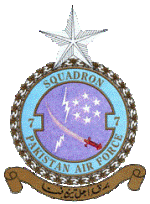
No. 7 Squadron

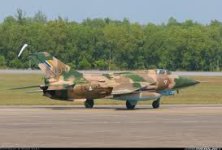
After bidding farewell to the 'Heavies' (B-57s) on 27 December 1983, the agile and sleek A-5s became the flying machines of 7 Squadron. During 1988, the maintenance of the A-5 fleet was going through a trubulent phase, so the men and material of this squadron were distributed among other units. The squadron was temporarily disbanded during the second half of 1988. On 13 November 1989, when the squadron was re-established with A-5s that had been overhauled in China, it took hardly any time to retain its operational status. The squadron participated in all the operational exercises conducted by the PAF. In May 1990, the Air Headquarters declared this squadron as an OCU for A-5 aircraft. A batch of newly graduated fighter pilots from the FCU reported to the squadron and completed their operational conversion succesfully. Unfortunately, owing to the limitations of the aircraft ejection seat, many aircrew fatalities took place on the A-5s. Therefore, the fleet was grounded again. During this transitional period, all aircrew except the officer commanding, were attached or posted to other squadrons. On 1 July 1991, PAF Base Masroor recieved the first batch of Martin Baker zero-zero ejection seats and all the A-5s started flying again within a span of two months.

Air Headquarters decided to re-equip No. 7 Squadron with ex-Australian Mirage-III aircraft, and thus the A-5s were transferred to Peshawar. Pilots experienced on Mirage aircraft were initially posted to the squadron to make it operationally stable. Those pilots were dubbed the 'Magnificent Seven' in the squadron history book. They were tasked with the responsibility of restoring the operational status of the squadron as soon as possible. After the first three Mirages had been recieved from PAC Kamra, the dawn of 24 November 1991 witnessed the first training sorties being generated by the squadron.

During 1992, the squadron continued to gain proficiency on the newly inducted weapon system. On 15 February 1993, the squadron's entire flight assets were swapped with those of 22 OCU. While this change kept the squadron waiting for allotment of role and task by the Air Headqarters, it remained busy while integrating this new weapon system in the squadron. In November 1992, the squadron participated in the exercise Saffron Bandit, for the first time. The squadron also participated in all the operational exercises including High Mark-93 and 95, and air-to-air camp in 1995. The squadron stood fourth overall in the armament competition held in 1996.

The Squadron recieved the ROSE modified ex-Australian Mirage Aircraft during 1997. It proved its mettle in annual air-to-ground weapons delivery exercises. The squadron participated in the Live Missile Firing Camp, held at PAF Base Masroor in 1998. It had the honour of guarding the aerial frontiers over Balochistan, prior to Pakistan's nuclear tests. At present, the squadron operates the maximum number of ROSE modified aircraft. After the induction of the new airborne radar, the squadron's role changed from tactical to multi-role unit.
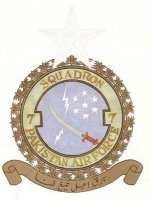
7sqd.gif
 
Last edited:
Operational Years:-
  • 1960-1982 - Light Bomber
  • 1982-1988 - Tactical Attack
  • 1989-1990
  • 1990-1991 - Operational Conversion Unit
  • 1991-1993 - Tactical Attack
  • 1997- - Multi Role
Equipped Aircrafts:-
  • B-57 Canberra
  • A-5C Fantan
  • Mirage-III
  • Mirage-III ROSE
 

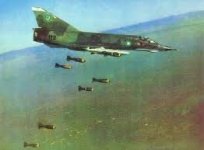
mir1 PAF Mirage-IIIEA ROSE-1 from the No. 7 Squadron​

01/08/2023 By Richard Darling


A Pakistan air force pilot in a Mirage aircraft gives a hand signal during the Falcon Air Meet 2010 alert scramble competition at Azraq Royal Jordanian Air Base, Jordan, Oct. 20, 2010. The United States, Jordan and Pakistan participated in the Falcon Air Meet to improve international military relations and joint air operations. (U.S. Air Force photo by Tech. Sgt. Wolfram M. Stumpf/Released)
 

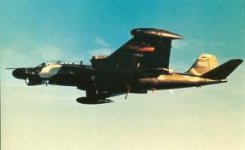
Air Force B-57 the intrepid bomber of PAF​


Jan 18, 2012

Columnist Gp Capt SULTAN M HALI writes about the B-57, the workhorse bomber of the PAF which served the country well

The B-57 Bomber was built under licence by the American Martin Company during the 1950s for the USAF from the British Canberra Bomber. The first B-57 flew its maiden flight on 20 July 1953. The B-57 was a tandem two-seat night intruder and a tactical bomber. Its crew comprised a pilot and a navigator-cum-bombardier. Carrying a payload of 56 rockets and 8000 lbs. of bombs, 2 turbo jets, fired by cartridge starters powered the B-57. It was very large in size, having a length and wingspan of 65 feet, which meant virtually no manoeuvrability. Its speed was just 500 mph, and although it could fly at 50,000 feet, in war the bomber pilots hardly rose above 200 feet in order to avoid enemy radar. Once over the target they would pull upto about 8000 feet, from where they would release their payloads. Induction in PAF

After the 1955 Pak-US agreement, the PAF received 26 Martin B-57s including 2 training versions, which formed two squadrons, Nos. 7 and 8, of No 31 Bomber Wing on 11 May 1960. Squadron Leader Ayaz A Khan became the first Squadron Commander of No 7 Squadron while Squadron Leader Muhammad Iqbal, who later attained shahadat in the 1965 War, became No 8 Squadron's pioneering Squadron Commander. Subsequently, the PAF also received two modified Martin RB-57F high altitude reconnaissance aircraft.

World's First Formation Loop with B-57s

PAF's B-57 pilots soon mastered this heavy and unwieldy aircraft. under the command of the Bomber Wing's Officer Commanding, they became the first in the world to form a regular formation aerobatics team of 4 B-57s. On 27 October 1964, led by Wing Commander Nazir Latif with Flight Lieutenants Altaf Shaikh, Basit and Shams, the team performed aerobatics at Peshawar during an air display at which Air Marshal Omar Dani, the C-in-C of the Indonesian Air Force was the chief guest. The team coolly executed loops, rolls and wingovers in full view of disbelieving spectators. The manoeuvres performed were till then unheard of in such a sluggish aircraft as the B-57, which was not really designed to perform aerobatics even singly. The precise but easy looking station-keeping throughout the demonstration effectively concealed the intense mental concentration, physical exertion, and high dexterity that was required of all the team members.

The 1965 War

When war came in 1965, PAF's Bomber aircrew were fully prepared. They carried out counter air operations against enemy airfields at Jamnagar and Jodhpur in the South and Ambala, Adampur, Halwara, Srinagar and Pathankot in the north. Undefended by fighters, and beyond the range of own radar to receive any support, these night intruders made a lasting contribution to PAF's total war effort. PAF's B-57 force remained committed to the night attack of Indian airfields as its principal task throughout the war. Its meagre force of 22 aircraft undertook a total of 195 missions delivering more than 600 tons of bombs as compared to an estimated 92 night bombing sorties against PAF targets by more than 60 IAF Canberras.

After the first hectic night's operations, when the B-57 crew were extended to their limit by flying upto 3 sorties during the hours of darkness, no more than two missions per night were allowed. This was a fairly frequent commitment, however, and the B-57 crew still had a very long tour of duty each day. For the first week of operations when most missions against the northern Indian airfields originated from Peshawar, the centralized spares and servicing organization for the B-57s at Mauripur necessitated the bomber crew returning to their Karachi base at the conclusion of each night's mission. The northern bases were also considered too vulnerable to IAF attacks during the day.

To attack the close concentration of enemy airfields in the north, and to remain out of reach of the Indian fighter-bombers; the bomber wing remained on the hop throughout the war. The pattern often repeated was to set off from home base, strike inside Indian territory, recover to another base to rearm and refuel, and then to strike again before returning to base or to another safe airfield. This enabled them to be prepared to attack their targets night after night. By arriving over their targets in a stream at intervals of about fifteen minutes, the B-57s certainly succeeded, disregarding even the actual damage they inflicted, in achieving a major disruption of the overall IAF effort, disabling their optimum attack capability the next morning. The effect on the morale of the IAF personnel was devastating. The effect of fatigue caused to them was most pronounced on their air and ground crew while they were forced to keep shuttling in and out of air raid shelters and trenches. This made the task of PAF fighter pilots that much easier to fight them in the air the next morning.

PAF's B-57 Losses

Of its twenty-two B-57s, which fought the war, PAF lost three but out of these, only one due to enemy action. After the first strike on Jamnagar at 6 P.M. the bombing shuttle was maintained all night by single sorties. One such lone bomber flown by Squadron Leaders Shabbir Alam Siddiqui and Alam Qureshi, the navigator, was doing its third mission in less than nine hours. As an over-fatigued crew descended lower and lower to pin point its target, the bomber hit the ground and exploded with all its ordnance and the invaluable officers. The second bomber was lost as a result of enemy anti-aircraft fire on 14 September. On their thirteenth mission of the war, Flight Lieutenants Altaf Shaikh and his navigator Bashir Chaudhri ran the gauntlet of concentrated flak thrown up by 50 to 60 guns at Adampur airfield. Both officers ejected in enemy territory and were repatriated after the war. The third B-57, piloted by Flight Lieutenants M A Butt and A S Z Khalid as navigator, was lost in the early hours of 17 September. While making an approach to land at Risalpur, the B-57 encountered adverse weather in the shape of strong wind sheer coupled with reduced flight visibility. Unable to maintain height, the aircraft crashed south of the runway, instantly killing both pilot and navigator.

The Grand Finale

The PAF's B-57 campaign came to an end with a close support mission during the night of 22 September by four B-57s, which dropped 28,000 lbs. of bombs on enemy artillery and tank concentrations at Atari. Large enemy reinforcements had been seen that day moving towards Atari for a possible assault on the salient on the eastern bank of the BRB Canal. It was the task of the PAF to prevent these reinforcements from reaching their destination. The bombs from the B-57s dropped 'in train' engulfed the enemy armour and other vehicles concealed under the trees and in the bushes. Very few survived to reach Atari.

No 8 Squadron is Number Plated

In the post-65 period the B-57 squadrons trained hard to achieve even higher standards in the light of the lessons learned during the war. However, the dwindling spares support following the arms embargo imposed by USA necessitated the number plating of No 8 Squadron and its assets being amalgamated with No 7 Squadron. Thus ended an era of valour and grit but the values learnt would remain enshrined in the history of the squadron to be continued with renewed vigour when it would be reactivated in 1982 with Mirage V aircraft.

The War in 1971

The B-57 force of PAF gave its very best in the 1971 War too. Of the available strength of 16 B-57s at the outset of the war, 15 were launched the very first night as a follow up to the pre-emptive strike on 3rd December. Twelve IAF runways were targeted the first night and a total of 183 bombs were dropped. Although no immediate assessment of the damage was available, yet confirmation came much after the war from a very unlikely source. Air Chief Marshal P C Lal, the Chief of the Indian Air Force during the 1971 War, in his memoirs titled My Days with the IAF provides full details of the destruction caused by PAF, naming every IAF airfield attacked.

B-57 Crew who embraced Shahadat in 1971.

The PAF's night bombing campaign was continued with good effect throughout the war and reflected great credit upon the courage and perseverance of the B-57 crew, six of whom embraced shahadat over enemy airfields. Squadron Leaders Khusro and his navigator Peter Christy had both joined PIA but when war became imminent, they rejoined their squadron. Both displayed exemplary courage, determination and fighting spirit. On 6 December, their aircraft failed to return after a bombing mission to Jamnagar and they were declared missing in action. Squadron Leader Ishfaq Hameed Qureshi, who was recalled from PIA and his navigator Flight Lieutenant Zulfiqar Ahmad were unable to return from their second mission of the war on 5 December and were declared missing in action. Flight Lieutenants Javed Iqbal and his navigator Ghulam Murtaza Malik flew two missions against heavily defended Indian airfields and displayed great bravery. On 5 December, they failed to return after a bombing mission to Amritsar airfield and were officially declared missing in action.

Night Bomber on Day Light Raid

A serious situation had developed in the south when Indian ground forces advancing on four axes, penetrated along the Khokhrapar-Chor railway line upto Umarkot and Chachro and to Nagar Parkar itself. PAF was called upon to blunt this attack and prevent the enemy's further advance inland. B-57s from No 7 Squadron were also pressed into daring daylight raids to save Hyderabad from falling into enemy hands. F-86s and F-104s provided top cover. The armed reconnaissance and interdiction mission achieved the destruction of enemy trains and this virtually choked the flow of supplies vital to the enemy advance. Emboldened by their success, the B-57 crew followed their bombing attacks by several strafing runs on the freight wagons and stopped the enemy dead in his tracks forcing him to abandon his planned offensive.

Gallantry Awards

Bomber crew are traditionally known as the unsung heroes of war. The reason for this is simple. A fighter pilot's mission is at once spectacular and visible at least to our own radar, and the results of its success or failure are known almost immediately after the mission, either through some of the pilots within the formation or are recorded by own gun cameras; the bomber crew's exploits take place far away from their bases and are well outside the ranges of their own radar. Their missions are carried out mostly at night, with its inherent risks and dangers, and there are often no cameras to record their success or their failure. It is only recently that the results of bomber operations can be confirmed through satellite imagery and other sophisticated techniques.

PAF, however, did recognize the services of its bomber crew in both the wars. As a tribute to PAF's B-57 crew who valiantly faced the highest loss rate of the war, and persisted doggedly each night, and its navigators who, despite their rudimentary bomb aiming devices and the difficulty of map reading at low level on pitch dark nights, carried the war deep into the enemy's heartland, the Government of Pakistan awarded 15 Sitara-e-Jurats (6 posthumous) and 2 posthumous Tamgha-e-Jurats to B-57 pilots and navigators.

End of an Era

On 27 December 1983, a colourful ceremony was held at Masroor Air Base, the erstwhile home of the B-57s to mark the end of their service. A smartly turned out contingent of air and ground crew participated in a parade. No 7 Squadron was formally re-equipped with A-5s and bade farewell to the intrepid B-57s. At the ceremony's conclusion, 2 B-57s in close line astern formation flew past to mark the end of their era and in came three A-5s in close Vic formation depicting the new weapon system being inducted.


BIBLIOGRAPHY
Ansari, Farhan, Flight Lieutenant, 'A Tribute to the B-57 Bomber', published in The Pakistan Times, Rawalpindi, September 06, 1993.
Fricker, John, Battle for Pakistan: The Air War of 1965, Allan Printing Ltd, Shepperton, Surrey, UK, 1979.

Hali, Sultan M., Group Captain, 'The Air War in 1971-Revisited', published in Shaheen, Vol.XLVI Summer issue, 1997, Rear Air Headquarters, Peshawar.

Rafi, Rais A., Air Commodore (Retd), 'B-57s Over Ambala', published in The News, Islamabad, September 06, 1995.

Sheikh, Altaf, Air Commodore (Retd), 'Fateful Bomber Mission over Adampur-1965 War', published in The News, September 07, 1997.

The Story of the Pakistan Air Force, published by The Shaheen Foundation, Islamabad, 1988.
 
PAF Base Masroor (ICAO: OPMR) is the largest airbase operated by the Pakistan Air Force. It is located in the Mauripur area of Karachi, in the Sindh province.

PAF Base Masroor
Summary
Map
Runways
  • IATA: none
  • ICAO: OPMR
Airport typeMilitary
OperatorPakistan Air Force
LocationKarachi
Opened1940
CommanderAir Commodore Muhammad Asim Rana
OccupantsPakistan Air Force
  • No. 2 Squadron
  • No. 4 Squadron
  • No. 7 Squadron
  • No. 8 Squadron
  • No. 22 Squadron
Elevation AMSL35 ft / 11 m
Coordinates24°53′37″N 66°56′20″E
WebsitePakistan Air Force
220px-Karachi_Transport_Network.png

10px-Airplane_silhouette.svg.png

PAF Base Masroor
DirectionLengthSurface
ftm
04/228,6222,628Asphalt
09/279,0222,750Concrete
The base was originally known as RPAF Station Mauripur and after 1956, as PAF Station Mauripur.

PAF Base Faisal is the other Pakistan Air Force base in Karachi. The new PAF Base Bholari near Karachi was inaugurated in January 2018.


History​


PAF F-86 Sabres lined up during a ceremony at MasrurPAF F-86 Sabres lined up during a ceremony at Masrur
The airbase at Mauripur was established by Britain (Royal Indian Air Force, RIAF) during World War II in 1940–1941. On establishment of the Royal Pakistan Air Force (RPAF) the base became RPAF Station Mauripur.

PAF Base Mauripur was renamed PAF Base Masroor in honour of former Base Commander, Air Commodore Masroor Hussain, who died in June 1967 due to a bird strike on his aircraft. He managed to direct the burning aircraft away from a populated area before crashing.


Features​


Masroor base has the distinction of not only being the largest base, area wise, in Pakistan but also in Asia. Before Karachi Airport, this airport had been used for domestic flights and also by Quaid-e-Azam Muhammad Ali Jinnah, the founder of Pakistan. It is of immense strategic importance considering it has been entrusted upon the task of defending the coastal and Southern region of Pakistan. It houses the 32 Tactical Attack (TA) Wing which comprises six separate squadrons. squadrons include No 2 MR squadron operating JF-17C Block 2s, No 4 AWACS Squadron operating Karakoram Eagle AWACS, No 7 TA Squadron operating Mirage 3 ROSE 1, No 8 TA Squadron operating Mirage 5PA2/3, No 22 OCU operating Mirage 3EL/D and No 84 CSS operating AW-139 Seahawk CSAR helicopters. Base is also home to College of Aviation safety management and Tactical Air Support school (TASS).


See also​


References​


  1. Shazia Hasan (7 September 2018). "Defence Day celebrated in city with great zeal". Dawn (newspaper). Retrieved 4 October 2021.
  2. PAF inaugurates new operational air base at Bholari near Karachi
  3. Khawaja Asif lays foundation stone of PAF Bholari base in Jamshoro
  4. Pakistan Air Force (scroll down to read PAF Base Masroor) Scramble (Dutch Aviation Society) website, Retrieved 4 October 2021
  5. Pakistan Air Force Bases (list includes PAF Base Masroor) nuke.fas.org website, Retrieved 4 October 2021

External links​


No. 8 Squadron was raised on August 1, 1960 and is presently equipped with Mirage V aircraft.
squadron8.jpg
The B-57 light bomber wing of the PAF - No 31 - was established in May 1960 with Nos 7 and 8 Squadrons at PAF Station, Mauripur (Masroor). No 8 Squadron was raised in August 60 with Squadron Leader Muhammad lqbal as its first officer commanding. He saw the squadron through its infancy and was succeeded by Squadron Leader Saeed A Ansari in November 63. On 27 October 64, the squadron became the first in the world to form a regular formation aerobatics team of 4 bombers which coolly performed loops in full view of disbelieving spectators. Squadron Leader Rais A Rafi succeeded Squadron Leader Ansari in October 64 and remained in command till April 68. It was thus during his tenure that this squadron saw action in the 1965 war with India. During the war the squadron carried out counter air operations against enemy airfields at Jamnagar and jodhpur in the south and Ambala, Adampur, Halwara and Pathankot in the north. The squadron also carried out daring day and night close support missions in the Shakargarh sector. During most of the night strikes the squadron flew in single aircraft stream raids at low level. In the attack phase, the aircraft were pulled up for bomb delivery from multiple diving attacks. The squadron followed this attack mode despite much greater exposure to ground fire because it ensured the best probability of killing their targets. During one of these missions Squadron Leaders Alam Siddiqui and Aslarn Qureshi - pilot and navigator - were killed in action. After the war, the squadron was awarded two Sitara-i-Juraats and eleven Imtiazi Sanads. for the gallantry and dedication of its crews during operations. In the post-65 period the squadron trained hard to achieve even higher standards in the light of lessons learned during the war. The unit was number-plated on 1 May 70, and its assets amalgamated with those of No 7 Squadron. This became necessary because of dwindling spares support following the American arms embargo. In May 82, the squadron was reactivated at PAF Base, Masroor with Mirage-V aircraft under the command of Wing Commander Khalid A. Sattar. The reequipment ceremony was presided over by the Chief of the Naval Staff, Admiral Tariq Kamal Khan. In March 86, No 8 Squadron won the award for the best formation in the Pakistan Day fly past.
 
RDT_20240613_0954222824365431088998721.png
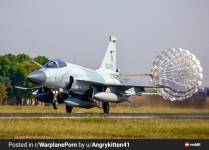
JF-17 Thunder has replaced the Mirage-V aircraft with the No 8 Squadron "Haiders"
 

Users who are viewing this thread

Pakistan Defence Latest

Back
Top