North Korea Defence Forum

surprised the Koreans haven’t attempted to build their own homemade fighter jet submarines, destroyers,tanks and nuclear weapons but not even a whiff of a fighter jet or helicopter man if any rogue nation could Koreans could definitely
 
surprised the Koreans haven’t attempted to build their own homemade fighter jet submarines, destroyers,tanks and nuclear weapons but not even a whiff of a fighter jet or helicopter man if any rogue nation could Koreans could definitely

Fighter jet is different level. The hardest part. And they have no modern reference point. They would be better off buying Su-57s from Russia.
 
Fighter jet is different level. The hardest part. And they have no modern reference point. They would be better off buying Su-57s from Russia.
Officially, the DPRK is still subject to UN arms sanctions, which were also signed by Russia at the time.
Therefore, in theory, Moscow should refrain from supplying any weapons systems, including fighter aircraft.
As you can see, the DPRK’s most modern weapons bear only a resemblance to Russian-made models; they are not identical systems.
It would therefore be difficult to ‘conceal the origin of the SU-57’, but there are certainly alternatives: the DPRK could acquire 4th-generation+ aircraft, for example platforms from the SU-27 series, for which it would be more difficult for our Western friends to accuse Moscow, as these aircraft have been exported to many countries.
Another alternative is the MiG-29, which the DPRK has already assembled in the past and which it appears to still be assembling in small numbers, whilst also carrying out modernisation work on them.
An extensively modernised MiG-29 – and in this case, Russia could provide significant assistance.
Third alternative: the renewed alliance with Russia could provide the DPRK with tangible assistance in directly developing a new fighter aircraft that would only partially resemble a Russian aircraft. (SU-75??)
4th alternative: in the naval sector, North Korean engineers and technicians working on the new destroyers have followed a design that partly resembles Western designs (see the ship’s hull and main armament); therefore, who knows whether, in the aeronautical field too, a hypothetical new fighter aircraft might appear with an external resemblance to a Western design.

I think we are way past UN Sanctions now.

Russia has already supplied subsystems to North Korea for its Warships. The fighter jets are not a unique restriction in the UN Sanctions anyways.

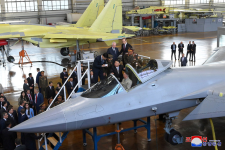
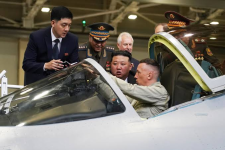
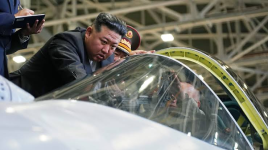
He was touring Su-57 production facilities as well.

1793050057012.png

1793050071016.png


The question really is about Money, what Russia will sell it for, and how much Kim can pay, as well as if its the right fight for North Korea's strategy(we don't know if he wants to try to match South Korea plane for plane, its not economical for him).
 

Attachments

  • 1793050078752.png
    1793050078752.png
    413.2 KB · Views: 0
I think we are way past UN Sanctions now.

Russia has already supplied subsystems to North Korea for its Warships. The fighter jets are not a unique restriction in the UN Sanctions anyways.

He was touring Su-57 production facilities as well.

View attachment 220977

View attachment 220978


The question really is about Money, what Russia will sell it for, and how much Kim can pay, as well as if its the right fight for North Korea's strategy(we don't know if he wants to try to match South Korea plane for plane, its not economical for him).
That’s right, one might speculate that subsystems are being supplied, but externally there is nothing ‘identical’ to the military products currently in use in Russia.
And during that visit to Kim Jong-un, they didn’t just show him the SU-57, but also the SU-35 (which is a direct successor to the SU-27 and bears a strong resemblance to it, making it easier to supply).
But they also showed him the TU-95, TU-22 and TU-160 bombers – though that doesn’t mean they’ll be offered to him.

PS
The cornerstone of the DPRK’s doctrine is the Juche Idea, which is based on self-reliance and is expressed in three forms of independence:
Chaju (political independence)
Charip (economic self-reliance),
but what is of interest here is Chawi (military self-defence): The belief that a state must be able to defend itself against external imperialism, a theory which has legitimised massive military investment, the development of a nuclear arsenal and modern systems.
I am therefore convinced that the next fighter aircraft will be produced in the DPRK, whether under licence or not.
 
I think we are way past UN Sanctions now.

Russia has already supplied subsystems to North Korea for its Warships. The fighter jets are not a unique restriction in the UN Sanctions anyways.

He was touring Su-57 production facilities as well.

View attachment 220977

View attachment 220978


The question really is about Money, what Russia will sell it for, and how much Kim can pay, as well as if its the right fight for North Korea's strategy(we don't know if he wants to try to match South Korea plane for plane, its not economical for him).
Every friggin South Korean airbase is in range of NK long range rockets let alone BM's if NK fires first I don't know what percentage of SK air force and USAF survives.
 
PS
The cornerstone of the DPRK’s doctrine is the Juche Idea, which is based on self-reliance and is expressed in three forms of independence:
Chaju (political independence)
Charip (economic self-reliance),
but what is of interest here is Chawi (military self-defence): The belief that a state must be able to defend itself against external imperialism, a theory which has legitimised massive military investment, the development of a nuclear arsenal and modern systems.
I am therefore convinced that the next fighter aircraft will be produced in the DPRK, whether under licence or not.
It is difficult to explain these concepts to them clearly; they belong to two entirely different worlds.

The DPRK is deeply influenced by traditional Chinese thought—the idea that in the nation’s most perilous moments, one can rely only on oneself. Consequently, the DPRK prioritizes absolute autonomy and self-reliance in the development of its military industry. This logic stands in stark contrast to the mindset of "beggar" nations. In the eyes of the latter, the DPRK is undoubtedly a "foolish" state—simply because they have no grasp of what "true self-reliance" actually means.

Take, for instance, the assault rifle—a fundamental piece of equipment for any modern military. From the ammunition, components, and raw materials like steel, all the way to the complete, integrated assault rifle system for the individual soldier, only a handful of nations worldwide possess the capability for total, end-to-end self-sufficiency. And this is not even accounting for advanced, integrated accessories such as optical sights or electronic targeting systems.

North Korea (DPRK) is one of the few countries that has achieved such complete, autonomous production. Notably, no Islamic nation—including Turkey—appears on this list.

This is not merely a technical issue; it is a matter of national or collective will. Some countries possess the full range of necessary technologies, yet—driven by economic considerations—they opt to import specialized raw materials from abroad rather than building their own production facilities, as importing is often far more cost-effective than domestic manufacturing.

For the DPRK, however, economic efficiency is not the primary concern. Consequently, if they possess the full technical know-how, their priority is always to manufacture the items themselves, even if the domestic production cost is higher. (Note: This does not imply that they have already achieved complete, absolute autonomy in their military-industrial sector; rather, it refers to the underlying driving force rooted deep within their thinking.)

The advantage of the former approach (importing) is immediate access to superior products; the drawback is that as technology evolves, one risks being left behind, while the supply chain remains highly vulnerable to the international political climate.

The disadvantage of the latter approach (domestic production) is that the technology one possesses may already be outdated or obsolete; the advantage, however, is the ability to pursue continuous, iterative development—all while keeping the supply chain insulated from external international pressures.

These are two completely different modes of thinking, and it is very difficult for them to persuade one another.

BTW.
This is also the core reason why both the Soviet Union/Russia and China have been reluctant to supply the DPRK with significant amounts of advanced military technology or weaponry. From the perspective of the DPRK’s neighbors, this underlying ideology poses a serious danger. Yet, viewed from the impartial standpoint of an outside observer, the fact that the DPRK has reached its current level of development—while under a comprehensive, global-scale blockade on military technology—is an absolutely remarkable achievement.
 
Last edited:

Users who are viewing this thread

Back
Top