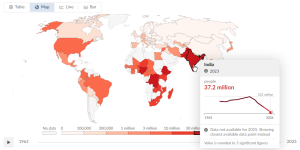
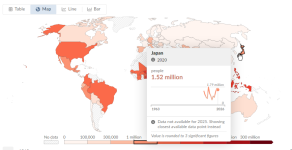
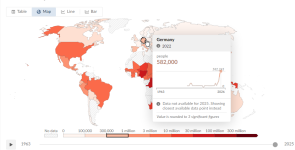
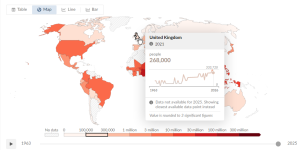
Number of people living in extreme poverty2025

Beijingwalker

VIP Member
Joined
Nov 4, 2011
Messages
94,188
Reaction score
114,370
Reputation
1,907.4
Country of Origin
Country of Residence

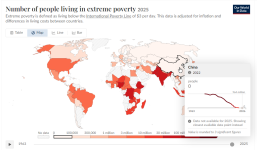
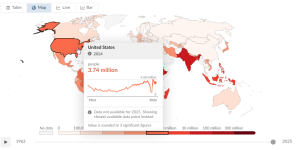
Number of people living in extreme poverty2025​

Extreme poverty is defined as living below the International Poverty Line of $3 per day. This data is adjusted for inflation anddifferences in living costs between countries.
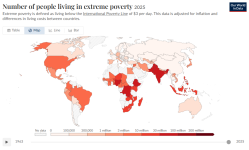
搜狗截图20261111125448.png
Data source: World Bank Poverty and Inequality Platform (2026) – Learn more about this data

Note: This data is expressed in international-$ at 2021 prices. Depending on the country and year, it relates to income (measured after taxes and benefits) or to consumption,per capita. Where data for 2025 is unavailable, the value from the closest year between 2020 and 2026 is shown instead.

What you should know about this indicator​

  • The World Bank defines extreme poverty as living on less than $3 per day. This threshold, known as the “International Poverty Line”, is set so that poverty can be compared across countries. This indicator plays an important and successful role in focusing the world’s attention on the very poorest people. The UN uses this indicator to track progress toward ending extreme poverty by 2030.
  • Two centuries ago, most of the world’s population was extremely poor. Many believed that widespread poverty was inevitable. But this turned out to be wrong. Economic growth is possible, and poverty can decline. With this poverty line, we can track whether countries are leaving the worst poverty behind.
  • This data comes from the World Bank’s Poverty and Inequality Platform, which is based on a large collection of national survey data. To achieve wide coverage, it pools data from two kinds of surveys. For high-income countries, the data measures people’s incomes after taxes and benefits. For most low- and middle-income countries, it instead measures their consumption — a different but closely related measure.
  • In lower-income countries, many people produce food for their own use or exchange goods without money. This data accounts for that by estimating what these goods would have cost if bought in the market and adding that value to their consumption.
  • The exact surveys that countries run can change over time, creating breaks across which data points are less comparable. The World Bank provides an indicator of where these breaks occur, and this chart gives the option to show the breaks.
  • For a small number of countries and years, the data source provides two estimates: one measuring households' income and one measuring consumption. To show a single series over time, we keep only one of these observations. You can see which measure each data point corresponds to by selecting the option to show breaks in the data.
  • Regional and global estimates are extrapolated to the year of the data release using growth estimates and forecasts from national accounts. For more details about the methodology, please refer to the World Bank PIP documentation.
  • This data is expressed in constant international dollars to adjust for inflation and differences in living costs between countries. Read more in our article, What are international dollars?
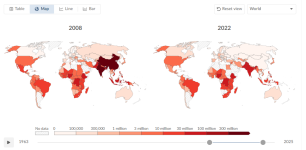
 
View attachment 222562

until 2008, China still had the world most impoverished population numbering 345 million, dropped to zero around 2022.
Commies are so evil, eliminated the freedom of living in poverty in just a decade.
Look at the 2008 Libya.

American bastards destroyed it.
 

How China lifted nearly 100 million people out of poverty in just 8 years​

20:36, 11-Nov-2026

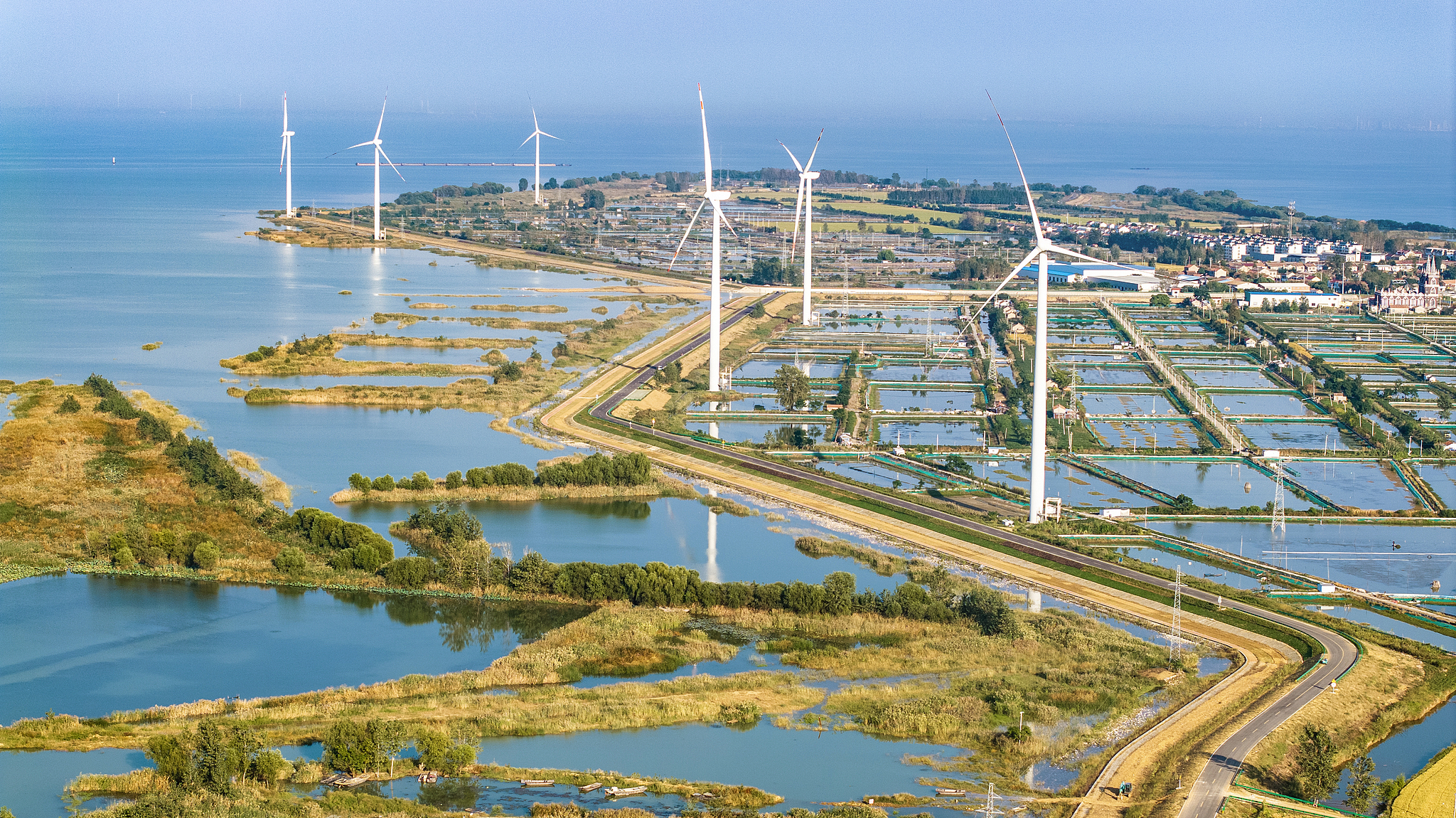
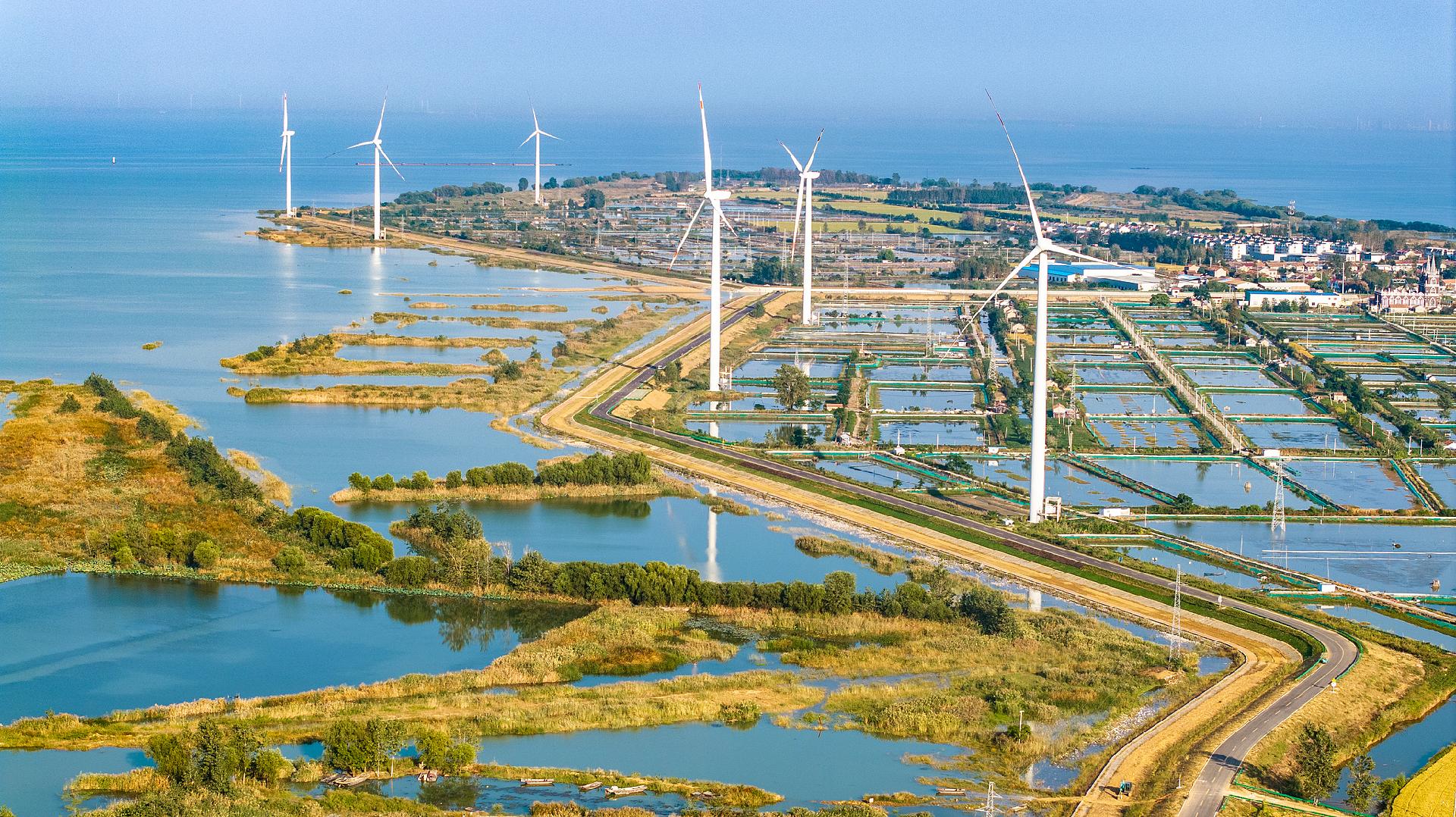
Wind turbines and aquaculture ponds are seen along the shores of Hongze Lake in Longji Town, Sihong County, east China's Jiangsu Province, October 7, 2025. /VCG


Wind turbines and aquaculture ponds are seen along the shores of Hongze Lake in Longji Town, Sihong County, east China's Jiangsu Province, October 7, 2025. /VCG

In its poverty elimination effort, China has succeeded in lifting nearly 100 million people out of absolute poverty in just eight years, a scale and speed the World Bank has recognized as "historically unprecedented" by any measure.

The country's eradication of extreme poverty – the first target of the UN 2030 Agenda for Sustainable Development – 10 years ahead of schedule, is celebrated as a milestone in the history of the Chinese nation and the history of humankind.

Behind this success story lies the strong leadership of the Communist Party of China (CPC), whose scientific planning, targeted strategies and people-centered philosophy have underpinned China's extraordinary fight against poverty.

The long-term planning

A fundamental reason for China's poverty alleviation achievement is the country's consistent, forward-looking strategic planning and sustained governance efforts.

Since its 18th National Congress in 2012, China has elevated poverty eradication to a core governance priority, launching an eight-year campaign through 2020 that fundamentally eliminated absolute poverty that had plagued the country for millennia.

To prevent large-scale post-campaign poverty relapse, the country designated a five-year transition period from 2021 to 2025, maintaining stable key supportive policies to consolidate poverty alleviation outcomes.

Data from the National Bureau of Statistics show that per capita disposable income for rural populations in former poverty-stricken counties stood at 18,627 yuan (approximately $2,729.6) in 2025. Their average annual income growth during the transition phase aligned with the 14th Five-Year Plan period reached 8.2%, higher than the national rural benchmark.

Local Party members promote specialty agricultural products through e-commerce livestreaming in Xin'an County, central China's Henan Province, August 25, 2026. /VCG


Local Party members promote specialty agricultural products through e-commerce livestreaming in Xin'an County, central China's Henan Province, August 25, 2026. /VCG
Since the start of 2026, the first year of the 15th Five-Year Plan (2026-2030), China has integrated regular poverty assistance into its rural revitalization strategy, opening a new chapter in modernizing agriculture and rural areas.

Xiao Xinjian, a researcher with the National Development and Reform Commission, the country's top economic planner, noted that the country avoided a one-size-fits-all approach after completing the eight-year poverty relief campaign.

Instead, it has adopted dynamic, targeted policy adjustments and built a progressive, long-term poverty governance system that moves from eradicating absolute poverty to preventing a return to poverty and ultimately promoting rural revitalization, Xiao said.

The strategy of targeted poverty alleviation

Targeted poverty alleviation is China's most powerful tool for securing a decisive victory over poverty and a groundbreaking innovation in global poverty reduction theory and practice.

It highlights the country's sound, pragmatic approach of tailoring policies and measures to local conditions and development needs.

Covering the full cycle of poverty reduction from identification to sustainable exit, the strategy laid out clear answers to five essential questions: who should be helped, by whom, through what means, when to exit, and how to prevent a return to poverty.

To accurately identify those in need of help, China has run a national poverty alleviation information system that profiles poor households and villages in detail.

Officials note that this registration system marks a historic first: it has enabled the authorities to identify every poor individual in every village and systematically record every poor household's causes of poverty and specific assistance needs.

In addition, the targeted poverty alleviation strategy focuses on creating conditions for poor households to secure employment and stable incomes to achieve self-sufficiency. It delivers tailored support such as housing, skills training, healthcare and job-search assistance.

Hao Dong, a professor at the Party School of the CPC Central Committee, said that the full-cycle management method, which covers every stage from profiling and on-the-ground assistance to long-term follow-up monitoring, has helped guarantee sustained and effective poverty governance.
Tourists stop to rest and enjoy the scenery at a rest stop along a winding mountain road in the countryside of Huaibei, east China's Anhui Province, October 21, 2026. /VCG


Tourists stop to rest and enjoy the scenery at a rest stop along a winding mountain road in the countryside of Huaibei, east China's Anhui Province, October 21, 2026. /VCG
The path to prosperity for all

Beyond eliminating absolute poverty, China's poverty alleviation effort prioritizes common prosperity for all, focusing on fostering endogenous momentum and bridging regional growth gaps.

Having left no single poor area behind, the country has pooled national resources and established an assistance framework linking the developed eastern regions with their less-developed western counterparts.

For example, thanks to talent, technology and market resources brought by the Guangdong-Guizhou pairing assistance program, Zheng'an, once a severely impoverished county in Guizhou province, has grown into one of the world's largest guitar manufacturing bases, producing one in every seven guitars sold globally.

Li Xiaoyun, a renowned scholar from China Agricultural University, said that the east-west pairing program is not a simple financial transfer, but a transfer of development capabilities, injecting lasting endogenous vitality into underdeveloped areas.

China's poverty alleviation experience has also transcended national boundaries, offering a practical Chinese approach to addressing global poverty challenges.

 
Number of people living in extreme poverty2025

搜狗截图20261112010949.png搜狗截图20261112011022.png搜狗截图20261112011057.png搜狗截图20261112011130.png搜狗截图20261112011214.png搜狗截图20261112011248.png
 
View attachment 222562

until 2008, China still had the world most impoverished population numbering 345 million, dropped to zero around 2022.
Commies are so evil, eliminated the freedom of living in poverty in just a decade.
India has made huge strides in reducing poverty, though we're still nowhere close to China's achievements. Do you have a map showing poverty as a percentage of the population rather than absolute numbers? As they don't really capture the progress countries have made.
 
Last edited:
India has made huge strides in reducing poverty, though we're still nowhere close to China's achievements. Do you have a map showing poverty as a percentage of the population rather than absolute numbers? As they don't really capture the progress countries have made.
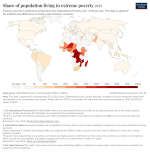
Ok got it here with % rather than absolute numbers
 

Attachments

  • share-of-population-in-extreme-poverty.png
    share-of-population-in-extreme-poverty.png
    1.5 MB · Views: 2
Last edited:

Users who are viewing this thread

Pakistan Defence Latest

Latest Posts

Back
Top