Operation Ghazab Lil Haq (Pakistan - Afghanistan War)

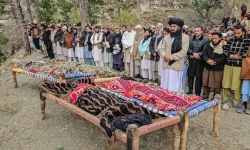
Afghan Taliban shelling kills 3 civilians in Bajaur, injures 3

  • In a befitting response, security forces destroy Afghan Taliban positions used for attacks on civilians
BR Web Desk
April 15, 2026

1776278984231.png

At least three civilians, including two children, were killed and three others seriously injured after Afghan Taliban forces carried out cross-border shelling in Khyber Pakhtunkhwa’s Bajaur district, state-run PTV reported on Wednesday, citing security sources.

The incident took place in the border village of Malik Shaheen in the Katkot area, where, according to PTV, “unprovoked aggression” targeted a residential house, resulting in the deaths of a woman and her two children from the same family.
 
To view this content we will need your consent to set third party cookies.
For more detailed information, see our cookies page.
 
By Brig. Gen. Mark Kimmitt - Tuesday, April 14, 2026
OPINION:
While the U.S. stands on the verge of resuming Operation Epic Fury, Pakistan continues to conduct its own combat operations across the Durand Line into Afghanistan.
Under Operation Ghazab lil-Haq (“Wrath for Justice”), Islamabad is conducting precision strikes into Afghanistan, targeting Tehrik-e Taliban Pakistan sanctuaries and Taliban facilitators, achieving clear tactical success while attempting to minimize civilian casualties.
The operation highlights Pakistan’s growing capability to conduct military operations against cross-border threats. Pakistan recognizes that military operations alone will be insufficient, unlike the U.S. operations, which rely far more on blunt force and overwhelming combat power.
Pakistan recognizes that true stability needs to extend beyond the battlefield. Insurgent economies rely on porous borders, weak governance and illicit trade networks. Pakistan’s ongoing efforts to strengthen border management and coordinate with regional partners can help dismantle these structural enablers of militancy, turning battlefield successes into longer-term stability.
Both Epic Fury and Ghazab lil-Haq reflect a broader lesson in modern conflict. Military action on its own is insufficient to achieve submission or even concessions from an enemy. Wartime goals are more likely to be achieved when paired with sustained political, economic and diplomatic action.
While the United States has demonstrated that precision operations can achieve battlefield dominance, Pakistan seeks to translate similar momentum into long-term regional stability.
Islamabad’s campaign has been carefully framed as limited, targeted and transparent. Officials emphasize that it is directed only at militant networks operating from Afghan territory and that they have no intention of regime change in Kabul.

With more than 180 militant sites destroyed and more than 30 staging areas neutralized, the campaign has effectively degraded hostile networks with a minimum of civilian casualties. By contrast, reports of significant civilian casualties in Iran have worked against U.S. claims of surgical strikes limited to military targets.

Pakistan recognizes that true stability needs to extend beyond the battlefield. Insurgent economies rely on porous borders, weak governance and illicit trade networks. Pakistan’s ongoing efforts to strengthen border management and coordinate with regional partners can help dismantle these structural enablers of militancy, turning battlefield successes into longer-term stability.

Equally notable is Islamabad’s emphasis on isolating combat operations from civilian population centers to maintain legitimacy and trust. Its strategic information operations continue to emphasize that Afghanistan’s political future belongs to Afghans themselves, signaling respect for sovereignty even as it takes firm defensive measures.

Sustaining these gains requires broader collaboration. Civilian agencies, local communities and regional institutions all have roles to play. By advancing the national action plan, investing in civilian counterterrorism capacity and depoliticizing internal security structures, Pakistan can ensure that military progress evolves into national resilience.

The military’s professionalism, as dictated by Field Marshal Asim Munir, has created valuable space for diplomacy and governance to take root rather than for the military to take the lead. A common complaint in U.S. operations in both Afghanistan and Iraq is that the military overwhelms the processes and consigns the diplomats and other government specialists to “the end of the table.”

Operation Ghazab lil-Haq represents not only tactical expertise but also a strategic opening. If combined with political outreach and institutional reform, then the region of Afghanistan along the Durand Line can enjoy a measure of stability.

Pakistan is culturally, diplomatically and geographically positioned to encourage dialogue and governance and help close the cycle of conflict that has long defined the border region.

Although many in the U.S. would simply dismiss these plans as American counterinsurgency models that have proved unsuccessful in the past 25 years, the foundation of Ghazab lil-Haq is to build on the historical and cultural affinity among the people along the Durand Line.

As the U.S. and Israel attempt to achieve their objectives primarily through coercive force of arms and Iran continues to embrace a resistance model that emphasizes resilience and patience, Pakistan’s more balanced approach of military action, diplomacy and civic action can serve as an alternative.

Pakistan’s model is decisive in military action, but it recognizes that wars end at the negotiating table. The challenge now is to sustain the momentum, to pair operational success with political vision.

If done right, Operation Ghazab lil-Haq could mark a successful campaign and the beginning of a more confident Pakistan leading regional stability efforts.

• Brig. Gen. Mark Kimmitt (retired) is a former deputy assistant secretary of defense for the Near East and South Asia and former assistant secretary of state for political-military affairs.

https://www.washingtontimes.com/news/2026/apr/14/pakistans-quiet-military-success/
 
To view this content we will need your consent to set third party cookies.
For more detailed information, see our cookies page.
 
To view this content we will need your consent to set third party cookies.
For more detailed information, see our cookies page.
 
1776601213489.png

QUETTA: Balochistan government officials presented a video statement by a woman, Rahima Bibi, in connection with the Nokundi suicide attack.

In her confessional statement, Rahima Bibi, a resident of Faisal Colony in Dalbandin, said she married Manzoor Ahmed in April 2025. She maintained that two months after her marriage, her husband gave her a mobile phone, which she used. Later, he began using her phone as well, which raised suspicions, indicating deliberate misuse of personal identity to conceal operational contacts.

Rahima Bibi further claimed that on November 11, 2025, her husband brought an unidentified woman to their home, who was associated with the BLF, and introduced her as a temporary guest. The following day, he took the woman away in a vehicle and later told her that she had been handed over to relatives in Afghanistan.

According to Rahima Bibi, on November 30, her husband showed her a photograph of a woman identified as Zarina Rafiq, a suicide bomber who had previously stayed at their home, endorsing that residential houses were knowingly used as temporary shelters for individuals later involved in terrorist operations.

Raheema Bibi's confessional statement established that Zarina Rafiq received training in Afghanistan and was later used in a suicide attack on a Frontier Corps camp in November 2025, reinforcing long-standing concerns about cross-border terrorist facilitation structures.
 
She added that on December 3, 2025, her husband fled to Afghanistan and later contacted her younger brother, asking him to send her there as well. However, on the night of December 8, she and her brother were arrested.

Rahima Bibi accused her husband of abandoning her and refusing to take responsibility for their unborn child. She further alleged that he had told others to kill her, saying "he did not care".

During the presser, the officials urged the public to remain vigilant, report suspicious activity and avoid falling prey to extremist propaganda. They also advised parents to thoroughly verify backgrounds before arranging their children's marriages to prevent such incidents.

They further noted that anti-state actors abroad are attempting to mislead youth through social media propaganda.

According to Counter Terrorism Department assessments, terrorist groups operating in Balochistan are increasingly exploiting women through psychological manipulation, coercion, and organised recruitment mechanisms, indicating a clear shift in terrorist operational tactics.
 
Emerging security assessments indicate that radicalisation of vulnerable youth and women is often carried out through ideological messaging and narrative influence, while recruitment, training, and operational deployment are executed by terrorist groups such as BLA and BLF after individuals have been psychologically conditioned.

Analysts have noted that certain activist platforms, including those linked to groups such as BYC, contribute to narrative environments that influence vulnerable individuals, creating ideological conditions that can be exploited by militant recruiters for terrorist activities.

Security assessments indicate that when terrorist -linked individuals are intercepted, arrested, or disengaged from operational pipelines, associated networks and activist elements attempt to portray such cases as "missing persons," thereby shaping public perception and diverting attention from militant linkages.

Security findings highlight that emotional, social, and familial vulnerabilities are deliberately targeted to facilitate recruitment, concealment, and movement within organised militant systems.
 
The confirmed movement of individuals to Afghanistan for training reflects longstanding security concerns regarding the continued use of cross-border territories by BLA, BLF, and TTP terrorists for training, logistical support, and operational planning, which remains a critical enabler of terrorism in Balochistan and Khyber-Pakhtunkhwa.

According to Senator Anwaarul Haq Kakar, terrorist organizations increasingly operate through a dual strategy that combines violent actions with coordinated narrative campaigns designed to create confusion, influence public opinion, and weaken societal resistance to terrorism.

Babar Yousafzai said hostile elements and facilitators attempt to exploit women and social vulnerabilities to support militant objectives and disrupt community cohesion.

According to DIG CTD in Quetta, terrorist networks are complex, organised, and international in nature, functioning through interconnected layers of recruiters, facilitators, trainers, and handlers.
 

Users who are viewing this thread

Back
Top