Operation Ghazab Lil Haq (Pakistan - Afghanistan War)

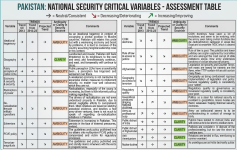
I hear a lot of noise - but we must accept that the situation in Afghanistan cannot be viewed in isolation without considering outside threat factors, hostile actors and their impact on Pakistan's NATSEC doctrine.
1782984273619.png

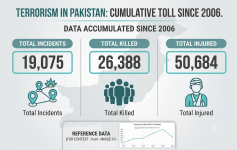
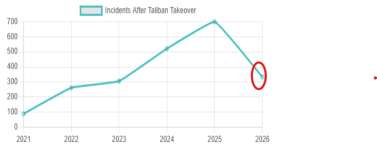
Overall whilst recent terrorism and cross border incidents have been "spectacular" as most terrorism incidents are - gaining attention of the national and international media - the trend of incidents and casualties has seen a downward trajectory compared to 2025.
1782983690072.png
1782983758223.png
Regardless of noise, this alone is proof that our policy is working - however more action is needed on this front, I empathize with the security forces because a lot of the work being done is being done covertly without much visibility - the powers that be, need to make sure to keep up public awareness on these IBOs and their overall impact beyond power point presentations - to maintain public confidence and increase trust factor among all stakeholders.
 
I hear a lot of noise - but we must accept that the situation in Afghanistan cannot be viewed in isolation without considering outside threat factors, hostile actors and their impact on Pakistan's NATSEC doctrine.
View attachment 204250

Overall whilst recent terrorism and cross border incidents have been "spectacular" as most terrorism incidents are - gaining attention of the national and international media - the trend of incidents and casualties has seen a downward trajectory compared to 2025.
View attachment 204245
View attachment 204246
Regardless of noise, this alone is proof that our policy is working - however more action is needed on this front, I empathize with the security forces because a lot of the work being done is being done covertly without much visibility - the powers that be, need to make sure to keep up public awareness on these IBOs and their overall impact beyond power point presentations - to maintain public confidence and increase trust factor among all stakeholders.

Understood, however is there a reason why top level TTP and BLA leadership have not been targeted?

Are they leaving space for negotiations?
 
Understood, however is there a reason why top level TTP and BLA leadership have not been targeted?

Are they leaving space for negotiations?
Correct, Pakistan has always maintained a policy of keeping doors open. There is method to what may seem like madness given the circumstances.
 
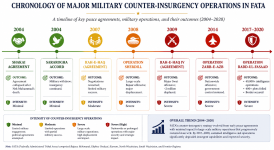
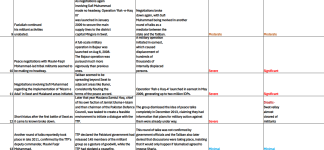
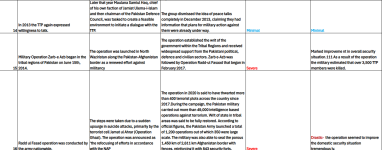
@Distant_Observer I have complied a brief timeline of "Peace deals" with militants for you to better understand the dynamics at play when it comes to Pakistan's strategy. There has been a consistent trend line about negotiating with the terrorists as a viable conflict resolution mechanism.

Conventionally, COIN regimes are said to be 80% political and 20% military in nature. However, the first thing which becomes obvious is that the Terrorists do not seem serious about the political aspect of COIN.

This is arguably a vindication of the proponents of the ‘hard line’ stance towards militants such as the Taliban; they do not seem too amenable to the political aspect of COIN utilizing negotiations.

In fact, they have apparently used the negotiation table as a tactic to gain time, interrupting trend lines of operations which were underway at the time. The state always tried to reason with the militants as a logical enemy but have not gained any useful advantage from it.

Considering the Pakistani case in question, the Pakistani COIN has been for long focused on pushing the militants out of their territorial sanctuaries and holding these areas. This is the result of a long-drawn out process consisting of lots of talking and little fighting till 2009, when the Pakistani army decided to engage in full blown offensives that re took Swat, and cleared large swathes of territory which the state has held successfully.

The militants in Pakistan do not seem amenable to negotiation, or the political side of COIN, and have in fact used the negotiating table as a tactic to interrupt trend lines of operations underway at the time. The state initially tried to reason with the militants as a logical enemy but did not gain any useful advantage from it.

In all operations before ‘‘Rah-e-Haq’’ and ‘‘Rah-e-Nijat’’ the Pakistani government’s counterinsurgency policy was consistently skewed toward negotiating with one warlord or the other.

1782993414901.png

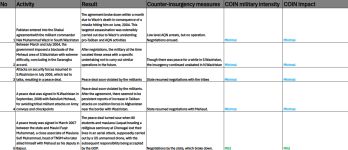
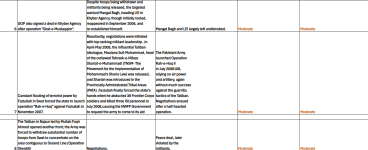
Breakdown of timeline and significant events:
1782993466430.png
1782993504285.png
1782993540730.png
1782993569110.png
 
He is not wrong. Every afghan regime was anti pakistan starting from 1947, its only the black sheep in Pakistan that has divided opinion about Afghanistan

Keep it 100. It's some Pashtuns that have divided loyalty.
 
Yes I know all about the Durand line claim but there is a huge power dynamic over there and there always have been and therefore TTA thinks its better to ally TTP so they can protect their own throne but the pashtun factor also does play a role in that.
Can Pakistan's ISI not do that?

faiz-hameed-isi.jpg
Why choose the ISI between 1979-2021, and then ally with TTP?

Why find refuge in Pakistan between 1979-2021, and then ally with India?

What's the excuse?
 
@Distant_Observer I have complied a brief timeline of "Peace deals" with militants for you to better understand the dynamics at play when it comes to Pakistan's strategy. There has been a consistent trend line about negotiating with the terrorists as a viable conflict resolution mechanism.

Conventionally, COIN regimes are said to be 80% political and 20% military in nature. However, the first thing which becomes obvious is that the Terrorists do not seem serious about the political aspect of COIN.

This is arguably a vindication of the proponents of the ‘hard line’ stance towards militants such as the Taliban; they do not seem too amenable to the political aspect of COIN utilizing negotiations.

In fact, they have apparently used the negotiation table as a tactic to gain time, interrupting trend lines of operations which were underway at the time. The state always tried to reason with the militants as a logical enemy but have not gained any useful advantage from it.

Considering the Pakistani case in question, the Pakistani COIN has been for long focused on pushing the militants out of their territorial sanctuaries and holding these areas. This is the result of a long-drawn out process consisting of lots of talking and little fighting till 2009, when the Pakistani army decided to engage in full blown offensives that re took Swat, and cleared large swathes of territory which the state has held successfully.

The militants in Pakistan do not seem amenable to negotiation, or the political side of COIN, and have in fact used the negotiating table as a tactic to interrupt trend lines of operations underway at the time. The state initially tried to reason with the militants as a logical enemy but did not gain any useful advantage from it.

In all operations before ‘‘Rah-e-Haq’’ and ‘‘Rah-e-Nijat’’ the Pakistani government’s counterinsurgency policy was consistently skewed toward negotiating with one warlord or the other.

View attachment 204310

Breakdown of timeline and significant events:
View attachment 204311
View attachment 204312
View attachment 204313
View attachment 204314

taliban copied the iranian model of religious orientated proxy war to protect their interests and compensate for a lack of traditional military capability.

It would have been better to go to war with the taliban in 1992 when they started using AQ/OBL to embed ideologically in NWFP/KP and not to seek coexistence or this perverted form of "strategic depth".

After the NATO invasion of Afghanistan taliban issues a casus belli in the region and problems compounded for Pakistan which is why they persisted with talks in fear of full blown rebellion. Now they are on the backfoot. What did the the taliban do? They doubled down and here you are 20 years later at number 1 in the global terrorism index.

Scorched earth is the only way forward. Accept this, make peace with it and do what is necessary.

Asim Munir's successor will be even more aggressive and bellicose no doubt.
 
Last edited:
I know some people from KPK that says their watan is Peshawar, not Pakistan. Mind you, im Pashtun myself but you will see people with these mentalities time to time.
Mehmood Achazai appeals these people who consider themselves More Afghans than Pakistanis.
 
Im hearing another drone attack, why is this being downplayed?
Maybe thats exactly what they want...that even their small tickle should make big headlines in Pakistan.....it pinches them alot once their tickles and our response (not every time proportionate) dont make our headlines....
 
Maybe thats exactly what they want...that even their small tickle should make big headlines in Pakistan.....it pinches them alot once their tickles and our response (not every time proportionate) dont make our headlines....
There is some degree of logic to this.

We should be somewhat unpredictable in the minds of our enemies.
 
"Pashtunistan" issue is of no relevance on the Pakistani side of the border, and is of minority importance on the Afghan side. If you fought a war for that issue, you truly wasted your time and blood on a nothing burger.

by the way, if they really are mercs as you say, why don't you just rent them rather than fruitlessly fighting them for 50 years ?
Itni akal naheen hai ?

Same reason feeding and clothing you resulted in nothing.
 

Users who are viewing this thread

Pakistan Defence Latest

Latest Posts

Back
Top