Navigation
Install the app
How to install the app on iOS
Follow along with the video below to see how to install our site as a web app on your home screen.
Note: This feature may not be available in some browsers.
More options
Style variation
You are using an out of date browser. It may not display this or other websites correctly.
You should upgrade or use an alternative browser.
You should upgrade or use an alternative browser.
PA MLRS, Self Propelled and towed artillery [BM-11, Fatah-I GMLRS, Fatah-II] - News, Updates & Discussions
- Thread starter CSAW
- Start date
More options
Who Replied?


MS Sandhu
Registered Member

Russia launched 10 Kinzal Ballistic Missiles on Kiev, all were intercepted.
Kinzal is much more capable than F-2.
Limited Manueverability is not enough to penetrate Defence Systems.
Russian Subsonic Cruise Missiles are not showing that much success either.
59 out of 70 were intercepted.

 www.telegraph.co.uk
Kinzal is much more capable than F-2.
Limited Manueverability is not enough to penetrate Defence Systems.
Russian Subsonic Cruise Missiles are not showing that much success either.
59 out of 70 were intercepted.
Feared Russian hypersonic missile shot down over Kyiv
The US-supplied Patriot air defence system shot down a ‘record’ ten hypersonic missiles fired at Ukraine from Russia on Tuesday morning.
www.telegraph.co.uk

Oscar
Moderator

Yes, jammers on the Indian side. No effect.Nice.
Did you consider the effects of ECM?

Quwa
Research Partner

I agree, but from a different angle.The Ukraine war (and the Swift Retort episode) probably allowed our strategic planners to grasp that such strictly conventional systems (which are separate from the nuclear ones) gave them a lot of options for 'controlled escalation' (to 'punish' India) in the event of a low-intensity/localized conflict while remaining under the nuclear threshold.
Also, I would be very surprised if we had the industrial capability to be able to achieve the production scale that such large numbers would demand. It is still a ballistic missile with a lot of 'moving parts' so to speak and it is a fact that we are not self-reliant in sourcing all the mechanical/structural/propulsion inputs. This doesn't include the electronics, which might be the easier part.
The engineer in me would give anything to be able to see the actual electronic hardware that goes into these systems.
This would also explain the sudden appearance of the Taimoor ALCM at int'l defence fairs without any publicly revealed flight tests or any news about its integration with any of the PAF's platforms.
I would say that this shift towards strictly 'conventional' systems is part of broader strategic signaling, reflecting post-Swift Retort learning regarding the need for options for controlled escalation. It would be safe to assume that Swift Retort shook up some people in our higher echelons because of India's brinkmanship (preparing missiles for launch, etc) and our inability to respond with any 'strategic' system without initiating a nuclear conflict.
Perhaps I'm reading too much into this, but there also may be a realization that in a similar future conflict, there might be too much of a risk for aircraft to carry out Swift Retort-style precision strikes to 'punish' India.
Basically, our policymakers aren't concerned about initiating a nuclear conflict. Rather, they care about guaranteeing Pakistan's territorial integrity. If that is lost, then they'll go nuclear and, in turn, force the adversary into losing everything too.
Unfortunately, the Balakot episode showed that India didn't care about the nuclear threat. Rather, India will probe and instigate to see if our policymakers will "pull back" their red line. Yes, territorial integrity will trigger a nuclear response, but how much territory? Perhaps, at some point, India did wager that they could bite into Pakistan without triggering nuclear retaliation (i.e., Cold Start). But in turn, our policymakers decided that TNWs were a fair response to such situations.
Now, with Balakot, India isn't probing how much territory they can take, but how much insecurity they can create in Pakistan (via conventional means) without getting a nuclear response. This is a different problem to what the nuclear capability was designed for; now, we're not talking about the loss of territorial integrity, but national integrity. Citizens cannot feel safe closer to the border and, if left unchecked, India will expand its probing deeper into our territory (exerting a sense of de facto control over our affairs).
Thus, we're at a point now where 'conventional deterrence' is essential. Things like the long-range SAMs (across both the PAF and PA, possibly even the PN later) are there to help defend against a 'probe.' Likewise, the sudden and open emphasis on acquiring a stealth fighter (J-31), HALE UAVs, longer-ranged guided rockets, enlarging the surface fleet, adding AIP-equipped SWATS (thereby ballooning our SSP fleet to 12-16+ boats), etc, all point towards both neutralizing and following up on Indian probes with more Swift Retort-type operations.
The point being, if India decides to probe and, in turn, create insecurity for Pakistanis, then the Pak Army, Air Force, and Navy will carry out retaliatory measures which will cost India. This would start with neutralization of incoming threats (via SAMs, more tactical fighters like JF-17C/J-10CE, SWATS parked in our busy waters, frigates guarding SLOCs, etc), but then be followed up with very heavy conventional strikes. The heavy conventional strikes are meant to inflict a high cost, one that will be too high for India to continue probing. IMO, Swift Retort may have given India the idea that the Balakot-type ops - as undertaken at the time - was too expensive relative to the losses they had incurred due to Pakistan's response. And, in turn, they de-escalated.
So, overall, the conventional deterrence focus is now there to, basically, deter Indian probing in the future. IMO, for our policymakers, if India escalates into brinkmanship is irrelevant, or - devil's advocate here - a good thing. Why? Because Indian brinkmanship now interferes with American geo-political goals in Asia (containing China) and, in turn, invite American pressure on India (esp. if India started the 'panga' so to speak).
tbh i think p282 will probably end up being yj21e which contradicts my other theory lol- why do thye make it so hard for us!
Well, this Fatah-2 episode confirms one important thing...what our military designates something before it's inducted doesn't mean anything. So, for all we know, the "P282" could be a supersonic-cruising AShM (like HD-1 or CM-302), while the ASBM is something else.
MS Sandhu
Registered Member
I hope Fattah-2 developers are taking notes from Russian Iskandar-M BM:

 www.thedrive.com
Russia’s Use Of Iskander Ballistic Missiles In Ukraine Exposes Secret Decoy Capability
The novel decoy, ejected from the base of the missile, is designed to confuse hostile radar and interceptor missiles.
www.thedrive.com

mdmm55
Registered Member
so this Fatah-2 is enough to combat S-400 piled on Pakistani borders.
Q1- Is this made in Pakistan or from China ?
Q2- What is big difference between S-400 and Fatah-2 and can Pakistan improve it to S-400 level ?
Q1- Is this made in Pakistan or from China ?
Q2- What is big difference between S-400 and Fatah-2 and can Pakistan improve it to S-400 level ?
Dr Serious
Registered Member
Can be tested on Iranian Navy Assets.
mdmm55
Registered Member
Thank you for full informations.I agree, but from a different angle.
Basically, our policymakers aren't concerned about initiating a nuclear conflict. Rather, they care about guaranteeing Pakistan's territorial integrity. If that is lost, then they'll go nuclear and, in turn, force the adversary into losing everything too.
Unfortunately, the Balakot episode showed that India didn't care about the nuclear threat. Rather, India will probe and instigate to see if our policymakers will "pull back" their red line. Yes, territorial integrity will trigger a nuclear response, but how much territory? Perhaps, at some point, India did wager that they could bite into Pakistan without triggering nuclear retaliation (i.e., Cold Start). But in turn, our policymakers decided that TNWs were a fair response to such situations.
Now, with Balakot, India isn't probing how much territory they can take, but how much insecurity they can create in Pakistan (via conventional means) without getting a nuclear response. This is a different problem to what the nuclear capability was designed for; now, we're not talking about the loss of territorial integrity, but national integrity. Citizens cannot feel safe closer to the border and, if left unchecked, India will expand its probing deeper into our territory (exerting a sense of de facto control over our affairs).
Thus, we're at a point now where 'conventional deterrence' is essential. Things like the long-range SAMs (across both the PAF and PA, possibly even the PN later) are there to help defend against a 'probe.' Likewise, the sudden and open emphasis on acquiring a stealth fighter (J-31), HALE UAVs, longer-ranged guided rockets, enlarging the surface fleet, adding AIP-equipped SWATS (thereby ballooning our SSP fleet to 12-16+ boats), etc, all point towards both neutralizing and following up on Indian probes with more Swift Retort-type operations.
The point being, if India decides to probe and, in turn, create insecurity for Pakistanis, then the Pak Army, Air Force, and Navy will carry out retaliatory measures which will cost India. This would start with neutralization of incoming threats (via SAMs, more tactical fighters like JF-17C/J-10CE, SWATS parked in our busy waters, frigates guarding SLOCs, etc), but then be followed up with very heavy conventional strikes. The heavy conventional strikes are meant to inflict a high cost, one that will be too high for India to continue probing. IMO, Swift Retort may have given India the idea that the Balakot-type ops - as undertaken at the time - was too expensive relative to the losses they had incurred due to Pakistan's response. And, in turn, they de-escalated.
So, overall, the conventional deterrence focus is now there to, basically, deter Indian probing in the future. IMO, for our policymakers, if India escalates into brinkmanship is irrelevant, or - devil's advocate here - a good thing. Why? Because Indian brinkmanship now interferes with American geo-political goals in Asia (containing China) and, in turn, invite American pressure on India (esp. if India started the 'panga' so to speak).
Well, this Fatah-2 episode confirms one important thing...what our military designates something before it's inducted doesn't mean anything. So, for all we know, the "P282" could be a supersonic-cruising AShM (like HD-1 or CM-302), while the ASBM is something else.
Kindly add some more information the major differences between S-400 and Fatah-2 missiles system, here, please

farooqbhai
THINK TANK: CONSULTANT
ISPR said that rockets were used in the attack. So likely the Fatah1A/B MRLS variants. How many batteries do we have now of fatah that some systems were able to be re deployed to Iranian side.
@Panzerkiel
@Panzerkiel
Suggestion to Pak Army, somebody can tell them.
Cheapest Rockets, Also known as hamas Rockets, according to internet those rockets cost around 500-3000$ depending on range. So imagine we make around 30,000 Rockets of different Ranges from 50km to 500km without any significant tech in it and make it as cheap as possible with predictable target range and location on all indian airbases and air defence units as targets. lets give average price of 1500$ to a rocket, so thats around 45million $ (thought it will be less), to take out all the stock of airdefence of indian side at the begining of the war and different stages of war to deplete air defence missiles before lunching our jets, real missiles, rockets etc.
Is this a good investment, how hard is to do this project, is it cost effective solution, how much price difference with guided rockets?
Cheapest Rockets, Also known as hamas Rockets, according to internet those rockets cost around 500-3000$ depending on range. So imagine we make around 30,000 Rockets of different Ranges from 50km to 500km without any significant tech in it and make it as cheap as possible with predictable target range and location on all indian airbases and air defence units as targets. lets give average price of 1500$ to a rocket, so thats around 45million $ (thought it will be less), to take out all the stock of airdefence of indian side at the begining of the war and different stages of war to deplete air defence missiles before lunching our jets, real missiles, rockets etc.
Is this a good investment, how hard is to do this project, is it cost effective solution, how much price difference with guided rockets?


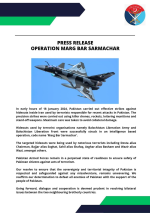

In both last conflicts, though small in nature like a skirmish, it was the use of stand off weapons which brought results with help from drones and aircrafts as well as jamming side of the things.I agree, but from a different angle.
Basically, our policymakers aren't concerned about initiating a nuclear conflict. Rather, they care about guaranteeing Pakistan's territorial integrity. If that is lost, then they'll go nuclear and, in turn, force the adversary into losing everything too.
Unfortunately, the Balakot episode showed that India didn't care about the nuclear threat. Rather, India will probe and instigate to see if our policymakers will "pull back" their red line. Yes, territorial integrity will trigger a nuclear response, but how much territory? Perhaps, at some point, India did wager that they could bite into Pakistan without triggering nuclear retaliation (i.e., Cold Start). But in turn, our policymakers decided that TNWs were a fair response to such situations.
Now, with Balakot, India isn't probing how much territory they can take, but how much insecurity they can create in Pakistan (via conventional means) without getting a nuclear response. This is a different problem to what the nuclear capability was designed for; now, we're not talking about the loss of territorial integrity, but national integrity. Citizens cannot feel safe closer to the border and, if left unchecked, India will expand its probing deeper into our territory (exerting a sense of de facto control over our affairs).
Thus, we're at a point now where 'conventional deterrence' is essential. Things like the long-range SAMs (across both the PAF and PA, possibly even the PN later) are there to help defend against a 'probe.' Likewise, the sudden and open emphasis on acquiring a stealth fighter (J-31), HALE UAVs, longer-ranged guided rockets, enlarging the surface fleet, adding AIP-equipped SWATS (thereby ballooning our SSP fleet to 12-16+ boats), etc, all point towards both neutralizing and following up on Indian probes with more Swift Retort-type operations.
The point being, if India decides to probe and, in turn, create insecurity for Pakistanis, then the Pak Army, Air Force, and Navy will carry out retaliatory measures which will cost India. This would start with neutralization of incoming threats (via SAMs, more tactical fighters like JF-17C/J-10CE, SWATS parked in our busy waters, frigates guarding SLOCs, etc), but then be followed up with very heavy conventional strikes. The heavy conventional strikes are meant to inflict a high cost, one that will be too high for India to continue probing. IMO, Swift Retort may have given India the idea that the Balakot-type ops - as undertaken at the time - was too expensive relative to the losses they had incurred due to Pakistan's response. And, in turn, they de-escalated.
So, overall, the conventional deterrence focus is now there to, basically, deter Indian probing in the future. IMO, for our policymakers, if India escalates into brinkmanship is irrelevant, or - devil's advocate here - a good thing. Why? Because Indian brinkmanship now interferes with American geo-political goals in Asia (containing China) and, in turn, invite American pressure on India (esp. if India started the 'panga' so to speak).
Well, this Fatah-2 episode confirms one important thing...what our military designates something before it's inducted doesn't mean anything. So, for all we know, the "P282" could be a supersonic-cruising AShM (like HD-1 or CM-302), while the ASBM is something else.
While the enemy has mired Pakistan in the labyrinth of terrorist attacks, which will take years for Pakistan to clean itself from, the next potent weapon that enemy might use will be IT related - repetitive cyber attacks against all command, control, database, and operational systems that Pakistan uses, even nuclear facilities.
While Pakistan may save its territory through use of nuclear weapons at some stage in a war, the enemy will not fight that war. The enemy will fight a war where it can subdue Pakistan and the nuclear weapons become ineffective in any deal that enemy throws at Pakistan.
Going back in recent history, how enemy has tested Pakistan's responses:
1. Fake surgical strike- nominating SF attacked targets in AJK along LOC.
2. Balakot strike - It was the long range missiles (SOWs) which came as the last option for both countries and both refrained. If Pakistan didn't have LR rockets and missiles (ALCM, CM, BM etc), India would have subdued Pakistan in some way or another to either fall to its knees or come up in a compromising situation somehow.
3. Infiltration of missile - checking Pakistan's response (politically and militarily) and defense system against incoming missiles. Pakistan had no worthwhile response.
4. Iranian conflict - Use of loitering munitions, drones, the good old aerial delivery system of long range missiles which are PAF's aircrafts along with long range MLRS.
In such short conflicts, Pakistan gives a good response using SOWs, but what about longer conflicts, such as a conventional war, albeit having low chances of occurring but can put strain on inventory of missiles, drones, and aircrafts.
The long term war is the war on terrorism, which is still a stalemate. This is where India wants Pakistan to bleed to death and so far there is no adequate response that Pakistan can provide since missiles and aircrafts stand aside in this conflict. Tanks and artillery sits uselessly. Infantry sits in their barracks while the paramilitary takes constant hits along with police. There is a flurry of repeated intel failures and no worthwhile military offensive is in sight for the infantry sitting in barracks.
Raises the question why 19 infantry divisions are sitting numb and what will be the future when automated processes of robot sentry's and surveillance systems based on sensors will become common for manning borders.
One more important thing- after the fake surgical strike by Indians, the SF's of both countries took a back seat. While there was a time when just like armor, it was the SF which was considered the spearhead in any tactical offensive to damage enemy, the behind enemy lines Ops, but its the drones that have been found to be 100-fold damaging to the enemy than SF being sent into enemy territory. The role has become limited like hostage rescue, anti terror Ops, protecting VIPs, etc. Those days of pathfinders and recon force, may get taken over by drones completely at some point. e.g. 1965 war, PA sent in SSG to damage/destroy IAF's airfield, now PA/PAF will send missiles, drones etc.
In the future, the supporting arm which always took a back seat in PA, will be the most important- Air Defense. The dynamics of modern war has shown use of aerial weapons and aerial weapons delivery platforms. These missiles, drones, loitering ammo, aircrafts etc can be deterred using proper use of technologically advanced AD systems.
If somehow Pakistan starts to combat terrorism effectively, the next attacks will be cyber through which the whole IT industry of India will spring into action.
Last edited:

AZADPAKISTAN2009
Elite Member


Fantastic video just like the Tea

safriz
Elite Member
Fateh 2 seems very large and heavy . Going by visuals, and the amount of dust it kicked up.
Even bigger than Nasr .
It's a collaboration between GIDS of Pakistan and some Chinese company.
May be a variant of WS-2D or WS-3.
Even bigger than Nasr .
It's a collaboration between GIDS of Pakistan and some Chinese company.
May be a variant of WS-2D or WS-3.

Kermit
Elite Member
There is no active collaboration with China to make FATAH-II. Never was. It is an old Pakistani project which was brought back to life. FATAH-I seems to share similarity with A-100s etc so it might be a reverse-engineered rocket. China, unfortunately, does not give free lunch like most Pakistanis and even foreigners believe.Fateh 2 seems very large and heavy . Going by visuals, and the amount of dust it kicked up.
Even bigger than Nasr .
It's a collaboration between GIDS of Pakistan and some Chinese company.
May be a variant of WS-2D or WS-3.
Comparing it to Nasr is like comparing apple and oranges.
FATAH-II has variants which might or might not share the same name due to different trajectory/flight paths and different classifications/roles.
It was needed to counter emerging AD threats.
Users who are viewing this thread
Total: 5 (members: 0, guests: 5)
Pakistan Defence Latest
-

-

-
 Federal cabinet gives nod to imposition of emergency in KP; summary sent to president (13 Viewers)
- Latest: IceCold
-

-

Country Watch Latest
-
 Iran - Israel/US War: Israel-US declare war on Iran, Iran responds (205 Viewers)
- Latest: Khorasan Black Flags
-
-

-
 Official B-21 Discussion Thread: Manufacturing ramping as operational capability expected in 2027 (2 Viewers)
- Latest: SolarWarden
-
Latest Posts
-
-

-
-

-
Iran - Israel/US War: Israel-US declare war on Iran, Iran responds (205 Viewers)
- Latest: Khorasan Black Flags