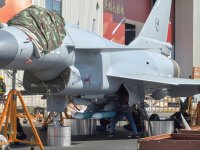
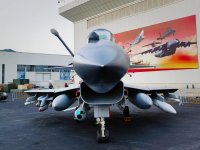
Due to limited imagery, it's difficult to determine exactly which type of missile it is. However, it cannot be the YJ-21 hypersonic missile or the so-called "miniature" version of the YJ-21 hypersonic missile.
Original image
View attachment 168185
1. Regarding the missile itself: A hypersonic missile needs sufficient range (>800 km) and sufficient destructive power to be militarily effective. These factors dictate that it cannot be too light. It is generally estimated that the air-launched version of the YJ-21 weighs between 2 and 4 tons.
2. From the image, we can see that the missile is mounted on the second hardpoint of the wing. When a fighter jet carries heavy payloads, it can only use the hardpoints near the wing root or the hardpoints under the fuselage. Mounting a heavy payload on the second hardpoint would put excessive stress on the wing and could easily lead to flight accidents. (
@HemlockKhalid/AeronautIR A pilot could probably explain this better.)
When a fighter jet carries a payload on its wings, the further the hardpoint is from the fuselage, the lighter the payload it can carry. Conversely, the closer the hardpoint is to the fuselage, the heavier the payload it can carry.
=======================================================
The J-10C/CE aircraft has three hardpoints on each wing.
Inner hardpoint:
Has the strongest load-bearing capacity. Typically used for carrying external fuel tanks, heavy air-to-ground munitions, etc.
Middle hardpoint:
Has a medium load-bearing capacity. Typically used for carrying BVR air-to-air missiles, light air-to-ground munitions, electronic warfare pods, etc.
Outer hardpoint:
Has the weakest load-bearing capacity. Typically used for carrying short-range air-to-air combat missiles.
=======================================================
Therefore, the missile in the image cannot be a hypersonic missile.