Pakistan gets the Chinese PL-17 long-range air-to-air missile targeting sensitive air assets
Pakistan's inclusion of the very long-range air missile is the Chinese PL-17, the origin of its J-10C Vigorous Dragon fighters, a detailed development in the Air Force Balances in South Asia, as the bases of the air conflict re-draws and breaks the patterns of traditional superiority by investing technology capable of threatening the most sensitive air assets of the opponents, even with the limited numerical size of the Air Force. Pakistani.
The PL-17 missile is designed to fight clashes at distances exceeding 400 km, and with its inclusion on an advanced platform of the fourth and a half generation such as J-10C, the concept of air superiority moved from the battles of close engagement and short-range missiles to a new level based on the strategic objective of the high-value targets located in the depth of the hostile air field.
However, the merger was not a simple technique. It was necessary to reinforce the combat structure to accommodate the huge missile with a length of 7 meters and a weight of approximately 2,500 kg, which imposed the development of central suspension points made of titanium and aluminum alloys, capable of withstanding the large load while maintaining the dynamic aerobic balance. These points were not just mechanical pregnant women, but rather advanced electrical-mechanical units equipped with high-capacity data channels and advanced energy systems, as an alternative to ancient mechanisms with air and hydraulic propulsion. Air control software has also been modified to compensate for changes in the center of gravity and ensure that the fighter remains maneuvering.
However, the most prominent challenge was related to the mechanism of scoring. The extent of the missile exceeds the capabilities of the KJ-7A AESA radar, which does not exceed half of the distance. So Pakistan built a multi-layer sensor network that includes ZDK-Karakoram Eagle, Long -range ground radars, and anti-stealth Chinese monitoring systems, as well as satellite and ground electronic intelligence data. All of these sources are integrated into the task computer for the fighter through advanced tracking algorithms that reduce the error margin to less than half a degree before the launch.
As for the missile itself, it depends on the triple -phase guidance system: navigation with self -deficiency during the average path, the active radar guidance in the final stage, and the negative tracking of hostile radar signs. The dual-direction data link also provides the Mermatian wave frequencies that the direction can be re-directed during flying and receives instant updates, which is immune to jamming thanks to the spectroscopy-liner jumping techniques associated with the electronic warfare system of the J-10C fighter.
Live experiences between 2024 and 2025 confirm these capabilities, as Pakistan has carried out 12 experimental absolutely against targets that simulate IL-78 early warning aircraft. The missile proved its ability to capture targets from a distance of 250 km, even in environments full of confusion, and the missile proved its ability to resist the simulator jams of the advanced Russian S-400 radars. His final speed has reached 6 Mach, giving the opponent a very limited time to respond.
But this force is matched by clear restrictions; The load of the missile reduces the internal fuel capacity of the fighter by 25%, to become the duration of the combat patrols less than two hours without air supply, as well as the radar fingerprint of the fighter from 1.2 m² to about 3.5 m², which reduces its ghost features compared to the Chinese J-20 fighter that can carry the missile internally (there are reports claiming that the internal room of J-20 cannot accommodate this The missile). Therefore, PL-17 is seen as a selective deterrent weapon devoted to targeting high-value assets instead of being normal ammunition.
The operational repercussions of this system are deep; Indian early warning aircraft such as A-50ei Falcon and Netra become an open target, as well as IL-78 fuel aircraft, and even Rafale fighters equipped with Cruise missiles. With India having to remove these assets for a distance of more than 450 km from the front, the scope of its air force is shrinking, giving Pakistan opportunities for air breakthroughs by manned or drone planes.
View attachment 142518
The PL-17 (NATO symbolic name: CH-AA-12 AUGER) or PL-20 is an atmosphere-oriented air missile that exceeds visual vision, developed by the People's Republic of China in favor of the Chinese Popular Liberation Army (Plaaf). The missile is alleged to have more than 400 km (250 miles) range, and it is designed to target high -value air assets such as air - tanker aircrafts and early warning and control planes (AEW & C).
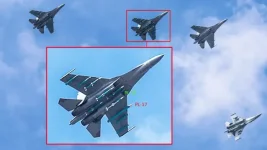
The missile was tested on the Senyang J-16 fighter, 2016, and can also be operated by the SU-30MKK and Su-35 fighters. The PL-17 is said to be a separate development of the PL-XX (PL-21) missile, which works with a Ramjet engine. In October 2022, the official Chinese media reported that the PL-17 missile entered service in the Chinese Air Force.
The PL-17 is characterized by its large size compared to the other long-range air-to-air missiles, with a length of 6 meters (20 feet), while missiles such as PL-15 and AIM-120 are about 4 meters (13 feet), allowing it to carry more solid fuel. This additional length makes the missile not suitable for the internal weapons room of the Chengdu J-20 fighter.
During flying, the missile depends on inertial guidance systems, satellite navigation, and data link to track targets. In the final stage, the missile operates the Multi -position, which includes active AESA radar, passive sensors, and infrared tracking to follow the target independently.
The missile is characterized by a low-thrust design, and its maneuvering is characterized by four small fins for control and engines with Variable drive steering motors. The missile is powered by a twin-pulse rocket engine and is fired on an elevated trajectory to achieve the declared range of 300–500 km(190-310 miles) according to various media sources, or 400 km (250 miles) according to the Royal United Services Institute, at a maximum speed of 4 Mach.
Source: defense-arabic.com