ALCM Taimoor
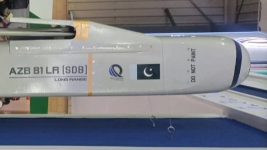
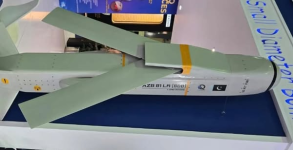
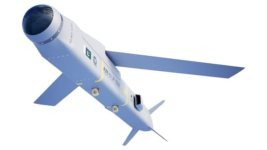
".....At the 2024 International Defense Exhibition and Seminar [IDEAS] in Karachi, Pakistan, Global Industrial and Defence Solutions [GIDS] showcased the Taimoor

Pakistan’s cruise missile inventory includes short-range land and sea-launched Babur, and short-range air-launched Ra’ad missiles. These missiles are aimed at providing credible deterrence against a wide spectrum of threats from India that include supersonic cruise missiles, acquisition of advanced air defence systems and conventional superiority as well. In a recent development, Pakistan successfully test-fired Ra’ad-II air-launched cruise missile (ALCM) on
February 17, 2020, with a reported range of 600 km and capable of delivering multiple types of warheads.
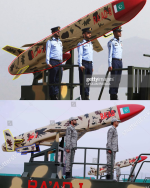
The Ra’ad-II cruise missile, which is an advanced version of the Ra’ad-I, is believed to be a ‘stealth’ with pinpoint accuracy. It is described as terrain hugging as well as a highly maneuverable missile. At present, the Ra’ad-II is attachable to Pakistan’s Air Force’s (PAF) Mirage-III aircraft with a provision to be integrated with the JF-17 thunder jets as well.
It is worth mentioning here that cruise missiles, unlike ballistic missiles, fly an essentially horizontal cruise path for most of the duration of their flights and can maneuver like a fighter jet through various waypoints. They are difficult to be located and provide a distinct advantage over ballistic missiles. Moreover, due to their varying altitudes during the flight, they are believed to be complex as far as their detection and interception are concerned, with the provision of air defence systems. This has been evident in how Iran’s cruise missiles reportedly penetrated the US
Patriot surface-to-air system (PAC-2) – one of the most advanced air defence systems in the world, in September 2019.
The PAC-2 has spectacularly failed to deter and defend against the reported cruise missiles attacks by Iran. The lapse was such that even the US Secretary of State
Michael Pompeo had to justify it by admitting that some of the finest air defence systems do fail sometimes when it comes to providing defence shield against the cruise missiles.
Coming to the relevance of air defence systems vis-à-vis cruise missiles in the South Asian context, it would be significant to highlight some prevalent factors. India is investing heavily in the provision of a sophisticated air defence shield aimed at deterring Pakistan. In this regard, at present, India possesses and intends to acquire some advanced air defence systems in its missile defence inventory that would likely cover a broad range of spectrums including cruise missiles.
These include indigenously developed ballistic missile defence systems such as the Prithvi Air Defence
(PAD) missiles, the Advanced Air Defence
(AAD) Ashwin missiles and the
Barak-8 missile defence system which has been jointly developed with Israel. Furthermore, to enhance its future capabilities which would also cover the spectrum of cruise missiles, India had also signed an agreement with Russia for the acquisition of the
S-400 anti-missile system back in October 2018, the delivery of which will start by the end of
2021. In another significant development, India reportedly intends to acquire the medium-range ‘National Advanced Surface to Air Missile System-II (
NASAMS-II) from the US. This system once acquired, would be an addition to India’s air defence inventory specifically focused on cruise missiles.
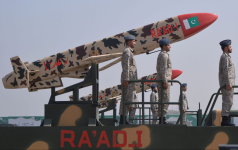
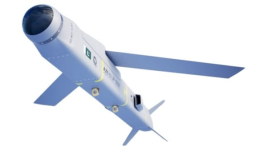
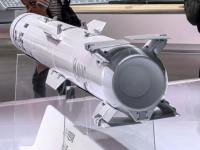
GIDS Taimoor is likely an export variant of the Air Weapons Complex (AWC) Ra’ad-II, one of the Pakistan Air Force’s (PAF) ALCMs.
Taimoor is capable of both land-attack and anti-ship roles.
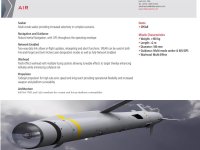
Taimoor turbojet-powered ALCM is a highly accurate, long-range, INS/GNAS-guided, all-weather ALCM. It is able to carry multiple types of conventional warheads for land attack precision missions on high-value targets. The terminal guidance is via an imaging infrared (IIR) seeker.
.
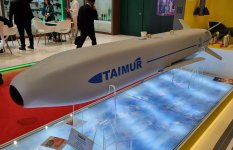
Taimoor ALCM weapon system weighs 2,500 lbs. The weapon is equipped with different warheads designed for lethality against specific targets including pre-fragmented, fragmentation blast, and penetrator warheads. The missile system technical specifications include a 290 kilometre range (MTCR exportable restricted range), an average cruise speed of Mach 0.7, a terminal speed of Mach 0.8.
The weapon can fly very low over ground at a programmable height using terrain contour matching (TERCOM) and Digital Scene Matching Area Correlator (DSMAC), thus reducing the detection probability and increasing survivability
Essentially it is a low observable, subsonic anti-surface weapon system. First unveiled at the IDEAS 2022, Taimur is a direct competitor to
MBDA Storm-Shadow/SCALP and Roketsan SOM (Stand-off Missile) in the export market.
The Taimur Air-Launched Cruise Missile (ALCM) is an anti-ship, export variant of Pakistan’s nuclear-capable
RAAD-II ALCM (600 km) optimized for deployment via fixed-wing aircraft for air-to-surface operations. It serves as both an anti-ship and land-attack cruise missile. Designed for stand-off engagements, it allows the launch platform to effectively engage distant targets up to 290 km.
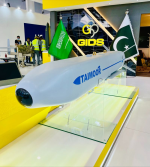
Taimur is Equipped with an imaging infrared (IIR) seeker for high-accuracy terminal guidance. It is also capable of terrain-hugging and sea-skimming capabilities, enabling it to fly at low altitudes while hugging the terrain or skimming over the sea surface. Operating at low altitudes, it maintains stealth and stability at subsonic speeds throughout its cruise.
Technical Specifications:
- Range: 290 Km
- Warhead Type: Blast: Fragmentation
- Navigation System: Ins / Gnss
- Length: 4.38 M
- Weight: 1100 Kg
- Wing Span: 3.2 M
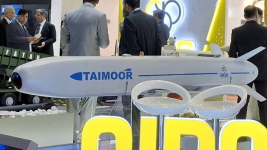
The missile’s advanced INS/
GNSS guidance system, coupled with its low observability, allows it to penetrate sophisticated air defense networks with high precision and reduced chances of interception. Based on a modular design, it is the third variation of the RAAD series of missiles, which is a testament to its upgradability, ensuring its relevance and effectiveness in rapidly evolving warfare."
-------------------------------