Pakistan Agriculture News / Discussions

KSA eyes corporate farming investment in Pakistan​

Discussions covered cooperation in rice, fodder (including alfalfa), meat, and selected agri-products​


11102824765634c.webp

Saudi Arabia has expressed interest in investing in corporate-scale farming in Pakistan under structured, long-term arrangements, read a statement on Wednesday.

The development came during a high-level meeting between Federal Minister for Commerce Jam Kamal Khan and Ibrahim Al‑Mubarak, Assistant Minister of Investment of the Kingdom of Saudi Arabia, held to review and advance bilateral cooperation in trade, investment, and joint engagement in regional markets.

During the meeting, the Saudi side expressed interest in corporate farming in Pakistan. It was noted that Pakistan already meets quality requirements, and that investment in corporate-scale farming, mechanisation, storage, and logistics could enable consistent exports of rice from Pakistan to Saudi Arabia under structured, long-term arrangements.

More broadly, in agriculture and food security, discussions covered cooperation in rice, fodder (including alfalfa), meat, and selected agri-products.

Both sides also explored the potential role of Saudi financing institutions in supporting export-linked agricultural and infrastructure projects in Pakistan, particularly those aligned with a guaranteed offtake to Saudi Arabia.

The meeting also examined corporate farming and mechanisation as long-term solutions to productivity challenges, including in crops such as cotton, where declining yields and high manual input costs have affected competitiveness.

Jam Kamal noted that export-oriented investment models could help revive agricultural output while supporting downstream industries, including textiles and yarn.

The meeting also reflected strong convergence of views on adopting an investment-led and partnership-based approach to economic cooperation. Both sides emphasised the importance of enhancing competitiveness, scaling up production, and strengthening value chains to unlock Pakistan’s export potential and meet growing regional demand sustainably.

A key focus of the discussion was the joint exploration of regional markets, particularly Central Asia, Africa, and ASEAN, identified as high-growth regions offering significant opportunities for collaboration.

The two sides agreed that Pakistan and Saudi Arabia, by leveraging their respective strengths, can position themselves as complementary partners—combining Pakistan’s production capabilities with Saudi Arabia’s capital strength, market access, and regional connectivity.

Human resource development emerged as another important area of collaboration. Both sides agreed that the most acute shortages across healthcare, hospitality, and services lie in the nurses, caregivers, technicians, and mid-tier hospitality staff, rather than senior professionals.

H.E. Eng. Ibrahim Al-Mubarak shared Saudi Arabia’s experience in vocational training and skills development and expressed openness to replicating train-to-deploy models in Pakistan, linking training programs with employment opportunities abroad.

Opportunities in building materials and construction inputs were also discussed, with the Saudi side noting substantial import requirements for products such as limestone, marble, aggregates, and other materials not locally available. It was agreed that focused engagement between Pakistani suppliers and Saudi building material trading companies could deliver early outcomes through direct private-sector matchmaking.

Both sides also exchanged views on expanding cooperation in pharmaceuticals, sports goods, footwear, and light manufacturing, recognising Pakistan’s growing industrial base and the scope for joint ventures, contract manufacturing, and split-production models targeting regional and global markets.

The meeting concluded with an understanding to pursue follow-up through sector-specific workshops and business-to-business engagements, aimed at translating policy alignment into tangible trade flows, investment projects, and employment generation, further strengthening Pakistan–Saudi Arabia economic relations.
 
This is positive development but we have to ensure that at least half of the agriculture products will be consumed in Pakistan in case of food emergency. Where is the water source for this project ? Rivers are running dry and water table has fallen over the years.
 
aik ur choran
This isn’t a Churan problem - it’s a “your ego is writing checks your intellect cannot cash” problem.

Because its clear from the earlier agriculture project failures that the wrong people were in charge and wrong decision makers who have zero qualifications other than “My family had lands”.

Until this establishment issue of “I know this” is solved - NOTHING can be fixed. This is the single biggest problem of rotten Pakistani culture (not just establishment) of thinking they know it all or pretending to for ego reasons.

This character flaw across the entire nation can be harmless(relatively) at Lahoris giving directions level to disastrous when at leadership level
 
This isn’t a Churan problem - it’s a “your ego is writing checks your intellect cannot cash” problem.

Because its clear from the earlier agriculture project failures that the wrong people were in charge and wrong decision makers who have zero qualifications other than “My family had lands”.

Until this establishment issue of “I know this” is solved - NOTHING can be fixed. This is the single biggest problem of rotten Pakistani culture (not just establishment) of thinking they know it all or pretending to for ego reasons.

This character flaw across the entire nation can be harmless(relatively) at Lahoris giving directions level to disastrous when at leadership level
There is a running joke in Israel about Palestinians never missing an opportunity to miss an opportunity. This might as well fit on Pakistanis too:
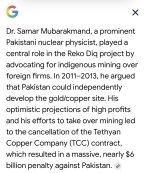
Dr Samar Mubarakmand, a physicist credited to have developed Pakistan’s nuclear weapons, was called upon as a witness at the International Center for the Settlement of Investment Disputes (ICSID) in 2012. He was asked what was the estimated worth of copper and gold that could be mined from Reko Diq, a site in western Balochistan. He stated that it could generate “a profit of 2,354 million US dollars per year or a total of 131,824 billion US dollars over the life of the mine.”

A lawyer who has represented Pakistan at the ICSID hearings says Dr Mubarakmand’s estimate contributed significantly to the almost six billion US dollar fine imposed on Pakistan for violating a contract with Tethyan Copper Company (TCC) that worked on finding and extracting copper and gold from Reko Diq for years. “His statement was the final nail in our coffin. He told the court exaggerated figures which helped it decide upon a higher quantum of the fine,” the lawyer says, sitting in a cozy office in a posh Lahori neighborhood. “I don’t understand what governments and officials have been doing in Balochistan. Their sheer incompetence has cost us billions of dollars that we should actually have earned from the mining project,” he remarks.
 
There is a running joke in Israel about Palestinians never missing an opportunity to miss an opportunity. This might as well fit on Pakistanis too:

You can see the systematic problem and what I said regarding Aqal e qul issue and also “don’t argue with elders” cultural phuddupan which btw Khan sb suffers as well to a massive degree.

Dr Samar is a brilliant man whom I have met a few times. But, why was he involved beyond his specific expertise even if broad due to his involvement in Uranium mining efforts?
Then, if he is called as witness where is the lawyer preparing him?
If the lawyer did not prepare him to not make such statements then shoot the lawyer in the ass. If the lawyer preparing him was not confident he would maintain his statements in court then the lawyer should have asked for his removal as a witness.

This is the idea of competence.

Jab lawyer hi bc ullu ke pathe hain tu marwao dunya ke saamne
 
Dr Samar is a brilliant man whom I have met a few times. But, why was he involved beyond his specific expertise even if broad due to his involvement in Uranium mining efforts?
He got himself involved due to your aforementioned 'Aql-e-Qul' syndrome commonly found among Pakistanis:
IMG_3073.jpeg
 
He got himself involved due to your aforementioned 'Aql-e-Qul' syndrome commonly found among Pakistanis:
View attachment 178235
Because no one dares argue with him. Ive seen how he is coddled and walked around in real life. He advocated for it based on the Uranium mining efforts and also - because there was a linked profit.

We assume everyone has the best intentions but interests come in. AQ Khan is a great example. Dr Samar’s family has their own business as well. I am not alleging this project had links but as a family those interests do come in. All smart people but are they qualified for everything?
 
The Arabs are not necessarily intelligent, but they are not foolish either.

KSA gets a nuclear umbrella and Pakistan gets an economic umbrella. It's a fair deal.

It's not foolish, they will make a return. Punjab and Sindh are now safe for mass investment.

It becomes a problem when its a Somalia or Sudan like environment which is the case in Balochistan and parts of KP. But the other 2 provinces are ready to go and we hope the others catch up soon.

When you have the scale of ultra cheap labour that Pakistan has, anything is possible. It just needs liquidity. Not these small $100 million deals, a heavy injection like India received.
 
Last edited:
KSA gets a nuclear umbrella and Pakistan gets an economic umbrella. It's a fair deal.

It's not foolish, they will make a return. Punjab and Sindh are now safe for mass investment.

It becomes a problem when its a Somalia or Sudan like environment which is the case in Balochistan and parts of KP. But the other 2 provinces are ready to go and we hope the others catch up soon.

When you have the scale of ultra cheap labour that Pakistan has, anything is possible. It just needs liquidity. Not these small $100 million deals, a heavy injection like India received.

In the grand scheme of things, no one really cares about the defense pact, as everyone knows Pakistan will not be able to deliver, you do not have the lift capability, the logistics to sustain a continuous supply of arms to both Pak Forces and allies among other issues; if you've noticed none on this forum, who are close to the military have given it much thought or value to this [Surprisingly, none has yet questioned why they've stayed silent?]

As for this: You do not have the infrastructure needed for large-scale corporate farming; there is a reason the military's project didn't take off. In this discussion, Pakistan offers the KSA regime an investment opportunity in infrastructure, but the question is why it would spend billions before seeing any returns, when, next door, it's a key-turn solution.

If anyone has been paying attention to KSA's domestic and economic policies, it's cutting back on its own projects due to liquidity issues and investing in companies and projects that don't require heavy lifting to get them off the ground.

Investors don’t just need opportunity; they need stability, predictability, and a system that rewards long‑term commitment. Pakistan hasn’t consistently provided that, in comparison to India.
 

Users who are viewing this thread

Country Watch Latest

Latest Posts

Back
Top