Pakistan Automobile Industries

Bikes, tractors and buses

The two- and three-wheeler sales increased by 35pc in February to 126,699 units year-on-year but fell 9pc month-on-month. This excludes numbers for Royal Prince Motorcycles and three-wheelers, as data is still awaited. Total two- and three-wheelers sales were 962,315 units in 8MFY25, a rise of 30pc year-on-year.

The total tractor industry recorded sales of 1,534 units during February, down 54pc year-on-year and 44pc month-on-month. Tractor sales were 29pc less at 21,692 units during 8MFY25 compared to last year.

Truck and bus sales in February were up 38pc to 486 units year-on-year while it fell 22pc month-on-month.

Mashood Ali Khan, an auto expert and a local vendor, said that overall car sales would remain brisk until June due to low interest rates, rising remittances, stable exchange rates, falling inflation, etc.

However, the situation will change from July as much will depend on the IMF-dictated policies for the industrial sector in budget 2025-26.

He believed that people drawing Rs200,000-225,000 salary could not purchase brand-new locally made cars. As a result, they are shifting towards new 100-150cc bikes. No serious efforts are being made to lower the prices of four-wheelers.
 
Vietnam devastated by wars is now exporting domestic “Vinfast” cars to North America. Mr. 10% and other leeches will milk any investor in Pakistan. The entrepreneurs leave Pakistan to greedy and criminal feudals and generals.
 
𝗜𝗧𝗧𝗘𝗙𝗔𝗤 𝗚𝗥𝗢𝗨𝗣 | Ground Breaking Ceremony of 𝗕𝗬𝗗 𝗠𝗲𝗴𝗮 𝗠𝗼𝘁𝗼𝗿 𝗔𝘀𝘀𝗲𝗺𝗯𝗹𝘆 𝗣𝗹𝗮𝗻𝘁 at Gharo Sindh 𝗣𝗮𝗸𝗶𝘀𝘁𝗮𝗻
🇵🇰


Ittefaq Group has officially conducted the Groundbreaking Ceremony, in which senior leadership of BYD from 𝗖𝗵𝗶𝗻𝗮 also participated for the prestigious 𝗕𝗬𝗗 / 𝗠𝗲𝗴𝗮 𝗠𝗼𝘁𝗼𝗿 Assembly Plant in Gharo Sindh .

Ittefaq Group has been 𝗔𝘄𝗮𝗿𝗱𝗲𝗱 the Civil Works contract for this landmark project (𝟭.𝟰 𝗠𝗶𝗹𝗹𝗶𝗼𝗻 𝘀𝗾 𝗳𝘁) a significant milestone in Pakistan’s automotive sector.

© Ittefaq Group
 
EV snapshot of Pakistan

For a country that’s spent decades running on petrol and diesel, the idea of plugging in your ride instead of filling it up is still unfamiliar for most. And yet, something has started to move, slowly and quietly.

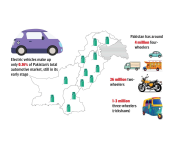
Pakistan’s EV footprint is still small, less than 0.2% of all registered vehicles in the country, according to figures shared by the Engineering Development Board this year. It's the kind of statistic you can miss if you blink. But it also tells you the first steps have been taken.

The focus so far has been on volume, and volume, in Pakistan, lives on two and three wheels. Which is why it’s not surprising that of the 57 EV manufacturing licenses issued by the government, most are for electric bikes, scooters, and rickshaws. In the last fiscal year alone, nearly 33,000 EVs were rolled out by these local players, small numbers compared to traditional vehicles, but a crucial first wave.

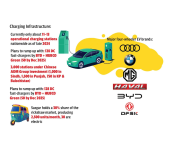
What’s lagging, though, is the infrastructure. In a country of over 220 million people, there are just a handful of public EV charging stations, most of them concentrated in Karachi, Lahore, and Islamabad. In late 2024, the number hovered just above a dozen.
 
Companies like BYD and Hubco Green are now working on plans to install 128 fast chargers by the end of 2025. The government says it wants to take that number to 3,000 over the coming years, with 40 locations already earmarked along motorways. The plan is to space them about 100 kilometers apart, enough, in theory, to make intercity EV travel more viable.

There’s optimism on the policy front, too. The updated National Electric Vehicle Policy (2025–2030) sets an ambitious goal: shift 30% of all new vehicle sales to electric by the end of this decade. The government is backing this with financial incentives, subsidies for over 100,000 electric bikes and thousands of e-rickshaws, including quotas reserved for women riders.

The math supports the urgency. Road transport is a major contributor to urban air pollution, responsible for close to half of it, according to various environmental assessments. Add to that the 60% chunk of national petroleum consumption that goes into fueling cars, motorcycles, buses, and trucks. The cost isn’t just environmental. It’s financial, political, and it's also showing up in people’s lungs.
 
Four-wheelers – big leap with big barriers

For most middle and upper-income Pakistanis, the idea of owning an electric car still sits somewhere between aspiration and uncertainty. The appeal is clear: no fuel queues, lower running costs, and greener footprint. But turning that promise into reality is another story.

Right now, four-wheeler EVs in Pakistan cater mostly to early adopters who can afford higher upfront cost and have a second car just in case. Danish Khaliq, VP Sales and Strategy at BYD/Mega Motor, sees this firsthand. “Our users are the ones who can charge at home, who are excited that a global brand like BYD is here,” he says. “They want to try it.”

But even for this niche, convenience has its limits. “There’s still dependency on commercial charging infrastructure,” he explains, especially for longer trips. And while a fast charge takes about 20 to 25 minutes, he points out it’s not unfamiliar. “Pakistan is a nation that has stood in CNG lines for an hour. So yes, 25 minutes is a lot, but we’ve done worse.”

BYD’s response has been to build smarter, not wider. Through Hubco Green, they’ve partnered with PSO, Total, and others to roll out 50 fast-charging stations by the end of 2025, with plans to double that the year after. But Danish is quick to note that hardware alone isn’t enough.

The bigger issue, he says, lies in policy design. “The government introduced a tax structure where EVs with batteries larger than 50 kWh are taxed at 18%, plus 3% more. Smaller batteries are taxed at 12.5%,” he explains. “The intention was affordability, but they’ve penalized range, which is exactly what people want in a car.” Range anxiety, he adds, remains one of the biggest psychological blocks for buyers.

Still, he acknowledges the intent. “The current auto policy was designed five years ago to attract investment, and in that, it worked. But there are nuances that need better understanding.”

Miral Sharif, Country Head at Yango Pakistan, echoes the concern but adds another layer. For a ride-hailing company, electrification isn’t just climate-driven, it’s economic. “Lowering operational costs are essential. Our pilots show EVs reduce them by 35%,” she says. “That’s a game-changer for our drivers.”

Until policy, infrastructure, and public confidence align, four-wheeler EVs in Pakistan will remain more ambition than mainstream.
 
Two and three-wheelers

If you want to know where Pakistan’s electric future is most likely to take root, look away from elite showrooms and towards the congested, noisy, unpredictable roads where bikes and rickshaws outnumber cars by millions. This is where the EV shift, if done right, will matter the most.

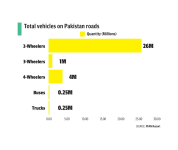
With more than 26 million motorcycles on the road, and millions of three-wheelers, the volume, and the opportunity, sits on two and three wheels. From delivery riders and gig workers to students and small business owners, this segment represents the face of urban mobility in Pakistan.

Shah Talha Sohail, co-founder and CEO of Mode Mobility, an automotive design and engineering company, has been working in this space since 2020, long before EVs became a talking point in budget speeches. “Back then, we didn’t know 2025 could be the year of EVs, and 2026 even better,” he says. “But now, people come to us wanting to buy an EV. It’s not about selling the idea anymore, it’s about helping them pick the right one.”

That shift didn’t happen overnight. It took early adopters willing to take a risk, and manufacturers willing to learn. “EVs are still a high-risk purchase,” Sohail admits. “People don’t know if the claimed battery life will hold up. But consumers are evolving. There’s some push, some pull, we’re somewhere in between. That’s actually a good place for Pakistan to be right now.”

What complicates the picture, though, is the sudden flood of opportunistic entrants. “Every morning there’s a new paddle boat and two-wheeler in the market,” Sohail says. “It’s easy to import a $300 kit from China, assemble it, and sell it for triple. But that’s not our game. Our strength is design and engineering, creating something that actually fits this market and lasts in our conditions.”

That kind of thinking, build local, build durable, is echoed by Ali Moeen Malik, co-founder of ezBike. His company started as a bike-sharing service and evolved into one of Pakistan’s few EV startups focused on manufacturing and conversion. “We realised early on that most people couldn’t afford a new EV bike,” he says. “So we started converting existing 70cc motorcycles into electric ones.”

The conversion reduced upfront costs by as much as 75%. “People were converting their bikes for around Rs60,000-Rs65,000,” he says. “Most of them recovered that money through fuel savings in less than six months.”
 

Sazgar records ‘second-highest’ 4-wheeler sales in June 2025


Salman Siddiqui
July 4, 2025

The Sazgar Engineering Works (SAZEW) reported on Friday that it had sold 1,349 units of its 4-wheelers in June 2025, a number that a local research house said was the company’s second highest in a month.

The company anticipated in April 2025 that the demand for automobiles would boost in the wake of economic stabilisation and reduced interest rates in Pakistan.

SAZEW rolled out its first four-wheeler in August 2022 in Pakistan under a joint venture with Great Wall Motor (GWM) of China.

According to a notification SAZEW sent to the Pakistan Stock Exchange (PSX), its sales in the month of June were notably higher compared to production of the vehicles reported at 985 units in the month under review.

In a brief commentary, Topline Research said, “SAZEW records second highest 4-wheeler sales in June 2025”.

The sales hit 1,349 units in June 2025, surging by 47% compared to the previous month of May. The sales jumped 2.55-time in June compared to the same month of the last year. With this, the company’s sales doubled in a year, rising to 10,844 units in FY25 compared to FY24, according to the research house.

The company sold 2,435 units of 3-wheelers in June 2025 that remained significantly high compared to the production of 1,420 units of the vehicle in the month, according to the notification.

According to the third quarterly financial statement of the company of March 2025, it sold a total of 8,313 units of 4-wheelers in the first nine-month (Jul-Mar) of FY25 that were 159% higher compared to 3,205 units sold in the same period of FY24.

“Auto sector is gradually recovering and progressing towards higher sales volume in line with economic stabilisation. Lower interest rates are expected to boost the auto financing and demand of vehicles in the country,” financial statement read.

At present, SAZEW is marketing around six cars including a hybrid electric vehicle (HEV) Haval in Pakistan. It is expected to roll out NEV [New Energy Vehicles] into the Pakistani market in the latter part of FY26, as the automaker announced to raise the capital expenditure (CapEx) of its NEV facility by 155%.
 

Car sales in Pakistan jump 43% in fiscal year 2024-25


KARACHI: Car sales in Pakistan jumped by 43% in the fiscal year 2024-25, the Pakistan Automotive Manufacturers Association (PAMA) reported on Thursday, an increase that analysts attributed to stable macroeconomic environment, introduction of more variants, lower interest rates, and improving consumer sentiment.

In FY25, car sales (including jeeps and pick-ups) stood at 148,023 units, against 103,829 units reported in FY24.

In June 2025, car sales clocked in at 21,773 units, reflecting a 64% year-on-year (YoY) and 47% month-on-month (MoM) rise.

“The YoY growth is supported by a more stable macroeconomic environment, introduction of more variants, lower interest rates, easing inflation, and improving consumer sentiment,” said Myesha Sohail from Topline Research in a statement.

According to PAMA data, except for farm tractors, sales of all vehicles including two, three and four-wheelers gained momentum.

Sales of jeeps-cum-pickups increased by 61% to 35,820 units. Trucks and buses sales went up by 103.2% to 4,444 units and by 73.6% to 788 units, respectively. Sales of motorcycles and rickshaws also shot up by 32.1% to 1,518,752 units.

Meanwhile, sales of farm tractors sharply fell down by 36.4% to 29,192 units as both farmers and progressive farmers face economic issues due to climate change and lower prices of their output.

Talking to Business Recorder, auto sector expert Muhammad Sabir Shaikh said tractor sales fell because growers could not get better prices of their respective last agricultural produce.

A dramatic decrease in the interest rate and easy leasing policies of banks pushed up car sales and customers are nipping down to new vehicles while getting rid of old ones, Shaikh added.
 

Launch of new models: car sales in Pakistan jump 28% in July 2025


Salman Siddiqui
August 12, 2025

Pakistan car sales surged 28% on year-on-year (YoY) basis in July 2025, rising to 11,034 units apparently due to launch of a number of new models in recent months and availability of car financing at affordable interest rate.

Car sales had stood at 8,589 units a year ago in July 2024, according to Pakistan Automobile Manufacturers Association (PAMA) data.

“The year-on-year growth is due to a more stable macroeconomic environment with lower interest rates and easing inflation which has improved consumer sentiment,” Topline Research’s analyst Myesha Sohail said in a commentary.

Sohail added, “we expect the momentum in auto sales to continue in FY26, supported by lower interest rates and a strong pipeline of new model launches across various engine types, including hybrid and plug-in hybrid”.

The July sales, however, declined 49% month-on-month (MoM) basis which is “mainly attributed to the high base effect from Jun’25, when sales spiked due to a surge in pre-buying ahead of the increase in vehicle taxes, namely the imposition of the electric vehicle (EV) adoption levy and the increase in sales tax (ST) on 850cc vehicles from 12.5% to 18% under the FY26 federal budget,” AHL Research’s analyst Menka Kirpalani said in another commentary.
 
Company wise sales

Indus Motor Company (INDU) recorded a two-fold year-on-year increase in sales to 3,337 units.

The growth was led by a 17% MoM rise in the ‘Fortuner and IMVs’ segment, while demand for Corolla, Yaris, and Cross also remained robust, according to Topline.

Hyundai Nishat’s sales grew 2.1-time YoY to 1,225 units.

“The Hyundai Porter was the only model to post MoM growth, rising 31%, while the Tucson and Elantra recorded 5-time and 4-time YoY increases, respectively.”

Sazgar Engineering (SAZEW) sales rose 31% on YoY basis in the month under review.

“The increase in sales was supported by clarity from the company that budget had no impact on its flagship car Haval prices. Sales were also supported by the launch of the new HAVAL facelift, with further growth expected from August onwards following the introduction of the H6 PHEV variant,” Topline commentary read.

Honda Atlas Cars (HCAR) recorded a 61% YoY increase to 1,500 units in July 2025. Pak Suzuki Motor Company (PSMC), however, posted an 18% YoY decline.
 
Two-three wheelers sales

Two and three wheeler sales rose 44% YoY in July 2025, rising to 122,441 units. Electric motorcycles and three-wheelers, newly added to the data, accounted for 542 units of the total. “Road Prince figures are still awaited and could add 2,000 units to the total.”

The total tractor industry recorded sales of 1,195 units, down 18% YoY and 57% MoM. “Tractor sales fell on year-on-year basis due to weak farm economics, in our view,” Sohail said.

Truck and bus sales in July 2025 were up 22% YoY while down 49% MoM, reaching 374 units.
 

Users who are viewing this thread

Latest Posts

Back
Top