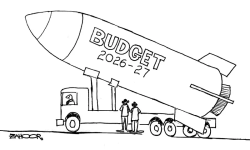
Pakistan Budget for FY 2026-27

Budget FY27: Carrots fade


June 1, 2026
BR Research

Earlier, expectations were building around some relief in the budget and a possible transition from stabilization to growth. Formal businesses and employees kept highlighting the unfairly high taxation on them — and rightly so — while real estate players had high hopes for sectoral relief. There were also promises made to exporters and others.

For the past few months, the government kept showing them all carrots. However, the way things are culminating, there may not be much in the offing. The budget numbers — the bottom lines — are already being decided with the IMF, and the debate is now about how to achieve them.

The IMF is showing no leniency despite rising global oil prices, and to meet the numbers, the government may have to forgo most of its promises to the business community and salaried individuals.
 
The reliance on taxation through the petroleum levy is likely to increase at a time when oil prices are rising. The federal government’s yield from the petroleum levy is 2.5 times higher than what it gets from taxes collected by the FBR.

For instance, for every Rs100 collected by the FBR, the federal government gets only around Rs40, while in the case of the petroleum levy, the full Rs100 is retained by it.

Thus, petroleum prices are likely to remain high, keeping inflation elevated amid low growth. The salaried class may get some small actual relief — and much more relief in government advertisements.

There may be some reduction in tax liability for low- to middle-income groups, while higher salary brackets may get some relief through a reduction in the tax surcharge.

Similarly, the corporate sector may get some token reduction in super tax, but it may not get what it wants in terms of easing intercorporate dividend taxation, relaxation in minimum taxes, and other demands. Formal businesses and export-oriented firms are therefore likely to continue facing a disadvantage.
 
Traders will remain the blue-eyed boys, while real estate players may get some relief — as they already have in the form of changes to Section 7E.

The government is now returning to the old formula of trying to generate growth through a real estate pump. The eventual dump could come in the form of another balance of payments crisis. But it appears the government is losing patience.

A big hit may be coming for domestic power consumers using 200 units or less. The government is likely to end cross-subsidies for them, and they may face a sharp increase in bills amid rising fuel cost adjustments.

The benefit may not be passed on to those who are currently subsidizing them; instead, it may be used to lower power sector subsidies.

This could bring a new round of inflation and more clamor. But more of the same is likely to continue.
 
To view this content we will need your consent to set third party cookies.
For more detailed information, see our cookies page.
 
IMG-20260602-WA0033.jpg
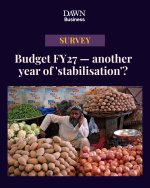
SURVEY: It has been a difficult few years, with purchasing power eroded by inflation and ever-higher taxes. As Pakistan prepares for the FY27 budget and the government seeks to maintain IMF-backed reforms, tell us how the past year has affected your household finances.

This annual survey gauges the impact of the economy and the federal budget on household budgets. The results will be published in Dawn's Business & Finance pages.

Take the survey: https://docs.google.com/forms/d/e/1FAIpQLSfVZ8Afe1uvSwRRO5xdCX9Xmg57aiTH3CEs_QVJ0Axqq-Hocg/viewform
 

Govt to announce budget on June 10 instead of June 5, says parliamentarian

  • Earlier, NEC meeting was postponed to facilitate further deliberations
June 2, 2026
Tahir Amin

Pakistan government will present its annual budget on June 10 for the financial year 2026-27, it was learnt on Tuesday.

Senior Pakistan Muslim League-Nawaz (PML-N) leader and Member of the National Assembly (MNA), Tahira Aurangzeb, confirmed to Business Recorder that the federal budget, which was earlier scheduled to be announced on June 5 (Friday), would now be presented on June 10 (Wednesday).

She also disclosed that the National Assembly session convened for the budget presentation had been postponed accordingly.

When asked about the reasons behind the delay, the parliamentarian declined to elaborate on the factors prompting the rescheduling.

Earlier, the National Economic Council (NEC), chaired by Prime Minister Shehbaz Sharif, postponed its crucial meeting, scheduled to be held tomorrow, to facilitate further deliberations on the upcoming budget.

“It is to inform that the meeting of the National Economic Council (NEC) scheduled on Wednesday, 3rd June, 2026, has been postponed. New date will be communicated in due time,” read the notice by the Cabinet Division.

The postponement of the NEC meeting is particularly significant as the constitutional body is required to approve key macroeconomic targets and endorse the size of the Public Sector Development Programme (PSDP) before the federal budget is formally unveiled.
 
Federal Minister for Planning, Development and Special Initiatives Ahsan Iqbal said that the Ministry of Finance allocated Rs1.126 trillion for the PSDP 2026–27 against total development requirements of Rs4.097 trillion, resulting in a funding gap of nearly Rs3 trillion.

Meanwhile, another factor contributing to the delay is the government’s continuing engagement with the IMF over the fiscal framework underpinning the upcoming budget, said sources.

Pakistan is currently navigating negotiations related to revenue targets, expenditure rationalisation and fiscal consolidation measures, making IMF consultations central to the finalisation of the budget architecture.

Sources said authorities wanted to ensure broad alignment with IMF expectations before locking in spending commitments and announcing taxation measures.
 
*Federal Budget Presentation Delayed as NEC Meeting Postponed*
_ISLAMABAD:_ The presentation of the federal budget, initially scheduled for June 5, has been delayed.

According to sources, the National Economic Council (NEC) meeting slated for June 3 has been postponed, and a formal notification confirming the delay has been issued. The notification states that a new date for the NEC meeting will be announced at a later time.

Sources indicate that a definitive new date for the presentation of the federal budget has not yet been finalized. However, it is anticipated that the budget will likely be presented on either June 8 or June 12.

Meanwhile, sources within the National Assembly have provided a different timeline, suggesting that the federal budget is expected to be unveiled on June 10.
 
seems the govt alongwith IMF wants to create chaos/anarchy and riots by people in the country if theyre going to tax the people to death on everything

while they still won't curtail their useless spending/wasting/corruption of the taxpayers money, what a shitshow.
 
IMG-20260603-WA0041.jpg
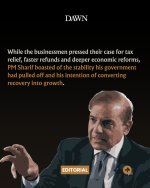
EDITORIAL: As the government prepares the budget for FY27, Prime Minister Shehbaz Sharif’s meeting with the country’s leading businessmen on Monday offered a glimpse of the wide gap that exists between the two sides’ perception of Pakistan’s economic recovery. While the businessmen pressed their case for tax relief, faster refunds and deeper economic reforms, Mr Sharif boasted of the stability his government had pulled off and his intention of converting recovery into growth.

The government’s narrative is simple. After saving Pakistan from a likely sovereign default, restoring macroeconomic stability, reducing inflation and complying with the IMF programme, officialdom believes the foundation for sustained recovery has been laid. PM Sharif argued that the next phase would focus on growth. He did not say when. But the businessmen’s proposals suggest that much of the private sector is unconvinced that the investment climate has improved.

Read more: https://www.dawn.com/news/2004833/missing-confidence
 
View attachment 199919
EDITORIAL: As the government prepares the budget for FY27, Prime Minister Shehbaz Sharif’s meeting with the country’s leading businessmen on Monday offered a glimpse of the wide gap that exists between the two sides’ perception of Pakistan’s economic recovery. While the businessmen pressed their case for tax relief, faster refunds and deeper economic reforms, Mr Sharif boasted of the stability his government had pulled off and his intention of converting recovery into growth.

The government’s narrative is simple. After saving Pakistan from a likely sovereign default, restoring macroeconomic stability, reducing inflation and complying with the IMF programme, officialdom believes the foundation for sustained recovery has been laid. PM Sharif argued that the next phase would focus on growth. He did not say when. But the businessmen’s proposals suggest that much of the private sector is unconvinced that the investment climate has improved.

Read more: https://www.dawn.com/news/2004833/missing-confidence

People are getting fed up with stability phase that is never ending. No reform, just stability through IMF program is retarded.
 

Users who are viewing this thread

Country Watch Latest

Latest Posts

Back
Top