Pakistan Constitutional Amendments:

Its ok bro. Not here to argue. There are different stages a country has to go through and its institutions allowed time to build.
Coming back to the topic, clearly suggests amendment is just for show, and we all know whose calling the shots.
So let the game continue and Pakistan grow albeit at a stunted rate.

Pakistan was literally facing a 'fiscal default' barely three years ago. You know what that would mean for Pakistan? And look at where Pakistan now in comparison. While it remains to be seen how well the economy is going to perform in next ten years, I have a strong faith in Pakistan's revival, especially boosted by Modi's folly of Operation Sindoor.
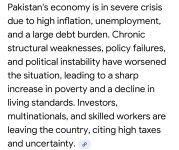
We will see what happens but short of a devastating war against India, I see Pakistan is going to be in a MUCH better place in 2030 and even better in 2035 should there be stability and focus which this Const. Amendment is trying to engineer.
 

Slide into authoritarianism

Maleeha Lodhi
November 10, 2025

The writer is a former ambassador to the US, UK and UN.

PAKISTAN’S slide into authoritarianism has been unmistakable over the past three years or more. Now a fresh move will reinforce the trend of democratic regression.

The 27th constitutional amendment tabled in parliament will alter the country’s judicial structure with significant implications for governance and democracy.

Last year, when parliament adopted the 26th Constitutional Amendment, it was done in the darkness of night, without providing the final text to lawmakers before being tabled. The entire legislative process lacked transparency and was over in hours in parliament.

Official coercion to secure the required two-thirds vote robbed the process of legitimacy. But the controversial amendment passed, making the judiciary subservient to the executive and undermining the rule of law. Consequently, the government won every case concerning constitutional interpretations.

The proposed 27th constitutional amendment seems to follow a similar path. It was kept under wraps until PPP leader Bilawal Bhutto-Zardari disclosed the government had sought his party’s support and revealed the amendment’s key elements. This set off a public furore with constitutional lawyers calling this ‘state capture of the judiciary’, opposition leaders dubbing it as a ‘power grab’ directed by the establishment and others deeming it as a ‘threat to democracy’ and ‘assault on the notion of separating justice from politics’.
 
When officers and soldiers in uniform engage in activities outside their military profession, do you expect conversation to be restricted to just the operational aspects when discussing the role of the Chief of Defense Forces?

It's up to the military to provide substance for us to discuss. The majority of the country is still trying to determine whether this is a political party, a business conglomerate, or a standing professional military.

Please let us know which alphabet character they choose so we can have a proper discussion moving forward.

The COAS has been involved in politics in one way or another, Bajwa was no less involved in politics than Asim Munir, so this is not a new revelation. Having said that, this is a Defence Forum, where we are supposed to be discussing operational aspects of changes in the Armed Forces structure, but some people just cannot see past their cult leader.
 
As presented in the Senate, the 27th Amendment consists of the following core elements. Establishment of a federal constitutional court, transfer of high court judges between courts and changes to Article 243 which concerns the control and command of the armed forces.

The 27th constitutional amendment is part of the broader trend towards democratic backsliding.

Establishment of a federal constitutional court was also attempted by the government in the 26th Amendment. But due to fierce opposition, constitutional benches were instead set up in the Supreme Court and high courts. That too was criticised because the composition of benches, influenced by the executive, empowered the government to choose which judges could hear constitutional cases of concern. It all but took away that jurisdiction from regular benches.

Objections to a constitutional court rest on solid ground. Packed with judges chosen by the government it will set up a parallel executive-compliant court. This will denude the Supreme Court of its jurisdiction in constitutional cases and those relating to fundamental rights. Meanwhile, the proposal to transfer high court judges between courts, without their consent, will mean the executive will be able to sideline ‘independent judges’ through its influence on the judicial commission, empowered to do this.
 
Grow? Grow where? Into more mess with this increased authoritarianism? 🙄
The system is designed to push the good ones out for remittance and the keep the elite corrupt to blackmail them into doing ‘their bidding’.

A symbiotic relationship of sorts.
 
Originally the proposed amendment also included rollback of constitutional safeguards for provincial shares in state revenues determined by the National Finance Commission Award, which guarantees they are not reduced. While the fiscal logic for this was understandable as the federal government is left with limited resources to meet its expenditure, the PPP opposed this as unacceptable erosion of the 18th Amendment. This was then dropped from the amendment but with ministers indicating it might be taken up later.

Modification of Article 243 of the Constitution, which gives the government control and command of the armed forces, is predicated on the argument that defence needs have changed as a result of modern warfare while the post of field marshal necessitates constitutional recognition.

The amendment bestows wider constitutionally sanctioned powers and privileges to the top military leadership. The office of Joint Chiefs of Staff Committee (headed at different times by the army, air force and naval officers who were supposed to do so by rotation) is to be abolished. Instead, the new post of Chief of Defence Forces will be created, to be held by the army chief.
 
The Field Marshal, Marshal of the Air Force and Admiral of the Fleet are all given legal immunity akin to the president’s and can only be removed by impeachment.

They will remain in uniform and retain the rank for life with the same privileges and immunity. The effect of all this is to further shift the power balance to the military from the civilian system.

Seen in the context of democratic erosion in recent years, the 27th amendment delivers another blow to democracy by further emasculating an independent judiciary. There have been a series of democratic reversals under the hybrid government-plus arrangement.

Every indicator of democracy has shown regression. Parliament has been reduced to a rubber-stamp, freedom of assembly restricted, opposition suppressed, media controlled, independence of the judiciary compromised and the civil-military balance skewed to the latter’s advantage by a ruling coalition happy to act as a subservient junior ‘partner’.

It can be argued that democratic backsliding is nothing new and similar to what happened in the past. Previous periods of civilian rule also saw governments take repressive measures — crackdowns on opposition, jailing of opposition leaders on trumped-up charges, marginalisation of parliament, muzzling the media and undermining judicial independence.
 
While the present situation has echoes of the past, the nature and extent of democratic erosion makes it different. Previous civilian governments would persecute political opponents and take other autocratic measures including eroding judicial independence and controlling the media, but they would do so mostly on their own without the establishment’s direct involvement.

That changed after 2018 and more so after 2022. The establishment became directly involved in efforts to ‘control’ the opposition, courts, media and digital space. This expanded its sphere of political interventions in an unprecedented way. Perhaps what ‘necessitated’ this was that the government installed after the 2024 election had little political weight as it rested on a dubious mandate. So, it needed to be shored up.

Past periods of civilian democracy did not see continuous bans on political protests and public assembly as happens now. Moreover, targeting of political opponents is now accompanied by efforts at broader repression. Raids on opposition leaders’ homes and incommunicado detention of party activists are part of the present government’s inventory of repressive actions. Because there is more to control, the government has gone much further than its civilian predecessors in micromanaging the electronic media and imposing curbs on digital space.
 
The COAS has been involved in politics in one way or another, Bajwa was no less involved in politics than Asim Munir, so this is not a new revelation. Having said that, this is a Defence Forum, where we are supposed to be discussing operational aspects of changes in the Armed Forces structure, but some people just cannot see past their cult leader.

You bet if Imran was the current PM, then these same people reflexively objecting would be supporting this move. Imran never showed a shred of collective wisdom in his thought processes while he was the PM and he was already engineering a behind the scenes 'arrangement' with some top Generals to prolong his power for the next ten years.
 
Against this backdrop the 27th constitutional amendment is part of a broader pattern of Pakistan’s slide to an undemocratic system.

But as the country’s history shows, aggrandisement of power and manipulation of law neither makes a government secure nor guarantees its future. It only exposes its lack of self-confidence and absence of faith in democracy.
 

Users who are viewing this thread

Pakistan Defence Latest

Back
Top