Pakistan Exports / Imports - Updates

Pakistan’s seafood exports cross $500mn milestone for first time

  • Pakistan is expanding its global reach with new markets and a planned $60-80 million seafood processing zone
Published May 16, 2026
1778931120134.jpeg
Photo: Reuters/ File

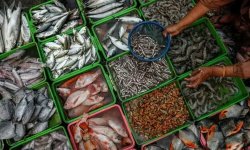
Federal Minister for Maritime Affairs Muhammad Junaid Anwar Chaudhry on Saturday announced that the country’s exports of fish and fisheries products have surpassed the $500 million mark for the first time, calling it a landmark achievement for the maritime sector and the blue economy.

The minister said the government’s target of $500 million for the current fiscal year was reached 46 days before the year-end.
He attributed the milestone to government reforms, improved facilitation and expansion into new markets aimed at strengthening the maritime economy and boosting export potential.

Chaudhry praised coordinated efforts by the Ministry of Maritime Affairs, the Marine Fisheries Department and other stakeholders to raise quality standards, modernise the fisheries sector and improve international market access. He also commended Marine Fisheries Board Director General Dr Mansoor Wasan and his team for meeting the target ahead of schedule.

Highlighting recent gains, the minister said Pakistani fish and seafood had for the first time gained approval to enter the Russian market.

To date, 16 Pakistani companies have been authorised to export seafood to Russia. He said access to Russia could pave the way into other Eurasian Economic Union markets. He estimated that annual seafood exports could climb to $800 million, with initial exports to Russia alone projected to bring about $300 million in revenue.

Chaudhry noted that seafood would move via sea, air and land routes, adding that overland corridors to Central Asia offered cost-effective opportunities amid rising demand in Kazakhstan, Uzbekistan and Turkmenistan.

Referring to sector performance, the minister said the marine fisheries sector posted strong growth in the first half of fiscal 2025–26, with exports reaching 122,629 metric tonnes valued at $253.24 million between July and December 2025. In the same period the previous year, exports were 102,942 tonnes worth $208.25 million, a year‑on‑year increase of 19.1% in volume and 21.6% in value.

Frozen fish remained the top export category with shipments of 26,669 tonnes valued at $53.33 million. Shrimps and prawns generated $40.46 million, and frozen cuttlefish contributed $36.13 million. Other exports, including shrimp meal, crabs, sardines, mackerel, flatfish and fish meal, helped broaden the product mix and lift value‑added processing.

China remained the largest seafood market, importing more than 83,602 tonnes worth $149.2 million, or nearly 59% of total seafood exports. Thailand was the second‑largest market, importing mainly Hazard Analysis Critical Control Point (HACCP)‑processed shrimps and prawns valued at $31.3 million. Exports to the United Arab Emirates, Malaysia and Japan also rose, while diversification efforts expanded shipments to the European Union, Saudi Arabia, Vietnam, Kuwait and the United States.

HACCP is a globally recognised food safety management system designed to proactively identify, evaluate, and control potential biological, chemical, and physical hazards throughout the food production process.

Monthly export momentum peaked at $56.42 million in November and $55 million in December, supported by seasonal demand and logistical improvements. Non‑tax revenue from the fisheries sector increased to Rs127.7 million from Rs118 million a year earlier.

Chaudhry also noted that Pakistan has secured a four‑year extension for seafood exports to the United States after the National Oceanic and Atmospheric Administration classified Pakistani fisheries as “comparable” under the Marine Mammal Protection Act.

Announcing a major infrastructure plan, the minister said the government will establish a 100‑acre seafood processing and export zone at the Korangi Fisheries Harbour Authority to promote the blue economy and expand its role in the global seafood trade. Estimated at $60–80 million, the project would house 20–25 medium and large processing units for fish, shrimp and cephalopods, along with value‑addition and export‑grade packaging facilities.

The zone will include cold storage and blast‑freezing facilities with multi‑temperature storage from minus 18 to minus 40 degrees Celsius, ice plants and flake ice stations with a daily production capacity of 50–100 tonnes, he added.
 

Pakistan joins top tyre exporters

The Newspaper's Staff Reporter
Published May 15, 2026


1778934804494.jpeg
This photo shows tyres displayed at a local shop. — Photo courtesy: Shazia Hassan/File

KARACHI: Pakistan has emerged among the top 10 exporters of truck and bus radial (TBR) tyres to key global markets including the United States and Brazil.

Service Long March Tyres Ltd (SLM) has rapidly expanded its international footprint since commencing operations in 2022, recording strong export growth across the US, Brazil and in emerging markets like South Africa and Egypt, says a press release.

SLM is leveraging state-of-the-art Chinese technology to maintain one of the lowest production cost structures among tyre manufacturers in Pakistan, providing the company a strong competitive advantage in international markets and enabling it to export nearly 40 per cent of its truck and bus radial tyre production.

Domestically, Pakistan’s tyre market continues to present significant scale. Annual demand is estimated at around 1.7 million units in the truck and bus segment, alongside approximately seven million units for passenger vehicles. Historically, a large portion of this demand was met through imports, but local manufacturing is increasingly replacing imported volumes.

SLM currently produces approximately 1.6 million TBR tyres annually and plans to expand capacity to two million units by July 2026 and 2.2m units by June 2027. The company holds an estimated 58pc share in the domestic TBR segment.
 
TPO official outlines key pillars for achieving $10b Iran-Pakistan bilateral trade target

TEHRAN- The Director General of Asia and Subcontinent Department of Iran's Trade Promotion Organization said: Focusing on removing infrastructure barriers, activating the transit corridor, developing border market activities, and utilizing the barter mechanism under current circumstances are the main pillars of the Iran-Pakistan trade roadmap to increase bilateral trade to the level of $10 billion.


Imports from North America surge

Mubarak Zeb Khan
May 17, 2026

ISLAMABAD: Pakistan’s merchandise exports to North America posted a modest increase of 1.72 per cent to $4.921 billion in the first nine months of 2025-26, from $4.838bn a year ago.

Imports from the region, however, surged 33.44pc to $2.538bn during July-March FY26 compared to $1.902bn in the corresponding period, indicating a widening inflow of goods from North America.

The rise in imports reflects Islamabad’s efforts to ease trade imbalances with the region, particularly with the United States. However, exports to Canada declined.

The US remained the dominant market, accounting for nearly 95pc of Pakistan’s total exports to North America, with the remaining share going mainly to Canada and other countries.
 
Exports show paltry growth to $4.921bn in 9MFY26

Within the region, exports to the US increased 2pc to $4.634bn in 9MFY26 from $4.543bn a year earlier. In FY25, exports to the US stood at $6.028bn, compared to $5.444bn in the corresponding period of the previous year, registering an increase of 10.72pc.

Pakistan’s exports to Canada recorded a negative growth of 2.40pc to $286.88m in 9MFY26 from $293.94m over the corresponding months of last year.

The imports from North America stood at $2.538bn in 9MFY26 from $1.902bn over the previous year, showing an increase of 33.44pc. The imports from North America stood at $2.588bn in FY25 from $2.038bn over the previous year, showing an increase of 26.98pc.

Of these, imports from US stood at $2.133bn in 9MFY26 from $1.724bn over the corresponding months of last year, reflecting an increase of 23.73pc.

Export to Latin America stood at $51.85m in 9MFY26 against $58.09m over the previous year, indicating a negative growth of 10.74pc. Pakistan’s export to Latin America stood at $73.521m in FY25 against $79.502m over the previous year, indicating a decline of 7.52pc.

Shipments to Central America stood at $124.90m in 9MFY26 from $124.95m over the previous year, showing a paltry decline.
 

Seafood exports top $500 million

Kalbe Ali
May 17, 2026

ISLAMABAD: Maritime Affairs Minister Junaid Anwar Chaudhry on Saturday said the fish and fisheries product exports exceeded the $500 million mark for the first time in the first eleven months of the current fiscal year, mainly due to the opening of the Russian market.

In a statement, the minister called it a landmark achievement for the maritime sector and the blue economy.

Currently, the minister said 16 Pakistani companies have been authorised to export seafood to Russia.

He was confident that access to Russia could pave the way into other Eurasian Economic Union markets and estimated that annual seafood exports could climb to $800m, with initial exports to Russia alone projected to reach about $300m.
 
Frozen fish remained the top export category. Other exports, including shrimps, prawns, crabs, sardines, mackerel, flatfish and fish meal, helped broaden the product mix and increase value-added processing.

China remained the largest seafood market, importing nearly 59pc of total seafood exports. Thailand was the second‑largest market, importing mainly Hazard Analysis Critical Control Point (HACCP)‑processed shrimps and prawns valued at $31.3m.

HACCP is a globally recognised food safety management system designed to proactively identify, evaluate, and control potential biological, chemical, and physical hazards throughout the food production process.

Pakistan exports fish and seafood to the UAE, Malaysia, Japan, the EU, Saudi Arabia, Vietnam, Kuwait and the United States.

Pakistan has recently secured a four-year extension for seafood exports to the United States after the National Oceanic and Atmospheric Administration classified Pakistani fisheries as “comparable” under the Marine Mammal Protection Act.

Recently, the minister announced a major infrastructure plan to establish a 100-acre seafood processing and export zone at the Korangi Fisheries Harbour Authority to promote the blue economy and expand the authority’s role in global seafood trade. Estimated at $60-80 million, the project would house 20-25 medium- and large-scale processing units for fish, shrimp, and cephalopods, along with value-addition and export-grade packaging facilities.
 
To view this content we will need your consent to set third party cookies.
For more detailed information, see our cookies page.


To view this content we will need your consent to set third party cookies.
For more detailed information, see our cookies page.
 

Users who are viewing this thread

Back
Top