Pakistan External Debt

Kuch Aysa Scene hai

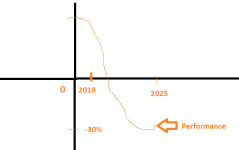
This little tiny "rise" is called performance
If your economy tanks 20-30%, and then you rise 0.5% for every 4 month , on paper it looks like progress

But you are still down 29%


The Massive "Dip" from 2018 to 2025 is ignored but the tiny rise up is applauded by Tout media

1759713951062.png
 
Kuch Aysa Scene hai

This little tiny "rise" is called performance
If your economy tanks 20-30%, and then you rise 0.5% for every 4 month , on paper it looks like progress

But you are still down 29%


The Massive "Dip" from 2018 to 2025 is ignored but the tiny rise up is applauded by Tout media

View attachment 151830
no shit sherlock
 
Tiny , little , rise Like Caterpillar

You see when regional countries are loosing -40% and -46%
Our tiny gain looks 5 star but we are also -29%

Minus means bad , very bad but if you say at least it is not -46% which find

However you have to account for the losses coming up from Flood farming loss which will kick in next growing cycle

Then well see or numbers fall to -65%

Pakistan makes money from sale of crops , fruit and vegetables , if we have lost 30% capacity you can only figure out the massive loss coming once the accountant add up all the numbers in next reporting
 
Last edited:
Kuch Aysa Scene hai

This little tiny "rise" is called performance
If your economy tanks 20-30%, and then you rise 0.5% for every 4 month , on paper it looks like progress

But you are still down 29%


The Massive "Dip" from 2018 to 2025 is ignored but the tiny rise up is applauded by Tout media

View attachment 151830
What was the reason for the massive dip?

Let's look at the overall timeline - Im using perplexity - anyone is free to use any tool but put their prompts so people can replicate to see if there is any twist.

Here is my prompt;

"
Create a comprehensive, objective, and detailed timeline of Pakistan’s economic conditions and policies from 2018 to mid-2025, highlighting key government actors (including Imran Khan and the Pakistan Democratic Movement), their specific policy decisions, reforms, and external events affecting the economy. Include macroeconomic indicators such as inflation, fiscal deficits, exchange rates, sovereign debt, and IMF engagements. Within each year, describe:

  • Major economic and political events and their dates
  • Specific fiscal, monetary, and structural reform policies adopted or delayed, naming responsible ministers or authorities where applicable
  • Impact of external factors like the COVID-19 pandemic, global commodity prices, and geopolitical financial aid
  • Quantitative data on growth, inflation, deficits, debt levels, and investor confidence, citing credit rating changes and sovereign risk indicators
  • How policies under different administrations contributed to economic dips or recoveries, focusing on cause and effect
  • Any critical delays or failures in policy implementation that worsened crises, and notable stabilizing measures or program resumptions
  • The latest developments up to September 2025 with data on sovereign default risk reductions and market confidence
Organize the timeline year-by-year with up to 3-5 detailed bullet points per year, ensuring clarity, neutrality, and full context so readers can understand the economic trajectory without bias"


Result:

2018​

  • Imran Khan's government took office in August 2018, inheriting economic challenges including a widening current account deficit (4.4% of GDP in H1 FY2017-18) and falling foreign reserves (~$9.6 billion). The fiscal deficit increased to 5.5% of GDP by July 2018.
  • The Pakistan Muslim League-Nawaz (PML-N) era preceding Khan saw loose monetary policy with low interest rates and an overvalued currency, boosting domestic consumption but worsening the import-export imbalance.
  • Early fiscal and monetary policy moves began focusing on stabilization amidst rising inflation and currency pressures, setting the stage for later IMF engagement.
  • Inflation was elevated and rising, with monetary policy not yet fully tightened.

2019​

  • Imran Khan's government negotiated and entered into a challenging IMF Extended Fund Facility (EFF) program starting in 2019, signaling deep macroeconomic reforms targeting fiscal consolidation, stabilization of the exchange rate, and structural reforms.
  • Inflation spiked, exacerbated by currency depreciation, averaging around 10-12%, creating public pressure.
  • Fiscal reforms included attempts to increase tax revenues under Finance Minister Asad Umar, with mixed success; subsidy rationalizations and austerity measures were introduced but often politically unpopular.
  • The government aimed to reduce fiscal deficits, which remained elevated but began showing signs of moderation.

2020​

  • The COVID-19 pandemic severely impacted Pakistan's economy leading to contraction; GDP shrank approximately 0.4% in fiscal year 2020.
  • The government introduced social safety programs and stimulus packages to cushion pandemic impacts.
  • Inflation remained volatile but generally elevated, partly due to supply chain disruptions and commodity price shocks.
  • The IMF program was adjusted and extended, with Pakistan receiving financial support to maintain fiscal and external balances.
  • External factors included global commodity price fluctuations and pandemic-related trade disruptions.

2021​

  • Economic recovery began with GDP growth rebounding to about 3.9%, driven by increased agricultural output and industrial activities.
  • Inflation remained a challenge, averaging around 9%, driven by both food and energy price increases.
  • Pakistan continued IMF engagements, meeting conditionalities and receiving tranche disbursements to support external reserves.
  • Foreign Direct Investment and remittances surged aiding the current account.
  • Pakistan Democratic Movement (PDM), an opposition alliance, remained politically active criticizing economic policies but no major policy shifts occurred.

2022​

  • Inflation peaked close to 12%, driven by global commodity price increases due to the Ukraine conflict.
  • Fiscal deficits remained high but showed some improvements due to revenue mobilization efforts.
  • The exchange rate faced depreciation pressures amidst global monetary tightening and external shocks.
  • The government attempted structural reforms focused on energy sector losses reduction and broadening the tax base.
  • Investor confidence was fragile with credit rating agencies maintaining cautious outlooks.

2023​

  • Economic growth slowed to 0.2% due to continuing inflationary pressures and external vulnerabilities.
  • Policy focus shifted to controlling inflation through tighter monetary policy by the State Bank of Pakistan.
  • IMF program was continued with periodic reviews; delays in some reforms created uncertainty.
  • Sovereign debt remained high, limiting fiscal space; debt servicing consumed a large share of revenues.
  • The government introduced measures to improve exports and stabilize currency, with mixed results.

2024​

  • GDP growth rebounded to 2.5% with improved agricultural and services sectors.
  • Inflation declined significantly to around 8-9% due to easing global commodity prices and exchange rate stabilization.
  • Fiscal deficit narrowed sharply to below 2% of GDP due to better tax collections and spending controls.
  • Pakistan successfully hosted the SCO Summit in 2024, boosting investor confidence.
  • Foreign exchange reserves and currency stability improved via IMF disbursements and sovereign bond issuances.

Early to Mid-2025​

  • Pakistan’s economy demonstrated continued improvement with GDP growth close to 0.9% in Q1 FY2025.
  • Inflation reduced substantially to around 7.2% in H1-FY2025 supported by eased global prices and stable exchange rates.
  • Fiscal deficit drastically reduced to near 0.04% of GDP in July-November 2025, a remarkable improvement from previous years.
  • Foreign Direct Investment surged by 20%, led by power and oil sectors investments.
  • Remittances and exports strengthened the current account, posting a surplus of $1.21 billion in Jul-Dec FY2025.
  • The Pakistani rupee appreciated slightly, reflecting improved external sector conditions.
  • The government introduced a homegrown 5-Year Economic Transformation Plan, "URAAN Pakistan," focusing on inclusivity, fiscal discipline, and sustainable growth.
  • Sovereign default risks declined significantly with rising market confidence attributed to sound macroeconomic management and IMF program compliance.
 
Cause for Dip : "H Y B R I D" System

AI bhi smart hai , omitted all the stuff from September flood

First there will be low revenue , profits from Export , because we will see 30% drop on exports for rice , food to Middle East

Then we will have to provide Farmers with seed (cost )
All free

Then we will have to provided $$$ Support for farmers to survive 1 year till crops grow back

Replace all the machinery which got damaged by floods
not to mention of loss of animals like Cow and Goats

Only after this much effort we will get capacity back to normal

Almost 1.5 years gone
 
Last edited:
AI Prompt :
Explain how the Hybrid Government system destroyed Pakistani Economy since Ousting of Prime minister imran khan


Understanding the Hybrid Government System in PakistanThe term "hybrid government" or "hybrid regime" in Pakistan refers to a political arrangement where civilian leaders (typically from parties like PML-N or PPP) hold formal power, but the military establishment exerts significant behind-the-scenes influence over key decisions, including foreign policy, security, and even economic priorities. This model intensified after the ouster of Prime Minister Imran Khan via a no-confidence vote on April 10, 2022, which many analysts attribute to the military's withdrawal of support from Khan's PTI government. The subsequent coalition government under Shehbaz Sharif (PDM from 2022–2023, followed by the 2024-elected PML-N-led coalition) has been widely described as a "hybrid" setup, with the military's role formalized through bodies like the Special Investment Facilitation Council (SIFC), which blends civilian and military oversight on economic projects.Critics, including PTI supporters and independent analysts, argue this system prioritizes short-term political survival and elite interests over long-term reforms, leading to policy paralysis, corruption, and investor flight. While some sources credit the hybrid setup with stabilizing IMF negotiations, the overall economic trajectory since 2022 shows contraction, stagnation, and vulnerability. Below, I outline the key mechanisms through which this system has exacerbated Pakistan's economic woes, supported by data up to mid-2025.Key Economic Impacts and Mechanisms of DestructionThe hybrid system's flaws—chronic instability, military-civilian friction, and ad-hoc policymaking—have amplified pre-existing issues like high debt and low exports. Here's a breakdown:


  1. Political Instability and Policy Inconsistency:
    • The post-Khan era has been marked by protests, arrests (e.g., Khan's ongoing detention), and rigged election allegations in 2024, eroding investor confidence. This instability delayed IMF bailouts (e.g., a $1.1 billion tranche stalled from November 2022 to mid-2023) and deterred foreign direct investment (FDI), which dropped over 20% from 2022 levels.
    • Hybrid dynamics lead to fragmented decision-making: Civilian governments push populist subsidies (e.g., fuel price freezes in 2022), while military priorities (e.g., security spending) divert resources. Result: No cohesive reforms, with the economy stuck in a cycle of IMF dependencies.
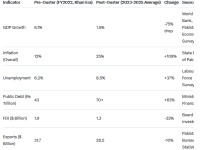
    • Public debt surged from Rs 43 trillion (April 2022) to over Rs 70 trillion by 2025, with interest payments consuming 50–60% of federal revenue. The hybrid regime accumulated $200 billion in new debt since 2022, while GDP grew by just $33 billion—pushing debt-to-GDP above 70%.
    • Circular debt in the energy sector ballooned from Rs 2.5 trillion (2022) to Rs 3.5 trillion (2025), fueled by delayed reforms and subsidies. Military-linked projects (e.g., CPEC extensions) added opaque borrowing without productivity gains.

1759716084776.png
Pakistan Bureau of Statistics
Broader Systemic Failures


  • Military Overreach in Economy: The SIFC (launched 2023) aimed to attract $25 billion in investments but delivered under $5 billion by 2025, prioritizing military-linked ventures (e.g., mining exports without local value-add). This crowds out private sector growth and fosters corruption, with tax-to-GDP at a dismal 9.2%.
  • Erosion of Institutions: Censorship (e.g., internet blackouts targeting PTI), judicial interference (26th Amendment, 2024), and media harassment stifle innovation. IT exports, a bright spot under Khan, stagnated due to outages.
  • Social Fallout: 2022 floods exposed hybrid governance flaws—slow response and elite capture of aid—worsening food insecurity. Youth exodus and rising terrorism (diverting security budgets) compound the crisis.
Counterarguments and NuancesSome sources (e.g., PML-N officials) argue the hybrid system averted default via IMF deals (e.g., $3 billion SBA in 2023, extended 2024) and stabilized reserves to $9–10 billion by 2025. Credit ratings improved slightly (Caa2 Positive, Moody's 2025). However, these are bandaids: Growth remains volatile, and without addressing hybrid-induced instability, experts warn of another crisis by 2026. Khan's era (2018–2022) saw 6% peak growth and FATF grey-list exit, but inherited deficits; the post-2022 decline is steeper due to regime change fallout.In summary, the hybrid system has "destroyed" the economy by entrenching instability and elite capture, turning a fragile recovery into a debt-fueled stagnation. True revival demands civilian-led reforms, reduced military meddling, and export-focused policies—steps blocked by the current setup. As of October 2025, green shoots (e.g., stock market gains) mask deeper rot, with poverty and emigration signaling a humanitarian edge.
 
Last edited:
If I was to just read that - I would assume that in the end it is the PML(N) government that was responsible for what PTI inherited - and they through a mix of somewhat smart moves tried to stabilize things but were hampered by the pandemic and also IK's populist decisions at times. The graph shown

Then the hybrid government comes in, initially has no idea how to stabilize things because at the end Dar is an incompetent charlatan but then the establishment takes the reigns and forces following measures and things are now finally on an uptick.

However, that would be too simplistic because one has to see what PML(N) inherited from PPP post 2008 to see how much they tried to "fix".

To view this from purely an economic lens is also a misnomer - how many of the events that led to poor performance or good performance for any government was layered on by global events?

For e.g. Would Musharraf have been able to usher the economic growth sans events of Sep 2001 and flowing in Aid along with preferential financial assistance?
 
Cause for Dip : "H Y B R I D" System

AI bhi smart hai , omitted all the stuff from September flood

First there will be low revenue , profits from Export , because we will see 30% drop on exports for rice , food to Middle East

Then we will have to provide Farmers with seed (cost )
All free

Then we will have to provided $$$ Support for farmers to survive 1 year till crops grow back

Replace all the machinery which got damaged by floods
not to mention of loss of animals like Cow and Goats

Only after this much effort we will get capacity back to normal

Almost 1.5 years gone
There was no Hybrid system in 2020 and still there was a dip.
There was no Hybrid system from 2008 to 2018 either.

2008​

  • PPP government, led by President Asif Ali Zardari and Prime Minister Yousaf Raza Gillani, took office amid challenges including rising violence and economic instability following Musharraf's 2008 resignation.
  • GDP growth slowed to about 4.1% (down from nearly 9% under Musharraf). Inflation was rising, tight monetary policy struggled to control it amid high currency in circulation (~31% of deposits), signaling stagflation.
  • Fiscal deficit widened, and limited coordination between fiscal and monetary policy worsened economic stagnation.
  • Foreign exchange reserves began to tighten, pressuring the exchange rate.
  • No significant structural reforms implemented immediately; focus was on political stabilization.

2009​

  • PPP launched social programs including Benazir Income Support Programme (BISP) benefiting low-income families.
  • Energy sector challenges persisted; Pakistan initiated gas import discussions with Iran.
  • Fiscal pressures remained high with limited reform on subsidies and tax collection.
  • Inflation stayed elevated; external debt and deficits worsened, undermining investor confidence.
  • No IMF program was entered this year; government avoided austerity amid political challenges.

2010​

  • Continued infrastructure projects and rehabilitation after 2009 military operations.
  • Fiscal deficit and debt-to-GDP ratio continued rising, exceeding 60%, limiting fiscal space.
  • Inflation remained volatile, with sustained pressure on the Pakistani rupee.
  • Attempts at reforms were limited and sporadic; energy sector losses remained a critical bottleneck.
  • Political instability reduced effectiveness of economic policymaking.

2011​

  • Inflation peaked amid global commodity price rises; fiscal deficit over 5% of GDP.
  • Limited progress on tax reforms and subsidy rationalization.
  • Pakistan reentered talks with IMF for potential financial support but delayed formal arrangements.
  • Balance of payments pressure increased; foreign reserves dipped.
  • Government prioritized social and political stability over tough economic reforms.

2012​

  • Pakistan formally agreed to an IMF Stand-By Arrangement in late 2012.
  • Structural reforms were planned including reducing energy subsidies and broadening tax base, overseen by Finance Minister Abdul Hafeez Shaikh.
  • Inflation remained in high single digits to low double digits, attracting concern.
  • Fiscal deficit persisted above 5%, financing largely through domestic debt.
  • Economic growth remained sluggish, near 3.6%.
  • Persistent power shortages and security issues dampened investment.

2013​

  • PML-N government assumed power under Prime Minister Nawaz Sharif.
  • Focused on energy sector reforms to reduce circular debt, infrastructure investment, and fiscal consolidation.
  • GDP growth improved to about 4%, underpinned by CPEC-related projects.
  • Inflation moderated somewhat but remained a concern.
  • Fiscal deficit targeted for reduction via tax reforms led by Finance Minister Ishaq Dar.
  • Exchange rate pressure reduced through tighter monetary policy and better reserve management.
  • Pakistan resumed IMF program successfully, receiving tranches conditional on reforms.

2014​

  • Energy projects accelerated under PML-N, addressing load shedding, positively impacting industrial output.
  • Inflation fluctuated with global oil price shocks but remained mostly under 8%.
  • Fiscal deficit reduction efforts made progress; revenue collection improved via FBR reforms.
  • Foreign exchange reserves improved; currency stabilized against the US dollar.
  • Investment increased due to improved infrastructure outlook and political stability.

2015​

  • Economy grew at ~4.7%, with agriculture recovering and services expanding.
  • Inflation was lowering, roughly 4-6%, aided by falling global oil prices.
  • Fiscal deficit reduced to around 4.5%; tax-to-GDP ratio raised.
  • Pakistan's sovereign credit rating outlook remained stable though low investment grade.
  • IMF programs completed successfully; Pakistan regained some market confidence.

2016​

  • GDP growth maintained near 4.7%.
  • Inflation edged up to about 4.2% due to domestic factors.
  • Fiscal deficit hovered near 4.3%-4.5%; subsidy reforms and tax administration improved.
  • Exchange rate pressures re-emerged modestly due to external vulnerabilities.
  • CPEC projects advanced, attracting FDI and boosting investor sentiment.
  • Government prioritized fiscal discipline but faced challenges from subsidy burdens and security spending.

2017​

  • Growth slightly slowed to ~5.2%, driven by stronger industry and services.
  • Inflation rose again to near 4-5%.
  • Fiscal deficit increased slightly but controlled below 5%; continued tax reforms.
  • PKR depreciated about 10% against the USD between Nov 2017 and Mar 2018, pressuring inflation.
  • Sovereign risk remained moderate with cautious optimism from credit rating agencies.
  • Approximately $18 billion in foreign reserves by mid-2017 supported exchange rate stability influenced by remittances inflows.

Early 2018 (Up to mid-year)​

  • Economic policies continued from PML-N; inflation rising post-currency depreciation.
  • Fiscal deficit widened to approximately 6-7%, partly due to election year spending.
  • Currency pressures continued with depreciation risk increasing sovereign default concerns.
  • Investor confidence fragile but supported by ongoing reforms and IMF engagements.
  • Political uncertainty ahead of July 2018 elections affected market sentiment.

Clearly your post has no merit when you expand the context scope.
 
I don't need explanation I know Bus is about to hit the brick wall in 2026

Field Marshal will be holding his Green Card , and Nawaz Sharif is already out in London , rest of the "Crew" will fly out rapidly

Just which month of 2026 will the Tsunami hit is what I can't predict

Just like a Tsunami , first comes an Earth Quake , then there is a very short period of clam, eventually the ripples from Tsunami hit the shores

Smart ones normally make the run , before the Tsunami hits the beaches

We had out Disaster in September , so expecting stuff to go down by 2026, we are in the brief period of silence before the storm

Kashmir Ka Hal to Dekh Liya hoga

Kashmir was the first ripple
 
Last edited:
I don't need explanation I know Bus is about to hit the brick wall in 2026

Field Marshal will be holding his Green Card , and Nawaz Sharif is already out in London , rest of the "Crew" will fly out rapidly

Just which month of 2026 will the Tsunami hit is what I can't predict

Just like a Tsunami , first comes an Earth Quake , then there is a very short period of clam, eventually the ripples from Tsunami hit the shores

Smart ones normally make the run , before the Tsunami hits the beaches

We had out Disaster in September , so expecting stuff to go down by 2026, we are in the brief period of silence before the storm

Kashmir Ka Hal to Dekh Liya hoga
How do you know?
Do you have actual facts and potential scenarios to say bus will hit the wall or not.

Because this was the performance in a previous "Hybrid" system:

1999​

  • October 12: Military coup led by General Pervez Musharraf overthrew Nawaz Sharif's government, initiating military regime with an emphasis on economic stabilization.
  • Pakistan faced severe economic challenges inherited from prior civilian government: heavy external and domestic debt, fiscal deficits (~5.1% of GDP), low revenue generation, high poverty (32.6%), and weak foreign exchange reserves (~$1.2 billion).
  • Inflation stood at approximately 5.7%, and exchange rate faced depreciation pressures.
  • No significant IMF engagement this year but warning signals of macroeconomic instability and rising debt burdens.

2000​

  • Initial efforts to stabilize economy: fiscal deficit reduced to about 3.8% of GDP, inflation improved to ~3.1%.
  • GDP growth slightly rose to about 4.2%.
  • Government started liberalization policies and initiated structural reforms targeting revenue collection and investment climate.
  • Foreign exchange reserves began recovering; remittances and exports showed marginal growth.
  • Military regime prioritized macroeconomic stabilization amid ongoing political isolation internationally.

2001​

  • Pakistan entered an IMF Extended Fund Facility (EFF) agreement in December 2001 for approximately $861 million, to support ongoing stabilization efforts.
  • Inflation controlled around 3-4%, budget deficit remained manageable.
  • Exchange rate stabilized through tight monetary policies.
  • External geopolitical events post-9/11 enhanced Pakistan’s strategic importance, leading to increased U.S. financial and military aid beginning late 2001, bolstering reserves and creditworthiness.

2002​

  • Economy accelerated: GDP growth to about 5.1%, inflation stable near 3%.
  • Foreign reserves increased significantly to approximately $8.5 billion.
  • Fiscal deficit improved; government under PM Zafarullah Khan Jamali pushed reforms to enhance tax collection and privatization.
  • Significant foreign direct investment (FDI) inflows initiated (~$800 million).
  • Exchange rate stabilized; remittances increased.

2003​

  • Continued liberalization: Privatization efforts expanded including telecom sector partial privatization.
  • Inflation remained low mid-single digits.
  • Fiscal deficit approx. 3.5-4%, with improving revenue mobilization.
  • Foreign aid and capital inflows continued strongly, aided by geopolitical alliances.
  • Economic reforms improved business environment, increased investment, and job creation.

2004​

  • Growth robust at ~7-8% (peak years), driven by manufacturing, services, and large infrastructure investments.
  • Inflation kept fairly low (~3-4%).
  • Fiscal deficit remained under 4%, public debt to GDP ratio began to decline from near 100% in late 1990s toward 65-70%.
  • Remittances and exports increased significantly.
  • Exchange rate stable; bolstered by strong foreign exchange reserves and increased investor confidence.

2005​

  • Growth sustained at ~6.5-7% despite devastating October 2005 Kashmir earthquake.
  • Government allocated large fiscal resources (~40% increase) for rehabilitation, affecting deficit marginally.
  • Inflation edged higher to about 7-8% due to food price inflation.
  • Privatization including of PTCL moving forward, boosting revenues.
  • Continued IMF program compliance; reserves reached around $10 billion.

2006​

  • GDP growth about 7%, driven by CPEC precursor projects, manufacturing, and services.
  • Inflation hovered around 7%, driven by rising energy and commodity prices globally.
  • Fiscal deficit managed near 4%-4.5%, tax reforms ongoing under Finance Minister Shaukat Aziz.
  • Sovereign debt decreased to near 55% of GDP, improving sovereign risk ratings.
  • U.S. financial aid linked to war-on-terror alliance remained substantial, boosting macroeconomic stability.

2007​

  • GDP growth slowed slightly to about 6%; inflation rose to 8% from rising global commodity prices.
  • Political instability increased due to Musharraf’s imposition of emergency in Nov 2007 and assassination of Benazir Bhutto in Dec 2007.
  • Fiscal deficit and current account deficit widened moderately; government expenditures increased for security and social programs.
  • Debt to GDP ratio stable; strong reserves (~$10 billion) shielded currency.
  • Exchange rate stable but under pressure from uncertainty and capital outflows.

Early 2008 (until PPP government takeover in March)​

  • Economic growth decelerated; political uncertainty impacted investment climate.
  • Fiscal deficits grew due to election-related spending; inflation persisted near 8-10%.
  • Currency depreciation pressures increased; rupee weakened slightly post-election.
  • Foreign reserves remained adequate but tightening credit conditions evident.
  • IMF engagement ongoing with extended facilities; structural reforms slowed due to political transition.
 
Still P&G closed its operations in Pakistan last week just like some major multi-national companies have left Pakistan. Inflation is all time high. Income taxes are higher for salaried classes. Energy bills are increasing day by day. Fuel prices are steadily increasing. I don't know in which year we might see real improvement and reversal.
 
Pakistan has recorded one of the “sharpest drops” in sovereign default risk globally and now ranks as the second-best performer in the world, according to Credit Default Swap (CDS)-implied data reported by Bloomberg, adviser to the finance minister Khurram Schehzad said on Sunday.

A Credit Default Swap-implied probability estimates the likelihood that a borrower — such as a company or a country — will fail to repay its debt. This probability is derived from the market price of its CDS, which is a type of financial insurance investors buy to protect themselves against the risk of default, according to the International Monetary Fund (IMF).

If the cost of a CDS drops, it means investors see the borrower as less risky. So, when Pakistan’s CDS-implied probability falls sharply, it indicates that global investors believe the country’s chances of defaulting on its debt have significantly decreased.

“As per the latest data posted by Bloomberg, Pakistan stands out globally as the 2nd most improved economy in terms of reduction in sovereign default risk, as measured by CDS-implied default probability globally,” Schehzad wrote in a post on X.

He added that the country stood second only to Turkiye in the global emerging market (EM) rankings in default risk reduction, as the country has recorded one of the sharpest drops in sovereign default risk globally over the last 15 months (from June 2024 to September 2025).

“Notably, Pakistan is the only country in the EM sample showing consistent quarterly improvement across the past year,” he wrote, adding that the country’s default probability has decreased by 2,200 basis points.

“This marks the sharpest decline among major EMs, ahead of South Africa (3 per cent), EI Salvador (2pc). In contrast, countries like Argentina, Egypt, Nigeria, and others have seen their default risks rise.”

Schehzad further said the sharp decline in the country’s risk signalled “strengthening investor confidence, underpinned by macroeconomic stabilisation, structural reforms, timely debt servicing, and staying the course with the International Monetary Fund.”

He also cited the recent positive ratings movements from global credit rating agencies like S&P Global, Fitch, and Moody’s as a factor.

In a message to investors, Schehzad said. “Pakistan is steadily rebuilding market credibility, standing out as one of the most improved sovereign credit stories in the emerging market universe.”

Pakistan faced a prolonged economic crisis over the last few years, marked by critically low foreign exchange reserves, an acute balance-of-payment crisis, and the looming risk of default in 2023. The crisis was averted after the IMF released a crucial loan tranche, while support from friendly countries, including China, the United Arab Emirates, and Saudi Arabia, also played a key role.

After averting default, Pakistan has undertaken tough IMF-prescribed reforms to stabilise its economy and bolster macroeconomic indicators.
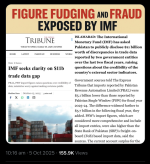
11 billion scam is coming which is caught by IMF by giving them wrong figures... get fell soon
 
Screenshot_20251006-061147.png
Another fine is coming. They fudged the digits. Pakistan has to pay big fine They don't to ful fill the American and Israeli demands. This is how they give another chance to them
 
The gist of it is Pakistanis are not serious to tackle the economy.

Some pointers:

- Focus should be on austerity and spending on areas with high ROI.
- IPP and circular debt issue
- Agriculture tax
- Real estate tax reforms
- Simplifying red tape for businesses
- Subsidies for politician affiliated enterprises

Export drop for this year is inevitable but that is not in control. Pakistan’s economic future lies in deep structural reforms without letting the deficit out of control.
 

Users who are viewing this thread

Country Watch Latest

Back
Top