Locations of downed Indian aircraft disclosed by security sources
Several Indian fighter jets were destroyed in PAF retaliatory strikes, with pilots reported injured
Our CorresondentMay 13, 2025
facebook twitter whatsup linkded email
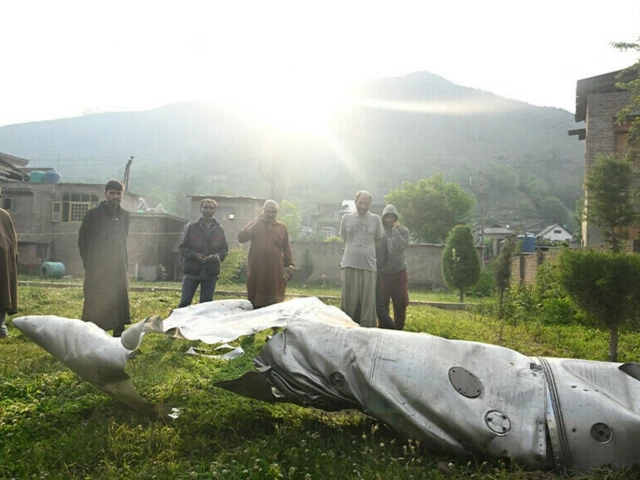
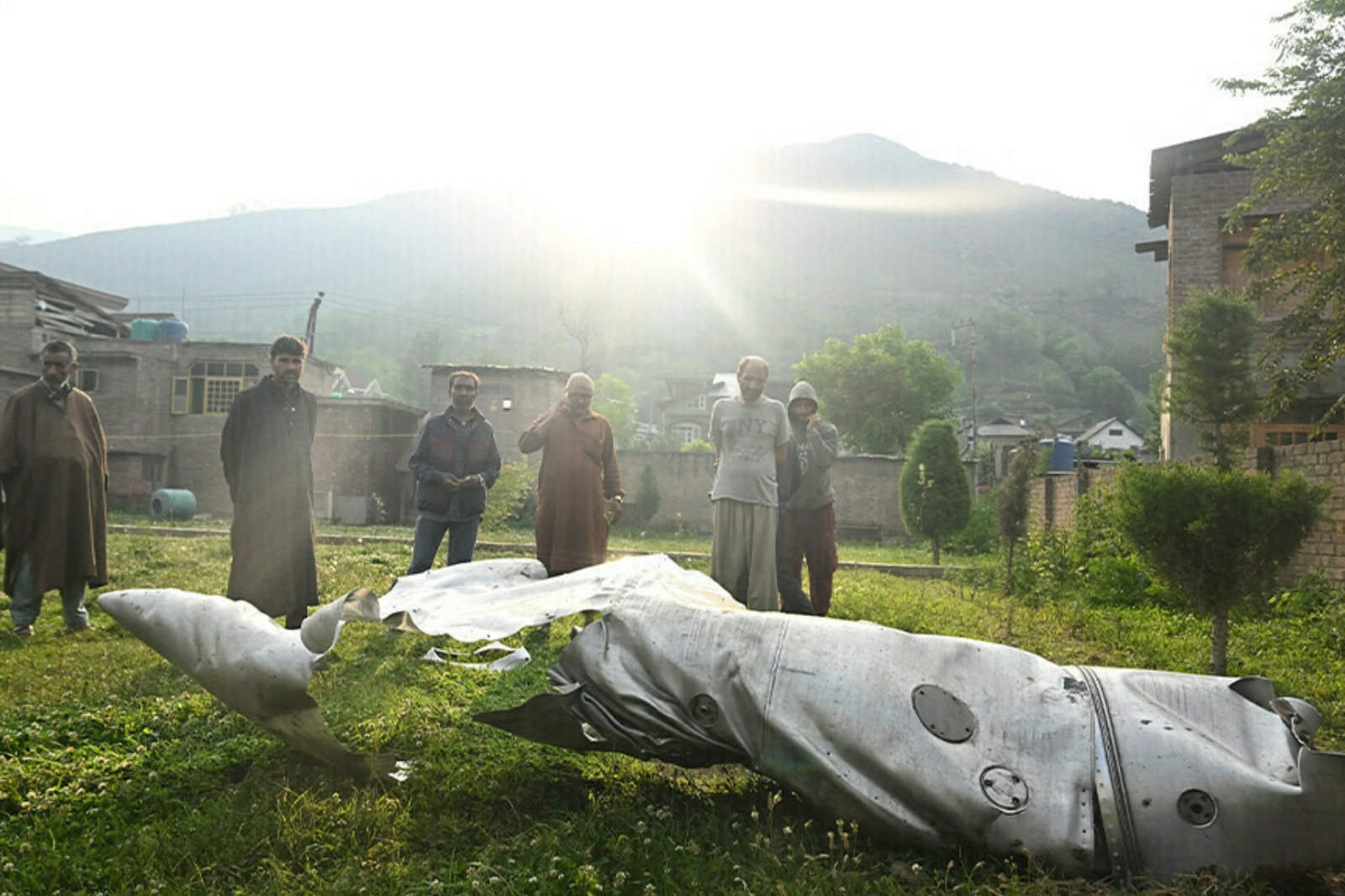
People look at a part of an aircraft in Wuyan near Indian Illegally Occupied Kashmir’s main city of Srinagar on May 7, 2025. Photo: AFP/ File
Listen to article
As New Delhi remains in denial about the loss of its fighter jets – including the prized Rafales – Pakistani security sources on Tuesday identified the locations where the Indian Air Force (IAF) warplanes crashed after being shot down by Pakistan during India’s Operation Sandoor.
On the night between May 6 and 7, when India launched missile strikes on civilian infrastructure at six locations in Pakistan, PAF fighter jets dealt a major blow to the IAF, shooting down multiple warplanes, including the multimillion-dollar French Rafale combat aircraft.
The wreckage fell on the Indian side as they never crossed into Pakistan and fired beyond visual range missiles from the Indian airspace at their targets.
Read more:
Pakistan downs five Indian fighter jets in retaliation for India's missile attack
One aircraft reportedly came down in the Anantnag district of Indian Illegally Occupied Jammu & Kashmir (IIOJK). The ejection seat of the downed jet was recovered from the Gadool Kokernag area, security sources claimed.
Sources further revealed that another IAF jet fell in the Pampore area of Pulwama region of IIOJK, with both pilots sustaining serious injuries. They were shifted to a hospital in Srinagar for treatment.
A third fighter jet crashed in the Pantiyal/Ramsu area of Ramban district. The pilot of that aircraft, Flying Officer Iqbal Singh, was injured and shifted to the army hospital in Udhampur.
Yet another aircraft crashed in the agricultural fields of Bharda Kalan in Akhnoor Tehsil of IIOJK. Both pilots ejected and were injured; they were moved to the Akhnoor Military Hospital for treatment.
Security sources also confirmed that another IAF aircraft crashed in Bathinda city, located in India’s Punjab province.
In a separate incident, an Indian Heron Remote Piloted Vehicle (RPV) was shot down 13 nautical miles east of Jammu city in IIOJK.
Read more: Pakistan destroys India's BrahMos stockpile, airbases in 'Operation Bunyan-un-Marsoos'
Defense analysts describe this series of losses as a major setback for the Indian Air Force, stating that the operation underscores the IAF’s complete operational failure. “The way Indian jets were downed like toys raises serious questions about their military strategy,” noted defence experts.
Tensions between India and Pakistan escalated after the April 22 attack in Pahalgam, Indian Illegally Occupied Jammu and Kashmir (IIOJK), which killed 26 people. India blamed Pakistan-based elements for the assault but provided no evidence. Islamabad strongly denied the allegations.
On April 23, India closed the Wagah border crossing, revoked Pakistani visas, and announced the suspension of the Indus Waters Treaty. Pakistan condemned the move as an “act of war” and responded by sealing the Wagah border from its side.
The confrontation then erupted on May 6–7 as India launched its attack against Pakistan, which spiraled into the gravest military clash between the neighbors in decades.
Read more:
40 civilians, 11 troops martyred in Indian aggression: ISPR
Pakistan condemned the attack and in retaliaton, the Pakistan Air Force achieved a historic BVR (Beyond Visual Range) combat victory, downing five Indian fighter jets—three Rafales, one SU-30, and one MiG-29—without incurring any losses. Officials declared the outcome a "100–0" score in Pakistan’s favour.
Despite repeated warnings from the Pakistani government, India, fueled by its media's war-driven rhetoric, continued provocative actions, including frequent drone incursions, which ultimately prompted Pakistan to retaliate.
On the night of 9–10 May, Pakistan initiated retaliatory action in response to Indian aggression in the early hours of Saturday, officially naming the operation “
Bunyaan-un-Marsoos”.
In what were described as decisive actions against Indian aggression, Pakistan reportedly targeted 26 military sites inside India and destroyed several Indian brigade and battalion headquarters along the Line of Control (LoC).
Following diplomatic intervention led by Washington, both sides agreed to halt military activity across land, air, and sea. However, hours after the truce, fresh skirmishes were reported along both sides of the LoC.
Read more:
'Losses are part of combat': Indian Air Marshal responds to Rafale downing
Although India never officially acknowledged the downing of its fighter jets, Indian Air Marshal A.K. Bharti admitted the possibility of losses but framed them as an inherent risk in active combat.
When asked about the downing of a Rafale fighter jet during the operation at a press briefing by the Directors General of Military Operations on Sunday, the Air Marshal responded by saying, “This is combat, and losses are part of it. But the real question is whether we achieved our objectives—and the answer is a thumping yes. We dismantled the terrorist infrastructure we set out to neutralise, and the results are evident for the world to see.”
Pakistan's Inter-Services Public Relations later on Tuesday May 13, confirmed that at least 51 people, including 40 civilians and 11 military personnel, were martyred during India's cross-border attacks on Azad Jammu and Kashmir and Pakistani territory.
Several Indian fighter jets were destroyed in PAF retaliatory strikes, with pilots injured or reported missing.

tribune.com.pk









 India Has Lost Air Superiority to Pakistan, No Jets Left to Fight (19 Viewers)


