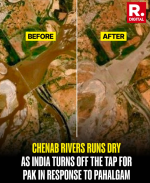
Pakistan is getting dry

Im not trying to be a d**k buddy but someone did a real number on you. I think they convinced you that pak is some massive superpower that can do this or that. Neither will pak do anything you have written nor do you have the capability.

And as for china...maybe you should ask your FO if they are saying India can become a permanent member of UNSC with a delayed veto of 15 years. I think only one betrayal is greater than that.
Actually we can hit you now with a precise accuracy you can't imagine.
On Chinese front, China threatened India just few days ago about building dams.
But in Pakistan it's a very genuine concern. And be ready for a Kaboom soon.
 
Not sure where you are going. Destroying Karachi? Obviously if city is infested with ethnic violence and terrorism then importance of Islamabad/Pindi/Lahore would increase for investors who want peaceful environment for their families and business. But you know what would benefit Punjab more? peaceful Karachi, Peshawar, Quetta. Destroyed Karachi/Gwadar only help UAE etc Not punjab. Punjab doesn't have port. Punjab will benefit from peaceful Gwadar/Karachi.

I know where you are going, the usual troop of punjabis being responsible for all the problems in Pakistan.


I work with international organizations, and honestly, everyone outside Pakistan already knows the truth. What surprises me is how naive many Pakistanis still are about what really happened to Karachi.

The city didn’t collapse on its own. It was pushed into chaos, repeatedly, strategically, and deliberately.

The Establishment didn’t just “manage” Karachi; it constructed the entire political ecosystem that later tore the city apart. They created MQM as a counterweight to Sindhi nationalist movements, then spent years inflating MQM’s power until it became too organized, too large, and too independent. And the moment MQM became a political force that could not be fully controlled, the Establishment split it, fragmented it, and pitted its factions against each other.

This wasn’t mismanagement. It was political engineering.

Karachi was kept in a state of permanent instability, a city where no single actor was strong enough to govern, and every actor was dependent on the invisible hand that controlled the levers.

In that chaos, Karachi paid the price:

• Target killings
• Extortion
• Paralysis of local government
• Criminalized politics
• Infrastructure collapse
• Thousands of lives lost

People remember the phrase “boti‑band lash” because it became a symbol of how deeply violence was normalized. Karachi became a city where fear was a political tool.

And when MQM’s factions became too unpredictable, the Establishment simply reset the board again.

They brought Mustafa Kamal and Anis Qaimkhani back from Dubai, everyone remembers the dramatic “rona‑dhona” press conferences and manufactured PSP out of thin air. Funding, logistics, media coverage, political space… everything was arranged. PSP wasn’t a grassroots movement; it was a project.

Then came the attempted PSP–MQM merger, another engineered experiment that collapsed because the actors didn’t trust each other and the public didn’t buy the script.

After decades of this political experimentation, what did Karachi receive?

Nothing.
No stability.
No governance.
No reforms.
No relief.

Just a broken system, shattered institutions, and a population forced to survive between political militias, extortion networks, corrupt administrators, and engineered ethnic tensions.

Karachi wasn’t neglected.
Karachi was kept unstable on purpose.

A chaotic Karachi is easier to control.
A divided Karachi cannot demand autonomy.
A fearful Karachi cannot challenge the status quo.

And that is the tragedy, a city that generates Pakistan’s revenue was never allowed to become Pakistan’s power center.

If the Establishment truly wanted to fix Karachi, they had every opportunity to do it in the 1980s. The city was young, economically vibrant, and politically manageable. But they didn’t. And the reason wasn’t incompetence — it was intent.

Karachi was never allowed to become stable because a stable Karachi would become powerful, autonomous, and politically influential. Instead, the national project was to prop up Lahore as the symbol of Pakistan’s stability, culture, and progress.

Over the decades, you can see the pattern:

• Every major sports headquarters was shifted to Lahore.
• Every national sports federation centralized its operations there.
• Lahore was marketed as the “model city,” the “stable city,” even the “Paris of Pakistan.”
• Massive budgets were poured into Lahore’s beautification, infrastructure, and branding.

Meanwhile, Karachi, the country’s economic engine was left in engineered chaos. Political fragmentation, turf wars, and administrative paralysis ensured the city could never challenge Lahore’s dominance or demand proportional representation.

The contrast wasn’t accidental. It was policy.

Lahore was polished.
Karachi was destabilized.
One city was elevated.
The other was contained.

And today, the consequences are visible: Lahore stands as the curated showcase of Pakistan, while Karachi still struggles with the instability that was deliberately allowed, even encouraged to grow.
 
I work with international organizations, and honestly, everyone outside Pakistan already knows the truth. What surprises me is how naive many Pakistanis still are about what really happened to Karachi.

The city didn’t collapse on its own. It was pushed into chaos, repeatedly, strategically, and deliberately.

The Establishment didn’t just “manage” Karachi; it constructed the entire political ecosystem that later tore the city apart. They created MQM as a counterweight to Sindhi nationalist movements, then spent years inflating MQM’s power until it became too organized, too large, and too independent. And the moment MQM became a political force that could not be fully controlled, the Establishment split it, fragmented it, and pitted its factions against each other.

This wasn’t mismanagement. It was political engineering.

Karachi was kept in a state of permanent instability, a city where no single actor was strong enough to govern, and every actor was dependent on the invisible hand that controlled the levers.

In that chaos, Karachi paid the price:

• Target killings
• Extortion
• Paralysis of local government
• Criminalized politics
• Infrastructure collapse
• Thousands of lives lost

People remember the phrase “boti‑band lash” because it became a symbol of how deeply violence was normalized. Karachi became a city where fear was a political tool.

And when MQM’s factions became too unpredictable, the Establishment simply reset the board again.

They brought Mustafa Kamal and Anis Qaimkhani back from Dubai, everyone remembers the dramatic “rona‑dhona” press conferences and manufactured PSP out of thin air. Funding, logistics, media coverage, political space… everything was arranged. PSP wasn’t a grassroots movement; it was a project.

Then came the attempted PSP–MQM merger, another engineered experiment that collapsed because the actors didn’t trust each other and the public didn’t buy the script.

After decades of this political experimentation, what did Karachi receive?

Nothing.
No stability.
No governance.
No reforms.
No relief.

Just a broken system, shattered institutions, and a population forced to survive between political militias, extortion networks, corrupt administrators, and engineered ethnic tensions.

Karachi wasn’t neglected.
Karachi was kept unstable on purpose.

A chaotic Karachi is easier to control.
A divided Karachi cannot demand autonomy.
A fearful Karachi cannot challenge the status quo.

And that is the tragedy, a city that generates Pakistan’s revenue was never allowed to become Pakistan’s power center.

If the Establishment truly wanted to fix Karachi, they had every opportunity to do it in the 1980s. The city was young, economically vibrant, and politically manageable. But they didn’t. And the reason wasn’t incompetence — it was intent.

Karachi was never allowed to become stable because a stable Karachi would become powerful, autonomous, and politically influential. Instead, the national project was to prop up Lahore as the symbol of Pakistan’s stability, culture, and progress.

Over the decades, you can see the pattern:

• Every major sports headquarters was shifted to Lahore.
• Every national sports federation centralized its operations there.
• Lahore was marketed as the “model city,” the “stable city,” even the “Paris of Pakistan.”
• Massive budgets were poured into Lahore’s beautification, infrastructure, and branding.

Meanwhile, Karachi, the country’s economic engine was left in engineered chaos. Political fragmentation, turf wars, and administrative paralysis ensured the city could never challenge Lahore’s dominance or demand proportional representation.

The contrast wasn’t accidental. It was policy.

Lahore was polished.
Karachi was destabilized.
One city was elevated.
The other was contained.

And today, the consequences are visible: Lahore stands as the curated showcase of Pakistan, while Karachi still struggles with the instability that was deliberately allowed, even encouraged to grow.

Post Zia take over, there was wave of PPP backed Sindhi terrorism. Muhajir were already pissed of because of Bhutto quota system.

Sindhi terrorism died down but MQM continued with bloodshed till 2010's.

In any case like I said Punjab would benefit more from prosperous Karachi, Quetta, Peshawar. Thats why establishment eventually took care of MQM militant wing as well. Now there is peace in Karachi and things are manageable.
 
Post Zia take over, there was wave of PPP backed Sindhi terrorism. Muhajir were already pissed of because of Bhutto quota system.

Sindhi terrorism died down but MQM continued with bloodshed till 2010's.

In any case like I said Punjab would benefit more from prosperous Karachi, Quetta, Peshawar. Thats why establishment eventually took care of MQM militant wing as well. Now there is peace in Karachi and things are manageable.

Bro, you are living in Fantasy world, reality is clear difference. Establishment survival depends on Pakistan in Chaos....KPK, Baluchistan and Sindh in Chaos. Pakistan is surviving on IMF, Arab & China loans and remittance.

To view this content we will need your consent to set third party cookies.
For more detailed information, see our cookies page.


Listen about what he is saying about Pakistan.
 

Users who are viewing this thread

Pakistan Defence Latest

Country Watch Latest

Latest Posts

Back
Top