Pakistan Major Dams News and Discussions

1724165477135.png

WAPDA

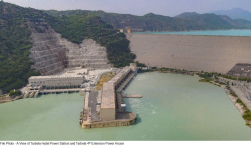
Tarbela Dam filled to its maximum conservation level of 1550 feet above mean sea level today, storing 5.766 million acre feet useable water in the reservoir. It is a good sign for irrigated agriculture and generation of green, clean and affordable hydel electricity in the country.
Tarbela Dam has been playing a key role for national economy and social uplift in Pakistan since its inception by supplying water for agriculture at a time when it is much needed, controlling floods and providing low cost hydel electricity to the National Grid.
 
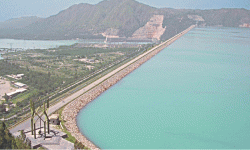
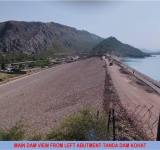
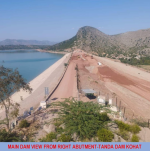
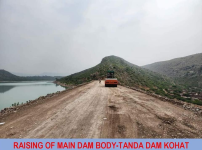
Raising of Tanda Dam Kohat.

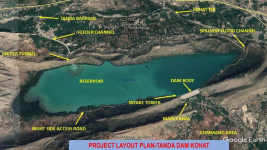
Tanda Dam is an offshore storage reservoir located approximately 10 km west of Kohat city. Constructed by WAPDA in September 1967, it was handed over to the Irrigation Department in September 1968. The project includes several major components:

• Diversion Barrage with Head Regulator
• Feeder Canal and Tunnel
• Reservoir, Main Dam, and Spillway
• Intake Tower, Outlet and Canal System
• Access Roads on both sides

The project involves a diversion system on Kohat Toi Nullah to redirect flood flows to the dam. Designed for a lifespan of fifty years. The main causes being the siltation of the reservoir during the 49 years operation of the dam, resulting in reducing its storage capacity from 78,000 acre-feet to 49,523 acre-feet.

To restore its original live storage capacity, the Irrigation Department of Khyber Pakhtunkhwa engaged consultants for a feasibility study and initiated this project to raise the dam body and its associated structures. Upon completion, the dam will regain its initial live storage capacity. The project is anticipated to be completed by June 2025.

1724185235342.png


1724185276576.png


1724185425845.png


1724185496366.png
 

Tarbela filled to full conservation capacity

Khaleeq Kiani
August 20, 2024

TARBELA Dam is the country’s second largest reservoir with a gross storage capacity of 11.6MAF.—File photo


TARBELA Dam is the country’s second largest reservoir with a gross storage capacity of 11.6MAF.—File photo
https://whatsapp.com/channel/0029VaMc238IiRov8okfYy3n
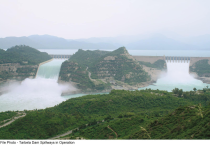
ISLAMABAD: Tarbela Dam — the country’s second largest reservoir — attained its full conservation capacity on Monday as total live storage crossed 11 million acre feet (MAF), just 15pc behind 13.35MAF maximum capacity.

“Tarbela Dam reached its maximum conservation level of 1,550 feet above mean sea level today, resulting in 5.766 million acre feet useable water in the reservoir,” Water and Power Development Authority announced.

Wapda said the filling of dam was a good sign for irrigated agriculture and generation of green, clean and affordable hydel electricity in the country.

On the other hand, Mangla Dam, the largest water reservoir in the country, stood about 30 feet short of its maximum storage.

Wapda reported its conservation level at about 1,214 feet. As of Monday, Mangla Dam was filled to a maximum elevation of 1,242 feet.

As such, useable water at Tarbela stood at about 5.18MAF on Monday against its maximum storage of about 7.3MAF.

Since April 1, about 6.5MAF water has flowed into the Arabian Sea — more than total storage of Tarbela dam. Under the 1991 water apportionment accord, the Indus River System Authority (Irsa) — the water regulator and Wapda are required to ensure at least 8MAF flows downstream Kotri Barrage for environmental reasons.

The Irsa on Monday reported total river flows of 417,000 cusecs at rim stations of which about 380,400-cusec water was released into the irrigation system, leaving behind about 47,000 cusec for conservation, mostly in Mangla and Tarbela dams.

The Indus was reportedly flowing at 256,400 cusecs at Tarbela dam against its total outflows of 235,000 cusecs.

The Kabul River at Nowshera was reportedly flowing at 66,400 cusecs, while the River Jhelum flows were registered at 25,800 cusecs at Mangla dam against its 10,000-cusec outflows.

At Marala headworks, the Chenab River was flowing at 62,700 cusecs.

Meanwhile, the federal flood commission reported medium flood in the River Indus in Taunsa-Sukkur reach and in low flood in Tarbela-Chashma reach. Also, the Kabul was in low flood at Nowshera.

Published in Dawn, August 20th, 2024
 
To view this content we will need your consent to set third party cookies.
For more detailed information, see our cookies page.
 
To view this content we will need your consent to set third party cookies.
For more detailed information, see our cookies page.
 
Hub Dam Filled to Maximum Level of 339 Feet
September 1, 2024: Hub Dam filled to its maximum conservation level of 339 feet above mean sea level today September 1, 2024 at 06:40 a.m. , with a live water storage of 646,000 acre-feet.

This storage of water in Hub Dam is anticipated to sustain the water supply requirements for Karachi, and Hub City, District Lasbella, Balochistan for approximately the next three years.

The safe passage of excess water through the spillway is currently in operation.


To view this content we will need your consent to set third party cookies.
For more detailed information, see our cookies page.
 
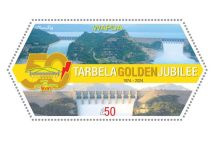
Tarbela Dam is now 50 years old.

1726142991225.png
 
Commemorative postage stamp issued on completion of 50 years of Tarbela Dam.

Pakistan Post has issued a commemorative postal stamp worth Rs 50, the commemorative postal ticket ceremony was held at Ronmai Wapda House
Chairman Wapda Engr Lieutenant General Sajjad Ghani (Retd) was the Chief Guest of the ceremony, Senior officers of Pakistan Post and Wapda attended the ceremony
17th October, 2024...... On completion of 50 years of Turbeladium, Pakistan Post issued commemorative postage of Rs 50

Director General (Operation) presented the album of commemorative postcards of Tarbela Dam to Chairman Wapda on behalf of Pakistan Post.

It is noteworthy that the Tarbela Dam, completed in 1974 has been the most important component of economic and social development in Pakistan during the last half century.

The importance of Tarbela Dam in the economic development of Pakistan can be assessed by this. That Tarbela Dam has provided 406 million acres of water stored in its reservoir for agriculture in the last 50 years, while Tarbela Hydel Power Station has provided 590 billion 36 crore 10 lakh units of affordable electricity to National Grid. One million acre feet in Pakistan. Less emissions than water have equal economic and economic benefits of 1 billion US dollars. Pakistan has benefited more than 400 billion US dollars in the past 50 years from Tarbela Dam.

Therefore, total benefits accrued from Tarbela Dam during the last 50 years stand at more than four hundred billion dollars.


1729371061379.png
 
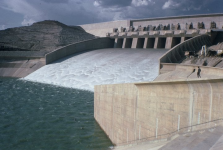
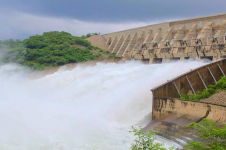
Two wonderful comparison pics of the Main Spillway taken almost 50 years apart. The first pic is from the PAM PHILPOTT album taken by her Dad, Dink: February, 1967 - First water over the Spillway.

The second pic is from A. AHMED KHAN: Upper Chute & Stilling Basin. Sep 5, 2014. (Pic credit Mr. Arshad)


1729803033060.png


1729803074415.png
 
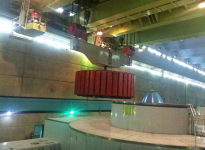
Two wonderful comparison pics taken in Mangla Power House 50 years apart. The first 1960’s pic is from the TOM APPLEBY(Dad) album: Historical pic of the installation of Unit No. 1, Mangla Power House. The second pic is from the ALI IMRAN album first posted in 2015: Mangla Power House.

1729803204090.png


1729803230643.png


1730647480525.png

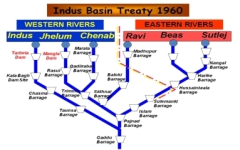
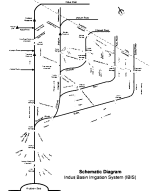
As a consequence of partition of the Indo-Pakistan Sub-Continent in 1947, India and Pakistan became two independent sovereign states. The Irrigation System which existed at the time of partition in 1947 was divided between the two countries without any regards to the irrigation boundaries resulting in an international water dispute which was resolved by signing of the Indus Water Treaty in 1960 under the aegis of World Bank.

1730647538811.png


The Treaty assigned three Eastern rivers (Ravi, Beas and Sutlej) to India and three Western rivers (Indus, Jhelum & Chenab) to Pakistan. It also provided construction of replacement works called Indus Basin Project (IBP) to compensate for perpetual loss of Eastern river's water. The works proposed under the Treaty included two multipurpose dams from one of which is Mangla Dam on Jhelum river having the provision of Power Generation.

Mangla Dam Project was actually conceived in 1950's as a multipurpose project to be constructed at a place called Mangla on river Jhelum located about 30 km upstream of Jhelum city. The initial investigation & its feasibility studies were completed in 1958. Later on the project was included in the Indus Basin Project. The construction of Mangla Dam was started in 1962 and completed in 1967.

Creation of dam investigation circle by G.O.P. for investigation & Feasibility Studies in 1952.

Project Planning Report completed by Consultant in 1958.

Included in Indus Basin Project after signature of Indus Basin Treaty.

Award of Contract
: January 20, 1962
Construction : 1962 - 1967
First Impounding : February 21, 1967
 

Users who are viewing this thread

Back
Top