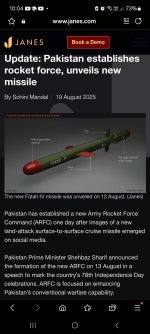
Pakistan Rocket Force Command News and Discussions

Difference is "Strategic" Force command and "Conventional" Rocket Force ....

Doctrine is different, usage would be different, even the situation and stages in which both will be used will be different.
oh, I think I get it now
this "Rocket Force Command" shall control conventional weapons, somewhat like long range artillery.
 
oh, I think I get it now
this "Rocket Force Command" shall control conventional weapons, somewhat like long range artillery.
Yaap .... It will deal with Conventional rockets and missiles .... Hence no need to have prior authorisation for use from NCA, SPD and then Strategic Force command.

Further as we know our strategic missiles and warhead are not stored in assembled state in ready to use conditions, therefore the utilization of those system take additional time which now would not be case with Conventional Rocket Force.
 
According to Him a Copy of DF17 is in service and there trying to get the real thing.
@Panzerkiel
Is this true?
What does a copy mean? a copy produced in Pakistan?
our own original design or based off of Chinese blueprints?
If its based off of Chinese blueprint, why is it called a copy?
When was it tested?
 
@Panzerkiel
Is this true?
What does a copy mean? a copy produced in Pakistan?
our own original design or based off of Chinese blueprints?
If its based off of Chinese blueprint, why is it called a copy?
When was it tested?
I think I mentioned that both things are on the cards... Not operational yet.
 
To view this content we will need your consent to set third party cookies.
For more detailed information, see our cookies page.
 
To view this content we will need your consent to set third party cookies.
For more detailed information, see our cookies page.


What Iran needs help with is rebuilding its airforce and not missiles!
 
I have just found this video on Chinese rocket force:

To view this content we will need your consent to set third party cookies.
For more detailed information, see our cookies page.


Most of the above applies to Pakistan v India. It's a very good assessment, and highlights advantages of rocket "artillery" vs traditional 155mm for example.

Suffice to say, this is devastating for India. In addition, it somewhat negates the need for small yield tactical nukes that were, let's be honest, a bad option for Pakistan anyway.
 
I have just found this video on Chinese rocket force:

To view this content we will need your consent to set third party cookies.
For more detailed information, see our cookies page.


Most of the above applies to Pakistan v India. It's a very good assessment, and highlights advantages of rocket "artillery" vs traditional 155mm for example.

Suffice to say, this is devastating for India. In addition, it somewhat negates the need for small yield tactical nukes that were, let's be honest, a bad option for Pakistan anyway.

This is not the PLA Rocket Force.

Pakistan's Strategic Plans Division Force is similar to China's PLA Rocket Force. Both are strategic nuclear weapons units.

Pakistan's Rocket Force is equivalent to the artillery brigades under the PLAGF's group armies.
 
Last edited:
This is not the PLA Rocket Force.

Pakistan's Strategic Plans Division Force is similar to China's PLA Rocket Force. Both are strategic nuclear weapons units.

Pakistan's Rocket Force is equivalent to the artillery brigades under the PLAGF's group armies.

Thanks
In practical terms, do the same conclusions apply?
 
In practical terms, do the same conclusions apply?
In the PLAGF's organization: Each group army consists of 12 brigades.

6 combined arms brigades: They are divided into heavy/medium/light combined brigades, mountain combined brigades, amphibious combined brigades, etc. according to the areas each group army is responsible for and the environment it faces.
Each combined brigade consists of 4 combined battalions and 5 functional battalions, one of which is an artillery battalion. Artillery battalions are usually equipped with 122MM self-propelled howitzers, 122MM truck-mounted guns, 122MM MLRS, etc.

6 functional brigades: These are six special function brigades: Aviation Brigade/Air Assault Brigades, Artillery Brigade, Special Operations Brigade, Air Defense Brigade, Service Support Brigade, and Engineer and Chemical Defense Brigade.
Each artillery brigade consists of six fire strike battalions:
Two self-propelled artillery battalions with PLZ-05A 155mm self-propelled howitzers
Two truck-mounted artillery battalions with PCL-181 155mm vehicle-mounted howitzers
Two long-range MLRS battalions with PHL-191 box-mounted long-range MLRS

These are general configurations, but they are not fixed. They can be rearranged at any time. For example, the artillery brigades near the Taiwan Strait are mostly composed of long-range MLRS battalions, which are very large in number.
Generally speaking, artillery brigades are responsible for striking conventional targets within a 1,000km range. Only special target strike missions are carried out by the PLAAF or PLARF.

Based on these circumstances, you can compare them with Pakistan's Rocket Force.
=========================================================
The PLAGF no longer has short-range ballistic missiles in its active arsenal. In other words, our heavy-duty guided rocket artillery is actually a short-range ballistic missile. They're just called differently, but their functionality and accuracy are exactly the same.
 
I think I mentioned that both things are on the cards... Not operational yet.
Heard the local knockoff didn’t meet expectations or the aimed parameters. And they need to develop more key technologies but lack of budget on rnd prevents that hence Pakistan looking to acquire the real chinese df17.
How much truth there is to this? Can you confirm with just a yes or no?
 

Users who are viewing this thread

  • Country Watch Latest

    Latest Posts

    Back
    Top