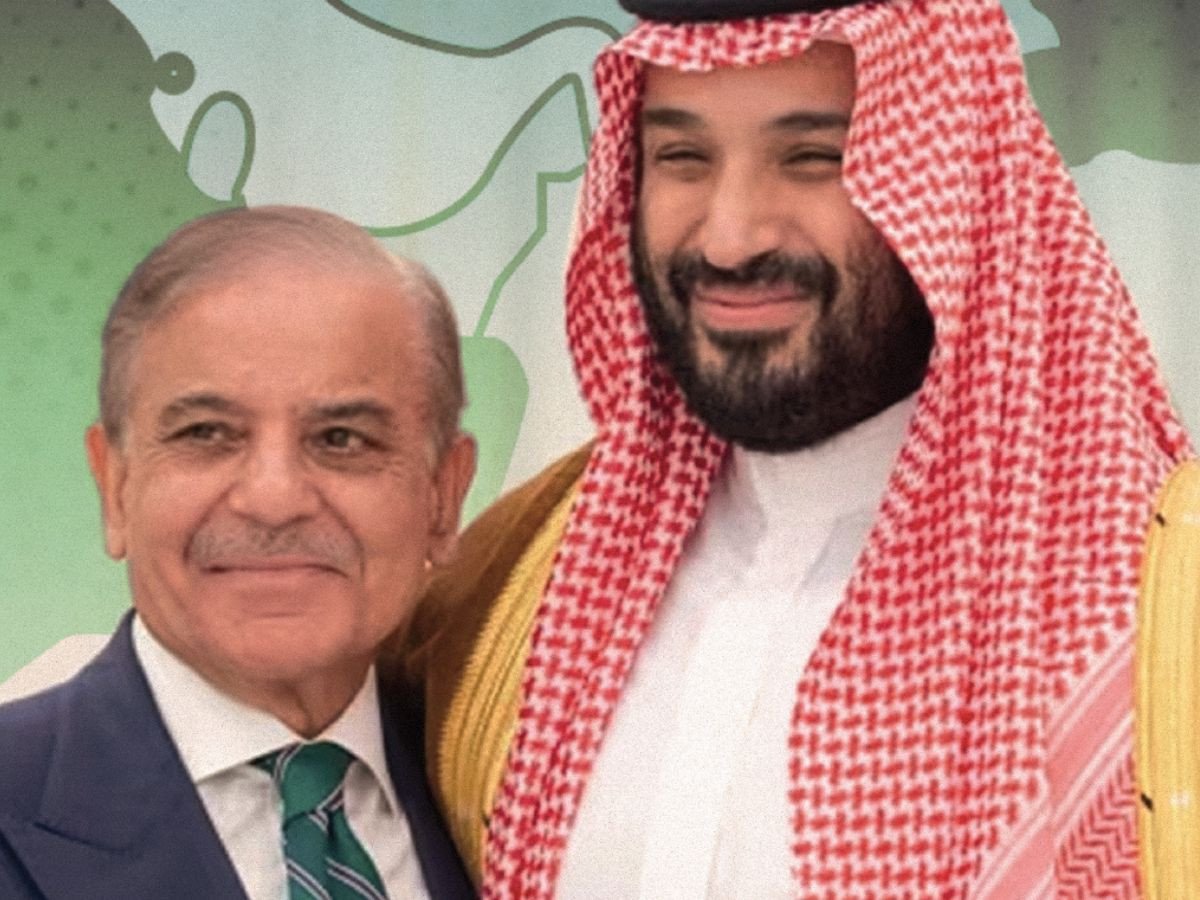
SMDA is a watershed, shielding KSA from Israel’s threat while offering Pakistan a vital economic lifeline

tribune.com.pk
Years ago, I was meeting the Saudi Ambassador as my job while in service. He told me that during his pre-departure protocol meeting with the King, his majesty wagged his finger at him to emphasise the importance of Pak-Saudi ties. So, after decades of groundwork, that bilateralism has been at last formalised into a ‘Strategic Mutual Defence Agreement (SMDA)’ signed by both sides in the Royal Court of Al Yamamah Palace in Riyadh on 17 September 2025.
The joint statement on the MOFA, Islamabad website describes the landmark Agreement purposed “to strengthen joint deterrence against any aggression. The agreement states that any aggression against either country shall be considered an aggression against both”. Whereas other details are not public, hence speculations would be counterproductive and unneeded, the cited presser points towards a NATO style partnership, where an attack on one country would be warranting a ‘joint response’.
Use of Pakistani military muscle in support of the Kingdom, and the Kingdom’s political, diplomatic and financial support has a long history hence the SMDA is not surprising for those in the know. India, after studying the proposals, has hoped Riyadh would be cognizant of Indian sensitivities, without elaborating.
Historic legacy
Recognising an independent Pakistan in 1947, Pakistan and KSA signed a “Treaty of Friendship,” in 1951, laying the foundation of strategic, political, military, and economic cooperation, later morphing into people-to-people, government-to-government, military-to-military, and business-to-business ties spanning almost eight decades.
In the security sector alone, since the 1970s, Pakistani soldiers are stationed in Saudi Arabia for the sacred calling of protecting the Harmain Shareefain. Training cooperation for officers and men at Pakistani military academies and other institutions is now longstanding. Advisory support to the Saudi military is in place. Extensive collaboration with the Royal Saudi land, air, naval forces, air defence and Royal Guards is ongoing, including secondment of fighter pilots and doctors to the Kingdom.
PAF fighter pilots took part in the Al-Wadiah War between Saudi Arabia and South Yemen in 1969, whereas Pakistan Army Engineers built Saudi fortifications along Saudi border with Yemen etc. Tabuk hosted a Pakistani armoured brigade in the 1970s and 80s under another agreement famously called the ‘1982 Protocol’. During the first Gulf War in August 1990, an infantry and an armoured brigade from Pakistan were deployed along Saudi-Iraq border. Pakistani battalions remain deployed in Mecca. All military services from both sides conduct regular security and counter-terrorism exercises.
The Kingdom has extensively collaborated in the development of Pakistan’s main battle tank (MBT) Al-Khalid. Joint R&D and defence manufacturing is a continuing process. Saudi Arabia also imports large quantity of Pakistan Ordnance Factories (POF)-manufactured arms and ammunition. In 2016 alone, POF exported arms and munitions worth $81 million to Riyadh.
Pakistan was also one of the key intermediaries in the Al-Yamamah arms deal, a series of arms contracts in the 1970s between the Kingdom and the UK, facilitating payment for Western arms through Saudi oil. Pakistan’s former COAS, Gen Raheel Sharif, commands the 41-nation ‘Islamic Military Counter Terrorism’ coalition, headquartered in Riyadh.
The list goes on. So, what sparked the Agreement?
The catalyst
Israel, the new sheriff in the Middle East, was always an essential component of the Saudi threat perception. Tabuk deployment is a case in point. Although the bonhomie under the Abraham Accord, and America’s enthusiastic push towards normalisation of relations between Riyadh and Tel Aviv had created a lot of hopeful momentum, the US dithering for extending a nuclear umbrella to Riyadh and Washington’s unequivocal support to Israel remained major impediments to any breakthrough. Recent incidents led to the Saudi change of heart under the very dynamic, savvy and progressive crown prince Mohammad Bin Salman’s (MBS).
One, Israel’s brutal war of Palestinian extermination in Gaza under its strategy of Dahiya or ‘domicide’ (rendering places uninhabitable through destruction) and America’s outright callous support to Israel. Two, the joint US-Israeli attack on Iran in June this year and the extensive usage of surrender phraseology in the arrogant conduct of that war. Three, the September 9, Israeli attack on Qatar, America’s major non-NATO ally, host to the sprawling Al-Udaid airbase, upgraded with Qatari money, accommodating US, UK and Australian troops; and the fact that Doha remains a major buyer of high-cost US military hardware. Sheriff Netanyahu has categorically said, he sees it right to pursue ‘terrorists’ anywhere in the world, under his ‘presumed’ notion of self-defence. Israel under Bibi’s right-wing government has become a regional and global threat and that greatly unsettles the Middle East.
The thinking in the Arab world, once clamouring for US protection, changed overnight, especially after the 10 Israeli missiles struck Doha. The US feigned ignorance initially and then conceded Israel had informed it on very short notice. The fickleness and unreliability of US interlocution have led to a search for alternatives, like the notion of some sort of ‘collective security’ among the Arab/Islamic states, as stated in the communiqué after the extraordinary and joint AL-OIC Summit in Doha on 15 September.
Collective security is a messy concept, and even NATO finds interoperability hard during deployments, hence the sensible push for multilateral and bilateral arrangements. And that provides a backdrop and urgency to the Saudi-Pak Defence Agreement that took almost a year to formalise.
The treaty & the agreement
The nuances and the debate about the binding nature of the treaty versus agreement aside; and given that speculation without knowing the exact Agreement details is misplaced; it is suffice to mention that any ‘defence agreement’ would and should deal with certain essentials like joint appreciation of the situation, threat perception and response options for perceived ‘aggression’, consequent training collaboration, required deployment of forces, basing possibilities, employment details in various scenarios, and the entailing logistic support, command and control modalities and other plans. The pact also might entail joint R&D, defence production, and trade in defence software and hardware.
Threat perception
As highlighted in the changed global and regional environment, Tel Aviv under its ‘present’ leadership poses a threat to both Pakistan and the Kingdom. Threat is the sum total of intention and capability. Israel possesses both. In military methodology, environment (global, regional and domestic) leads to threat perception and assessment, which in turn goes into exploring response options; and response provides basis for the developmental strategy, dealing with equipping the force. Israel poses non-contact threat to KSA and Pakistan. And Israel combined with India and a troubled Afghanistan provides a 2.5 front contact war scenario, under Pakistan’s complicated threat matrix.
Without gunning for a war with IDF, an over-confident and militarily ascendant Israel does pose a significant threat to both nations, after its conduct of war in Gaza, possible annexation of West bank, imposition of humiliating terms on Hezbollah in Lebanon, offensive posturing to Syria’s new Government and after fighting a bruising conflict with Iran. ‘Deterrence’ against Israel militarily would be marginally possible in the conventional domains, but more significant and robust in the non-conventional or nuclear domain. As an extension of the ‘nuclear umbrella’, remains the soul of the Agreement, therefore, ‘defensive deployment of non-conventional means alone’ would constitute ‘credible deterrence’.
Pakistan, thanks to Allah, its military, its scientific backbone and support from Saudi Arabia today possesses a nuclear triad (air, land and sea-based), which is reliable, fail-safe and multiplatform. Pakistan can effectively provide the needed nuclear umbrella to Riyadh, with the resolve to use it, if push comes to shove. In any case, any attack on Saudi Arabia raises an immense and uncontrollable emotional reaction in Pakistan. The November 1979 standoff by terrorist Juhayman al-Utaybi whose militants seized Haram Shareef in Mecca, is a case in point. While Pakistani commandos cleared the holy mosque, in Islamabad, the US embassy was burnt to ashes, as rumours of an American hand were rife. And by the evening, no liquor store in Peshawar, where one lived, remained intact.
There is a strong inkling that any exchange between Israel with either Pakistan or the Kingdom would descend precariously into the nuclear domain, given the political and psychological costs involved. Perceived attack on Harmain raises immense psychological cost; and attack on Pakistani nuclear sites, although of no utility other than embarrassing Pakistan’s military, would and should entaila quick, decisive, and punishing response.
Basing options of mainly the non-conventional capability, under the Agreement, as and when worked out, mitigates and deters any Israeli adventurism against the Kingdom and against Pakistan. And it also fortifies Pakistan’s response options against a bellicose India under its ‘new normal’. It compensates for Pakistan’s linear geography, range and reach complications. ‘Shaheens’ would find skies less contested, saturation and suppression of the enemy air defence (SEAD) relatively easy, and penetration through ‘slings and domes’ possible, if the calling ‘ever’ came.
The implications
First, the Agreement upgrades bilateral defence ties to the next level, integrating Pakistan’s military muscle with the Kingdom’s financial power; strengthening ‘joint deterrence’; and ensuring a binding security partnership. The optics of the visit and the high-profile presence of Field Marshal Syed Asim Munir underscore the military's stakes on either side. Even in turbulent times, Pak-Saudi military diplomacy has remained robust.
Second, there is speculation that commitment to joint defence might drag Pakistan into unwanted conflicts, like the Saudi pressure on Pakistan in 2015 to join Houthi war in Yemen. Pakistan’s successive governments have avoided such involvement, but in the changed circumstances, it would be good to be seen to be counted. Hedging for middle powers like Pakistan with a weak economy is never beneficial. Pakistan-Saudi Arabia and China is the emerging entente. Riyadh’s own defence diversification, investment and closer collaboration with China could be positively leveraged. Pak-Saudi jointness would certainly suppress potential conflicts.
Third, with regard to China, the triad of Chinese technology in surveillance, stealth, and AI — now decisively comparable to the West, as shown during the May Indo-Pakistan standoff — Pakistani military strength, demonstrated through the effective use of the J-10C/PL-15E combination and integration of other kill-networks, and Saudi financing could form a stabilising force in an otherwise volatile Middle East and South Asia.
Fourth, contrary to common perception, the Agreement reinforces Pak-India deterrence and is likely to work for peace between India and Pakistan, because of Riyadh-New Delhi commercial interests (US $43 billion bilateral trade in 2023-24, and growing); the Indian diaspora in the Kingdom (2.6 million); and New Delhi’s reliance on the Saudi (16-20%) and Gulf oil. The fact that India would not take the US bait of standing up militarily to neighbourly China and given the mercurial nature of the Indo-US relationship under the Trump presidency continuing until 2028, India, hopefully, might’ shun the path of conflict in its rise as a regional power, and instead value cooperation over competition and amity over arrogance in its dealings with Islamabad.
Fifth, GCC would enthusiastically welcome the Saudi initiative, being the most powerful and largest Arab nation. Most GCC sheikhdoms are US-UK protectorates, unable to pursue divergent and more independent policies. This might pave the way for more strategic independence in due course of time. This template in due course could be extended to UAE and Qatar, Pakistan’s two key allies, with mutual consensus. Deputy PM Dar and Defence Minister Khawaja Asif have alluded to the expansion of the Agreement.
Sixth, KSA still enjoys and will continue to enjoy a special relationship with Washington that has traditionally been used for Pakistan’s benefit. As of mid-2025, some 40,000–50,000 US troops remain in 19 US bases across the Middle East, including the Prince Sultan Air Base outside Riyadh. If Israel could be restrained, the Agreement does not impinge upon America’s core interest in the region.
Seventh, there is a feeling that, consequent to the Agreement, Pakistan risks entanglement in Saudi Arabia’s regional rivalries, like with Iran and Yemen. However, the US/Israeli attack on Iran has greatly altered the regional security paradigm, and Iran, during the emergency AL/OIC session, emphasised Muslim unity. Pro-Pakistan sentiment in Tehran consequent to Pakistan’s support during the cited crisis, and earlier rapprochement between Iran and KSA augur well. This is likely to diminish the Houthi threat to the Kingdom as well.
So, in a nutshell, this watershed Agreement is a paradigm shift that was years in the making. It addresses the Kingdom’s vulnerability against a nuclear-armed, bellicose and uncontrolled Israel, while at the same time, it extends an economic lifeline to Pakistan. It essentially is a defensive framework that is Riyadh and Islamabad’s sovereign right. Naysayers and detractors need to be more restrained in their commentary.
Time to celebrate without being unnecessarily apologetic. Nations do what they do in their selfish national interest, without fear and appeasement!