sutton9999
Registered Member

The whole world is assembling Chinese components (at different levels) when comes to Solar.
Follow along with the video below to see how to install our site as a web app on your home screen.
Note: This feature may not be available in some browsers.

物极必反!Pakistan’s solar rush unlocked $17-19bn in private investment in 8 years: study
Rehan Ayub
- In FY25 alone, solar mobilised $5-6bn, emerging as one of Pakistan’s strongest channels of private capital, study ‘The Many Dividends of Solar Rush in Pakistan’ says
Published December 12, 2025
View attachment 165082
Pakistan’s solar rush has unlocked $17-19 billion in private investment between FY17 and FY25, driven by household savings, rooftop systems, and the expansion of EPC (Engineering, Procurement, and Construction) and installation services, according to a study released on Friday.
In FY25 alone, solar mobilised $5-6 billion, emerging as one of the Pakistan’s strongest channels of private capital, the study ‘The Many Dividends of Solar Rush in Pakistan’, launched by think tank Renewable First said.
“This surge in activity has generated 300,000 direct and 200,000 indirect jobs, strengthening service industries, supply chains, and rural electrification efforts,” the study stated.
It highlighted that the mass-scale adoption of solar photovoltaic (PV) was not only reducing fossil dependence and easing grid strain but also mobilising private capital, creating jobs, and cutting emissions at scale.
Pakistan’s solar surge lifts it into rarefied 25% club
As Pakistan grapples with mounting climate risks, including the recent devastating monsoon floods, distributed solar continues to deliver one of the country’s strongest mitigation outcomes.
“In FY25, solar PV avoided an estimated 35 million MtCO₂-eq, pushing cumulative avoided emissions since FY17 to over 83 million MtCO₂-eq.”
At the current trajectory, Pakistan could avoid 50 million MtCO₂-eq annually by FY30, avoiding more emissions than the total currently produced by the country’s entire power sector, according to the study.
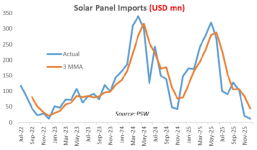
Pakistan’s rapid solar uptake has positioned it as the second-largest global importer of Chinese solar panels in FY25, bringing in 17.9GW, with cumulative imports surpassing 50GW, as per the stats given by the study.
Households, farms, and industries are increasingly shifting to solar as “it makes financial sense because of rising grid tariffs and expensive imported fuels”.
“Amid Pakistan’s worsening economic and employment challenges, the country’s solar rush is delivering clear cross-sectoral dividends, from declining thermal reliance to new economic activity and the creation of much-needed jobs,” noted Muhammad Sheraz, Energy Analyst at Renewables First.
“These outcomes are not only transforming the energy sector but also laying the foundation for substantial economic growth.”
With the deployment of an estimated 32GW of solar PV, the report found that Pakistan could potentially generate 42TWh of distributed electricity annually, equivalent to 38% of current grid sales.
This rapid growth in behind-the-meter generation is eroding the role of conventional power plants.
Imported coal has seen the sharpest decline, the study mentioned, with utilisation falling from 78% to just 11% between FY22 and FY24.
“RLNG plants have dropped from 51% to 31%, while local coal has eased from 81% to 70%. With RLNG cargoes for FY26–27 already cancelled and coal imports continuing to fall, these trends suggest a deep and structural shift in Pakistan’s fossil energy demand, driven not by policy mandates, but by the momentum of consumer-led solar adoption.”
BR RESEARCH: Solar imports slow, momentum will hold
The study suggested to align Pakistan’s power sector policies with the fast-growing reality of distributed energy resources. This included modernising grid and resource planning, undertaking tariff and market reforms suited to declining grid consumption, clarifying policies for distributed generation, storage, and flexible resources, and updating regulatory frameworks to enable a decentralised, consumer-driven energy future.
“Policies and planning frameworks must now keep pace with this shift to ensure the system is prepared for a rapidly changing energy landscape,” Sheraz noted.

Nothing to do with any governmentPakistan’s solar rush unlocked $17-19bn in private investment in 8 years: study
Rehan Ayub
- In FY25 alone, solar mobilised $5-6bn, emerging as one of Pakistan’s strongest channels of private capital, study ‘The Many Dividends of Solar Rush in Pakistan’ says
Published December 12, 2025
View attachment 165082
Pakistan’s solar rush has unlocked $17-19 billion in private investment between FY17 and FY25, driven by household savings, rooftop systems, and the expansion of EPC (Engineering, Procurement, and Construction) and installation services, according to a study released on Friday.
In FY25 alone, solar mobilised $5-6 billion, emerging as one of the Pakistan’s strongest channels of private capital, the study ‘The Many Dividends of Solar Rush in Pakistan’, launched by think tank Renewable First said.
“This surge in activity has generated 300,000 direct and 200,000 indirect jobs, strengthening service industries, supply chains, and rural electrification efforts,” the study stated.
It highlighted that the mass-scale adoption of solar photovoltaic (PV) was not only reducing fossil dependence and easing grid strain but also mobilising private capital, creating jobs, and cutting emissions at scale.
Pakistan’s solar surge lifts it into rarefied 25% club
As Pakistan grapples with mounting climate risks, including the recent devastating monsoon floods, distributed solar continues to deliver one of the country’s strongest mitigation outcomes.
“In FY25, solar PV avoided an estimated 35 million MtCO₂-eq, pushing cumulative avoided emissions since FY17 to over 83 million MtCO₂-eq.”
At the current trajectory, Pakistan could avoid 50 million MtCO₂-eq annually by FY30, avoiding more emissions than the total currently produced by the country’s entire power sector, according to the study.
Pakistan’s rapid solar uptake has positioned it as the second-largest global importer of Chinese solar panels in FY25, bringing in 17.9GW, with cumulative imports surpassing 50GW, as per the stats given by the study.
Households, farms, and industries are increasingly shifting to solar as “it makes financial sense because of rising grid tariffs and expensive imported fuels”.
“Amid Pakistan’s worsening economic and employment challenges, the country’s solar rush is delivering clear cross-sectoral dividends, from declining thermal reliance to new economic activity and the creation of much-needed jobs,” noted Muhammad Sheraz, Energy Analyst at Renewables First.
“These outcomes are not only transforming the energy sector but also laying the foundation for substantial economic growth.”
With the deployment of an estimated 32GW of solar PV, the report found that Pakistan could potentially generate 42TWh of distributed electricity annually, equivalent to 38% of current grid sales.
This rapid growth in behind-the-meter generation is eroding the role of conventional power plants.
Imported coal has seen the sharpest decline, the study mentioned, with utilisation falling from 78% to just 11% between FY22 and FY24.
“RLNG plants have dropped from 51% to 31%, while local coal has eased from 81% to 70%. With RLNG cargoes for FY26–27 already cancelled and coal imports continuing to fall, these trends suggest a deep and structural shift in Pakistan’s fossil energy demand, driven not by policy mandates, but by the momentum of consumer-led solar adoption.”
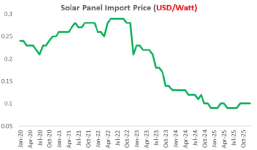
BR RESEARCH: Solar imports slow, momentum will hold
The study suggested to align Pakistan’s power sector policies with the fast-growing reality of distributed energy resources. This included modernising grid and resource planning, undertaking tariff and market reforms suited to declining grid consumption, clarifying policies for distributed generation, storage, and flexible resources, and updating regulatory frameworks to enable a decentralised, consumer-driven energy future.
“Policies and planning frameworks must now keep pace with this shift to ensure the system is prepared for a rapidly changing energy landscape,” Sheraz noted.


物极必反!
Everything needs to develop in an orderly manner. Uncontrolled and reckless expansion leads to things swinging from one extreme to another. This is not a good idea.
Pakistan's current solar power industry is experiencing excessive expansion. The government needs to guide the industry towards healthy development and formulate relevant policies and regulations to prevent potential negative consequences.
Anyone on here with expertise on solar panels placement? I'm in the process of renovating my house, there will be a new roof design but I'm stuck between optimising interior space or ideal solar panel placement.
I can share the plans and you can provide insight....? Any help would be appreciated before I ask the architect to change the drawings for a 10th time....(he told me drawings can be changed until I'm happy so he shot himself in the foot!).
You need to carefully understand my point of view.If you ever heard stories of Pakistani paying their electricity bill, then you won't think there is anything unhealthy about it.
Uncontrolled development in any industry can lead to extremely serious consequences.What is unhealthy about it ?
You need to carefully understand my point of view.
I didn't say that Pakistan shouldn't vigorously develop solar energy. My point is that the development of solar energy needs to be done in an orderly manner.
Uncontrolled development in any industry can lead to extremely serious consequences.
In the case of the solar energy industry:
1. Political instability and economic risks. I shouldn't elaborate too much on this. If you can understand these words, you'll naturally understand what I'm trying to express. If you can't understand them, any explanation I give will be futile.
Political issues.
A government's ability to effectively control its population depends on the degree to which the people rely on the public services provided by the government.
The stronger the service capabilities of the public services controlled by the government, the stronger the government's control will be. Conversely, if the public services controlled by the government completely lose their ability to serve the people, this also means that the government loses its ability to control the people.
Government service capacity = Government control capacity
Economic problems.
The fierce competition within the domestic market can lead to overdevelopment of industries. The ultimate consequences will not only fail to promote industrial development but will also result in a heavy economic burden.
2. Future generations will suffer the consequences. Simply put, this refers to the disposal and recycling process of energy storage batteries. If an efficient system for the disposal and recycling of energy storage batteries is not established before widespread adoption, the consequences will lead to extremely serious environmental pollution. The price paid for the benefits enjoyed by this generation will be suffering for future generations.
In recent years, the money China has spent on improving the environment far exceeds the profits earned from its economic development.
Even if you disregard political and economic issues, please pay attention to environmental problems.There is no proper "goverment" in Pakistan, it is totally disfuctional to the needs of the population.
Things only get done, or improve when people have to take matters into their own hands.
Are you sure he is not charging you for every revision ?!

There is no proper "goverment" in Pakistan, it is totally disfuctional to the needs of the population.
Things only get done, or improve when people have to take matters into their own hands.