Pakistan Solar Power: News & Updates

Pakistan’s solar boom squeezes grid demand, Chinese power projects: Bloomberg​

Grid electricity consumption falls as businesses turn to cheaper solar; overdue payments to Chinese power plants exceed $1.5bn

Pakistan’s accelerating shift towards solar power is cutting demand for grid electricity and adding pressure on the country’s power-sector finances, including Chinese-backed coal projects, Bloomberg reported on Thursday.

Electricity consumption across Pakistan’s distribution companies was almost 12% lower in the 12 months to July 2025 compared with three years earlier, according to NEPRA data cited by the report, as households and businesses increasingly turn to distributed solar generation.

Solar accounted for about 20% of Pakistan’s electricity generation in 2025, compared with around 3% at the beginning of the decade, Bloomberg reported, citing energy think tank Ember.

High grid tariffs, unreliable electricity supply and falling solar equipment costs have accelerated adoption. Pakistan became China’s third-largest solar export market last year, while imports of battery storage systems are also rising rapidly.

Customs data cited by Bloomberg showed Pakistan’s battery imports from China jumped nearly 150% in the first half of the year to about $392 million.

The shift is particularly visible in industrial areas. At Port Qasim, near Karachi, rooftop solar systems have spread across an industrial zone housing around 400 companies, alongside a Chinese-backed coal-fired power station.

Zaheer Allana, owner of a packaging factory in the area, said rooftop panels currently meet around one-fifth of his facility’s electricity requirements at less than one-third of the cost of grid electricity.
-
However, falling grid demand is worsening financial pressure on utilities because fixed power-sector costs have to be recovered from a shrinking pool of grid electricity sales.

The trend is also complicating the economics of Chinese-financed power projects. Overdue payments to Chinese electricity plants had exceeded $1.5 billion by August, while outstanding project debt linked to China-financed coal assets stood at $3.1 billion last year, according to figures cited by Bloomberg.

At the Port Qasim coal-fired power plant alone, overdue payments had reached nearly $300 million by June. The facility is among seven coal-fired plants delivered by China in Pakistan since 2017 at a combined cost of around $9.6 billion.

Energy Minister Awais Leghari told Bloomberg that Pakistan is seeking longer repayment periods for power-sector debt rather than reductions in the amounts owed.

“We are not expecting any haircuts in those terms and conditions,” Leghari said, adding that Islamabad had instead sought an extension of the debt repayment period.

Chinese officials have so far been reluctant to make major concessions that could impose losses on Chinese state-owned companies and banks, according to the report. Options being discussed include refinancing debt and repurposing under-utilised power plants.

The rapid expansion of distributed solar has consequently created a new challenge for Pakistan’s power sector: while consumers and businesses can reduce electricity costs by generating their own power, declining grid demand leaves utilities with fewer units over which to spread fixed capacity and infrastructure costs.
 

60GW later, batteries come knocking​

BR
October 6, 2026

Pakistan’s solar revolution is changing shape, and the speed of that change is becoming difficult to ignore.

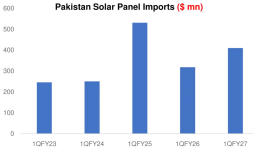
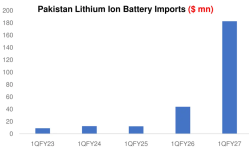
The latest import numbers make the point starkly. In 1QFY27, Pakistan imported around $405 million worth of solar panels and $182 million of lithium-ion batteries. Put differently, for every $2.2 spent on solar panels, the country now spends a dollar on batteries. Just two years ago, that ratio was $44 of solar panels for every dollar of battery.

The first phase of Pakistan’s solar revolution was about generation. Consumers bought panels to produce cheaper electricity during the day and reduce their dependence on an increasingly expensive grid. The economics were helped by a collapse in global panel prices, which made rooftop solar accessible at an extraordinary pace.

1791383696353.png


That phase is not over. In fact, panel imports have recovered after losing momentum earlier this year. But something else is happening alongside it. Storage is catching up at a remarkable speed.

And this matters because batteries change the relationship with the grid.

Solar panels reduce grid consumption when the sun is shining. Batteries allow that solar generation to be carried into the evening. The distinction is fundamental. The former changes the volume of electricity bought from the grid. The latter starts changing when, and potentially how often, electricity is bought from it.
 
Solar panels reduce grid consumption when the sun is shining. Batteries allow that solar generation to be carried into the evening. The distinction is fundamental. The former changes the volume of electricity bought from the grid. The latter starts changing when, and potentially how often, electricity is bought from it.

Pakistan has already imported close to 60,000MW of solar panel capacity. That is an enormous installed or installable base waiting to be paired with storage. The country’s officially net-metered capacity remains only a small fraction of this number, underscoring how much of the solar market has developed outside the formal grid-connected framework.

1791383761896.png

The next leg therefore does not require another panel boom of the scale seen in 2023 and 2024. Much of the hardware is already sitting on rooftops. What it needs is cheaper storage.

And storage is precisely where the economics are moving.
 
Solar module prices appear to have become relatively sticky around $0.10 to $0.11 per watt. The spectacular price declines that fuelled the first wave are becoming harder to replicate. Batteries are a different story. Prices are already at historically low levels, while improvements in cell chemistry, manufacturing scale, energy density and battery management systems offer further room for decline.

That creates a powerful combination. The cost of generating solar electricity has already fallen enough to make the technology compelling. The falling cost of storage is now making it increasingly possible to use that electricity when it is actually needed.

Regulation will alter the route, but perhaps not the destination.

The old net-metering regime has effectively given way to a new presumed framework, with the economics of exporting surplus electricity materially different from before. That should slow the growth of conventional grid-connected solar at the margin. But it may also strengthen the case for batteries.

If exporting excess solar becomes less valuable, consuming it yourself becomes more valuable.

That means the end of the old net-metering model may not mark the end of the solar revolution. It could accelerate its next phase.

Demand is no longer a simple function of economic growth, temperature and industrial activity. Millions of consumers are acquiring the ability to generate and increasingly store electricity themselves.

The shape of demand through the day is changing. The evening peak, once a fairly predictable feature of the system, could increasingly become a contest between grid supply and distributed storage.
 
The question is now how much of that solar will remain grid-dependent, how much will be paired with batteries, when those batteries will charge and discharge, and what that means for the utilisation of the network and conventional generation fleet.

Pakistan was late in recognizing the scale of the first solar wave. It cannot afford to repeat that mistake with storage.

The 1QFY27 numbers suggest the next disruption is no longer knocking on the door. It is already entering through the front door. The challenge now is to plan for it before the market once again makes the planning obsolete.
 

Users who are viewing this thread

Country Watch Latest

Latest Posts

Back
Top