Pakistan Space Related News & Discussions

Launch is still a major problem (it costs billions of dollars and very time consuming) - we rely heavily on Chinese launchers - see full explanation below

Pakistani space program: faster and more efficient but still dependent on China

Pakistan launched its fifth indigenous satellite into orbit within 16 months – but all launches used Chinese carrier rockets.

Aerospace propulsion engineer Dr. Sarah Qureshi told Sputnik how the program has accelerated.

Tech priorities

Pakistan is not inclined toward core research and development or investment in domestic technologies, and relies heavily on ready-made designs from China.

Why now

A suitable partner has been found in China.

Aerospace, defense and satellite technologies are now united under the Strategic Plans Division, improving coordination.

Modularity means designs no longer need to be built from scratch.

The launch problem

"If a satellite costs a million to build, the rocket to launch it to space costs billions," Qureshi says. "It requires a lot of money and time."


Pakistan is capable of building its own rockets, but no significant budget has been allocated to make it a national priority.

To view this content we will need your consent to set third party cookies.
For more detailed information, see our cookies page.

Doesn’t require „billions“.
We’ve been making missiles since the late 90s. If we can’t develop an uprated liquid rocket engine based on our experience then there is no point.
For a start, we should target an SLV capable of delivering a PRSC-sized satellite to LEO. We have adequate solid rocket motors from missiles to serve as boosters. Liquid motors would be needed for the main SLV stages and the satellite „bus“ stage. These liquid motors should be the target of development.
Will obviously require a lot of collaboration within the different SPD orgs due to the siloed sources of knowledge, experience and capability. this is the biggest bottleneck due to the absence of this collaborative culture (obviously since the orgs work on strategic programs) and since any hint of cross sharing of KH and tech between NESCOM and SUPARCO for eg will raise huge red flags, making it difficult to sustain even real civilian projects. SUPARCO is already a sanctioned organization due to it being a part of SPD and having been found procuring equipment and raw materials which could be used in the missile program (either due to it being used as a procurement front for NESCOM or due to dual use items for real civilian projects being flagged just bec SUPARCO is part of SPD)
 
Last edited:
Doesn’t require „billions“.
We’ve been making missiles since the late 90s. If we can’t develop an uprated liquid rocket engine based on our experience then there is no point.
For a start, we should target an SLV capable of delivering a PRSC-sized satellite to LEO. We have adequate solid rocket motors from missiles to serve as boosters. Liquid motors would be needed for the main SLV stages and the satellite „bus“ stage
The trouble is developing an SLV will attract unwanted attention, as it will imply we have ICBM capability. Besides, we probably don't have the volume requirements to justify having our own SLV, how many satellites do we really need launch?
 
The trouble is developing an SLV will attract unwanted attention, as it will imply we have ICBM capability. Besides, we probably don't have the volume requirements to justify having our own SLV, how many satellites do we really need launch?

So what if it sends certain signals? Pakistan’s missile program is already sanctioned left and right.
 
The trouble is developing an SLV will attract unwanted attention, as it will imply we have ICBM capability. Besides, we probably don't have the volume requirements to justify having our own SLV, how many satellites do we really need launch?
With the recent PIESAT deal, there might be just enough of a medium to long term need to justify an indigenous launch capability both for the initial launch and development of a constellation and due to the need to replace old satellites. The PRSC, PRSS and PakTeS sats all have a design life of roughly 5-8 years. Volume and launch frequency might make the case
 
So what if it sends certain signals? Pakistan’s missile program is already sanctioned left and right.
Sanctions is not the attention I was referring to.
 
So what if it sends certain signals? Pakistan’s missile program is already sanctioned left and right.
Will require better optics and more transparency. Some of these elements have already been seen such as the appointment of a civilian engineer as the Chairman of SUPARCO, greater outreach and PR such as the national competition to name the lunar rover, etc
A lot more needs to be done: better and more transparent social media presence, outreach to educational institutions - not just universities but schools too. Space is popularized among children across the world and SUPARCO must do that too and should tell the world that it’s doing that.
This will serve to create a softer image of the organization and make it a household name, thus reducing the „aura“ of mystery and secrecy that surrounds it. Everything is a game of perception after all.
All space agencies work with the military and share technology, but that fact is overshadowed by a lot of the things they do in the public domain
 
A View from Above: The Power of EO-1
Check out this crystal-clear view of Pathankot AirBase, captured by our EO-1 satellite!
Using the High-Resolution Satellite Sensor (HRSS), we can see incredible details on the ground with a 0.81m resolution. Whether it's for urban planning or monitoring geographic changes, our EO series continues to provide essential data from orbit.
Snapshot Specs:
📅 Captured: April 29, 2026
📍 Location: Punjab region
🛰️ Mission: SUPARCO SAT EO-1
Stay tuned for more updates from our missions! 📡✨
#SpaceScience #SUPARCO #Satellite #Mapping #Innovation #EOseries Suparco

View attachment 195096
View attachment 195097
View attachment 195098View attachment 195099

0.81m resolution is far better than I am expecting any Pakistani satellite to have. The question is, if Pakistan is using COTS components for this? How much of the lense, sensors are home grown ?
 
I wish SUPARCO would make APIs available on a pay-per-use basis, I'd love to use their imaging services in my apps/platforms.
I think They do sell images but it has enterprise level prices.
 
I think They do sell images but it has enterprise level prices.
That's fine, I'll just resell to all you lot :P

In seriousness, it's just that the track to getting a seamless integration from their system into a reseller system is unclear. We are developing a platform for drone service users (e.g., mappers, oil/gas, forestry, etc), and I am trying to get SUPARCO's mapping into the mix alongside our other providers.
 
0.81m resolution is far better than I am expecting any Pakistani satellite to have. The question is, if Pakistan is using COTS components for this? How much of the lense, sensors are home grown ?
Pretty sure the optics, the entire camera is Chinese. Suparco probably did systems engineering, software and integration.
 
The trouble is developing an SLV will attract unwanted attention, as it will imply we have ICBM capability. Besides, we probably don't have the volume requirements to justify having our own SLV, how many satellites do we really need launch?
We have the capability to develop SLV for more than a decade.... it's a political / economic decision not to develop it .
 
Doesn’t require „billions“.
We’ve been making missiles since the late 90s. If we can’t develop an uprated liquid rocket engine based on our experience then there is no point.
For a start, we should target an SLV capable of delivering a PRSC-sized satellite to LEO. We have adequate solid rocket motors from missiles to serve as boosters. Liquid motors would be needed for the main SLV stages and the satellite „bus“ stage. These liquid motors should be the target of development.
Will obviously require a lot of collaboration within the different SPD orgs due to the siloed sources of knowledge, experience and capability. this is the biggest bottleneck due to the absence of this collaborative culture (obviously since the orgs work on strategic programs) and since any hint of cross sharing of KH and tech between NESCOM and SUPARCO for eg will raise huge red flags, making it difficult to sustain even real civilian projects. SUPARCO is already a sanctioned organization due to it being a part of SPD and having been found procuring equipment and raw materials which could be used in the missile program (either due to it being used as a procurement front for NESCOM or due to dual use items for real civilian projects being flagged just bec SUPARCO is part of SPD)
If the Government wanted to have a domestic SLV, it would build one very quickly.

Take for an example, in just 2023, Pakistan launched it's first National Space Policy. Only 3 years later Pakistan has put 9 satellites in space in the last 2 years.

If Pakistan felt an SLV was of the utmost priority, you'll see it built, ready and launching satellites from Pakistani soil in no time. It all depends what our priorities are.

At the moment, an SLV will be more of a prestigious achievement for Pakistan as we don't have scores of satellites planned for the short-term.

Everything must grow with the economy, and our nominal GDP has been fluctuating since 2018, and not making any real progress due to the constant security issues and foreign threats.
 
0.81m resolution is far better than I am expecting any Pakistani satellite to have. The question is, if Pakistan is using COTS components for this? How much of the lense, sensors are home grown ?

Pretty sure the optics, the entire camera is Chinese. Suparco probably did systems engineering, software and integration.

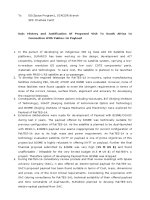
If the following document from 2017-18 is anything to go by, we do not have suitable facilities which can develop indigenous optical components for the imaging payloads. I also doubt that there is any serious HR capability which can undertake the development and manufacturing of optical components from scratch. Very few countries can.
However, I do believe that things must have improved since 2018. Where we once had to procure the entire imaging payload from a third party, we probably have the requirements engineering, design and qualification and testing capability now and can integrate various off-the-shelf components and develop supporting hardware and software.
In the future, we could see local capability in optics and sensor manufacturing for imaging payloads as well.

IMG_3376.jpeg
 
If the following document from 2017-18 is anything to go by, we do not have suitable facilities which can develop indigenous optical components for the imaging payloads. I also doubt that there is any serious HR capability which can undertake the development and manufacturing of optical components from scratch. Very few countries can.
However, I do believe that things must have improved since 2018. Where we once had to procure the entire imaging payload from a third party, we probably have the requirements engineering, design and qualification and testing capability now and can integrate various off-the-shelf components and develop supporting hardware and software.
In the future, we could see local capability in optics and sensor manufacturing for imaging payloads as well.

View attachment 195294
This is the PakTES1A imager:


Users who are viewing this thread

Latest Posts

Back
Top