Navigation
Install the app
How to install the app on iOS
Follow along with the video below to see how to install our site as a web app on your home screen.
Note: This feature may not be available in some browsers.
More options
Style variation
You are using an out of date browser. It may not display this or other websites correctly.
You should upgrade or use an alternative browser.
You should upgrade or use an alternative browser.
Pakistan Telecom, IT, Tech updates
- Thread starter ghazi52
- Start date
More options
Who Replied?
RealNapster
Elite Member
Mobile phone operators have proposed that the government could launch an installment scheme for mobile phones with a condition that a defaulter will be banned from getting a mobile SIM from any telecom company.
Why government is the one who should be doing this ? Why not these telcos ? They have been ducking blook of common Pakistani with 3rd class services and pricy packages. If they want to earn their profit, they should be the one financing payment plans for 5G devices. Its the same practice globally.

Fatman17
THINK TANK: CONSULTANT
PTCL users may face internet disruption during evening hours from May 11-18
A maintenance activity is planned on one of our submarine cables to repair a fault, the telecom provider says.
share.google
Internet slowdown

hydrabadi_arab
Trusted Member
Pakistan’s IT exports expected to reach $4.6 billion this fiscal year, PM told
Domestic internet connections rise to 5.1 million as primier reviews 5G rollout, AI initiatives and digital expansion plans
By
News Desk
Prime Minister Shehbaz Sharif on Monday chaired a review meeting on the affairs of the Ministry of Information Technology and Telecommunication, where it was informed that the number of domestic internet connections in the country had surged from 1.9 million in 2024 to 5.10 million this year, while IT exports were expected to reach $4.6 billion during the current fiscal year.
The prime minister said promoting the IT sector and increasing IT-related exports were among the government’s priorities.
He emphasised that Pakistan’s youth possessed immense potential in the IT field, which must be fully utilised.
Prime Minister Shehbaz instructed officials to accelerate the establishment of Asaan Khidmat Centres in Gilgit-Baltistan and Azad Jammu and Kashmir and to collaborate with provincial governments to launch the facilities across the provinces.
He said cooperation from provincial and district-level governments should be sought to reduce the digital gap between urban and rural areas in the IT sector.
During the briefing on various initiatives for the promotion of IT, participants were informed that a recent 5G services auction held in Pakistan marked the world’s largest such auction since 2016, generating $509 million in revenue for the country.
Besides, the “Indus AI Week” was organised in February 2025 to promote artificial intelligence, featuring events across 30 cities, participation from over 100 international delegates, and 88 pavilions.
It was informed that fibre connectivity had been provided to government schools and health units in Islamabad, while the provision of free internet hotspots in the capital was in its final stages.
Participants were also told that e-learning pods were being installed in Saidpur Model Village and Fatima Jinnah Park.
The meeting was attended by federal ministers Ahsan Iqbal, Azam Nazeer Tarar, Ahad Khan Cheema, and Shaza Fatima Khawaja, Minister of State for Finance and Railways Bilal Azhar Kayani, and other senior government officials.
Fatman17
THINK TANK: CONSULTANT

Pakistan’s Internet Connections Jump to 5.10 Million in 2026
Internet connections in Pakistan have reached 5.10 million in 2026, marking a major increase from 1.9 million in 2024. The growth reflects a significant
 share.google
hydrabadi_arab
Trusted Member
Chinese tech group to set up Pakistan digital HQ, targeting $10 billion in trade
New platform is expected to connect Pakistani SMEs with Chinese buyers and suppliers as business-to-business cooperation gains momentum.
A Chinese technology and industrial e-commerce group will establish its Digital Economy Headquarters in Pakistan under an initiative expected to generate more than $10 billion in potential trade and give Pakistani small and medium-sized enterprises direct access to China’s vast market.
The project, led by IBI Guolian Gufan and its affiliate IBI Beijing United Technology, is designed to serve as a “Digital Silk Road,” linking Pakistani businesses with Chinese manufacturers, suppliers and investors.
An 11-member delegation headed by Qian Xiaojun, founder, president and controlling shareholder of IBI Beijing United Technology, conveyed the plan during a meeting with Prime Minister Shehbaz Sharif on Friday, according to a statement issued by the Prime Minister’s Office.
The Chinese delegation said the new headquarters would create substantial opportunities for Pakistani SMEs by enabling them to participate more directly in cross-border trade with China.
Prime Minister Shehbaz welcomed the investment, saying it underscored expanding business-to-business cooperation between the two countries. He said the initiative would support digital economy collaboration, facilitate investment and deepen industrial partnerships.
Shehbaz described Pakistan and China as “all-weather strategic cooperative partners” and said he was looking forward to visiting China later this month.
Qian Xiaojun said IBI aimed to help develop the digital infrastructure needed to support Pakistan’s economic transformation and expressed confidence in the country’s economic outlook.
The Prime Minister’s Office said the delegation’s visit followed commitments made at the Pakistan-China Business-to-Business Investment Conference held in Beijing in September 2025 during the prime minister’s previous trip to China.
Chinese tech group to set up Pakistan digital HQ, targeting $10 billion in trade - Profit by Pakistan Today
New platform is expected to connect Pakistani SMEs with Chinese buyers and suppliers as business-to-business cooperation gains momentum.
 profit.pakistantoday.com.pk
hydrabadi_arab
Trusted Member
IBI Pakistan Digital Economy Headquarters launched
Published May 14, 2026 Updated a day agohttps://defencepk.com/forums/javascript:void(0)
ISLAMABAD: Pakistan on Wednesday launched the IBI Pakistan Digital Economy Headquarters in Islamabad, an integrated platform under the China-Pakistan Economic Corridor (CPEC) focused on trade facilitation, supply chain digitisation, and SME empowerment.
The initiative, established by Chinese industrial e-commerce giant IBI Guolian Gufan, will serve as a ‘Digital Silk Road’ and is expected to support more than USD 10 billion in potential trade with China.
Deputy Prime Minister (DPM) and Foreign Minister Ishaq Dar, while formally launching the initiative, described it as a powerful symbol of the enduring Pakistan-China partnership and a new chapter of digital collaboration. He said that the launch of the IBI headquarters marked a transformative milestone in the Pakistan-China all-weather strategic partnership.
Highlighting the federal government’s vision to establish Pakistan as a regional hub for digital innovation, DPM Dar said that the Pakistan-China partnership was transitioning from physical infrastructure, such as the Karakoram Highway and CPEC energy projects, toward “intelligent infrastructure,” AI, ICT, and digital connectivity.
“Today, our partnership with China is moving from roads to networks, from physical infrastructure to digital architecture, and both the nations are building a digital Silk Road today, beginning with the launch of the IBI headquarters in Islamabad,” the deputy prime minister said.
He told the gathering that under CPEC 2.0, cooperation was expanding beyond traditional sectors into digital transformation, smart cities, and climate resilience.
Sharing optimistic economic indicators, including a fall in inflation, rising GDP, and a decline in policy interest, he reaffirmed the government’s commitment to returning Pakistan to the roadmap of becoming a top-20 global economy.
With the world’s fifth-largest population and a rapidly growing youth demographic, Dar emphasised that Pakistan was no longer “waiting for its moment” but has reached a stage of immense IT potential and global competitiveness. He welcomed Beijing United Information Technology (IBI) to Pakistan, noting that its platform serving millions of enterprises across 100 industrial sectors in China reflected strong international confidence in Pakistan’s economy. He also hailed the efforts of Pakistan’s Ambassador to Beijing Khalil Hashmi for professionally facilitating B2B forums, noting that 30% of the $10 billion in MOUs signed during recent visits to China have already been translated into finalized projects.
Dar also announced that Prime Minister Shehbaz would undertake an official visit to China from May 23 to May 26, which would include a vibrant B2B business forum to further deepen commercial ties.
Speaking on the occasion, Special Assistant to the Prime Minister (SAPM) on Industries and Production Haroon Akhtar Khan stated that the initiative is not merely the launch of an office or institution, but a reflection of a new economic vision centered on digital transformation, innovation, investment, and long-term Pakistan-China cooperation.
He noted that despite regional and global challenges, Pakistan has consistently chosen the path of peace, stability, and engagement. Highlighting global economic trends, he said that the world economy is undergoing rapid transformation driven by artificial intelligence, e-commerce, automation, and digital connectivity. Countries that fail to embrace digitization risk being left behind in the global economy, while nations that innovate and adapt will emerge as future leaders.
He said the Government of Pakistan is undertaking wide-ranging reforms through the National Industrial Policy to revive industries, strengthen manufacturing, encourage value addition, and empower the private sector. He added that the National Tariff Policy is aimed at reducing the cost of doing business and creating a predictable, investor-friendly economic environment.
Haroon Akhtar Khan stated that under the Regulatory Guillotine reforms, unnecessary barriers are being removed, procedures are being simplified, and approvals are being digitized to replace bureaucratic delays with efficiency and facilitation.
He remarked that Pakistan is laying out “red carpets, not red tape” for investors and is focused on long-term structural transformation rather than temporary economic measures. He further said that China’s global leadership in technology, manufacturing, and innovation, combined with Pakistan’s strategic geography, youthful population, and reform-oriented policies, creates strong economic synergies and new opportunities for regional cooperation.
Federal Minister for Information Technology and Telecommunication, Shaza Fatima Khawaja, said that Pakistan’s ongoing digital transformation under “CPEC 2.0” carries significant potential to expand the national economy through data-driven policymaking, digitisation, and growth in e-commerce.
She said the headquarters was a flagship bilateral initiative aimed at strengthening high-priority economic cooperation between Pakistan and China. Operating under the China-Pakistan Economic Corridor (CPEC) framework, it integrated trade facilitation, investment promotion, supply chain digitisation, SME empowerment, and policy dialogue under a unified execution platform.
The minister said discussions on the Digital Economy Headquarters began during the Prime Minister’s visit to China last year, where she first engaged with the IBI team.
She described the project’s completion as part of a “whole-of-government approach,” supported by the Special Investment Facilitation Council (SIFC), which she said has helped address longstanding administrative and operational bottlenecks.
Outlining the Digital Nation Pakistan Act, she said it was built on three pillars: digital economy, digital society, and digital governance, with the digital economy remaining the government’s top priority. She added that Pakistan’s Gross Domestic Product (GDP) exceeded USD400 billion, with nearly half of it still within the informal sector.
Citing industry estimates, she said digital transformation across sectors could add 5 to 7 percent to GDP by 2030, strengthening the case for accelerated digital adoption.
She highlighted Pakistan’s expanding digital ecosystem, including more than 250 million mobile subscribers and over 157 million mobile internet users, saying this provides a strong foundation for e-commerce growth.
In his address, Pakistani Ambassador to China Khalil Hashmi explained that if Amazon and Alibaba were the e-commerce giants of consumer goods, IBI was the e-commerce giant of industrial goods. He said that IBI was a Fortune 500 company listed on the Shanghai Stock Exchange.
Copyright Business Recorder, 2026

ghazi52
THINK TANK: CONSULTANT

- Thread starter
- #278
Pakistan IT exports cross $400mn again in April, marking second straight month
- IT exports reach $3.81 billion during July-April FY26
By Gohar Ali Khan
Pakistan’s IT exports remained above $400 million for the second consecutive month in April, signaling sustained momentum in the country’s technology sector.
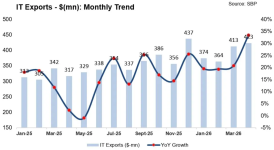
According to the State Bank of Pakistan (SBP), the export receipts of IT and IT-enabled services increased to $423 million in April, which is the second-highest export income of IT sector in its history.
In December 2025, the export of the IT sector made the highest-ever mark of $437 million.
In March 2026, IT exports stood at $413 million.
Dr Noman Said, an IT exporter, said the inflows of IT exports to over $400 million in April showed the strength of the IT export, which managed to record a sustainable growth despite the global crisis in the Middle East.
The government and IT exporters must explore the emerging opportunities for enhancing IT exports from the crisis and continue its policy to support IT industry in terms of taxes and promotion of exports to new markets, he urged.
During the period of the July-April of the financial year 2025-26, the IT sector reported a healthy growth, with receipts surging to $3.81 billion as compared to $3.14 billion reported in a similar period of the last financial year, showing 21% year-on-year growth.
ghazi52
THINK TANK: CONSULTANT
- Thread starter
- #279
Saad Shah, another IT exporter, said IT exports could have achieved it’s target if the frequent disruption of internet was not recorded in the current financial year.
He urged the government to ensure uninterrupted and speedy internet to IT companies by setting up IT parks in major cities, and pave the way towards launch of 5G and Satellite internet services as soon as possible in the country.
The exports of IT sector also included freelancers receipts, call centers and telecommunication sector.
However, the industry is expected to miss the annual target of $5 billion for the current financial year and likely to settle around $4.5 billion.
Chairman Pakistan Freelancers Association (PAFLA) Ibrahim Amin said the role of freelancers was increasing to enhance the export’s inflows of IT in the country, expected to cross the mark of 1$ billion in the current financial year.
He urged the government to ensure uninterrupted and speedy internet to IT companies by setting up IT parks in major cities, and pave the way towards launch of 5G and Satellite internet services as soon as possible in the country.
The exports of IT sector also included freelancers receipts, call centers and telecommunication sector.
However, the industry is expected to miss the annual target of $5 billion for the current financial year and likely to settle around $4.5 billion.
Chairman Pakistan Freelancers Association (PAFLA) Ibrahim Amin said the role of freelancers was increasing to enhance the export’s inflows of IT in the country, expected to cross the mark of 1$ billion in the current financial year.
Fatman17
THINK TANK: CONSULTANT

IT Exports Hit 2nd Highest-Ever Level After Crossing $400 Million Again
Pakistan’s monthly IT exports have surged past the $400 million mark for the second time in April 2026. According to the State Bank of Pakistan (SBP),
share.google
Fatman17
THINK TANK: CONSULTANT

Freelance export earnings set to hit USD1bn mark: SBP
KARACHI: With over USD950 million in export receipts during the first 10 months of the current fiscal year, Pakistan...
share.google
ghazi52
THINK TANK: CONSULTANT
- Thread starter
- #282
IT export push
By BR ResearchPakistan’s IT exports are offering a rare, good story. At a time when the external account remains under pressure, the technology sector is bringing in steady foreign exchange.
In April 2026, IT and IT-enabled services exports stood at USD423 million, up 33 percent year-on-year from USD317 million in April 2025 and around 2 percent higher than March 2026. This was the second consecutive month above USD400 million and the second-highest monthly number on record, after December 2025’s USD437 million.
The bigger story is the cumulative trend. In 10MFY26, Pakistan’s technology exports reached around USD3.81 billion, compared to roughly USD3.14 billion in the same period last year, showing growth of about 21 percent.
ghazi52
THINK TANK: CONSULTANT
- Thread starter
- #283
In an economy struggling with energy imports, debt repayments and weak investment inflows, this matters. Every dollar earned through exports reduces the need to borrow, roll over debt, or depend on temporary external support.
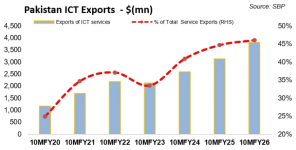
The sector has come a long way. SBP-based data shows that ICT exports have risen from around USD1.1 billion in 10MFY20 to nearly USD3.8 billion in 10MFY26. Their share in total services exports has also increased sharply.
IT is no longer a side story in the country’s export mix; it is becoming one of the country’s more serious foreign exchange earners. This is important because Pakistan’s export base has remained too narrow for too long. Textiles still dominate, followed by rice and a few other low-complexity goods.
ghazi52
THINK TANK: CONSULTANT
- Thread starter
- #284
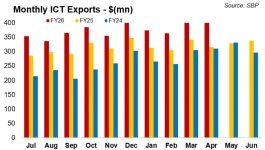
The monthly trend also shows that FY26 has gained momentum. After a record high in December and some moderation in early 2026, IT exports crossed USD400 million again in March and April. This suggests the sector has moved into a higher monthly range, rather than relying on one-off spikes.
Net IT exports are also encouraging. Exports minus imports stood at USD355 million in April, up 23 percent year-on-year. This is important because gross export numbers can sometimes overstate the real contribution if import payments are also rising.
The good news should not lead to complacency. The government has set a USD5 billion IT export target for FY26, but analysts expect the year to close closer to USD4.5 billion to USD4.6 billion.
ghazi52
THINK TANK: CONSULTANT
- Thread starter
- #285
Under the Uraan Pakistan plan, the government wants IT exports to reach USD10 billion by FY29. Meeting that target will require not just higher numbers, but more transparent and sustainable growth.
The numbers are encouraging, but they are not beyond question. Part of the recent rise may reflect better repatriation of dollars after SBP’s facilitation measures, while some industry voices suspect tax arbitrage and re-routing through IT entities.
That does not make the sector’s growth fake, but it does mean Pakistan needs cleaner data: how much is corporate software exports, how much is freelancing, and how much is simply income finding the lowest-tax route home.
Users who are viewing this thread
Total: 1 (members: 0, guests: 1)
Pakistan Defence Latest


Country Watch Latest


Latest Posts
-
Kylian Mbappe apologises after ‘dictator’ comment angers Chinese fans (21 Viewers)
- Latest: ChineseTiger1986
-

-
-
-
